Bochnia Salt Mine: A Historic Salt-Mining Complex in Poland
Site at a Glance
- Popularity
- Very High
- Country
- Poland
- Primary era
- Medieval
- Eras represented
- Medieval, Early Modern, Modern
- Civilizations
- Austria-Hungary, Habsburg, Kingdom of Poland, Polish–Lithuanian Commonwealth
- Site type
- Economic
- Remains
- Mine
On this page24 sections
History
Salt production and the founding of the mine
Bochnia Salt Mine is a historic rock-salt mine in Bochnia, Poland, where mining began in 1251 after rock salt was probably discovered three years earlier. Salt production in the surrounding area goes back at least to the Neolithic period, when salt-rich water was evaporated to obtain salt. A papal decree from 1136 refers to a saltworks at Babiza near Kraków, and saltworks also operated at Kolanów and Chodenice. The earliest known mention of Bochnia by name dates to 1198, when Mikora gave salt from the town to the monastery at Miechów.
Rock salt was probably found by deepening existing brine wells near the Babica stream in 1248. Mining followed in 1251, and the discovery was entered in a record of the Kraków cathedral chapter. The mine’s development may have involved monks from Wąchock. Because local workers had little mining experience and underground conditions were difficult, miners were also recruited from Kutná Hora and Silesia.
A town privilege issued by Bolesław V the Chaste, a 13th-century Polish ruler, in 1251 described an urban settlement established at the salt mine. Bochnia received formal town rights in 1253, as mining and settlement grew together.
The royal mine and medieval expansion
From the 13th century until 1772, the mine belonged to the royal Kraków Salt Works, the organization responsible for the salt mines at Bochnia and Wieliczka. In 1368, Casimir III the Great, king of Poland, issued a statute setting rules for managing the salt works and selling salt. Bochnia salt was exported to Hungary and to Rus, the medieval lands of Rus rather than the modern state of Russia. The workforce numbered about 120 to 150 at one stage and had grown to around 500 miners by 1518.
Mining expanded during the 15th and 16th centuries. In the 16th and 17th centuries, extraction areas included the largely exhausted Old Mountains in the east and the New Mountains in the west. From the late 15th century into the early 16th, the mine introduced machinery, horse power, and improved ways to move salt. Connecting passages and better ventilation helped address early problems with oxygen shortages and falls from wooden platforms, while also allowing production to increase. By this period the workings had reached a depth of about 300 metres.
The mine also provided support for injured workers and their families. In 1357 it established a 12-place hospital dedicated to the Holy Cross. A second hospital, funded by the mine and offering six places, followed in the 15th century. An unwritten custom provided lifelong pensions to the widows of miners killed at work.
Austrian rule, recovery, and mine fires
Wars and economic decline slowed development during the 17th century. After the First Partition of Poland in 1772, when Austria, Prussia, and Russia divided Polish territory, the mine came under Austrian control. That period lasted until 1918. Although the deposit was initially thought to be exhausted, mining soon resumed. Development picked up again after 1785 under superintendent Dionizy Stanetti. Improved ventilation and a new underground shaft, later named for Stanetti, opened access to additional salt deposits in 1794.
Fire repeatedly threatened the mine. A blaze in 1441 burned the wooden supports of a shaft, with flames reaching the surface. A fire that lasted 15 weeks in 1580 killed more than 30 miners, and a 1586 fire at Gazaris killed about ten. The mine’s first fire-safety instructions were prepared in 1747. Gunpowder had been introduced underground in 1709; by 1743 it was being used to break harder rock and cut new passages.
On 30 December 1875, a fire began at the steam engine in Sutoris and spread through the mine. Workers sealed the shafts and shut the ventilation to restrict the oxygen feeding the flames. Twelve people died in the fire and during a subsequent inspection, including mine director Andrzej Furdzik and mining councillor Edward Windakiewicz.
Industrial change and 20th-century events
New equipment transformed mining work in the 19th century. Hemp ropes were replaced by steel cables in 1854, and iron rails and wagons arrived in the 1860s. Steam-powered lifting engines were installed at Sutoris in 1874 and at Campi in 1883. After Poland regained independence, Bochnia gradually lost ground to mines in northern Poland, where deposits were richer and easier to work.
A fire on 19 July 1930 damaged the Campi shaft and nearby buildings, including the salt mill, loading station, and locomotives. The damage placed the mine’s continued operation at risk. Workers contributed to rebuilding, and the salt mill was running again by November that year.
In 1966 the mine adopted wet extraction, a method that dissolves salt underground with water so it can be removed in solution. A major pumping station was built in the lower mine, and drainage of water from the Quaternary period was completed. Water entering the workings damaged older areas, prompting the reconstruction of the Danielowiec level and Sutoris shaft to limit uncontrolled inflow.
Closure and heritage protection
Modern machinery, electric tools, and explosives helped exhaust most of the deposit by the 1990s. Industrial salt extraction ended in 1990 because it was no longer economical. The deepest and newest workings were backfilled, while historic areas were kept for therapeutic use and heritage interpretation. The mine no longer produces edible salt, although it makes and sells bath salts.
The historic workings entered Poland’s heritage register in 1981, and the mine became a Polish Historic Monument in 2000. The Wieliczka and Bochnia Royal Salt Mines were included in a World Heritage property first inscribed in 1978 and extended in 2008 and 2013; Bochnia joined through the 2013 extension. A German-language geological publication in 1851 described a profile of the deposit and its principal rock types.
Remains
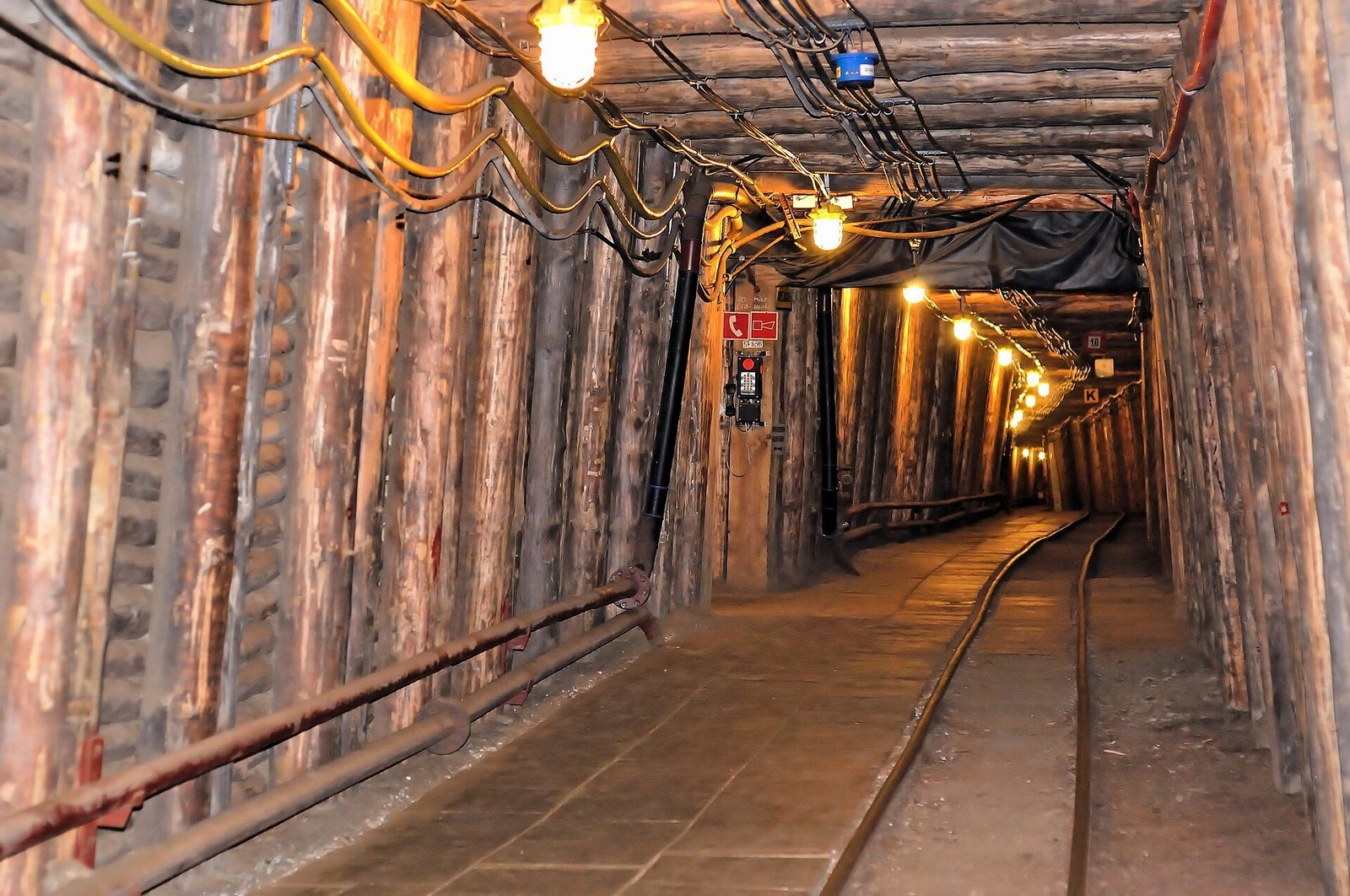
The mine is a connected underground system of shafts, exploratory pits, and galleries, with extraction chambers following the shape of the salt deposit. Its workings extend across 16 levels, meaning groups of passages at different depths. Preserved historic workings occupy nine former extraction horizons, from about 70 to 327 metres underground. Their combined extent is roughly 60 kilometres within an area about 3.5 kilometres long and up to 250 metres wide. The excavated spaces exceed one million cubic metres in volume, of which about 450,000 cubic metres are accessible. The two numbering systems differ: level I is called Danielowiec from Sutoris and August from Campi, while levels XV and XVI have no individual names.
Geological setting and mining layout
The deposit formed in Miocene sedimentary layers, laid down about 23 to 5.3 million years ago, associated with the Paratethys, an ancient sea that extended across parts of Europe and western Asia. Carpathian uplift and tectonic movement folded and enriched the deposit. Salt occurs around the Bochnia and Uzbornia anticlines, upward-folded rock structures. The nearly vertical, workable rock salt lies within the Bochnia anticline, while the Uzbornia anticline contains potash salts. The deposit extends about 3.5 kilometres from east to west and varies in width. Its southern edge meets Carpathian flysch, a sequence of sedimentary rocks, and its northern edge meets the Chodenice beds, a local sedimentary formation. Clays, sandstones, marls, and anhydrites occur in the deposit, with central salt beds about 8 to 12 metres thick.
The shape of the salt determined how miners excavated it. Early chambers were tall and narrow, and some linked neighboring levels; at first, chambers near individual shafts were separate. Later, miners cut narrower chambers in a stepped pattern along the deposit and filled excavated areas with dry material. Clean salt was brought to the surface, while heavily contaminated salt remained underground as fill.
Shafts
Sutoris
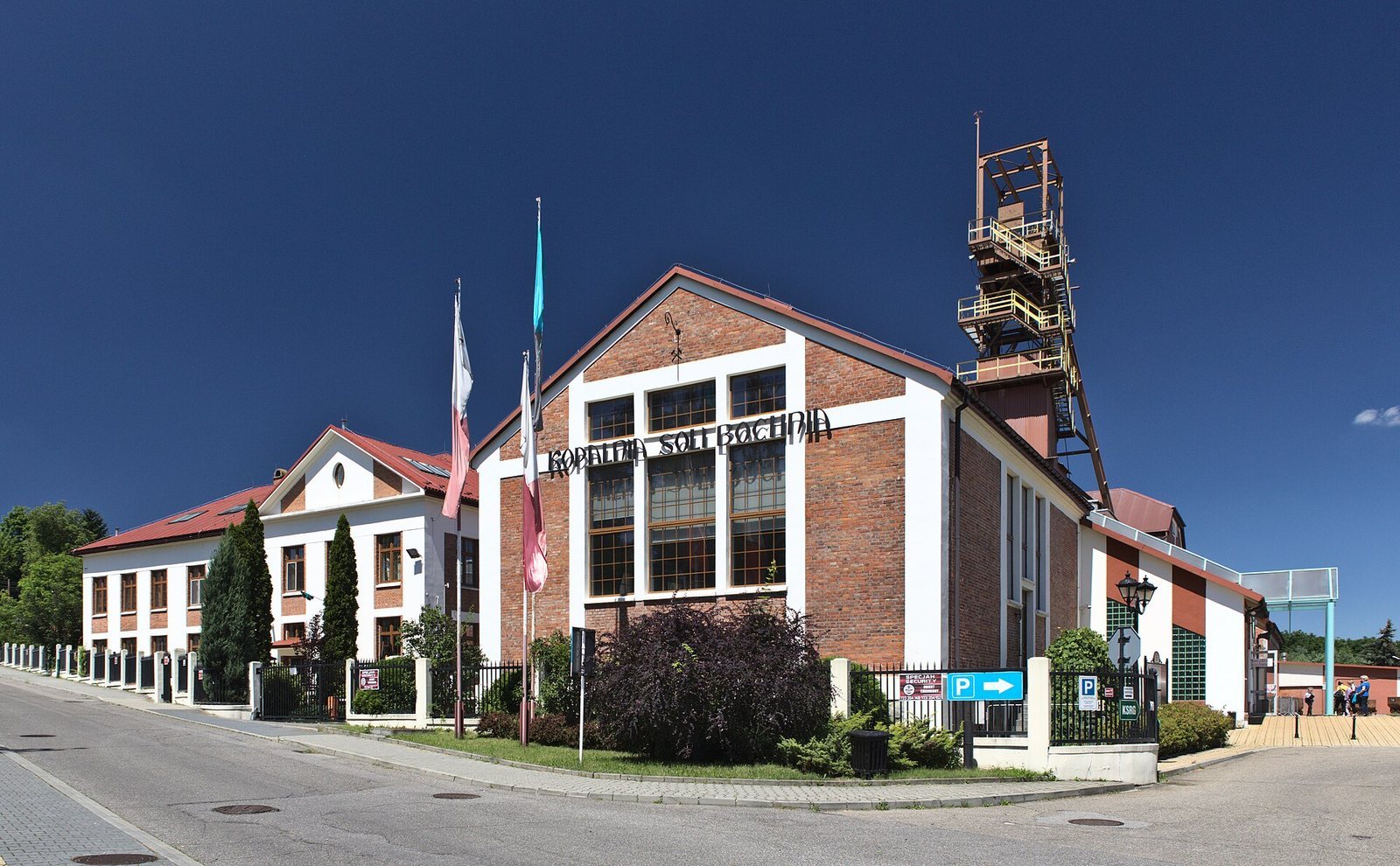
Sutoris was sunk in the mid-13th century and is the oldest shaft still in operation. Salt was first extracted there at a depth of about 35 fathoms, and the shaft initially descended roughly 60 to 70 metres. Its present surface buildings date from 1905 to 1906. During a major overhaul in 1993 to 1995, the shaft tower was replaced and the opening widened. An electric lifting engine serves the shaft, which carries passengers.
Campi
Campi was sunk between 1556 and 1568 through loose, water-bearing sand. By 1792 it had reached a depth of 212 metres. After a partial collapse, the shaft was rebuilt from 1909 to 1912. A steam engine brought there in 1909 lifted people and mined material until 1996; the preserved engine is displayed in a neighboring building.
Trinitatis
Completed in 1908, Trinitatis is the youngest of the three surviving shafts and is used for ventilation. It has a ladder compartment and a small hoist that does not carry passengers. Ventilation equipment stands at the entrance to a horizontal passage, with air-drying equipment beside the shaft building. An earlier attempt to build a shaft west of Campi and a 478-metre horizontal access tunnel was abandoned after four years and three collapses in water-bearing sand.
Gazaris
Gazaris began as a brine well near the Babica stream, in the southeastern corner of today’s Gazaris square. The first mine galleries connected it with Sutoris. Its position near the stream made the shaft vulnerable to flooding, and it was closed in 1842.
Regis
First mentioned in 1397, Regis reached a depth of about 180 metres and served as an important production shaft. It was rebuilt in 1923 and closed in 1967. A small green space, a commemorative plaque, and a mine cart mark its former location.
Floris
Also known as the Florentine shaft, Floris was built in 1428 by a builder from Florence. It stood higher than Gazaris and was less exposed to water hazards. Rebuilt between 1674 and 1685, it later served to draw air into the mine until 1967. The shaft is now filled, and its passage has narrowed. A plaque on a nearby clinic commemorates Włodzimierz Podgórzec, who died in Floris in 1940 while fleeing German gendarmes and Gestapo personnel. It remains uncertain whether he jumped in an attempt to escape or to protect other members of the underground resistance.
Galleries and transport routes
August Passage
The August Passage is the mine’s principal east-to-west route for moving salt and communicating between workings. It connects the surviving shafts and runs for nearly three kilometres. At Sutoris it lies about 176 metres below ground; at Campi it reaches a depth of about 212 metres. Its first section, initially called the Long Stove, was built between 1723 and 1743. Its designer straightened and leveled the mine’s transport routes.
Underground railway
An underground passenger railway runs for about one kilometre along the August Passage, from Campi to a small shaft connecting the passage with Ważyn Chamber. An electric battery locomotive, type Ldag 05, pulls the passenger wagons. The line has three stations, Campi, Kinga, and Sutoris, and can carry up to 60 people at speeds of up to 2.5 metres per second.
Surface transport links
A freight cableway built in 1900 linked the Campi shaft area to a terminal building near the railway station over a distance of about 1,020 metres. A rail siding built in 1922 connected Campi to Bochnia station and fell out of use in the 1980s. Parts of its route now form a cycle path and sidewalk, and a few distance-marker posts survive. A steam-powered mechanism for lifting people and materials also remains in the mine and is occasionally operated.
Chambers and underground structures
Ważyn Chamber
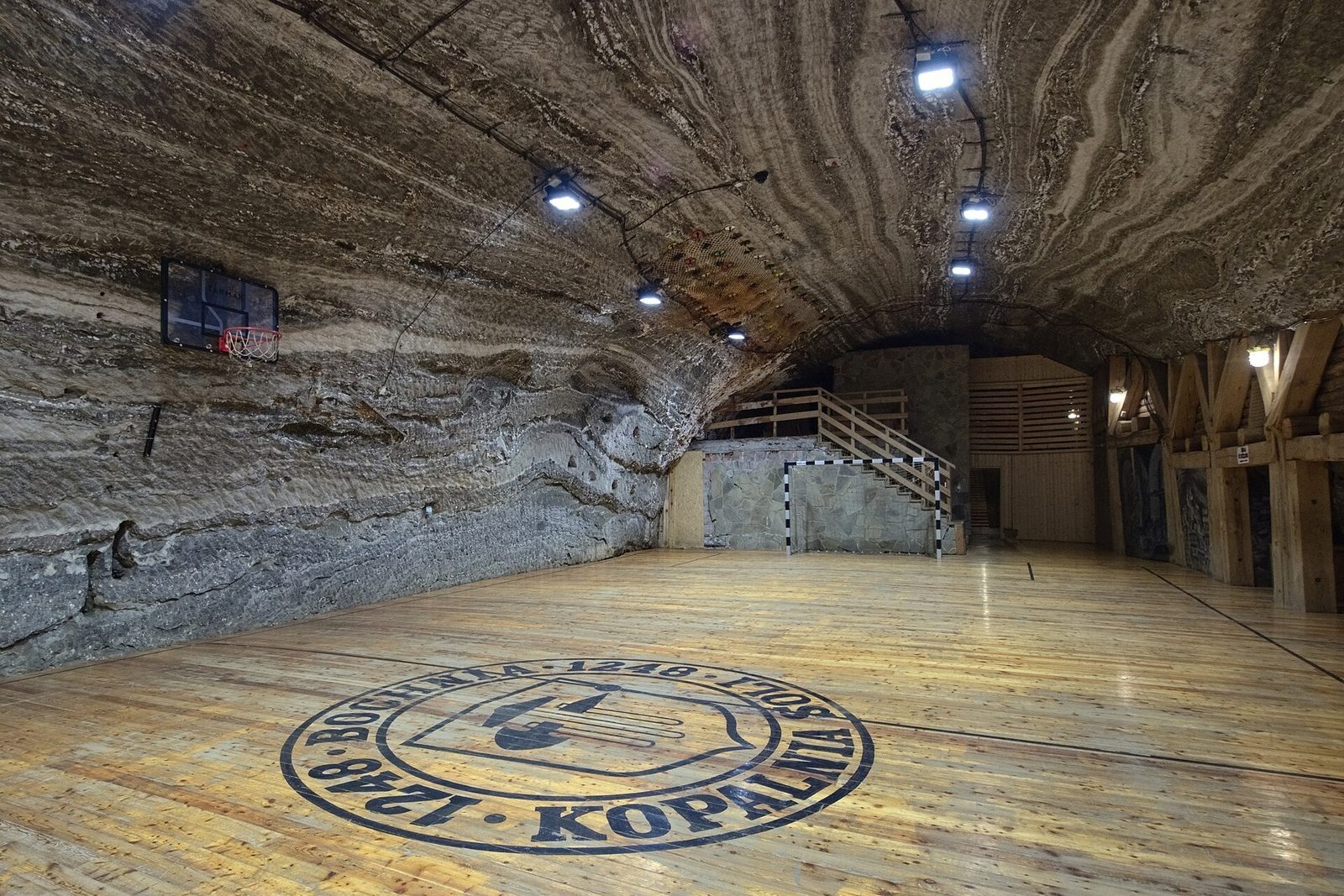
Ważyn is the mine’s largest chamber, about 250 metres underground. It covers roughly 2,500 square metres and measures about 255 metres long, up to 14.4 metres wide, and up to 7.2 metres high. Salt was extracted there from 1697 until the 1950s. The chamber was then enlarged with a mining machine for sanatorium use, work that continued until 1984. Its exposed roof includes the 17th-century Ernest Chute. The chamber’s temperature is about 14 to 16 degrees Celsius, and humidity reaches around 70 percent.
Chapel of St. Kinga
The Chapel of St. Kinga is the largest chapel in the mine. Its features include an altar bearing an image of St. Barbara, a plaque for those who died in the 1875 fire, and a pulpit carved from salt in 1922. The chapel also contains a year-round Nativity scene and monuments to Casimir III the Great and John Paul II. Mine railway tracks cross the chapel.
Mysiur Stable
Built before 1771, Mysiur Stable sheltered the mine’s working horses. It retains timber supports laid in a crib pattern and dated to the 17th century, as well as part of its original stable equipment.
Chamber 81
Chamber 81 is partly flooded with brine and has a boat crossing about 120 metres long. Its tall, elongated, relatively narrow form shows the shape of chambers created during salt extraction.