Bladenhorst Castle: A Moated Castle in Germany


Site at a Glance
- Rating
- 4.1
- Popularity
- Low
- Country
- Germany
- Primary era
- Early Modern
- External website
- Open
- Eras represented
- Early Modern
- Civilizations
- Holy Roman Empire
- Site type
- Military
- Remains
- Castle
On this page9 sections
History
Medieval origins and noble ownership
Bladenhorst Castle is a late-Renaissance moated castle in Castrop-Rauxel, Germany, rebuilt between 1530 and 1584. The site was first recorded in 1266, when the Knights of Blarnhurst lived there. By the beginning of the fourteenth century, it was held by the Düngelen family.
In 1338, Rötger von Düngelen made the property available to the Count of Cleves for use during wartime. The Count of Cleves ruled the County of Cleves, a historical territory in the Lower Rhine region that was later elevated to a duchy. The castle chapel dated from 1332 and was demolished in 1941.
Rebuilding and succession
The castle was rebuilt in the late Renaissance, a European architectural period that revived classical forms and reached northern Europe after developing in Italy. Through marriage, ownership passed to Philipp von Viermundt in 1496. In 1624, the castle came by inheritance to the Barons von Romberg, who retained it until 1891.
After 1891, Bladenhorst Castle belonged to the Barons Weichs zur Wenne. They sold it to Klöckner-Werke, a German industrial enterprise, in 1924.
Private ownership and adaptation
After four years of forced administration, Sparkasse Vest, a regional German savings bank, acquired the castle at auction in February 2006. The purchase price was 800,000 euros, below the minimum bid of 1.4 million euros. The bank received additional compensation because it had invested substantially in the building.
In January 2007, the remaining part of the castle passed from Sparkasse Vest to a private owner from Dortmund. A section of the north wing had already been converted into owner-occupied apartments in 2001. The last part of the moat-side building became habitable in 2010, and the old gatehouse was again usable as a dwelling in 2011. The castle remains privately owned and inhabited.
Remains
Setting and overall layout
Bladenhorst Castle stands in the fenland of the Emscherland, between the Emscher, the Deininghauser Bach, and the Salzbach. Damp lowland woodland and heath surround the complex, while numerous drainage ditches reflect the wet landscape that made a water-filled moat possible. The castle grounds form part of Bladenhorst Landscape Park, which was laid out in the style of an English landscape garden.
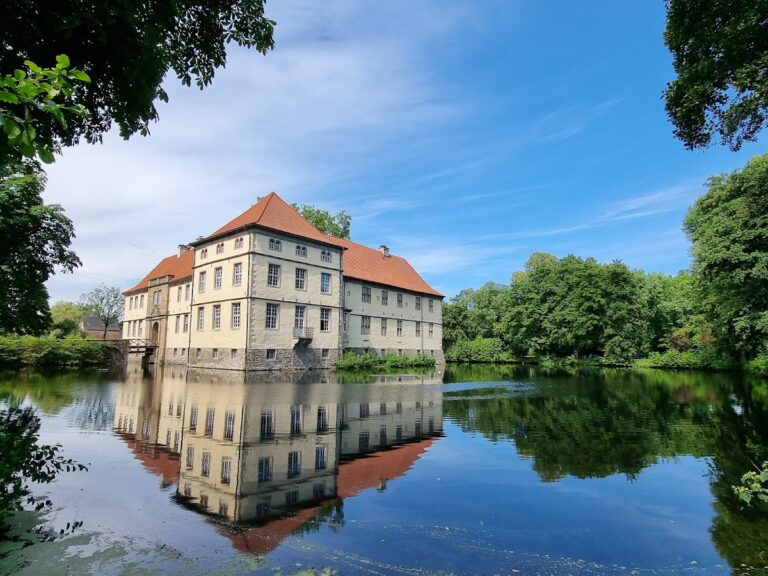
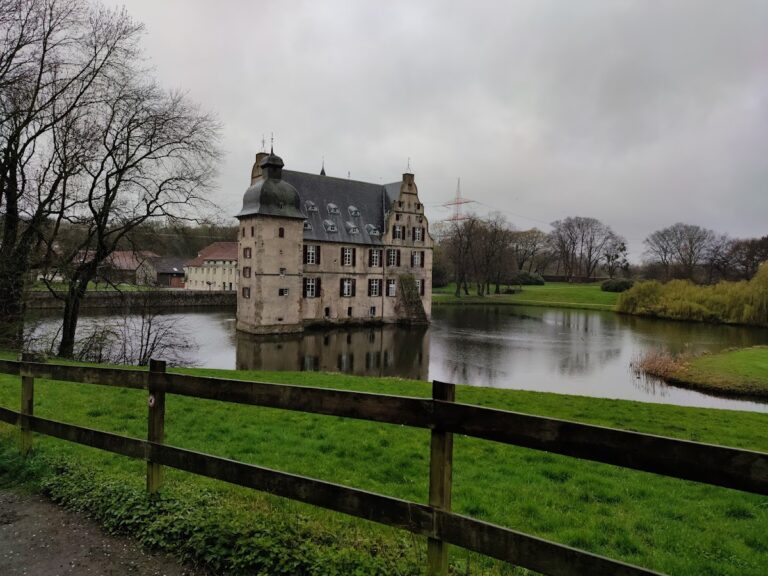
The complex originally consisted of four wings and is built in the late-Renaissance style associated with its rebuilding between 1530 and 1584. Its water moat surrounds the residential and defensive complex. At the end of the nineteenth century, a branch canal of the Dortmund-Ems Canal was constructed close to the castle, linking the Henrichenburg ship lift with Herne. The waterway later became part of the Rhine-Herne Canal, which lies north of the castle.
Defensive and residential buildings
Gatehouse
The gatehouse is the oldest part of the complex and was designed as a defensive structure. It later became a dwelling and was again made usable for habitation in 2011.
Wings and moat-side building
The four-wing arrangement created the main castle complex around its water-moated setting. A section of the north wing was converted into owner-occupied apartments in 2001, while the final part of the moat-side building was made habitable in 2010. The complex remains in residential use.
Nearby sites