Bir Hima Rock Petroglyphs and Inscriptions: An Ancient Arabian Archaeological Landscape
Site at a Glance
- Country
- Saudi Arabia
- Primary era
- Stone Age
- Eras represented
- Stone Age, Bronze Age, Iron Age, Classical, Medieval
- Civilizations
- Unclassified
- Site type
- Civic
- Remains
- Rock Art
On this page12 sections
History
The Bir Hima Rock Petroglyphs and Inscriptions are an archaeological landscape in southwestern Saudi Arabia, about 120 kilometres north of Najran. People occupied the area during the Paleolithic and Neolithic periods. The wider complex spans approximately 7000–1000 BC and preserves a cultural tradition that continued for roughly 7,000 years. Water, wildlife, and the local limestone terrain supported human activity.
Prehistoric occupation
Bir Hima is also associated with the Lower Paleolithic Oldowan, an early stone-tool tradition known for simple choppers and pebble tools. Investigations examined evidence of life across the wider span from about 7000 to 1000 BC, including hunting and herding practices. Findings indicate that people kept Saluki dogs, a breed of sighthound, and relied on a range of local animals.
Caravan route and the campaign at Najran
Bir Hima lay on a caravan route linking southern and northern Arabia. Its wells supplied water to travelling caravans, and the area was the location of the oldest known toll-collection station.
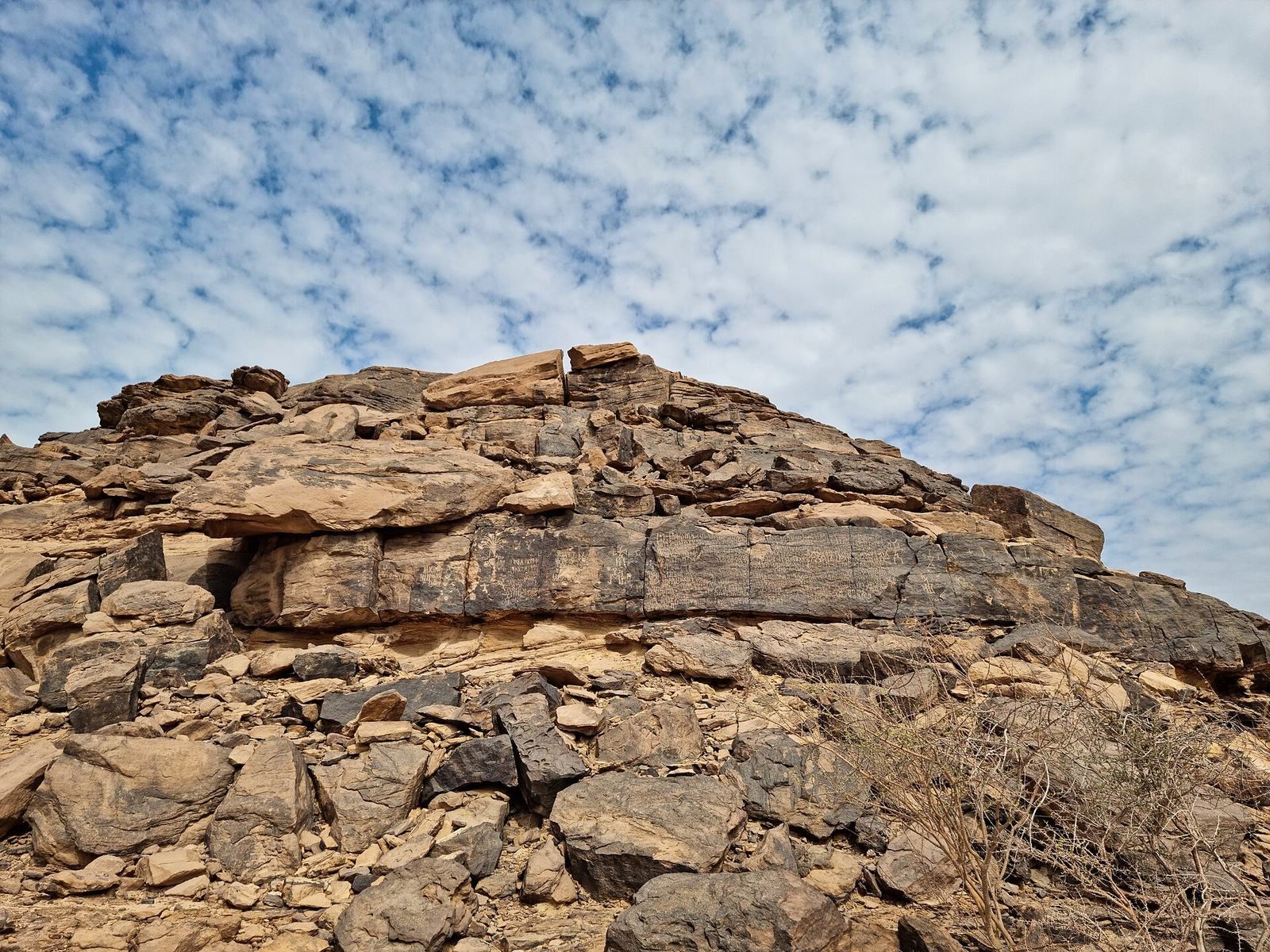
A rock inscription dated to AD 518 describes a campaign by Dhu Nuwas, the last king of Himyar, an ancient kingdom in southern Arabia. The inscription says that he occupied Najran and defeated its people and their Abyssinian allies. It claims that his forces destroyed a church, killed 12,500 men, captured 11,000 people, and took 200,000 camels, sheep, and cattle. The text also calls for blessings on the king and his companions and asks that the inscription be kept from harm. The inscription Ja 1028 helps illuminate the massacre of Najran’s Christian community.
Investigation and heritage recognition
The Philby-Ryckmans-Lippen expedition examined the area in 1951. One member recorded 250 images at a site west of the ancient wells, and images noted during the expedition were dated to about 300–200 BC. Archaeologist E. Anati published work on the expedition between 1969 and 1972. After investigations at Jubba and other sites from 1976 onward, Saudi Arabia’s Department of Antiquities took an interest in Bir Hima and the surrounding area.
A survey by the Saudi Ministry of Education’s Agency of Antiquities and Museums recorded varied rock-art sites and investigated evidence of life in the region. Its findings included hunting with spears, clubs, bows, and arrows, as well as the keeping of Saluki dogs. In 2021, Bir Hima became part of the Ḥimā Cultural Area, which UNESCO inscribed on the World Heritage List under criterion iii, recognizing exceptional testimony to a cultural tradition or civilization.
Remains
The remains form part of a broad landscape of rock art, inscriptions, wells, and stone structures. The Ḥimā Cultural Area covers about 557 square kilometres and includes more than 34 archaeological sites. Rock art appears at over 13 locations, with 550 panels; the Bir Hima–Najran complex contains 100 identified petroglyph sites. Across the panels are hundreds of thousands of images and inscriptions.
Rock art
Figures and scenes
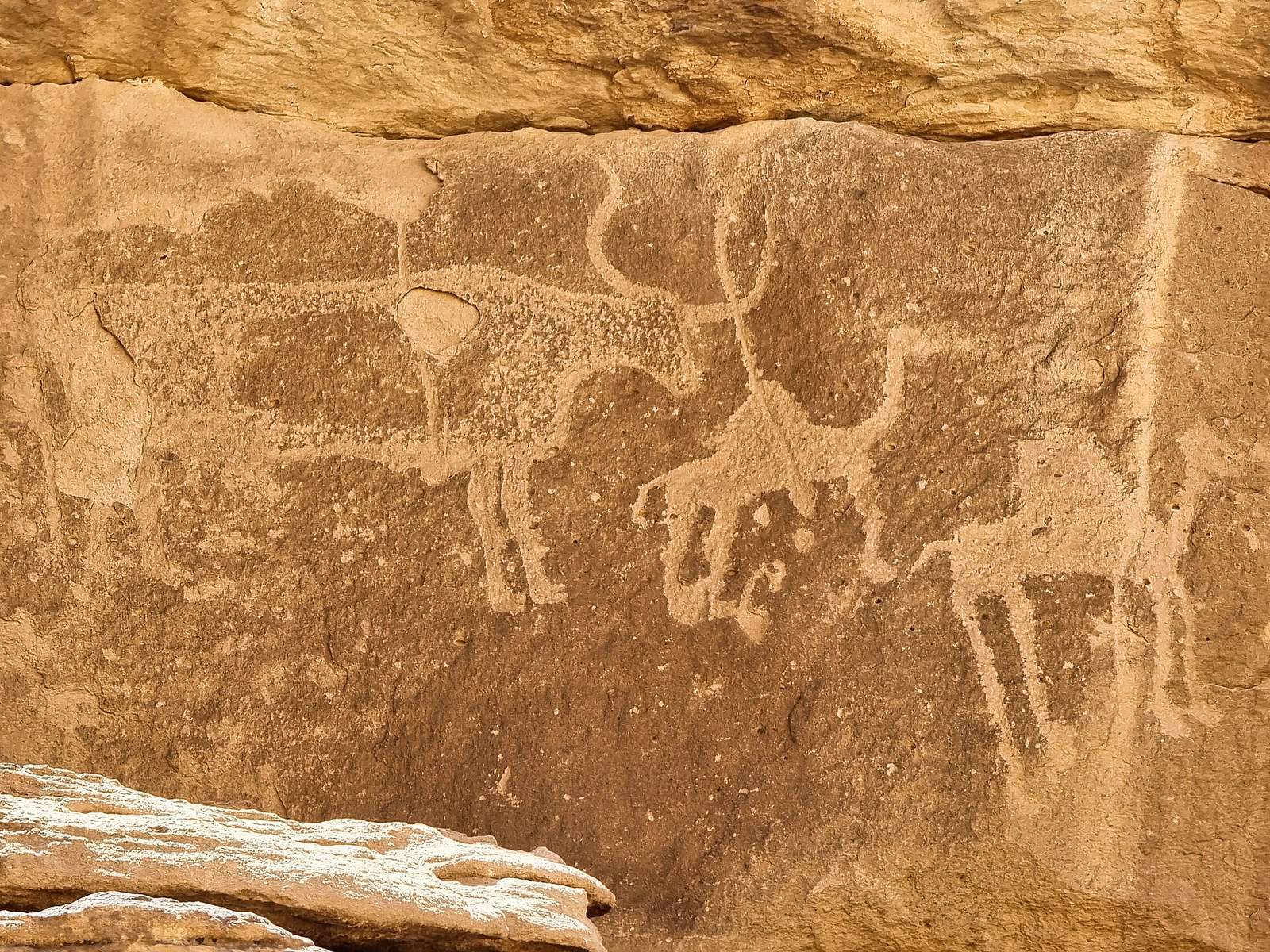
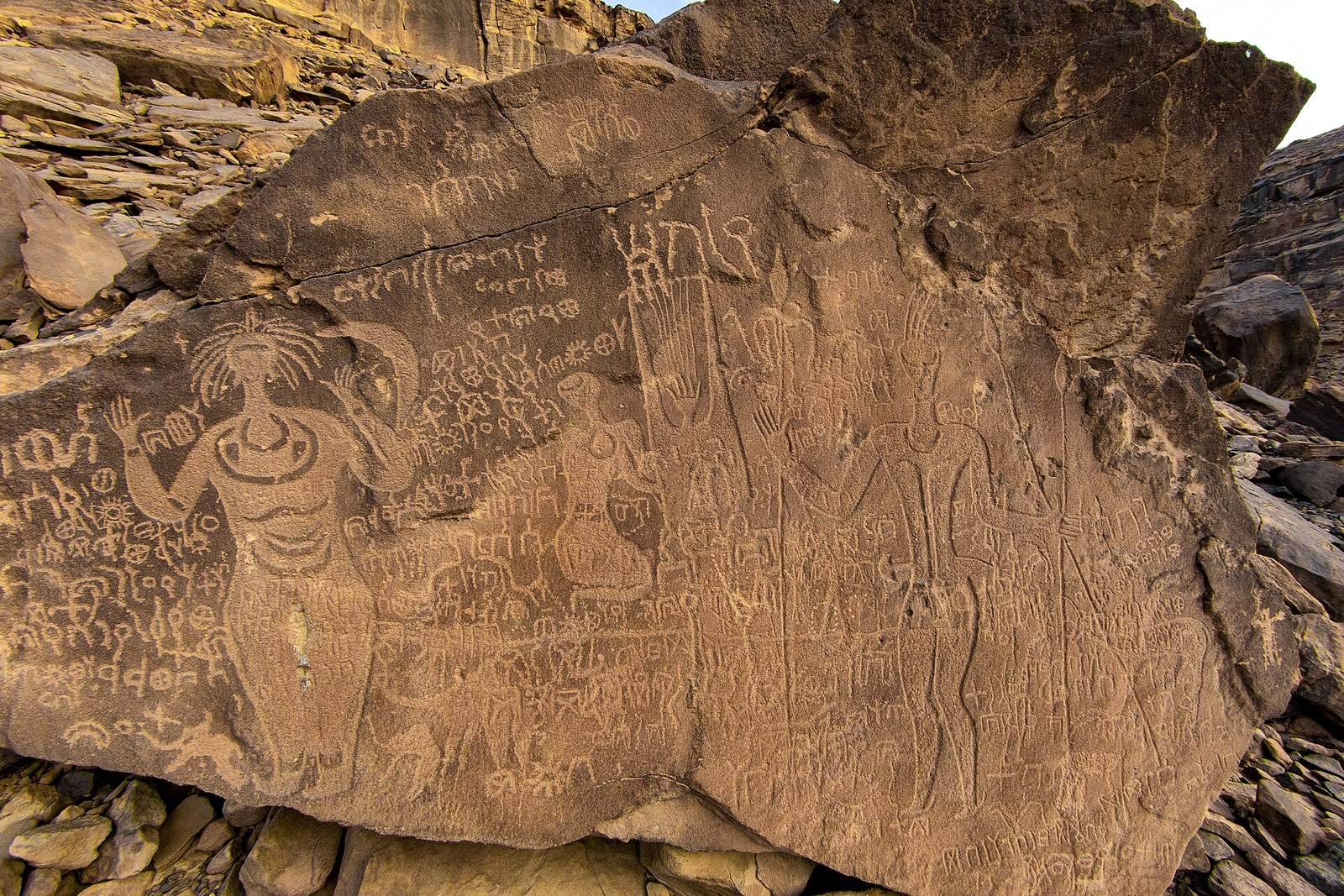
The carvings portray hunting, herding, people, animals, and plants. Human figures include larger-than-life depictions, with details such as head coverings, necklaces or collars, short garments wrapped at the waist, and, on some men, carefully rendered beards. Some figures wear anklets, possibly to produce sound during dancing or music. Hunting and fighting scenes include spears, sometimes decorated along their shafts, as well as shields, bows, arrows, knives, and blades. Other panels show groups dancing with instruments resembling bowed string instruments.
Depicted animals include cattle, camels, goats, ostriches, and sheep. A bow-bearing warrior from Bir Hima closely resembles figures on the Hunters Palette, a carved slate object from predynastic Egypt, though the Bir Hima engravings are probably earlier.
Large carved panel
One panel measures approximately 3 metres high and 4 metres wide. Dated to about 4,000 years ago and assigned either to the Bronze Age or the Iron Age, it shows a female dancer, a female musician, and a male warrior. Symbols and inscriptions on the panel have been interpreted as references to celestial deities and other gods.
Wells and stone structures
Six wells cut into the rock, known collectively as the Bir Hima wells, are at least 3,000 years old and still yield fresh water. The area also contains numerous troughs, types of which occur from northern Arabia to Yemen, along with burial cairns, or stone mounds raised over graves, and circular stone structures from different cultural periods.
Inscriptions and archaeological finds
Inscriptions
Inscriptions across the complex use Thamudic, a label for ancient Arabian inscriptions; South Arabian Musnad, an ancient South Arabian script; Aramaic-Nabataean, a form of Aramaic associated with the Nabataeans; and Greek. Islamic inscriptions are also present, including examples in Kufic, an early Arabic script. A mountain site contains a Musnad inscription associated with the campaign at Najran.
Tools and animal remains
Choppers and pebble tools made from quartzite, andesite, and flint have been found in the area. The images appear to have been cut with bronze tools. Excavations at site 217-44 recovered several articulated camel fragments. Across the broader Najran area, the images include as many as 6,400 human and animal figures, among them more than 1,800 camels and 1,300 people.