Basilica of St. Mark: A Renaissance Dominican Church in Florence


Site at a Glance
- Rating
- 4.6
- Popularity
- Low
- Country
- Italy
- Primary era
- Early Modern
- External website
- Open
- Eras represented
- Medieval, Early Modern
- Civilizations
- Grand Duchy of Tuscany, Republic of Florence
- Site type
- Religious
- Remains
- Basilica
On this page14 sections
History
The Basilica of St. Mark is a Roman Catholic church in Florence, Italy, rebuilt in the Renaissance between 1437 and 1444 as part of a Dominican convent complex under Medici patronage. Dedicated to Mark the Evangelist, it stands in the historic district once known as Cafaggio, a name preserved in early references to the church as San Marco al Cafaggio.
From medieval oratory to monastery
The site first contained an oratory dedicated to St. George. From the twelfth century, it was occupied by a Vallombrosan monastery. The Vallombrosans were a Catholic religious community associated with monastic reform. The complex later passed to the Silvestrines, who came from the rural church of San Marco Vecchio. These successive communities shaped the institution responsible for the church before the arrival of the Observant Dominicans.
In 1418, Pope Eugene IV ordered the Silvestrines to leave the monastery. In 1435, the complex was entrusted to the Observant Dominicans, a reform branch of the Dominican order. Two years later, Cosimo de’ Medici decided to renovate the entire site at the recommendation of Antonino Pierozzi, then vicar general of the order. Antonino Pierozzi, later known as St. Antoninus of Florence, became a Dominican archbishop and an important figure in the city’s religious life.
The Medici and the Renaissance rebuilding
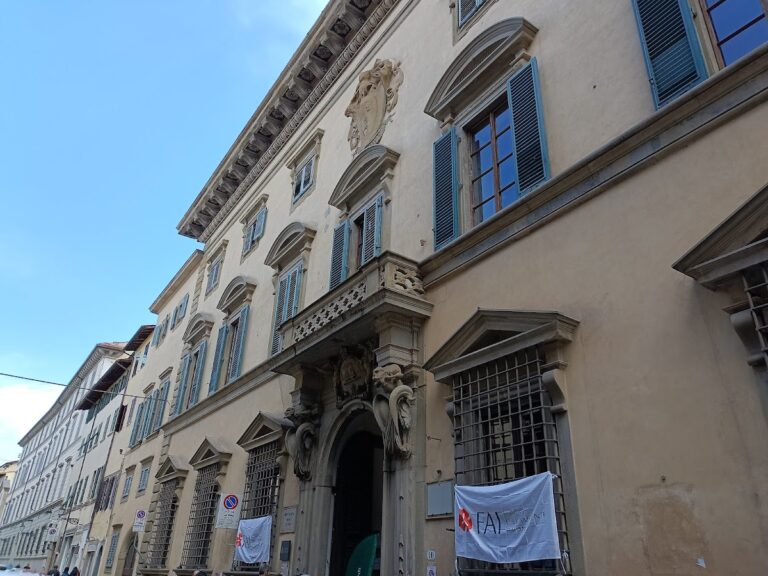
The church lay within the principal sphere of influence of the Medici family, whose residence was nearby in what is now Palazzo Medici Riccardi. Michelozzo, a leading Florentine architect and sculptor of the early Renaissance, directed the rebuilding. Fra Angelico and his collaborators, including Benozzo Gozzoli, decorated the walls between 1439 and 1444.
The renovated church was consecrated on the night of Epiphany in 1443 by Niccolò d’Acciapaccio, cardinal and archbishop of Capua, in the presence of Pope Eugene IV. The convent became an important center of fifteenth-century spirituality and culture. Its residents and associates included Cosimo de’ Medici, Antonino Pierozzi, Fra Angelico, Ambrogio Catarino Politi, Fra Bartolomeo, Tommaso Caccini, and Girolamo Savonarola.
Savonarola was a Dominican preacher and religious reformer who condemned what he regarded as moral decadence in Florence. In 1498, he was hanged and burned in Piazza della Signoria. The convent’s religious and intellectual connections also extended through the numerous confraternities that met in the church and its annexes. These included the Company of the Holy Cross of the Silk Weavers, the Company of the Magi of the Star, and the Company of the Purification of Mary and St. Zanobi. A confraternity was a religious lay association organized around shared devotional or charitable activities.
Later alterations and modern history
The church continued to change after its Renaissance rebuilding. The bell tower was erected in 1512 to a design by Baccio d’Agnolo. The side chapels were developed from 1579 onward, chiefly under the direction of Giambologna, and received many sixteenth- and seventeenth-century altarpieces. The tribune and carved ceiling followed Pier Francesco Silvani’s design from 1679, while the dome was raised by 1712 to Angelo Ferri’s design and frescoed by Alessandro Gherardini in 1717.
The convent was definitively confiscated in 1866. Part of it was converted into the Museum of San Marco in 1869, although the museum does not include the basilica or the adjacent San Domenico cloister. A Dominican friars’ community remained in the church and part of the convent around the cloister until 2019. After decisions taken by the order in 2017 and a subsequent decree by its Master, that community was suppressed. The Dominican community of Santa Maria Novella then assumed pastoral care and religious activities at San Marco and Santa Maria Novella.
The basilica forms part of the Historic Centre of Florence, inscribed on the UNESCO World Heritage List in 1982, and is recognized as an Italian national monument. Giorgio La Pira, mayor of Florence, lived in the former convent from 1934 and was later buried in the basilica.
Remains
The basilica has a single nave with numerous side chapels, a later Neoclassical facade, and a sequence of Renaissance, Baroque, and later interior additions. Its surviving fabric also preserves traces of earlier decoration, including fragments of fourteenth-century wall paintings beneath the plaster. The principal architectural and artistic features are arranged along the nave, around the presbytery, and within the specialized chapels and sacristy.
Exterior and earlier decoration
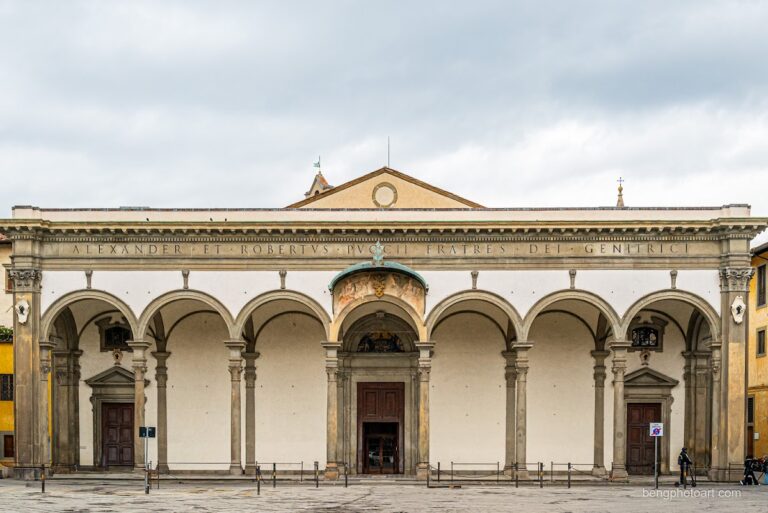
The present facade dates from 1777 to 1778 and is Neoclassical. Fra Giovan Battista Paladini designed it, as an inscription on a window records. Three horizontal orders are articulated by pilasters. A single portal is surmounted by a window, while the lower sides contain niches with statues. Ribbons and festoons decorate the upper bands, and a bas-relief occupies the upper register beneath a pediment topped by an iron cross.
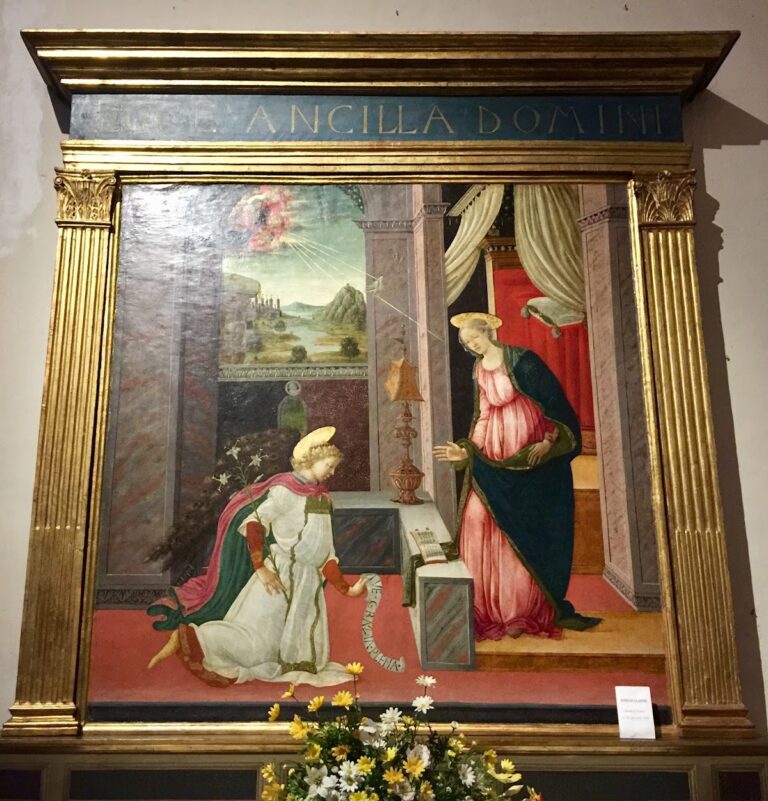
The bell tower, built in 1512, follows a design by Baccio d’Agnolo. Inside the church, traces beneath the plaster reveal that the walls were once covered with fourteenth-century frescoes. The surviving evidence points to successive painting campaigns dating approximately from 1380 to 1420. The counterfacade contains the most substantial remaining fragments, including a large Crucifix attributed to the Orcagna school and dated to about 1365. It also preserves an Annunciation documented in 1375 and close in style to Jacopo di Cione. The composition was modeled on the miraculous Annunciation in the Basilica of the Santissima Annunziata.
Nave and altars
Michelozzo rebuilt the sacristy and the apse, whose surviving features include two stone portal surrounds. From 1679, the tribune and carved ceiling followed Pier Francesco Silvani’s design. Giovanni Antonio Pucci’s central ceiling painting, the Assumption of the Virgin, dates from 1725. The dome was raised by 1712 and received Alessandro Gherardini’s frescoes in 1717. The presbytery walls contain frescoes by Ignace Parrocel, while Pier Dandini’s Last Supper, dated 1686, hangs beneath the organ. The high altar contains Fra Angelico’s Crucifix, dated 1425 to 1428.
Counterfacade and right-hand altars
On the left side of the counterfacade stands the former altar of the Silk Guild, placed there in 1575 after previously occupying a different position on the nave’s left wall. Its late-sixteenth-century structure retains the guild’s coat of arms. Botticelli’s San Marco Altarpiece, painted between 1488 and 1490 for the altar, has been moved to the Uffizi. The altar now contains Giovanni Battista Paggi’s signed Transfiguration, painted in 1596 for Vincenzo and Alessandro Brandolini, who became its patrons in 1595.
The first altar on the right contains Santi di Tito’s Vision of St. Thomas Aquinas with the Virgin, St. John the Evangelist, Mary Magdalene, and St. Catherine of Alexandria, commissioned by Sebastiano Pandolfini del Turco and dated 1593. Its pronounced illusionism, Venetian-style landscape, and naturalistic figures and portraits distinguish the composition. The second altar holds Fra Bartolomeo’s Madonna and Child with Saints, painted about 1509 and known as the Cambi Sacra Conversazione after the family that commissioned it.
The third right-hand altar contains a large mosaic of the Virgin from the ancient Basilica of St. Peter in the Vatican. It reached Florence around 1596, when the altar was constructed. The angels and the worshipping figures of Saints Dominic and Raymond were added in Florence as painted imitations of the mosaic by an artist close to Fabrizio Boschi’s style. The fourth altar contains Matteo Rosselli’s Madonna of the Rosary and Angels Carrying St. Dominic into Heaven, dated 1640. Giambologna’s statue of St. Zenobius stands on the arch framing the altar.
Left-hand altars and funerary monuments
The first altar on the left, nearest the counterfacade, contains Passignano’s Miracle of St. Vincent Ferrer, dated 1593. The second holds Anton Domenico Gabbiani’s 1690 copy after Fra Bartolomeo’s Mystical Marriage of St. Catherine. The third left-hand altar belonged to the Lucchese Company of the Holy Cross of the Silk Weavers. Its decoration includes the company arms, showing a cross surrounded by four stars, and a relief of the Holy Face in the center of the pediment.
After the demolition of the rood screen, the company acquired the altar in 1590 and commissioned Ludovico Cigoli’s Heraclius Carrying the Cross. Signed “L.C.” and dated 1594, the painting features richly decorated costumes and textiles that refer to the confraternity’s textile activities. Two funerary monuments beside the altar commemorate the humanists Pico della Mirandola and Angelo Poliziano, both buried in the church.
Chapels beside the presbytery and nave
Serragli Chapel
The Serragli Chapel, also called the Chapel of the Sacrament, opens to the left of the presbytery through a Baroque portal. Begun in the final decade of the sixteenth century, it was dedicated to the glorification of the Eucharist. Its frescoed vault is divided into three zones. Santi di Tito’s female personifications of the Gifts of the Holy Spirit, painted about 1594, surround a stucco dove. Bernardino Poccetti’s Christ in Glory and Hope, dating to about 1603, occupy the second zone, while his Fruits of the Sweetness of Communion fills the third. Four female figures surround a gilded stucco beehive, and Poccetti also painted saints and female saints associated with the Sacrament on the walls.
The chapel’s altarpiece, the Communion of the Apostles, was begun by Santi di Tito and completed by his son Tiberio. Other paintings include Passignano’s signed and dated Story of the Manna of 1625, Francesco Curradi’s Supper at Emmaus and Miracle of the Loaves and Fishes, and Jacopo Chimenti da Empoli’s Sacrifice of Isaac. Domenico Pieratti made the statues of St. John the Evangelist and St. Luke beside the altar. Lodovico Salvetti’s statues of St. Mark and St. Matthew stand on the rear wall beside the funerary monument of Prince Stanislaus Poniatowski.
Salviati Chapel
The Salviati Chapel, also called the Chapel of St. Antoninus, opens from the left side of the nave. It contains the remains of Antonino Pierozzi and differs from the church in both plan and elevation. Planned as a separate space at the end of the sixteenth century, it has its own exterior entrance. Construction began with the crypt, where members of the Salviati family are buried. A wall cartouche probably places the beginning of the work around 1580.
Giambologna designed the upper chapel, where the saint’s remains lie beneath the altar, and Alessandro Allori supplied much of its decoration. Allori completed the monochrome grisaille paintings, which imitate sculptural relief, in 1588. He also made the altarpiece of the Descent into Limbo, commissioned before 1584. The contemporary side paintings are Poppi’s Christ Healing the Leper and Giovanni Battista Naldini’s Calling of St. Matthew. Giambologna and his collaborators created bronze reliefs of episodes from St. Antoninus’s life between 1581 and 1587. In the vestibule, two large frescoes by Passignano depict the Translation and Recognition of the saint’s body.
Sacristy
The sacristy contains sacred furnishings dating from the fifteenth to the seventeenth century and Antonino Pierozzi’s first tomb. Its black-marble sarcophagus is surmounted by a bronze statue of the saint by Giambologna, cast with the assistance of Domenico Portigiani. The sacristy altar has a panel of the Mystical Marriage of St. Catherine of Alexandria with St. James the Greater and St. Christopher, attributed to the Romagnol artists Benedetto and Bartolomeo Coda. The panel may be identifiable with a work made in 1531 for the Bettini altar at San Domenico in Cesena.
The sacristy also preserves the St. Antoninus vestment set, designed by Alessandro Allori. In the passage between the church and sacristy is Antonio Novelli’s Resurrected Christ, dated 1640 to 1641 and commissioned by Agnolo di Silvestro Ganucci in memory of his pilgrimage to Jerusalem.
Works now held elsewhere
Several paintings formerly associated with the basilica are now dispersed among other collections. The Museum of San Marco in Florence holds Fra Angelico’s San Marco Altarpiece, Healing of the Deacon Justinian, and Burial of Saints Cosmas and Damian. His Saints Cosmas and Damian Saved from Drowning, Saints Cosmas and Damian before Lysias, Pietà, and Crucifixion of Saints Cosmas and Damian are in the Alte Pinakothek in Munich. The Louvre in Paris holds his Beheading of Saints Cosmas and Damian, while the National Gallery of Ireland in Dublin contains his Condemnation of Saints Cosmas and Damian to the Stake. His Healing of Palladia is in the National Gallery of Art in Washington.
Other works formerly at the basilica include Botticelli’s Altarpiece of the Goldsmiths, now in the Uffizi; the Master of the Fiesole Epiphany’s Holy Face with Saints Vincent Ferrer, John the Baptist, Antoninus, and Mark, now in the Los Angeles County Museum; and Fra Bartolomeo’s Pitti Altarpiece and Presentation in the Temple, now respectively in the Galleria Palatina in Florence and the Kunsthistorisches Museum in Vienna. A statue of Savonarola is also associated with the basilica’s former works.