Askeaton Castle: A Desmond Stronghold in Ireland


Site at a Glance
- Rating
- 4.5
- Popularity
- Very Low
- Country
- Ireland
- Primary era
- Medieval
- Eras represented
- Medieval, Early Modern
- Civilizations
- Norman
- Site type
- Military
- Remains
- Castle
On this page8 sections
History
Askeaton Castle is an Anglo-Norman stronghold in Ireland, near Askeaton in County Limerick, built in 1199 after the conquest of part of the country. It later became the principal base of the Earls of Desmond in Munster, and the remains are those of a castle repeatedly altered by war and destruction.
Anglo-Norman Foundations
Anglo-Norman feudal lords established the castle in 1199. It was subsequently held by Gamo de Valoignes, who served as Chief Justiciar of Ireland from 1197 to 1199. A Lord Justiciar was the senior Crown official who governed Ireland when the English Crown’s principal representative was absent.
The Annals of Inisfallen record that William de Burgh, an Anglo-Norman nobleman, received the castle and estates that had formerly belonged to Donal Mor, king of Thomond. Munster and Thomond were historic political territories in southern and western Ireland. The earliest written reference to Askeaton appears in the fifteenth-century Lebor na Cert, or “Book of Rights,” a medieval text concerning the privileges and political relationships of Irish rulers. There the castle is called Heftin Castle and is described as belonging to the King of Cashel.
The Earls of Desmond
The building that survives today principally derives from 1348, when Maurice FitzGerald, 1st Earl of Desmond, bought the barony of Lístíthin for 40 shillings. The Earls of Desmond then held Askeaton Castle for more than two centuries, using it as a stronghold of their authority in Munster.
The Earls were of Welsh-Norman origin, but they adopted the Irish language and many Irish customs. They followed Brehon law, the body of traditional Irish legal customs administered by learned jurists, and also adopted Irish clothing, music, and poetic traditions. Their power brought them into conflict with the MacCarthy clan of Cork and Kerry and with the Butler family, the Earls of Ormond.
Conflict with English Rule
In 1559, Gerald FitzGerald, 15th Earl of Desmond, used Askeaton Castle as his fortress. English authorities regarded both the castle and the earl as threats to their expanding control in Ireland. Gerald became known as the “Rebel Earl” and attracted broad support during the conflict with English rule.
Sir Nicholas Malby attacked the castle unsuccessfully in 1579, when Patrick Purcell and Irish Catholic troops defended it. After Carrigfoyle Castle fell, English forces attacked Askeaton again in 1580. When the defenders judged that further resistance was impossible, they detonated the castle’s gunpowder stores, destroying the stronghold and dying inside it. William Pelham, Lord Justiciar of Ireland, thereby brought the power of the Earls of Desmond at Askeaton and in the surrounding part of Ireland to an end.
Later Destruction
Askeaton Castle was partly rebuilt and later held by members of the Purcell family. It was destroyed again during the suppression of the Irish struggle for independence between 1640 and 1652. In 1652, a detachment of Oliver Cromwell’s army under Daniel Axtell stormed the castle and hanged the surviving defenders, including the garrison commander Patrick Purcell.
Axtell had taken part in the trial of Charles I and was among those who issued the king’s death sentence. After the restoration of the monarchy in 1660, Axtell was captured and hanged. Askeaton Castle was subsequently held by the English officer Captain Edward Berkeley.
Remains
Castle Site
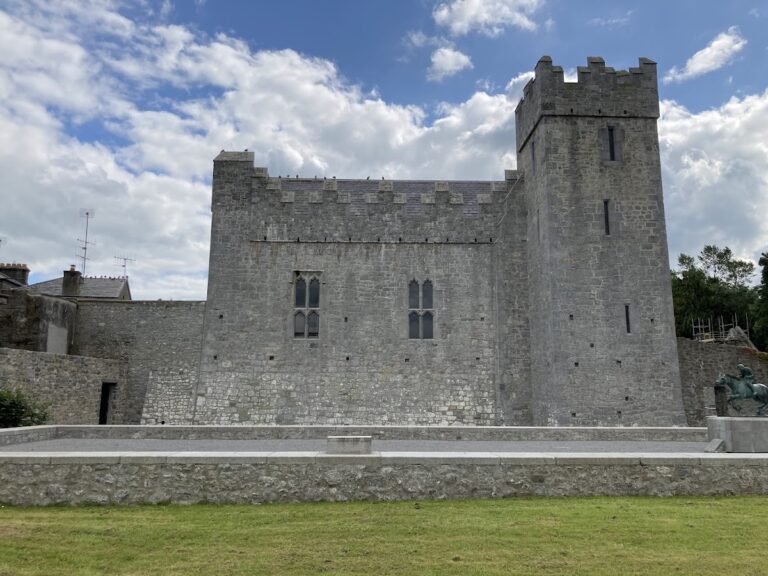
Askeaton Castle stands on a rocky island in the River Deel, approximately 3 kilometres from the River Shannon. The surviving fabric principally comes from the 1348 castle associated with Maurice FitzGerald, while its present condition reflects the explosion of 1580, the partial rebuilding that followed, and the later destruction of 1652.
The site has been associated with several historical names, including Askeaton, Ashkeaton, Askettin, Desmond Castle, and Heftin Castle. The Irish name means “Castle of Geitine’s Waterfall.” Its position on the river island and its successive phases of destruction and rebuilding form the principal physical evidence of its long use as a fortified stronghold.
Franciscan Friary
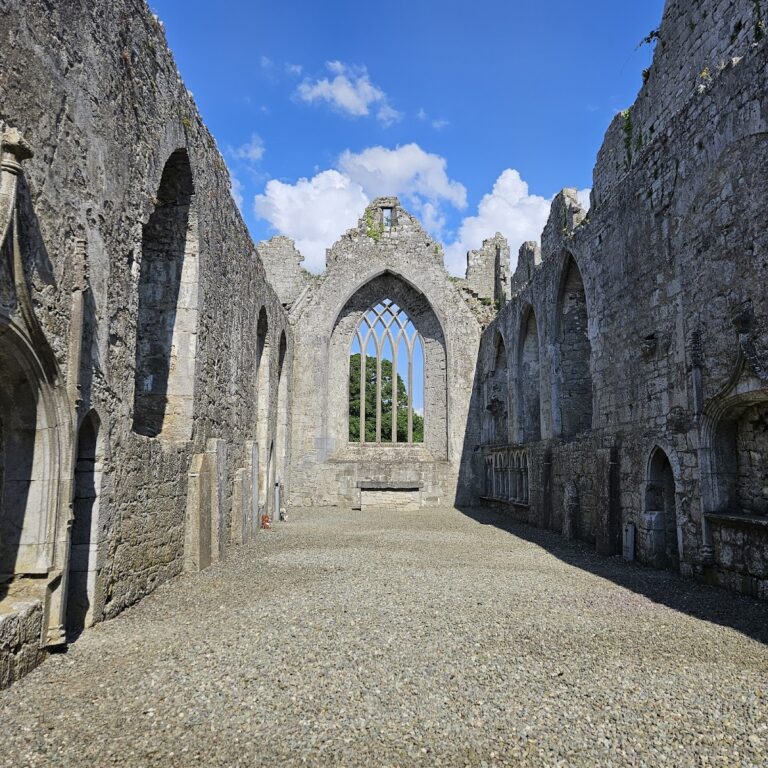
A Franciscan friary built in 1389 stands near the castle. Its presence places a religious foundation alongside the fortified residence of the Desmond lords and forms part of the historic setting of the castle site.
Nearby sites