Amalfi Cathedral: A Historic Cathedral Complex in Italy


Site at a Glance
- Rating
- 4.7
- Popularity
- Medium
- Country
- Italy
- Primary era
- Medieval
- External website
- Open
- Eras represented
- Medieval, Early Modern, Modern
- Civilizations
- Kingdom of Sicily
- Site type
- Religious
- Remains
- Cathedral
On this page16 sections
History
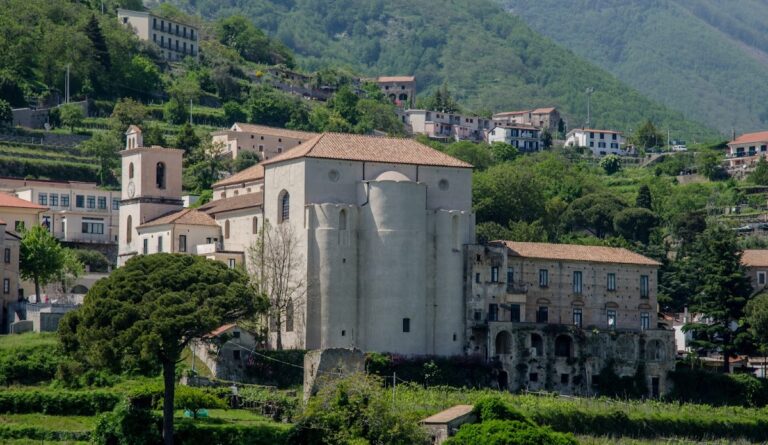
Amalfi Cathedral is a Roman Catholic cathedral in Amalfi, Italy, dedicated to Saint Andrew, one of the twelve apostles of Jesus and traditionally the brother of Saint Peter. Its main development dates from the ninth through eleventh centuries, and the complex combines Arab-Norman, Gothic, Renaissance, Baroque, and later nineteenth-century elements. It stands in Piazza del Duomo and has been the seat of the Archdiocese of Amalfi-Cava de’ Tirreni since 1986. Before that date, it served as the archiepiscopal seat of the Diocese of Amalfi.
Early Churches and Medieval Development
The complex began with a church built in the ninth century on the remains of an earlier temple. A second church was constructed to the south during the tenth century, and this later building became the cathedral. Construction of the cathedral is also associated with Duke Manson I, beginning in 987.
The two churches were initially used at the same time. By the twelfth century, they had been joined to form a single Romanesque church with six aisles. Between 1266 and 1268, the arrangement was reduced to five aisles to make room for the Paradise Cloister, which was created on the site of the city’s oldest cemetery. The bell tower was built in stages from about 1180 until 1276, while the crypt was completed around 1206 to 1208.
Saint Andrew’s relics reached Amalfi from Constantinople through Cardinal Pietro Capuano, a cardinal and papal legate, around 1206 to 1208. Their transfer followed the sack of Constantinople during the Fourth Crusade. The relics were placed in the cathedral crypt in 1208, establishing the principal religious identity of the complex.
Relics, Traditions, and Religious Change
A tradition holds that Saint Francis of Assisi visited the cathedral in 1218 to venerate the relics of Saint Andrew and stayed in Amalfi for two years. The same tradition attributes to him the foundation of the monastery of Santa Maria degli Angeli, later dedicated to Saint Anthony.
After the Counter-Reformation, the two sacred buildings were separated once more. The older church became the Basilica of the Crucifixion and later housed the Diocesan Museum. The cathedral complex now brings together the cathedral, the basilica, the Paradise Cloister, and the crypt of Saint Andrew.
A religious tradition associated with the relics describes a gelatinous liquid known as the “manna” or “oil of the saints,” believed to issue from the area where Saint Andrew’s remains are kept. The liquid has been associated with the cathedral since the thirteenth century. It is collected in a glass vessel and distributed during religious celebrations held twice each year. During wars, the bell tower also served defensive purposes.
Nineteenth-Century Rebuilding
In 1861, strong winds caused part of the poorly preserved crown of the facade to collapse and damaged the lower atrium. Although the damage was limited, the restoration commission supported a stylistic reconstruction that removed Renaissance, Baroque, and other later layers. Architect Errico Alvino rebuilt the facade, demolishing the porch, capitals, cornices, plaster, and eighteenth-century bases and pilasters attributed to Arcangelo Guglielmelli. The new facade was completed in 1891.
The intervention was locally justified by the claim that the church had almost completely collapsed, but it also removed much of the facade’s accumulated historical layering. The present exterior therefore reflects the nineteenth-century rebuilding as well as the medieval forms and decorative traditions that the reconstruction sought to evoke.
Remains
Approach and Facade
The cathedral is built on a hill above Piazza del Duomo. A broad, steep staircase of 62 steps leads to the entrance. The late nineteenth-century facade uses alternating marble and stone and rises to a tall pediment decorated with mosaics. Open arches and a deep porch with delicate Arab-Moorish tracery give the front its distinctive arrangement.
Facade Mosaics and Bronze Doors
The tympanum mosaic represents The Triumph of Christ, designed by Domenico Morelli, an Italian painter. The original designs are preserved in the town hall. The entrance lunette contains another mosaic designed by Morelli and executed by Paolo Vetri.
The bronze doors were cast in Constantinople during the first half of the eleventh century, before 1066, and bear the signature of Simeon of Syria. Four central images represent Christ, the Virgin Mary, Saint Peter, and Saint Andrew. The doors rank among the earliest post-Roman bronze doors in Italy.
Bell Tower and Cloister
Bell Tower
The bell tower stands in front of the first church. Its lower structure is Romanesque and was begun in 1180, with completion more than a century later. Above it, a larger central tower is surrounded by four smaller towers. The crown and upper storeys are covered with brightly coloured majolica tiles, a type of glazed ceramic tile, arranged to form interlaced Gothic arches in an Arab-Norman style.
Paired lancet windows, narrow pointed openings, occupy one tier, while another has three-light windows. Green and yellow polychromy gives the upper levels their strong colour pattern. The tower’s defensive use during wartime formed an additional role beside its religious function.
Paradise Cloister
The Paradise Cloister was created in 1266 to 1268 over the site of the former cemetery. Its arcades are framed by 120 slender Moorish-style columns, arches, and sculptures. The left gallery contains sarcophagi, including one from the first half of the second century showing the abduction of Proserpina and another from the second half of the second century showing the wedding of Peleus and Thetis.
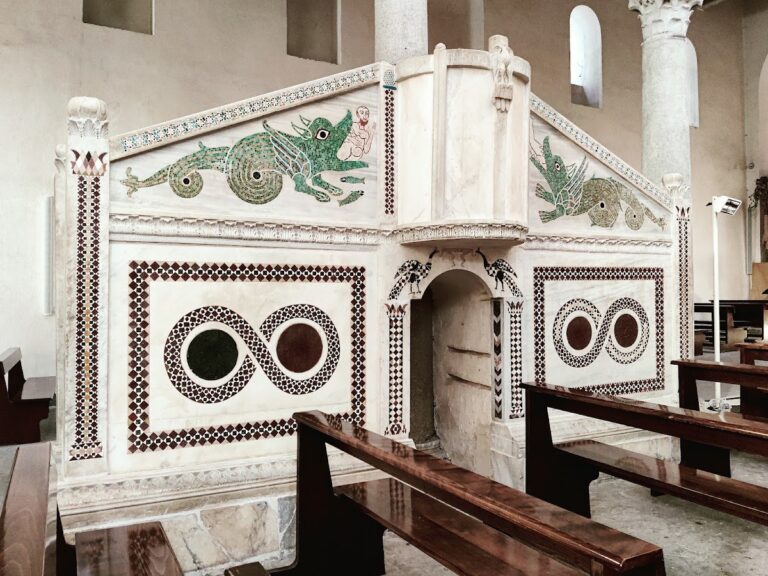
The cloister also preserves fragments of Byzantine reading stands, or ambos, dated from 1174 to 1202, together with mosaics associated with Cosmatesque craftsmen. Cosmatesque work is geometric decoration made from coloured stone and glass. A chapel contains a fresco by Roberto d’Oderisio, an artist associated with the Giotto school, showing the Crucified Christ, the grieving Virgin Mary, Saint John the Evangelist, Mary Magdalene, and soldiers in Angevin armour. An angel above receives the soul of the Good Thief.
Cathedral Interior
The interior was remodelled in the Baroque style. It has a basilica plan with a transept and apse, marble inlay, reused ancient columns, and coffered ceilings. The nave ceiling dates from 1702 and contains scenes of the Flagellation and the Crucifixion of Saint Andrew, together with Andrea dell’Asta’s 1710 painting of the Miracle of the Manna.
The gilded ceiling includes early eighteenth-century paintings by Andrea dell’Asta illustrating episodes from Saint Andrew’s life, including the Flagellation, Crucifixion, Miracle of the Manna, and Entombment. In the apse, his Martyrdom of Saint Andrew is joined by transept ceiling scenes by Giuseppe Castellano depicting the Calling of Saint Andrew and the Miraculous Catch.
Altar and Liturgical Furnishings
The high altar in the central nave uses the sarcophagus of Pietro Capuano, who died in 1214. Two Egyptian granite columns support the triumphal arch. Two additional twisted columns and two pulpits derive from a twelfth-century reading stand. One pillar incorporates a concealed column associated with the ancient Romanesque structure.
The liturgical area contains a wooden Crucifix from the thirteenth century. A second crucifix, made of mother-of-pearl and brought from the Holy Land, stands to the right of the rear door. At the left entrance is a large painting of The Calling of Saint Andrew by Vasily Nikolaevich Nechitailov and a baptismal font made from an ancient Roman porphyry vase.
The right entrance area contains the 1544 painting Saints Andrew and Matthew Saving the Inhabitants of the Gulf of Salerno from Turkish Pirates. The chapels on the right include sculptural groups of the Dead Christ with the grieving Virgin Mary and a bust of Saint Andrew with a fragment of his relics. The former Chapel of Relics, now the Chapel of Reconciliation, contains relics of numerous saints.
Side Aisles, Sacristy, and Organ
The left aisle contains a sixteenth-century reliquary statue of Saint Andrew, along with representations of the Dead Christ and the Virgin Mary. A chapel holds a wooden group showing the Apparition of the Archangel Michael to Saint Fidelis and a representation associated with the tomb of a martyr. Gilded ceiling friezes depict the Stories of Saint Andrew, and a modern painted wooden Crucifix is also present.
The sacristy contains an eighteenth-century processional image of Saint Andrew, kept in a wardrobe known locally as the “cabinet.” The cathedral also houses the Masi organ, opus 835. Its two bodies are divided between the counter-facade and an older case opposite the choir seat. The instrument has electric action, 40 stops, three manuals, and one pedalboard.
Crypt and Basilica
Crypt of Saint Andrew
The crypt is a subterranean sacred space built around the tomb of Saint Andrew. His relics lie beneath the floor, and a sixteenth-century fresco beside the organ represents their transfer to Amalfi. The vaults were painted in the 1660s with scenes from the Passion of Christ.
The principal marble altar was made by Domenico Fontana. Its bronze statue of Saint Andrew was created in 1604 by the Florentine sculptor Michelangelo Naccherino. Marble statues of Saint Lawrence and Saint Stephen stand beside it. Part of Saint Andrew’s head is kept in a special reliquary behind the altar, which is opened on particular occasions.
The largest fresco in the crypt depicts the arrival of Saint Andrew’s body at Amalfi. The altar also has a marble statue of Saint Lawrence attributed to Pietro Bernini and a statue of Saint Stephen attributed to a local sculptor.
Basilica of the Crucifixion and Museum
The Basilica of the Crucifixion remains connected to the cathedral through the former six-aisled Romanesque arrangement. It now functions as the Diocesan Museum. Its collection includes a thirteenth-century Angevin mitre decorated with gold, precious stones, and 20,000 pearls, as well as a thirteenth-century chalice, reliquaries, and a cross containing a fragment of the True Cross.
The museum also preserves a reliquary containing a thorn from the Crown of Thorns, a pectoral episcopal cross, an eighteenth-century monstrance, and a polychrome wooden image of the Virgin Mary from the second half of the fourteenth century. Other works include a wooden image of the prophet Elijah, an eighteenth-century portable episcopal chair, a fifteenth-century relief of the Madonna of the Snows, an eighteenth-century silver altar, and a Renaissance Madonna and Child of the Sienese school.
The chapels and adjoining garden and cloister contain Gothic and Renaissance works, colonnades, arches, sculptures, sarcophagi, architectural fragments, and mosaics. Together with the cathedral interior, crypt, bell tower, and Paradise Cloister, these elements preserve the complex’s long sequence of religious, architectural, and artistic development.
Nearby sites