Ali Pasha’s Mosque in Sarajevo: A Sixteenth-Century Sunni Place of Worship
Site at a Glance
- Rating
- 4.8
- Popularity
- High
- Country
- Bosnia and Herzegovina
- Primary era
- Early Modern
- Eras represented
- Early Modern
- Civilizations
- Ottoman
- Site type
- Religious
- Remains
- Mosque
On this page13 sections
History
Foundation and Ottoman neighborhood
Ali Pasha’s Mosque is a Sunni mosque in Sarajevo, Bosnia and Herzegovina, built in 1560–61 in the classical Ottoman tradition. It was established as a perpetual charitable endowment by Sofu Hadım Ali Pasha, also known as Hadim Ali Pasha, who directed in his will that a mosque be built beside his grave. He died in September 1560. The cemetery beside the mosque was already in use before its construction.
Ali Pasha came from a village near Sarajevo and served as governor of the Bosnian Sanjak, an Ottoman administrative district, in 1550–51 and 1553. He also held appointments as a beylerbey, a senior Ottoman provincial governor, at Buda in 1551–53 and 1556–57, as well as in Temișvar and Egypt. A neighborhood around the mosque was first noted in 1562.
Alterations, damage, and restoration
In 1884, the mosque was renovated to a design by Zagreb-based architect Ćiril Iveković. That year, a sixteenth-century stone bridge across the nearby Koševo stream was destroyed. In 1939, part of the cemetery facing the main Tito Street was converted into a park, and a hedge replaced its iron railing. A separate mausoleum opposite the mosque was demolished in 1950, and the grave markers of Ajni-dede and Šemsi-dede were moved into the mosque cemetery.
Behdžet Mutevelić and Abdulah, known as Avdo Sumbul, were activists of Gajret, a Bosnian Muslim cultural and educational association. They died in Arad in 1915; their remains were later transferred to Sarajevo. During the Bosnian War of 1992–95, Serbian forces damaged the mosque, especially its dome. The building was restored in 2004 and, together with its cemetery, designated a National Monument of Bosnia and Herzegovina in 2005. It remains an active place of Sunni worship.
Remains
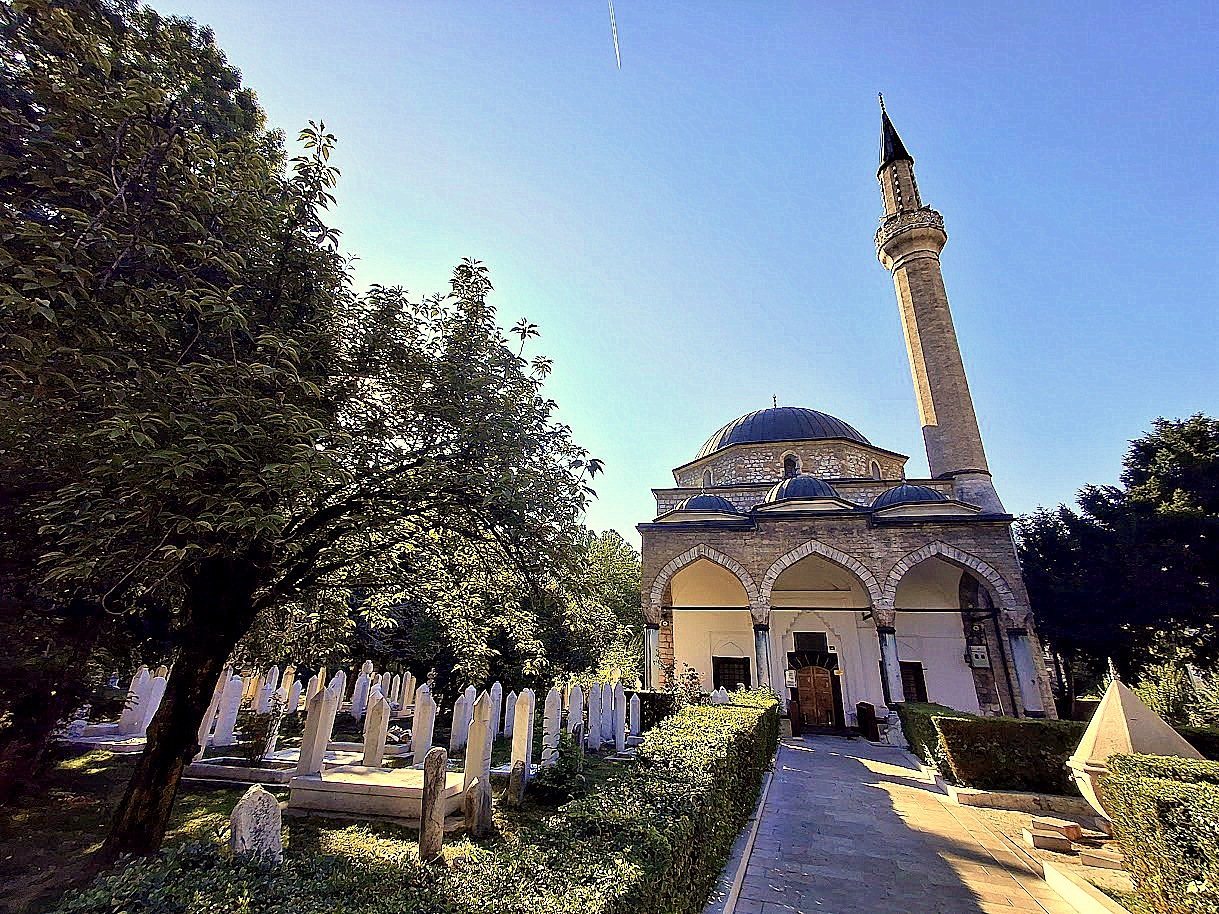
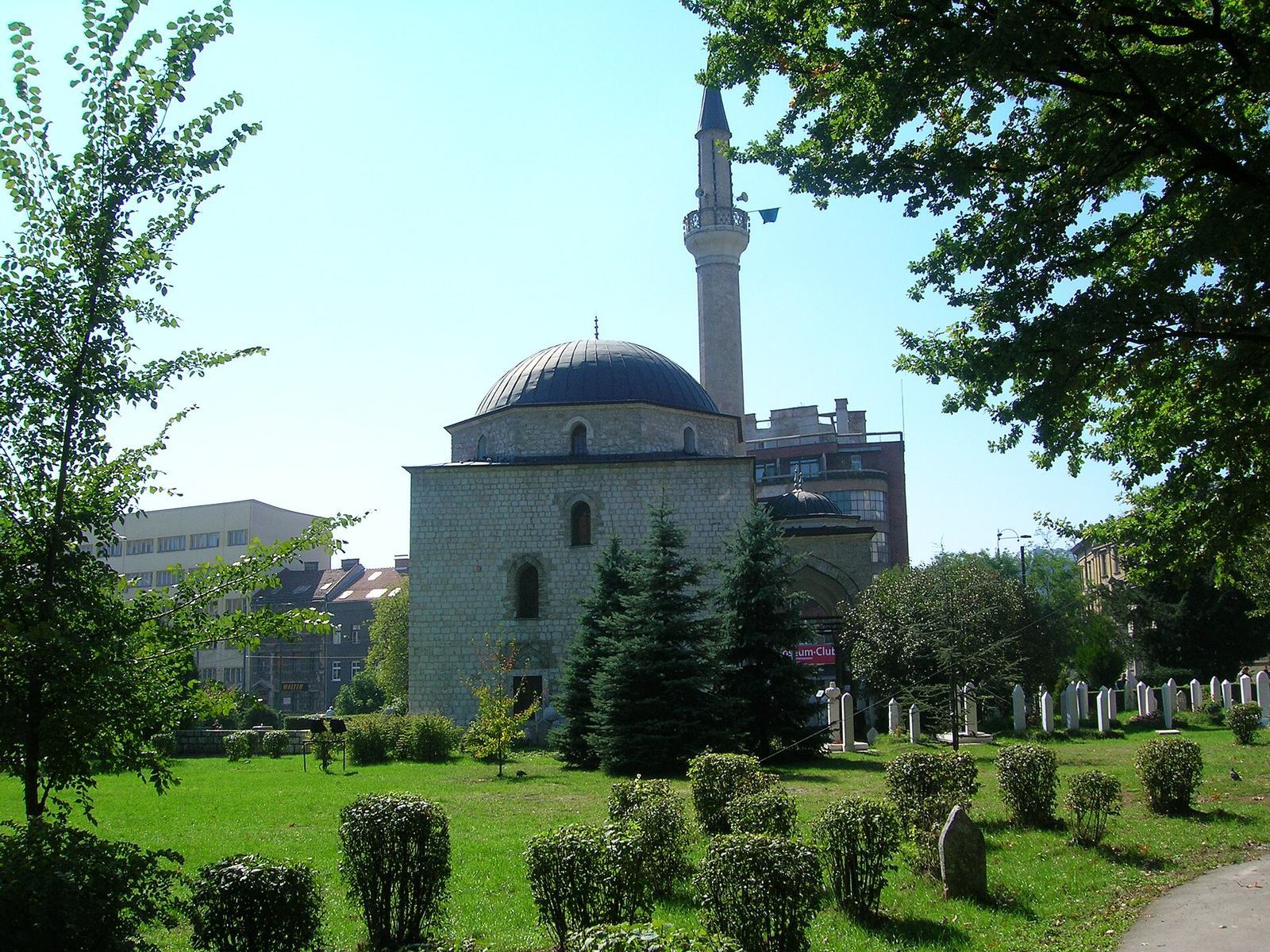
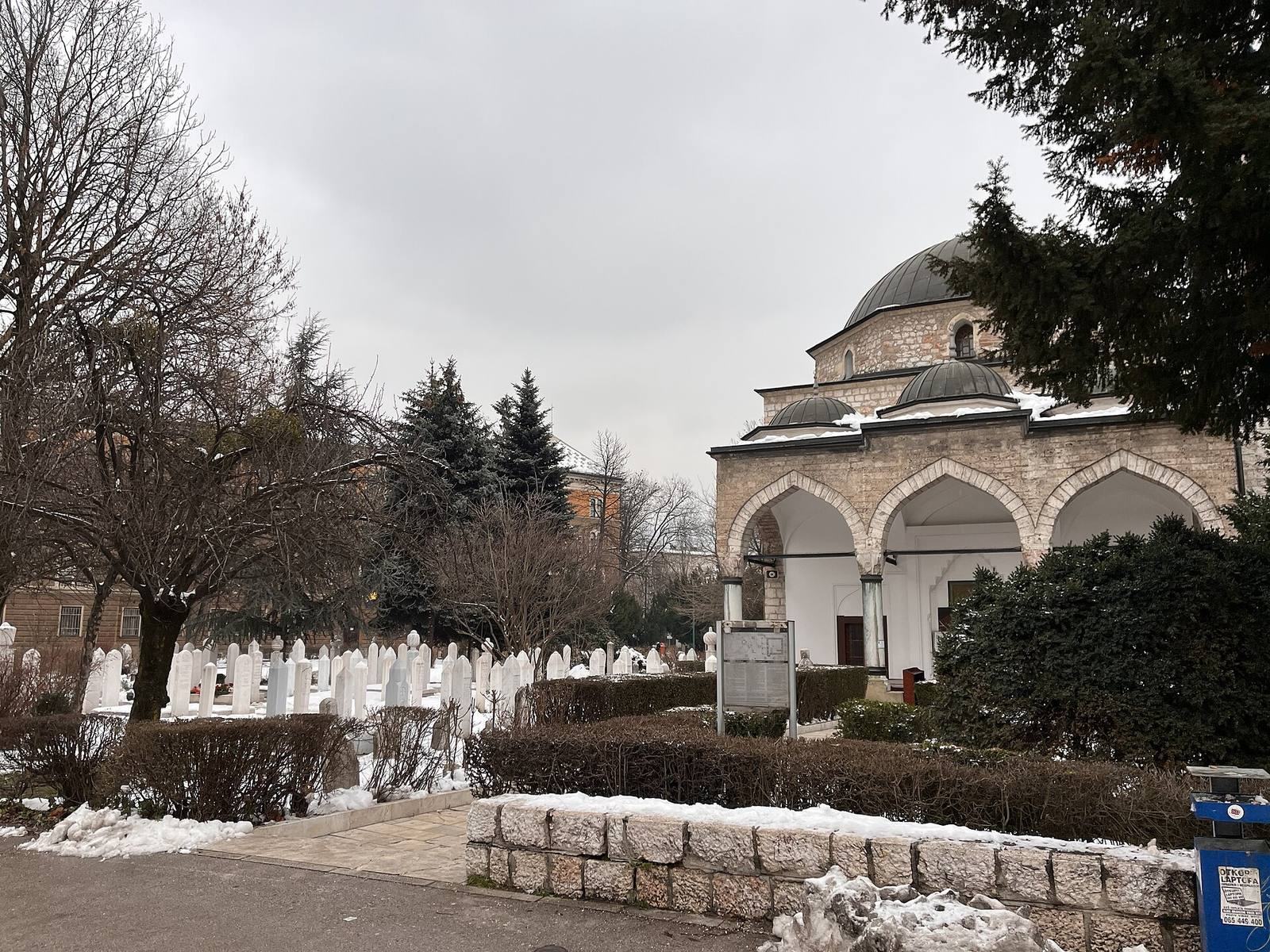
The mosque and its adjoining cemetery form the surviving complex. The mosque is a single-space building with a large central dome, a slender attached minaret, and an open porch covered by three smaller domes. Its finely dressed limestone walls and brick domes combine with stonework on the porch and minaret. Among seven single-space domed mosques of its period in Sarajevo, it is described as the largest of this type in Bosnia and Herzegovina.
The mosque
Plan and construction
The square prayer room measures 9.5 metres on each interior side, and its walls are about 1.1 metres thick. The external porch is 3.4 metres deep. Squinches, corner supports that help carry a dome over a square room, lead up to a drum, the raised structure beneath the dome. The interior cube is 9.5 metres high; the drum adds 1.5 metres, and the dome rises a further 3.33 metres, giving a floor-to-apex height of 14.33 metres. The walls are made of finely dressed limestone, while sedra stone was used for the minaret and porch. Turkish brick forms the main and smaller domes. The building method points to the work of Dalmatian stonecutters, and the builder may have been a pupil of Mimar Sinan, the chief Ottoman imperial architect of the sixteenth century.
Interior and entrance
The portal, arches, columns, prayer niche, pulpit, and raised gallery have relatively restrained ornament. The building’s proportions have been described as based on the golden ratio. Above the entrance, a stone slab carries a verse inscription in Arabic in monumental calligraphy. It praises Ali Pasha for establishing a place of worship and gives the date 1560–61.
The cemetery and grave markers
Ali Pasha’s grave and older markers
Ali Pasha’s grave lies within the cemetery and is marked by two uninscribed headstones and a stone sarcophagus. Around thirty older grave markers survive in the grounds, including thirteen with inscriptions, alongside later markers. Several old markers associated with martyrs also point to the cemetery’s early history.
Ajni-dede and Šemsi-dede
The two markers moved from the former mausoleum are each 95 centimetres high, with a base measuring 17 by 17 centimetres. Both have carved inscriptions on two sides and are topped with a turban associated with Naqshbandi dervishes, members of a Sufi order. Their Turkish verses give the date 1461–62, though the wording may have been composed in the first half of the seventeenth century, when their mausoleum was renovated. Ajni-dede’s inscription presents him as a battle martyr who advised a sultan on warfare. Šemsi-dede’s describes him as a military scout leader and says his mule led the army of Mehmed II, the sultan who conquered Constantinople in 1453; it, too, portrays him as a martyr.
Mausoleums
Mausoleum beside the mosque
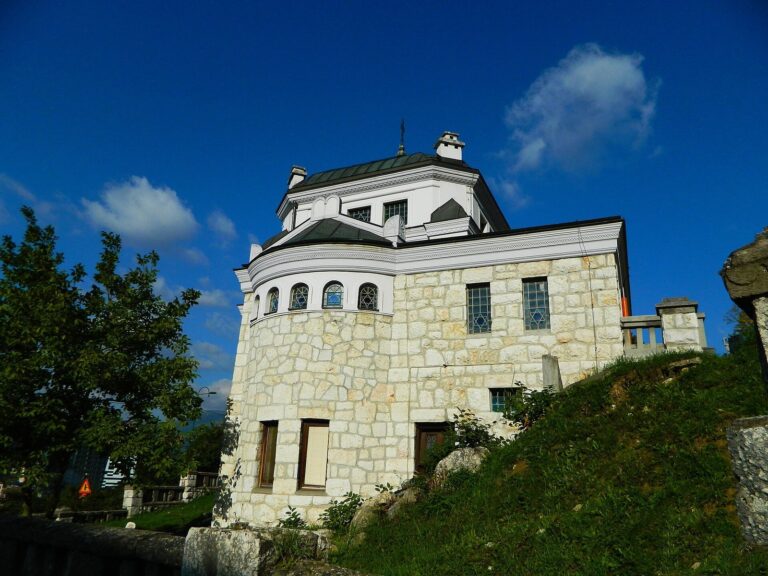
A mausoleum beside the mosque contains two sarcophagi for Behdžet Mutevelić and Avdo Sumbul, whose remains were transferred to Sarajevo after their deaths in Arad.
Former mausoleum opposite the mosque
The demolished mausoleum opposite the mosque was a simple structure of timber and adobe beneath a tiled roof. It held two wooden sarcophagi beneath the grave markers of Ajni-dede and Šemsi-dede.