A Famosa: The Portuguese Fortress of Malacca
Site at a Glance
- Rating
- 4.4
- Popularity
- High
- Country
- Malaysia
- Primary era
- Early Modern
- Eras represented
- Early Modern
- Civilizations
- Dutch, Portuguese
- Site type
- Military
- Remains
- Fort
On this page10 sections
History
A Famosa is a Portuguese fortress in Malaysia, established at Malacca in 1511 after a Portuguese fleet led by Afonso de Albuquerque defeated the Malacca Sultanate. Built during Portugal’s early expansion across the Indian Ocean, it stood on a natural hill near the coast and helped consolidate Portuguese control while supporting Malacca as a port on the maritime spice route to China.
Portuguese foundation and expansion
Construction began immediately after the conquest on the site previously occupied by the Malacca Sultan’s palace. Hundreds of enslaved people were used to build the fortress, a process described as taking four months. The stronghold formed part of a wider Portuguese network of maritime outposts, including Goa and Macau, which supported shipping between Portugal, India, Southeast Asia, and Ming China.
Malacca remained under Portuguese control from 1511 until 1641. As the Portuguese and European population grew, the original fortress became too small and was expanded around 1586. Its garrison numbered 500 men, including 200 assigned to service aboard ten vessels that formed the fortress’s supporting fleet. Defence was the site’s principal strategic function, while its position also supported Malacca’s role as a major port.
Dutch occupation
A Dutch siege ended Portuguese rule in 1641, after which A Famosa passed to the Dutch. The new rulers repaired and strengthened parts of the fortification and renovated the gateway in 1670. Malacca’s period of Dutch control lasted until 1795, when the Dutch transferred it to Britain to prevent its capture by Napoleonic France.
Demolition and archaeological rediscovery
The British ordered the fortress demolished in 1806. By about 1810 or 1811, it had been almost entirely dismantled, although the demolition was halted through the intervention of Sir Stamford Raffles, the British colonial administrator later associated with the founding of modern Singapore. Captain William Farquhar, who was responsible for demolishing the fort and town, spared two gateways, including the Porta de Santiago, together with the Stadthuys, a church, and a prison.
The surviving remains are regarded as among the oldest European architectural remains in Southeast Asia. The former fortress area now also contains more than twenty museums and St Paul’s Church. Archaeological discoveries have added to the surviving picture of the defences. A watchtower identified as the Santiago Bastion was found during construction at Dataran Pahlawan in June 2004. Part of the fortification believed to be the Middelburg Bastion was accidentally uncovered in late 2006 during work on a proposed revolving tower. Construction stopped, the tower was moved to Bandar Hilir, and the exposed bastion was restored in 2006 and 2007. The Malacca Museums Corporation regards it as a Dutch-period structure.
Remains
A Famosa stood close to the Malacca shoreline on a natural hill. Its early defences used earth and timber, partly incorporating demolished structures, before the fortification was strengthened with stone, laterite, and brick. Building material came from Malay tombs, the local mosque, and other earlier buildings, while Portuguese ships transported additional stone. The original fortress consisted of long ramparts and four major corner towers, with the ramparts reaching up to three metres in height.
Fortification and surviving gateways
Porta de Santiago
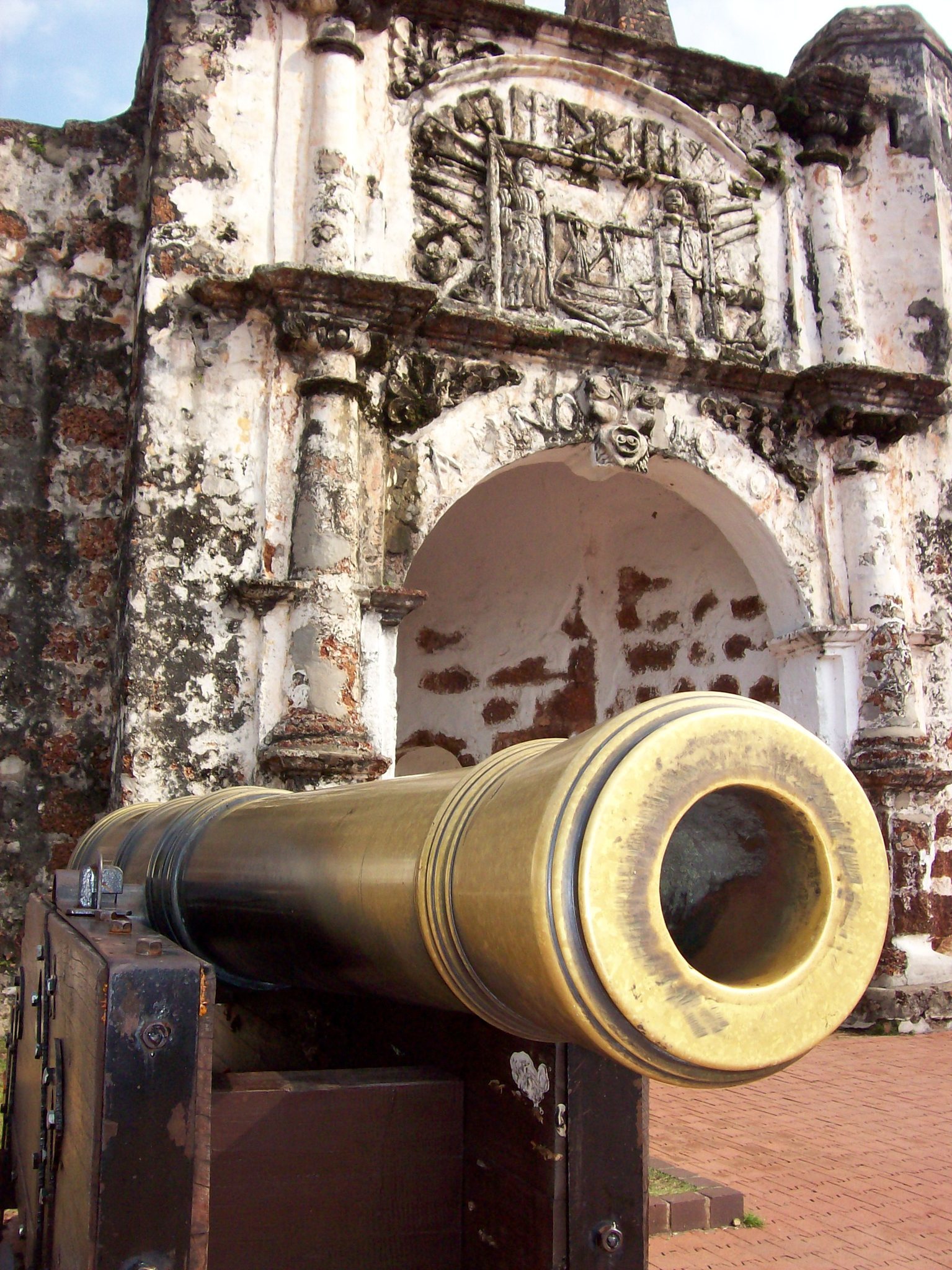
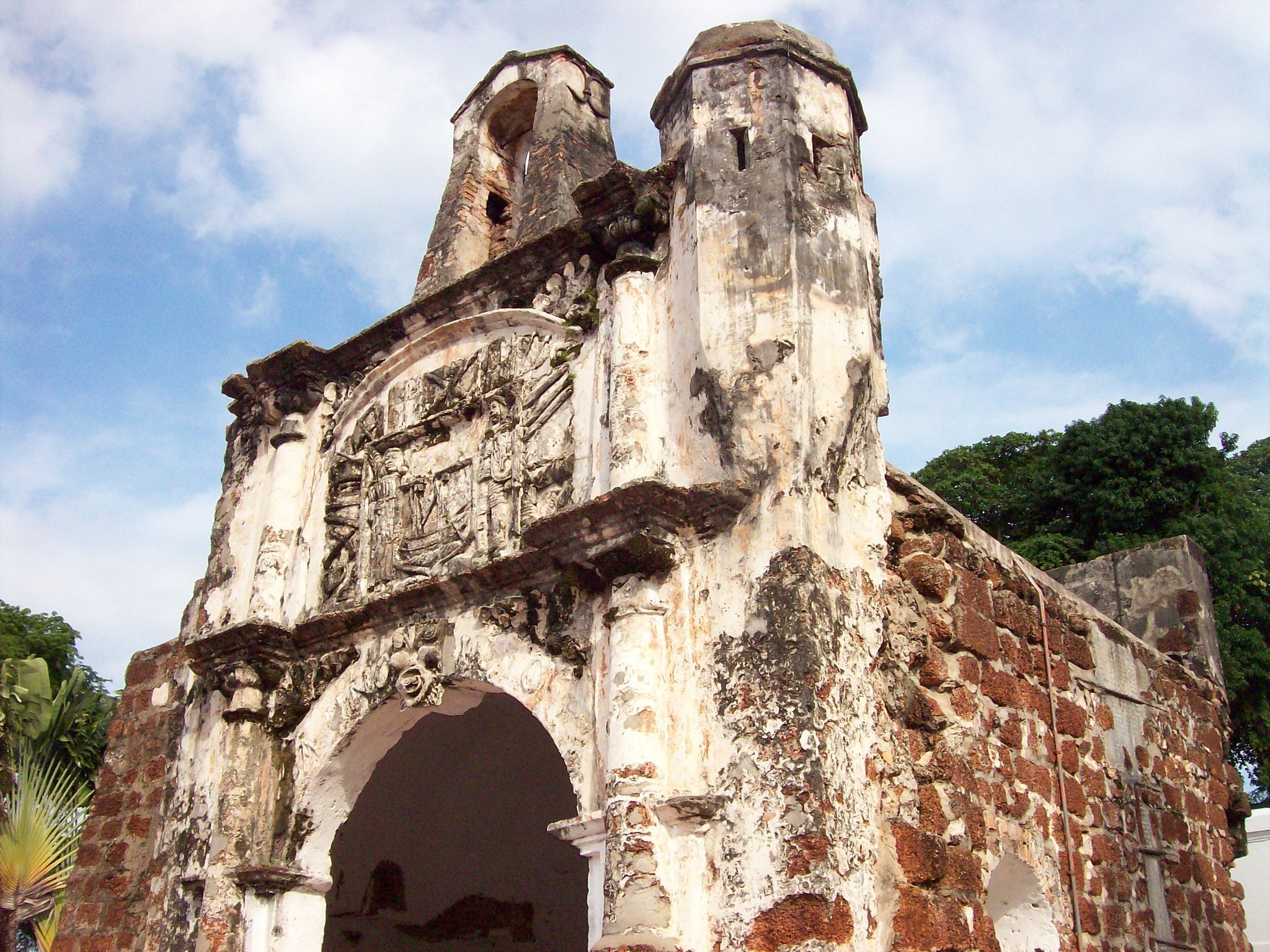
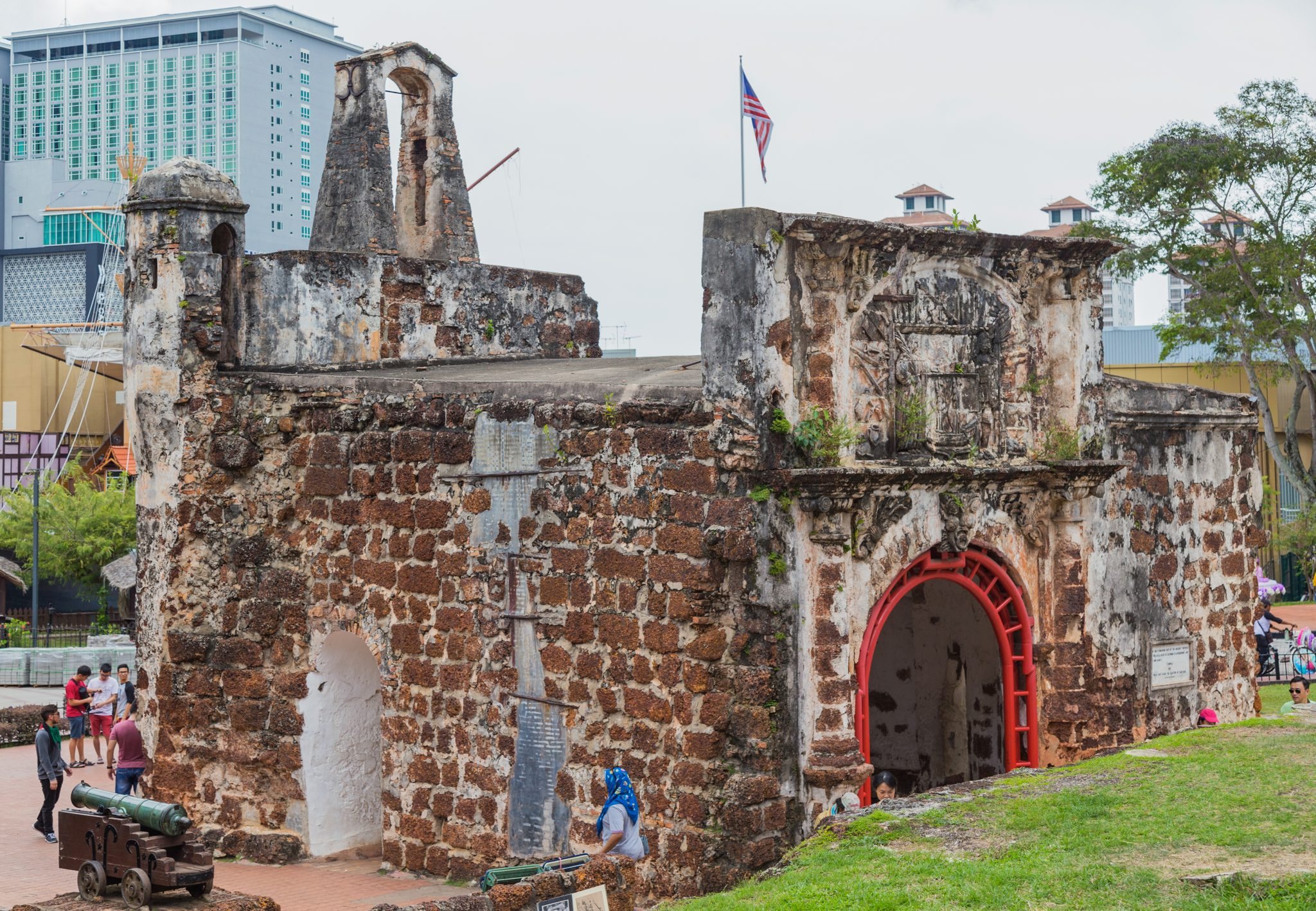
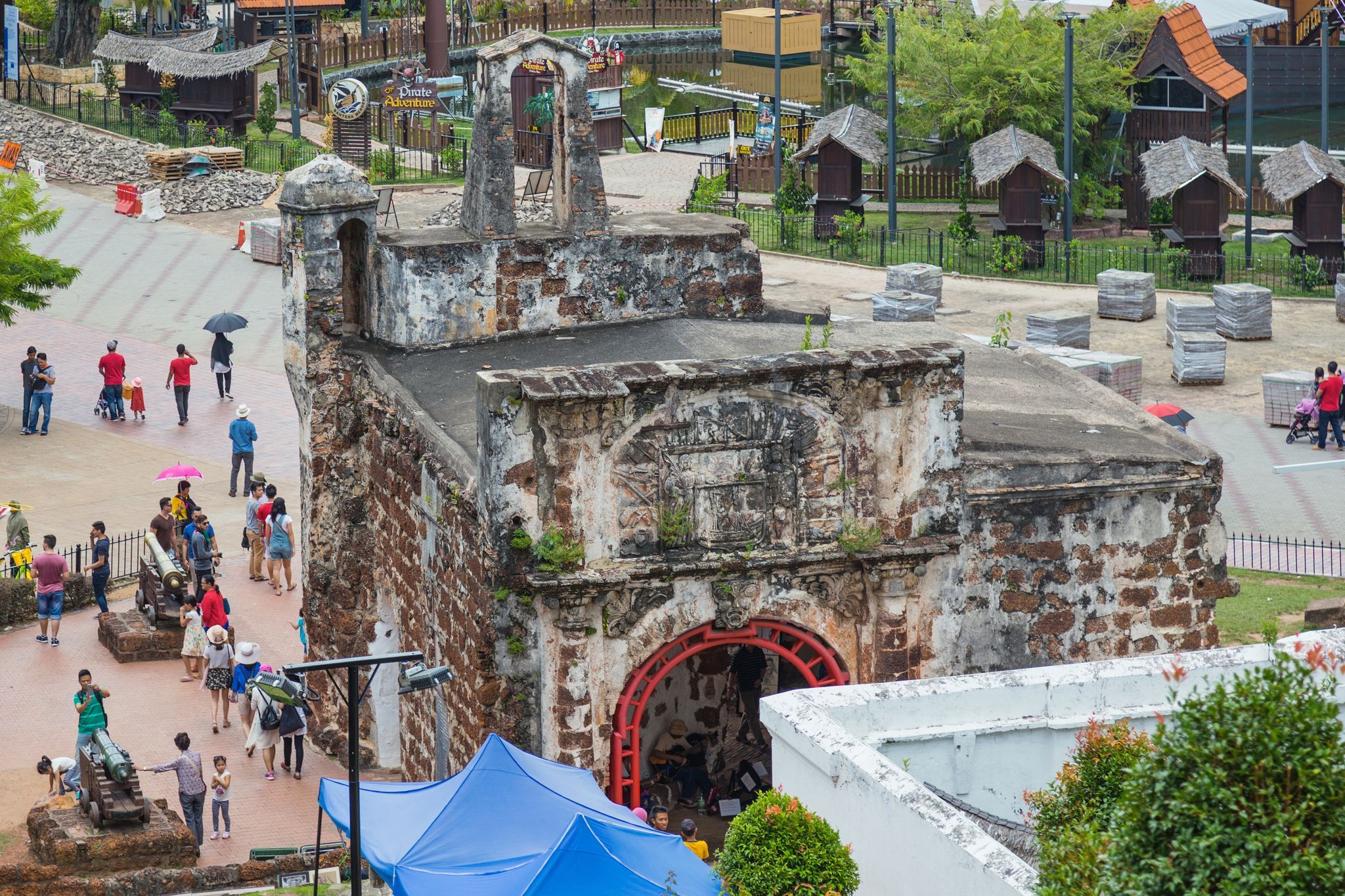
The Porta de Santiago is the principal surviving gateway of the fortress and the feature most commonly called A Famosa today. Dutch alterations made in 1670 are marked by the inscription “ANNO 1670” on the arch and by a bas-relief emblem of the Dutch East India Company above it. The company was a chartered Dutch trading and colonial corporation that operated across Asia, so its emblem identifies the gateway’s Dutch period of alteration.
Santiago Bastion
A separate watchtower discovered at Dataran Pahlawan in 2004 was identified as the Santiago Bastion. A bastion is a projecting fortification designed to let defenders observe and fire along the face of a surrounding wall. The discovery places another element of the defensive system within the former fortress area.
Middelburg Bastion
The Middelburg Bastion is a surviving and partly reconstructed fortification element believed to date from the Dutch occupation. Archaeological work uncovered it in 2006, and it was restored in 2006 and 2007. It provides physical evidence of the repairs and strengthening carried out after the Dutch capture of Malacca.
Fortress buildings and internal spaces
One of the original towers developed into a multi-storey keep, and this structure gave the entire fortress the name A Famosa, meaning “The Famous” in Portuguese. The keep stood near the bridge linking two parts of the city separated by a river or canal. The Dutch destroyed it after the Battle of Malacca in 1641.
The fortress contained an ammunition store, the captain’s residence, officers’ quarters, and civilian buildings. Civilian residents initially lived within the walls, while the wider complex included five churches, craft workshops, and markets. These functions made the fortress both a military centre and a substantial urban enclosure within Portuguese Malacca.