The best-preserved Roman sites around the world
One of the interesting findings when going through 2000+ ancient sites is that it becomes increasingly clear how countries have organized their preservation and maintenance of ancient sites. Some countries hardly have any sites and the few in existence are not well maintained. Other countries contain numerous sites which have all been well recorded, excavated and monetized in the form of a museum or fence with a ticket office.
On this page4 sections
The country with the best documented (and least impressive) sites: France
France has hundreds of ancient sites. Almost all sites are well documented containing at least a sign with some information on the site, and what it used to look like. However, several hundreds of them I would not see as worth visiting. A few examples of sites that did not make it to the map:
- Sanctuaire de Mars Mullo
- Hypogée Gallo-Romaine de Louin
- Site archéologique de Saint Blaise
- Archéologique de Tholon Garden
- Site des Flaviers
- Temple romain d’Izernore
- Sanctuaire Gallo-Romain de Margerides
- Combe de l’Écartelot
This is what the Sanctuaire de Mars Mullo currently looks like:
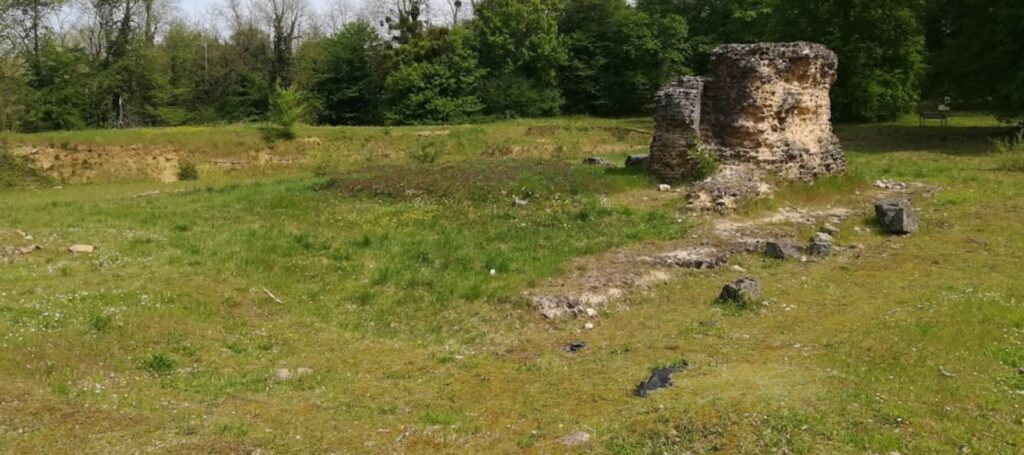
I have seen around 300 similar sites in France, merely containing a few leftovers but not much besides that.
Let it be clear though: France does have some excellently persevered sites such as the Pont du Gard, the amphitheatre of Nimes, the Temple of August and Livia in Vienne (Temple d’Auguste et de Livie). France simply did an excellent job preserving its heritage and has as a result identified virtually every archaeological remain in the country.
The countries with the worst maintained sites: Syria / Libya
On the other end of the spectrum, we have war-torn Syria and Libya. A few sites were reasonably well maintained such as Leptis Magna and Palmyra in Syria. Under the rule of Ghaddafi Libya was focused on exploiting its oil resources. Besides some domestic tourism, hardly anyone visited the country. For a few years (2003-2011) this situation changed and a ministry of tourism was established to decrease dependence on the oil industry. With the fall of the Ghaddafi government, this ground to a halt very rapidly. This very limited timeframe ensured the sites in Libya were not developed or explored.
In contrast to Libya, Syria’s tourism industry was more established before the 2011 war broke out. Still, the country contains so many archaeological sites that as a developing nation the funds are simply lacking to mimic France’s achievement. For example, Syria has archaeological sites with UNESCO states called the “dead cities of Northern Syria”, consisting of 40 ancient settlements situated in a narrow strip of land between Aleppo and Idlib. However, finding information on these 40 sites is nearly impossible. Academic reports exist of course, but finding the exact location on the map is not very easy. Coordinates provided are a bit off sometimes making the job even less easy. According to Wikipedia the area even contains up to 700 settlements. The UNESCO sites do have coordinates provided (for example https://whc.unesco.org/en/list/1348/multiple=1&unique_number=1761) but the actual information on the site is missing and there are no Google reviews. Perhaps these are the least visited UNESCO heritage sites in the world.
The country least interested in Roman archaeological sites: Egypt
The map of Roman sites in Egypt is limited to only a few sites. This is quite surprising since Egypt was one of the most important provinces of the empire. Of course, Egypt had its own distinct culture and was not easily Hellenized or Romanized. Still, the sites that we do know exist are either not excavated or are incredibly hard to find. For instance, I was aware of the existence of the oasis fortress in southwestern Egypt at the “Umm El Dabadib Spring”. However, it still took me around an hour to actually find the site on the map. It has only one review, which indicates it is not actively exploited for tourism. In comparison, the Colosseum has around 280.000 reviews. Egypt of course draws enough tourists with the Egyptian past, such as the pyramids, the Abu Simbel Temples, the Great Sphinx of Giza etc. The Roman past is conveniently forgotten.
So, where to find the least visited and best preserved ancient Roman sites?
France and Syria / Libya are two extremes. France contains a number of unpopular sites, which are also not very well preserved. The sites that are well preserved are also frequented by tourists. Syria and Libyan sites on the other hand are not well preserved or currently hard to access.
Personally, I would opt for Tunisia and Turkey for an off the beaten path experience. The sites there are well preserved, but tourism in the country is still recovering. Also, tourism is largely situated around a few famous sites, but both countries contain some of the best preserved Roman sites. In Tunisia for instance Dougga and Sbeitla could be considered. Turkey has numerous very well preserved sites. The sheer number of these sites ensure that tourism is dispersed, although a fair amount is directed to Pergamon and Troy.