Byzantine Sites in Bosnia and Herzegovina: Explore Blagaj Fortress
The Byzantine collection in Bosnia and Herzegovina centres on Blagaj Fortress, a hilltop stronghold above the Buna valley. Its early development has been connected with late antique fortification, although the date and extent of that work remain debated. The substantial walls and residential remains chiefly show the medieval and Ottoman fortress that developed on the hill.
Primary Function: All
Type: All
Popularity: All
Rating: All
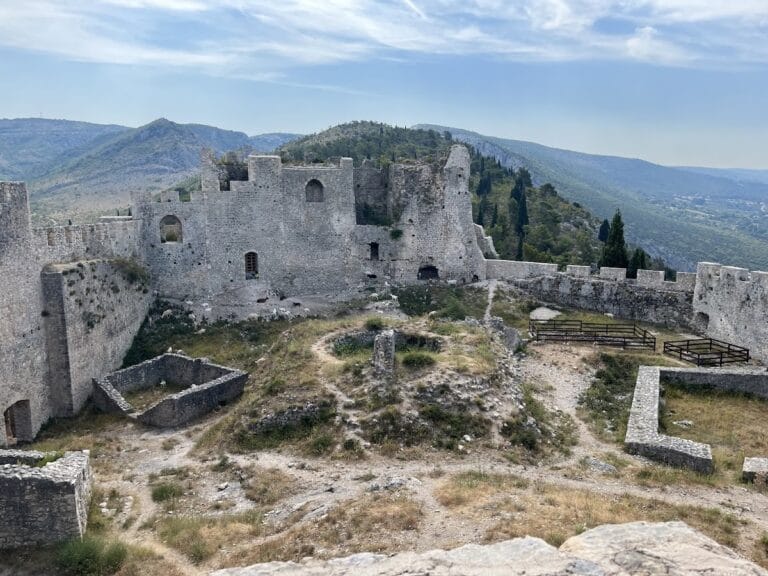
Blagaj Fortress, also known as Stjepan-grad, developed on a strategically placed karst hill above the Buna River. Its history extends from…
For details on how to use the maps, which sites are included, how popularity and ratings are determined, and how sites are classified, see the help page.
Blagaj: a fortified hill above the Buna
Blagaj Fortress, also known as Stjepan-grad, occupies a rocky height with steep cliffs on several sides. Its irregular enclosure follows the available summit rather than a rectangular plan. The most accessible approach required stronger built defences, concentrating the entrance and its protecting structures on that side of the hill.
A winding path reaches the gate through successive outer spaces. Tall curtain walls and towers enclosed the central area, with additional protection around the entrance. The combination of cliff edges and masonry restricted the routes by which an attacker could reach the defended interior.
Within the enclosure, excavations identified the remains of a palace. These belong to the fortress’s role as a medieval residence as well as a military position. The surviving arrangement is therefore more than a detached watchtower: it contained the rooms and defended spaces of a regional seat of power.
Early origins and later rebuilding
The wider Blagaj hill preserves evidence of occupation before the medieval fortress. Researchers have proposed late antique phases in its defensive development, while excavation reports and interpretations differ over the identification of early masonry within the present stronghold. A precise attribution of the standing circuit to Justinian would go beyond that evidence.
Later work is more clearly visible in the enlarged walls, towers and internal buildings. Medieval strengthening was followed by Ottoman repairs, and an explosion in an entrance-area tower caused further damage and rebuilding. The site’s individual article describes these phases alongside the proposed earlier history, allowing the substantial surviving fortress to be understood without treating all its masonry as Byzantine.
Explore the collection
Explore sites on the map or in the grid. Map icons reflect each site’s primary function, helping you identify different kinds of places at a glance. Narrow the results by primary function, site type or era, with additional filters for popularity and rating. Select a map marker to view the site’s details and open its article, or open the article from its grid entry.