Saint Peter’s Church, Malmö: A Baltic Brick Gothic Parish Church



Site at a Glance
- Rating
- 4.6
- Popularity
- Medium
- Country
- Sweden
- Primary era
- Medieval
- External website
- Open
- Eras represented
- Medieval, Early Modern, Modern
- Civilizations
- Danish, Swedish
- Site type
- Religious
- Remains
- Church
On this page19 sections
History
Saint Peter’s Church is an Evangelical Lutheran church in Malmö, Sweden, and the historic parish church of Malmö’s old town. Built by the Danish kingdom in the early fourteenth century in the Baltic Brick Gothic tradition, it became the city’s principal church and remains Malmö’s oldest church and oldest surviving building.
Medieval origins and construction
Malmö expanded rapidly as the herring trade developed from around 1200. The settlement formed part of the economic infrastructure surrounding the Hanseatic League, a medieval association of trading cities and merchant communities in northern Europe, and the Scania Market, a major herring market linked to wider Baltic commerce. By the end of the Middle Ages, Malmö had become the province’s most important commercial city.
A small Romanesque brick church stood on the site and was first mentioned in 1269. It was probably dedicated to Saint Nicholas, the patron saint of seafarers, and represents an earlier religious phase before the present building. The foundation stone of the crypt was laid in 1319 on the orders of King Christopher II of Denmark. The church may have been inaugurated or consecrated that year, while its construction was possibly completed by 1349 or, at the latest, well before 1380. During the fourteenth century, it was the largest town church in Denmark.
The new church was dedicated to Saint Peter and Saint Paul, early Christian apostles and central figures in the New Testament. Designed as Malmö’s principal city church, it served as an important spiritual centre as the town grew in commercial importance. Its form also connected Malmö with the architectural culture of Baltic cities, probably drawing directly on Lübeck’s Marienkirche while incorporating influences from contemporary French Gothic architecture.
Reformation and later medieval changes
The church became closely associated with the Reformation, the sixteenth-century movement that challenged the authority and practices of the Western Catholic Church and led to the creation of Protestant churches. Claus Mortensen, a leading reformer, served as a priest at Saint Peter’s. In 1529 he led the destruction of much of the church’s ornament because it was considered excessively Catholic. This iconoclasm, the deliberate destruction or removal of religious images and ornament, was one of only four acts of violence connected with iconoclasm during the Danish Reformation. More than sixty pre-Reformation altarpieces were reduced to one that survived more or less intact, and the interior was whitewashed in 1555.
The original tower collapsed in 1420. A replacement tower and new vaults were then built in the western part of the church, and a porch was added west of the main building. The tower partially collapsed again in 1442 and was rebuilt. Five side chapels were added during the late fifteenth and early sixteenth centuries, with three surviving into the present church. These changes expanded the building as Malmö’s urban and religious life developed.
Restoration and modern conservation
A major reconstruction took place between 1847 and 1853 under Carl Georg Brunius, when the church was in poor condition. The copper roof was entirely renewed, large sections of wall were replaced, much of the ambulatory was dismantled and rebuilt, and nearly all the buttresses were heavily reconstructed. Old gravestones covering the floor were removed and mostly broken, while much Renaissance furnishing was taken away. The altarpiece and organ façade were preserved despite Brunius’s wishes, although the altarpiece was painted grey.
Between 1904 and 1906, cathedral architect Theodor Wåhlin carried out restorative work intended to recover elements that had survived the nineteenth-century reconstruction. The altarpiece regained vivid colours, and the murals in the Merchants’ Chapel were uncovered and restored. Saint Anne’s Chapel was rebuilt in 1964, the interior was renovated in 1965–1967, further mural restoration took place in 1999, and a major interior restoration followed in 2011. Much of the present interior reflects the arrangement established in the early seventeenth century.
The western tower was reconstructed again in 1890 and acquired its present form, including its conical spire. The church is legally protected as a historic monument and is regarded as a major example of Gothic church architecture in Scania and a particularly authentic expression of Baltic Brick Gothic.
Restoration and expansion of the organs began in 2016. The main organ was revoiced and extended, while the surviving remote and choir divisions from the Walcker installation were restored. A new choir organ was completed and consecrated on 27 April 2019. The renovation of the Marcussen organ and construction of the choir organ were initiated by Carl Adam Landström, the church’s chief organist.
Remains
Gothic structure and urban setting
Saint Peter’s stands in Malmö’s historic centre behind the city hall at Stortorget, within an urban structure whose medieval street layout remains largely intact. It is a red-brick Gothic basilica, meaning that its central nave rises above lower side aisles. Transepts form the church’s cross-arm, while a pentagonal chancel at the eastern end is surrounded by an ambulatory, a passage around the sanctuary, and a ring of chapels.
The church’s red-brick construction expresses the Baltic Brick Gothic tradition, the medieval Gothic style that used brick instead of cut stone around the Baltic Sea. The nave reaches approximately 25 metres at the transept. Its walls, pillars, and vaults are whitewashed, creating the light interior visible today. The western tower rises approximately 98 metres and has the conical spire acquired during the 1890 reconstruction.
Chapels and medieval murals
Saint Anne’s Chapel
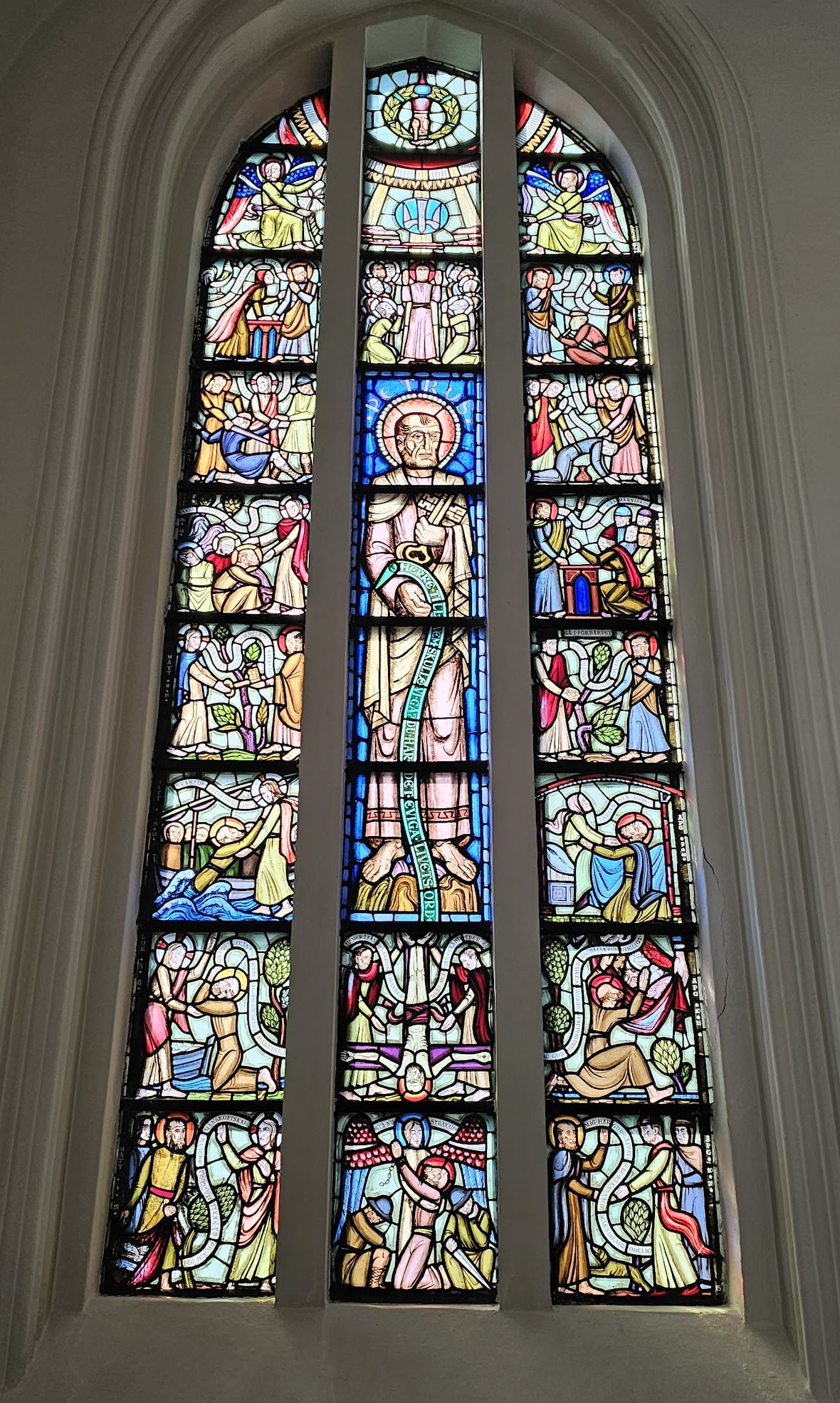
Saint Anne’s Chapel is one of the three surviving late-medieval side chapels. It was rebuilt in 1964 and contains modern stained-glass windows. A smaller choir organ built by Paul Ott of Göttingen in 1964 was moved from the chapel into the church in 1977.
Saint Mary’s Chapel
Saint Mary’s Chapel stands on the south side of the church. Its furnishings include a wooden Madonna made in 1995 and inspired by a medieval Madonna in the Historical Museum of Lund University.
Saint George’s Chapel, or the Merchants’ Chapel
Saint George’s Chapel, commonly called the Merchants’ Chapel, lies north of the entrance area. Malmö’s cloth merchants built it, and several city guilds also used it. Their coats of arms remain visible in the chapel.
The chapel preserves richly painted late-medieval murals on its walls and vaulted ceiling. Some paintings may date from the 1460s and others from the early 1510s. An unidentified master or workshop created secular and religious scenes among flowing green vines, including a griffin, a figure also found on Malmö’s coat of arms. The murals are noted for their sophisticated imagery and accomplished technique. Remnants of earlier pre-Reformation murals also survive in the main nave, where they were later uncovered after being covered with whitewash during the Reformation.
Altarpiece, pulpit, and baptismal font
Baroque high altar
The four-storey Baroque high altar was made in 1611. Built from oak, it is approximately 15 metres high and is one of the largest wooden altarpieces in northern Europe. Its superimposed levels depict the Last Supper, Moses, John the Baptist, the Crucifixion, and the Ascension. The uppermost section displays the name Yahweh. Local master carpenters Jacob Kremberg, Statius Otto, Curt Snedker, Öllrich Svarfer, and Henrik Könnicke made the structure with court painter Didrik Moll and local painter Pieter Hartman.
Pulpit
The pulpit was inaugurated in 1599. City-council member Engelbret Fris, also recorded as Engelbrekt Friis, commissioned it from Daniel Thomisen. Made of black limestone and light sandstone, it carries extensive gilding and ornament depicting scenes from the life of Christ. Its form has been compared with the pulpit in Lund Cathedral.
Baptismal font
Daniel Thomisen also made the octagonal baptismal font in 1601, commissioned by city-council member Rasmus Ludvigsen. The font is carved from black limestone. Six sides bear biblical scenes, while the other sides carry the donor’s monogram and an inscription commemorating the gift.
Memorials, library, and windows
The church contains elaborately decorated memorials to deceased Malmö burghers and a small library known as the Dringenbergska liberiet. The library holds approximately forty books dating from 1506 to 1570. The church’s windows are three-light, 23-pane semicircular openings fitted with uncoloured glass, while Saint Anne’s Chapel has modern stained-glass windows.
At the beginning of the chancel niche, a modern ambo and altar table use simple forms with surfaces decorated by offset blue, red, and black rectangles on a gilded ground.
Historic and modern organs
Early and nineteenth-century instruments
An organ with eleven stops was built in the sixteenth century and later enlarged to twenty-one stops. It stood on a gallery in the northern transept beside the altar. Its main action and pedal were sold to Genarp Church in 1799, while its back action went to Drängsered Church. The instrument was later moved from Genarp Church to Malmö Museum in 1937.
Olof Schwan of Stockholm built a thirty-four-stop organ in 1797. Its historic façade survives as the façade of the present organ on the west gallery.
Walcker and Marcussen organs
E. F. Walcker installed a large organ complex in 1913–1914. The main organ occupied the existing 1797 case on the west gallery and had 61 registers, three transmissions, and an effect register. A six-register remote division stood in the south-west corner of the crossing, and a three-register choir division was placed behind the altar. Both could be played through electro-pneumatic action from a fourth manual at the general console.
Marcussen and Søn of Aabenraa built a new main organ in 1951 inside the 1797 case, retaining the Walcker remote and choir divisions. The Marcussen instrument uses mechanical action in manuals I–III and the pedal, electrical action in manual IV, and electrical registration. Later work by Th. Frobenius og Sønner and A. Mårtenssons of Lund fundamentally renovated and electrified the main west-gallery organ. Orgelbau Klais added a 32-foot pedal stop and three chamade stops in the window niches on either side of the main organ. The instrument now has 81 registers across five manuals and the pedal, and its console can also control the altar and echo organs.
Choir organs
Klais built the new choir organ in the northern arch of the crossing, completing it in 2019. A mobile six-manual console in the choir operates it and can also control the main organ and remote divisions. The instrument has eighteen ranks, including traditional organ colours, ranks that produce harmonic partials, and an extensive overtone division. Its specification comprises 109 registers and five effect registers.
The smaller choir organ moved to Saint Peter’s from Saint Anne’s Chapel in 1977. Paul Ott built it in Göttingen in 1964 as a mechanical-action instrument. Its present façade is new and was designed by Eiler Graebe.