Madonna delle Grazie: A Catholic Sanctuary in Piove di Sacco, Italy


Site at a Glance
- Rating
- 4.7
- Popularity
- Low
- Country
- Italy
- Primary era
- Medieval
- External website
- Open
- Eras represented
- Medieval, Early Modern, Modern
- Civilizations
- Italian, Venetian
- Site type
- Religious
- Remains
- Sanctuary
On this page12 sections
History
Madonna delle Grazie is a Catholic sanctuary in Piove di Sacco, Italy, dedicated to the Virgin Mary. Building information classifies it as a fourteenth-century construction, while tradition places the beginning of its construction between 1480 and 1490. The sanctuary was consecrated in 1484 and later became a pilgrimage destination for communities near and far.
The Miracle Tradition and Foundation
The sanctuary’s origin is linked by tradition to a miracle involving two brothers of the Sanguinazzi family. After their father died, the brothers quarrelled over a painting of the Virgin Mary and eventually challenged each other to a duel. According to the story, a baby held by its mother spoke with the voice of the Virgin, ordering the brothers to abandon the fight and take the painting to the church of the Franciscan friars, where it was to remain. The episode was later depicted in a painting preserved inside the sanctuary.
The miracle is traditionally dated between 1470 and 1480. Its reputation spread beyond Piove di Sacco, bringing offerings and alms that helped fund the construction and decoration of the church, including an altar dedicated to the Virgin. A traditional account places the building work between 1480 and 1490, following approval attributed to Pope Innocent VIII, who led the Catholic Church from 1484 to 1492.
Franciscan Administration
From its foundation, the sanctuary was administered by Franciscan friars who lived there. The Friars Minor, the Franciscan religious order founded in the tradition of Saint Francis of Assisi, were suppressed in Piove di Sacco by a decree of the Venetian Republic dated 1 June 1769. The decree formed part of the religious reforms of Doge Alvise Mocenigo IV.
The sanctuary remained open because of its importance to the local population. For more than three years, a priest administered it together with the School of the Blessed Virgin of the Graces. On 2 September 1772, the Venetian Republic sold the entire complex to Andrea Querini for 4,040 ducats. Querini demolished the convent, retaining only the portion adjoining the sanctuary, and leased the church to the School of the Blessed Virgin.
From Venetian Rule to the Kingdom of Italy
After the fall of the Venetian Republic, Piove di Sacco came under Napoleonic French rule. A decree issued on 25 April 1810 suppressed religious orders and transferred the church lease from the School of the Blessed Virgin to a five-member church-factory board. Such a board managed and maintained a church and its property.
On 5 November 1813, Piove di Sacco entered the Austrian-controlled Kingdom of Lombardy-Venetia. This change of government produced no notable alteration in the sanctuary’s archival record. A civil dispute over unpaid rent arose between the Querini family and the church-factory board in 1840, prompting local devotees to seek ownership of the sanctuary.
Giovanni Molin purchased the sanctuary from Giovanni Querini on 22 March 1842 for 1,800 lire, payable in three instalments. In 1845, he established the Private Society of the Sanctuary of the Blessed Virgin of the Graces at Piove. In 1861, the society resolved to construct a new façade and renew the portico. It retained ownership after Austrian rule ended in 1866 and Veneto was incorporated into the Kingdom of Italy.
Modern Interventions
A major flooring project began in 1904. Venetian terrazzo was laid in both naves at a higher level than the former floor because the low-lying site sometimes flooded. The Private Society gradually ceased meeting and eventually disappeared. Its last surviving member, Giuseppe Silvestri, donated the sanctuary to the Municipality of Piove di Sacco in a letter dated 8 July 1940.
The sanctuary then underwent several important interventions. The Madonna painting was restored in 1942 and 1943, the smaller apse was rebuilt in 1957, and the lower floor level was restored in 1970. The organ was restored in 2022. These works altered or preserved elements of the building while maintaining its religious use and historical character.
The Annual Procession
In 1631, a plague that had already devastated Padua reached Piove di Sacco. The town’s mayor and clergy vowed that the city and its successors would process to the sanctuary every 6 May and offer wax on the altar, asking the Virgin to free the community from the disease. The first procession took place on 6 May 1631.
Tradition holds that sudden deaths began to decline and infected people recovered after the procession. Parish registers record the end of sudden deaths and the recovery of those who had fallen ill. Within days, shops and commerce reopened. The procession has continued as an expression of the town’s devotion.
Remains
Exterior and Façade
The sanctuary combines medieval masonry with later architectural treatments. The apse, side walls, and bell tower are built in terracotta masonry with hanging arches beneath the cornices. The exterior is also characterized by a sober Romanesque appearance, exposed masonry, and strong three-dimensional effects. Romanesque architecture is a medieval style known for robust walls, rounded arches, and restrained decoration.
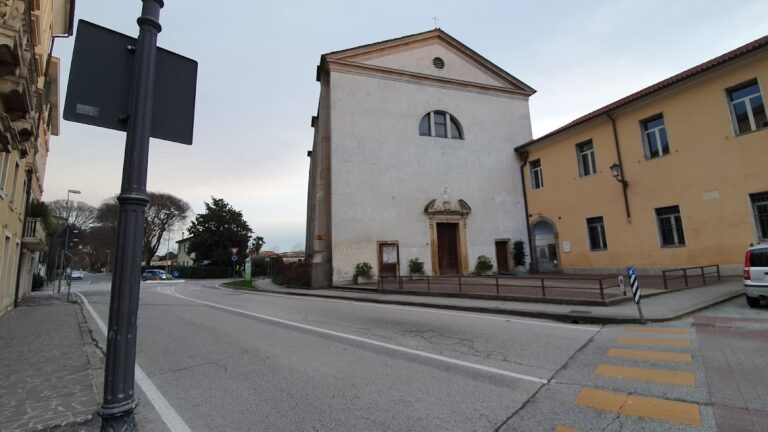
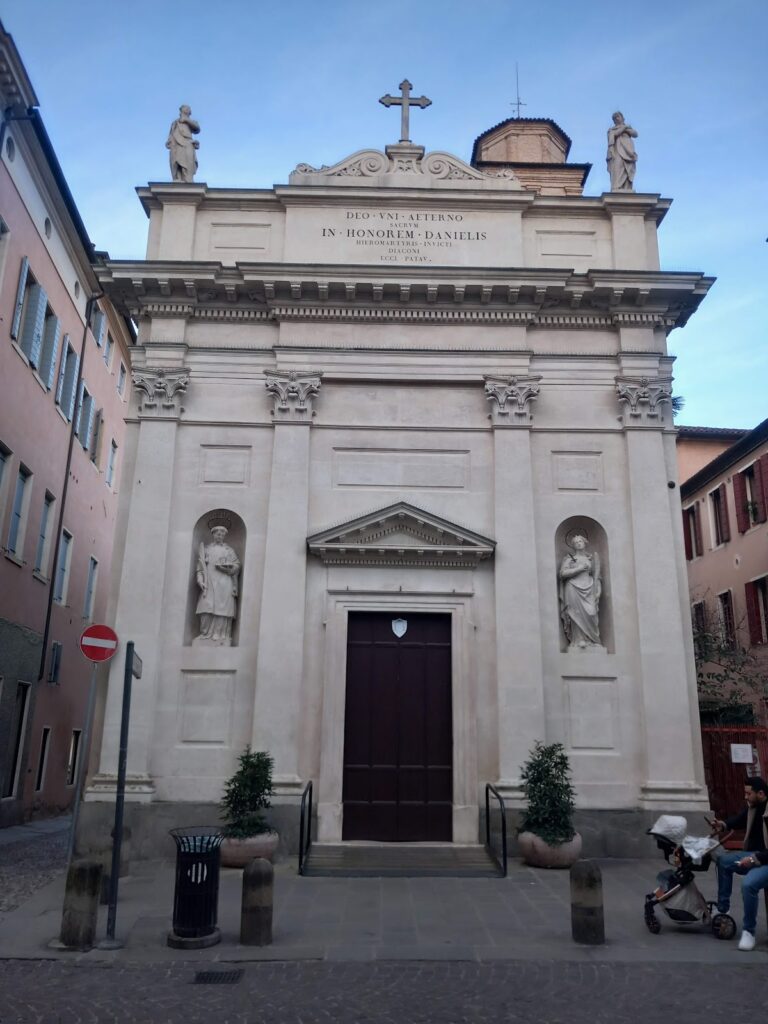
The present façade was constructed in 1861 to a design by Gian Battista Tessari. Its broad proportions, rich friezes, and ornamental treatment deliberately recall the residences of Venetian noble families. This later frontage contrasts strongly with the sanctuary’s medieval exterior. A large fresco of the Immaculate Conception occupies the centre of the façade. Annamaria Trevisan painted it in 2011, replacing a lost work by pupils of the local painter Oreste da Molin. Their earlier painting had faithfully copied Gian Battista Tiepolo’s celebrated Immaculate Conception.
Near the arched bridge stands an eighteenth-century statue of the Immaculate Madonna. In 1906, it was placed on a high pedestal to commemorate a popular mission. The local engineer Francesco Gasparini designed the pedestal.
Naves, Roof, and Frescoes
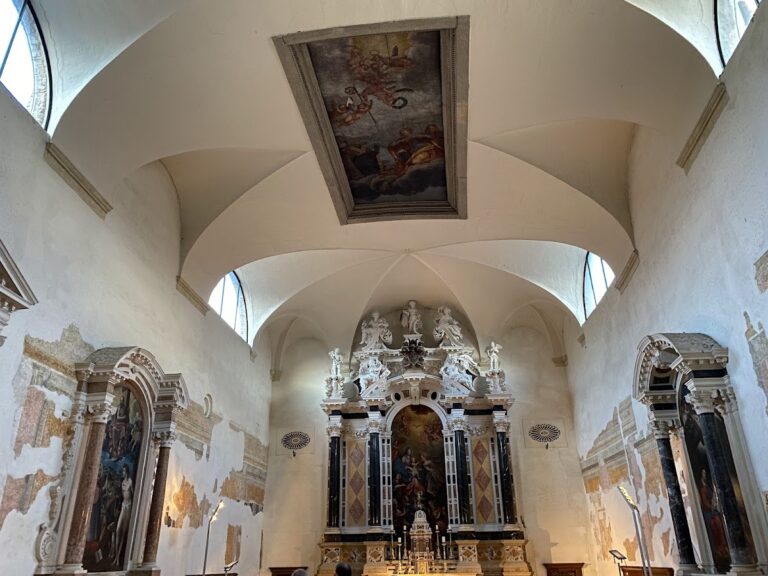
A pastoral report from 1584 described the church of Santa Maria delle Grazie outside the castle of Piove di Sacco as a large building with two vaulted naves and five altars. The present interior retains a broad main nave for solemn liturgical celebrations and a smaller, more intimate side nave. The main nave is covered by a roof supported by robust wooden trusses with decorated tiles, while the smaller nave ends in four light cross-vaults. A cross-vault is formed by the intersection of two barrel vaults.
Work in 1970 excavated the base of the interior and returned the floor to its original level, exposing the lower portions of the columns and their plinths. The pulpit and three altars that had stood against the longitudinal walls until around the middle of the twentieth century were removed during the reorganization, creating more space and depth within the interior.
The restoration of several windows on the south side increased the light inside the church. The illumination revealed thirty-five sixteenth-century frescoed medallions at the height of the roof trusses. They depict busts of saints and blessed figures, most associated with the Franciscan order. The paintings use simple features, light brushwork, and relatively subdued colours.
High Altar and Presbytery
The wooden high altar is a seventeenth-century Baroque work, later than the church’s construction. Its original commission and provenance remain uncertain, since it may have been made for the sanctuary or transferred from another deconsecrated or demolished church. The altar rises almost to the top of the triumphal arch and carries Baroque volutes, friezes, and carved figures of the Eternal Father and angels. Its gilded wood is imposing and relatively rare. The decorated lower section, known as the predella, contains three bas-reliefs showing the sacrifice of Abraham on the left, Moses bringing water from the rock on the right, and a third scene in the centre.
A new marble altar was placed against the wooden altar in 1683. During the reorganization of the presbytery in the 1970s, its tabernacle was moved to the Madonna’s apsidal chapel and its altar table, or mensa, was placed at the centre of the presbytery in accordance with liturgical arrangements associated with the Second Vatican Council. Held from 1962 to 1965, the council encouraged changes that oriented the celebration of Mass more directly toward the congregation.
The rear face of the marble altar, previously unfinished, was covered with fragments recovered from demolished minor altars. Their varied colours form a geometric inlaid surface. The frontal bears the Franciscan emblem of two crossed arms, one bare and one clad in a friar’s habit, above a cross.
Madonna Altar and Bellini Painting
The marble altar of the Madonna occupies the final bay of the smaller nave against the rear wall. It has a finely worked altar table, columns, Corinthian pilasters, and a tall broken-arch pediment. Since 1947, its central section has contained a white Carrara-marble pala made by Amleto Sartori specifically to display the Virgin’s painting closer to the faithful and in a more suitable relationship with it. The flanking angels have a style inspired by Donatello, while the allegory of Peace in the lower section has a freer and more modern character.
The central painting shows the Virgin holding the blessing Child. Noted critics attribute it to the Venetian Renaissance painter Giovanni Bellini and date it to around 1478, during his mature period. Bellini was especially known for religious images and his refined handling of colour, light, and landscape. The attribution is supported by the painting’s close resemblance to Bellini’s signed Madonna with the Blessing Child, also known as the Contarini Madonna, in Venice’s Gallerie dell’Accademia. The two works share a comparable type, dimensions, colours, private-family commission, and period of execution.
Humidity, candle smoke, and later retouching extensively damaged the painting and substantially altered its appearance. The Central Institute for Restoration in Rome carried out a radical restoration in 1942 and 1943 under the direction of Cesare Brandi. The restored image shows the Virgin behind a balcony-like ledge, wearing a blue-green mantle over a ruby-red garment while tenderly holding the blessing Child.
Behind the figures stretches a landscape of open fields, green hills on the right, and a cobalt sky crossed by clouds. Paint loss has affected much of the landscape on the left. The scene may include the Fiumicello stream, which still flows beside the sanctuary. A damaged and neutrally retouched area may once have represented the residence or another symbol associated with the Sanguinazzi family, although that interpretation remains uncertain.
The Madonna altar also contains a silvered-bronze tabernacle with panels by Amleto Sartori. The panels depict scenes associated with the joys and sorrows of Christ and the Virgin.
Organ and Choir Loft
The organ stands in a large choir loft on the counter-façade. The Giacobbi brothers of Bassano del Grappa built it in 1891 for the church of Santa Maria dei Penitenti, locally called the Chiesuola, in Piove di Sacco. It was transferred to Madonna delle Grazie in 1910. After its restoration, the instrument had one 52-note manual, an 18-note pedalboard, fourteen stops, and 631 pipes. Both the manual and pedalboard retain a short first octave, an older keyboard arrangement in which the lowest octave omits some chromatic notes.