Pfarrkirche (St. Burkard): Würzburg’s First Monastery Church


Site at a Glance
- Rating
- 4.8
- Popularity
- Very Low
- Country
- Germany
- Primary era
- Medieval
- External website
- Open
- Eras represented
- Medieval, Early Modern
- Civilizations
- Holy Roman Empire
- Site type
- Religious
- Remains
- Church
On this page19 sections
History
Pfarrkirche, also known as St. Burkard or the Burkarder Church, is a Roman Catholic parish church in Würzburg, Germany, and the city’s first monastery church. Founded in the eighth century, it combines an early medieval monastic origin with Romanesque and Gothic construction. It has served the Mainviertel parish since the Middle Ages and was also connected with the chaplaincy of the military hospital and the Marienberg fortress.
Foundation and early monastery
The institution began as St. Andrew’s Abbey around 750, when Burkard founded the monastery. Burkard was an eighth-century missionary bishop and Würzburg’s first bishop, ordained in 742 by Boniface, the missionary bishop who carried out the ordination. The early monastery was dedicated to Mary, Andrew, and later Magnus. Its holdings included the Marienberg and the Marienkirche, and until about 788 it served as the seat of clergy attached to the cathedral then situated on the Marienberg.
In 983, Bishop Hugo of Würzburg transferred the monastery to the Benedictines, members of the Order of Saint Benedict who followed the Benedictine Rule. He assigned it parishes, land, and dependent villages as an economic foundation. On 14 October 986, Burkard’s remains were brought to the monastery in a solemn procession and reburied there. The institution subsequently took his name, and Bishop Bruno of Würzburg consecrated the rebuilt abbey church.
Romanesque rebuilding and medieval reform
The earlier abbey buildings burned around 1000. After about 1033, Abbot Willemund directed the rebuilding of the church in Romanesque style. The Romanesque section was consecrated in 1042 in the presence of Emperor Henry III and Bishop Bruno.
During the High Middle Ages, the abbey was influenced by the reform ideas of Gorze Abbey from about 1057 and by those of Hirsau Abbey in the twelfth century. It was a proprietary monastery of the Bishops of Würzburg and had no lay advocate. Its convent consisted entirely of nobles, while monastic life increasingly diverged from the Benedictine rule in the later Middle Ages.
From Benedictine abbey to collegiate foundation
In 1464, Pope Pius II converted the abbey church into a collegiate church, an institution served by a chapter of canons rather than monks. The former monks were allowed to remain as canons, and Abbot Johann von Allendorf became the first provost. The foundation became Würzburg’s second noble collegiate foundation after the cathedral chapter. From this period until its dissolution, its provost was always a member of the cathedral chapter.
The institution had functioned as a Benedictine monastery until 1464 and then as a Ritterstift, a collegiate foundation whose canons were drawn from the nobility, until 1803. Johann von Allendorf was both its last abbot and first provost. He also served as chancellor to Prince-Bishop Rudolf von Scherenberg and founded the Hospital of the Fourteen Holy Helpers in 1496.
Construction of the late-Gothic east choir and transept began around 1490, and a late-Gothic high altar was added in 1495. The Peasants’ War of 1525, an uprising by rural communities and others against feudal burdens and authorities, destroyed or damaged much of the church’s artwork, although some works survived.
War, administration, and Baroque-era pastoral work
In the sixteenth century, the foundation’s considerable forest holdings generally provided sufficient income, although debts arose periodically. The conduct of its eighteen canons became a concern, and Bishop Julius Echter von Mespelbrunn temporarily placed St. Burkard under forced administration.
Swedish troops sacked the foundation during the Thirty Years’ War, the seventeenth-century conflict that began within the Holy Roman Empire and spread across much of Europe, and severely damaged the church. The foundation again possessed its own consecrated church from 1667. During the Counter-Reformation, the Catholic Church’s program of renewal in response to the Protestant Reformation, and during the Baroque period, the canons concentrated on pastoral care in seventeen parishes.
Between 1663 and 1667, Bishop Johann Philipp von Schönborn ordered the western choir, western transept, west tower, and two western bays of the nave demolished. The changes made room for new fortifications on the slopes below the Marienberg fortress and for a shipping canal. The eastern choir and transept, whose construction had repeatedly been interrupted by war, were completed during this period.
In 1715, with the support of the territorial lord Johann Philipp von Greiffenclau zu Vollraths, the collegiate foundation decided to move its administrative seat to the Rückermainhof at Karmelitenstrasse 20. Secularization dissolved the foundation on 23 February 1803 and transferred the church and its property to the parish. Adam Friedrich Groß von Trockau was the last provost.
Parish history from the nineteenth century
After massacres of Christians in Syria, Gregor Ata, the Melkite Catholic Archbishop of Homs, visited the Diocese of Würzburg in 1861 to collect alms for devastated Christian communities in his homeland. On 25 May 1861, he celebrated a service at St. Burkard according to the Byzantine rite, the liturgical tradition associated with the Eastern Christian churches of the Byzantine sphere. The Melkite Catholic Church follows this tradition.
From 1890, the Burkardushof at Burkarderstrasse 26 served as the clubhouse of the newly founded Catholic Workers’ Association. In 1930, the parish opened Würzburg’s first parish youth center.
The bombing of Würzburg on 16 March 1945 damaged the church during the Second World War. The roof structure burned and the nave suffered fire damage, while the choir and transept survived. Restoration was completed by 1950. From 2008, the parish formed a pastoral federation with St. Bruno in the Steinbachtal. It later became part of the pastoral federation of Heiligkreuz, St. Elisabeth, and St. Burkard, together with two parishes in the neighboring Zellerau.
A memorial stone in the Romanesque part of the church commemorates Würzburg’s fishermen’s guild, which has existed since 1010. The guild celebrates its existence at St. Burkard each year on Epiphany, 6 January. Another memorial text recalls resistance by individual parish members during the Third Reich, the Nazi regime in Germany from 1933 to 1945.
Remains
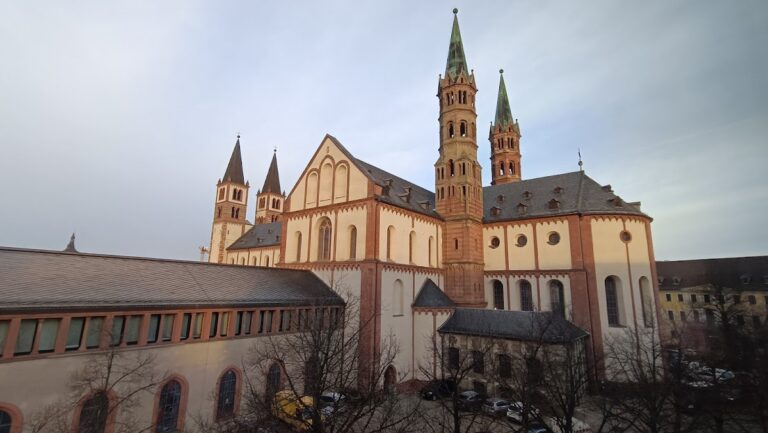
St. Burkard stands on the left bank of the Main at the foot of the Marienberg, below the Marienberg fortress. Its surviving fabric combines a Romanesque three-aisled basilica, a church plan with a higher central nave flanked by side aisles, with later Gothic additions. The Romanesque nave, two eastern towers, and northern portal remain partially extant, while the western end was altered in the seventeenth century.
Romanesque fabric
Nave and eastern towers
The Romanesque section consists of the three-aisled basilica, the two eastern towers, and the northern portal. The towers were raised by two storeys in 1250 and received polygonal upper sections. Their surviving forms belong to the long development of the church from its Romanesque rebuilding after the fire around 1000 through later medieval alterations.
Northern portal
The northern portal porch, an entrance vestibule, was built in 1168 under Abbot Engelhard. A capital with relief decoration, now reused as an offering box, illustrates the transition from Romanesque to Early Gothic design.
Late-Gothic additions and later alteration
Choir and transept
A late-Gothic transept, the cross-arm intersecting the nave, and an enlarged polygonal east choir, the area reserved for clergy and the principal liturgical focus, were added around 1490. To preserve passage along the riverbank road, the additions were supported on arches. Their interiors were completed in the seventeenth century after construction had been interrupted repeatedly by war.
Demolished western end
Between 1663 and 1667, the western tower and two bays of the nave were demolished as part of the physical alteration of the church for the Marienberg fortifications and a shipping canal. The same intervention removed the western choir and western transept while leaving the eastern parts of the church as the principal surviving Gothic additions.
Art and furnishings
Altars and sculpture
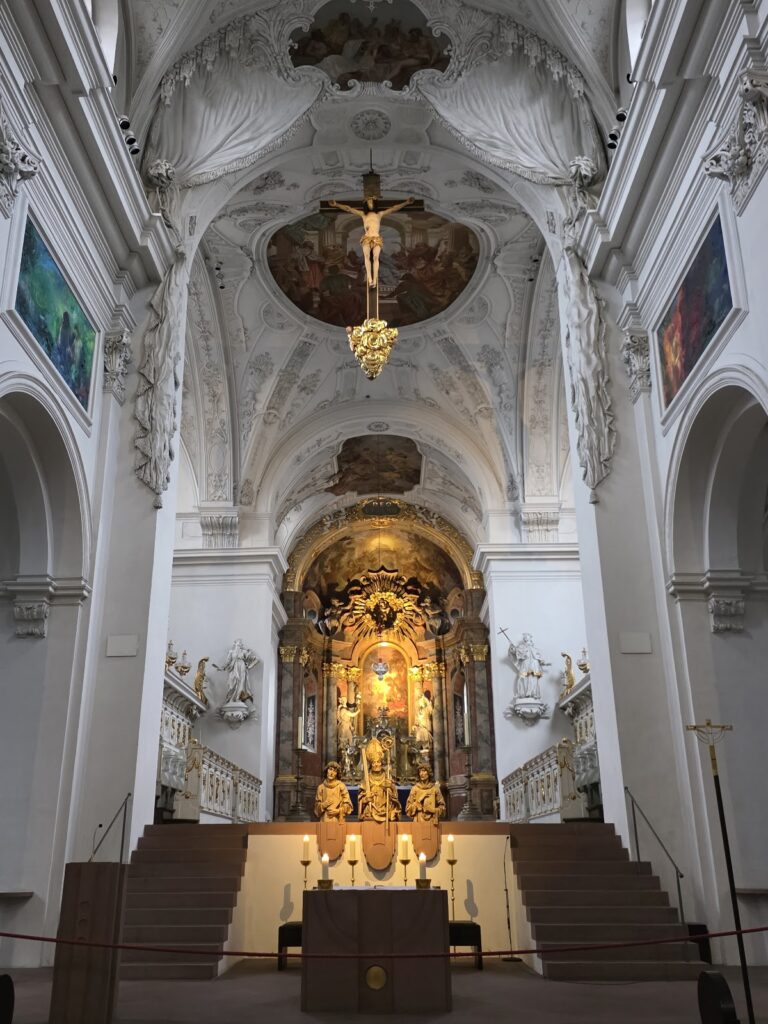
A Madonna attributed to Tilman Riemenschneider is displayed opposite the entrance, illuminated and protected behind glass. Other furnishings include works by Riemenschneider’s circle and pieces from the workshop of Johann Wolfgang von der Auvera. The high altar was made by Franz Wilhelm Driesler of Lohr, with figural elements created by the brothers Heinz and Matthäus Schiestl.
The former parish altar is a winged Marian altar made in 1589–1590. A winged altarpiece has hinged panels that can be opened or closed to show different scenes. Alexander Müller painted the Passion of Christ on the outer, weekday-facing sides of the commissioned altarpiece, while carved scenes from the life of Mary decorate the inner wings and shrine. The altar retains elements of the Gothic tradition.
Memorials
The Romanesque part contains the memorial stone for Würzburg’s fishermen’s guild, founded in 1010. The church also preserves the memorial text commemorating resistance by individual parish members during the Third Reich.
Organs and bells
Organ
A first organ is said to have been built around 1350. Nikolaus Will of Würzburg installed a new organ with ten stops, controllable groups of pipes, on the west gallery in 1683. Johann Philipp Seuffert expanded it to eighteen stops in 1739.
Martin Joseph Schlimbach built a new organ in 1900 with three manuals, or keyboards, and forty stops, while retaining the earlier case. It burned at the end of the Second World War. A replacement Hindelang organ with twelve stops, two manuals, and pedal was installed in 1952.
The present organ was built in 2003 by Richard Rensch of Lauffen am Neckar. It stands on the north wall of the transept in a modern case and has twenty-eight stops, two manuals, and pedal. Its key actions are mechanical and its stop actions electrical. The couplers are II/I, I/P, II/P, a super-octave coupler II/P, and a sub-octave coupler I/I.
Bells
The church has five bells with the striking notes C-sharp, E, F-sharp, A, and B. Together they form a motif associated with Richard Wagner’s Parsifal, with an added note. The Katharinenglocke, cast in 1249, is the oldest bell in Würzburg and the oldest surviving bell in the Diocese of Würzburg.
Nearby sites