Castle of Montearagón: Royal Fortress and Abbey in Spain


Site at a Glance
- Rating
- 4.2
- Popularity
- Low
- Country
- Spain
- Primary era
- Medieval
- External website
- Open
- Eras represented
- Medieval
- Civilizations
- Crown of Aragon
- Site type
- Military
- Remains
- Castle
On this page10 sections
History
Castle of Montearagón is a fortified royal residence, military base, church, and abbey founded by Sancho Ramírez of Aragon near Quicena in Huesca Province, Spain, during the late eleventh-century Christian expansion against the taifa of Zaragoza, an independent Muslim kingdom that controlled Huesca. The king chose the summit of Monte Aragón as a strategic position from which to surround the fortified city, then known as Wasqah or Oscha. The foundation formed part of the early political and dynastic development of the royal house of Aragon.
Foundation and the conquest of Huesca
Sancho Ramírez was encamped on the mountain in May 1085, and construction was underway before May 1086. The works included the fortress, the church of Jesus of Nazareth, and houses inside the walls for the first garrison and members of the royal court. The king had already rebuilt the strongholds of Marcuello, Loarre, and Alquézar, but Montearagón was intended to serve as the principal position for the campaign against Huesca.
The church and abbey complex were completed in early 1089. The community of Canons Regular of Saint Augustine, clerics whose communal life followed the Rule of Saint Augustine, was transferred there from the churches of San Salvador and San Pedro of Loarre. The church was consecrated on 15 May 1090. Sancho Ramírez used the fortress as a residence and held royal courts there until he was killed by an arrow during the siege of Huesca on 4 June 1094. His son Peter I conquered Huesca in 1096 after the Battle of Alcoraz.
A settlement called Montearagón grew beside the fortress to house the king’s troops. It remained a castle village until part of the fifteenth century and later included a Jewish quarter. After the conquest of Huesca, a dispute arose between Bishop Peter of Huesca and Simon, the first abbot, over the city’s principal mosque. The mosque had been promised to Montearagón but was required for the cathedral. Peter I awarded it to the bishop and compensated the abbey with the church of San Pedro el Viejo.
The royal abbey and its possessions
The Abbey of Jesus of Nazareth of Montearagón retained royal patronage and followed the Rule of Saint Augustine. It became one of the most wealthy and influential monasteries in medieval Aragon. Its canons held a seat in the Cortes of Aragon, the kingdom’s representative political assembly, and the community numbered about one hundred monks at one stage.
During the twelfth century, 104 churches and villages were under the abbey’s jurisdiction. Royal gifts included churches, chapels, tithes, first fruits, estates, rights, and other revenues in Aragon and Navarre. The Great Privilege of 1093 confirmed existing possessions and attached churches in 61 villages, including 38 in Aragon and 23 in Navarre. It also granted extensive rights between the Gállego and Alcanadre rivers, covering about 180 places, as well as grazing rights for the abbey’s animals in the king’s mountains.
The same privilege assigned possessions and revenues in Navarre, including the town and castle of Arrada, tithes from the royal saltworks of Grenez and Brece, and tithes from Jewish taxes in Estella and Lizarrarela. The inhabitants of Montearagón could also gather firewood in the king’s woodlands. Pope Urban II confirmed the abbey, its canons, and the king’s existing and future donations. He placed the institution under the direct jurisdiction of Rome while reserving the election of the abbot to the community, subject to royal approval. Pope Paschal II confirmed its churches and rights in a bull of 10 February 1104, and Pope Innocent II later did the same.
Further grants included Ipiés and Almunia de la Reina in 1097, Quicena and the tower of Frumiyena in 1099, and houses at Bolea with fishing and ferry rights in 1101. Conflicts with the bishopric of Huesca over ecclesiastical revenues continued. In 1102, Peter I returned several territories previously granted to the settlement of Montearagón to help establish an agreement between the bishop and Eximino, the second abbot. By 1104, the abbey’s jurisdiction between the Gállego and Alcanadre had been divided with Huesca. Of the more than 180 places formerly associated with Montearagón, 92 remained with the abbey, including 54 village churches, 10 churches belonging to hilltop castles, and 28 churches in isolated rural holdings known as pardinas. The bishop retained the authority to consecrate churches and altars and to ordain clergy.
Medieval religious and seigneurial power
The abbey’s military role declined after Huesca was conquered and the Hispano-Arab wars in the peninsula came to an end. Its monastic function, however, continued for nearly 750 years. Fernando of Aragon, son of Alfonso II of Aragon and Sancha of Castile, became abbot in 1205. He defended the abbey’s rights in disputes with the bishop of Huesca, later became its secular rector, took part in the second noble revolt against James I, and died in 1242.
His tenure was followed by instability, including a vacancy in the abbacy lasting at least nine years. A reform of the community took place in 1257, and an apostolic visitation in 1279 settled conflicts between the abbot and the canons. In August 1391, during the reign of John I of Aragon, the king ended a jurisdictional dispute by selling the abbey civil and criminal jurisdiction over 27 places. The transaction cost 1,000 gold florins and included the right to levy the seven-year monetary payment called the maravedí or monetático.
During the revolt of James II of Urgell in 1413, mercenary troops serving Antón de Luna seized the castle and raised the banners of James II. Ferdinand I of Aragon later recovered it. In 1414 he confirmed the abbey’s earlier privileges, granted it royal patronage and protection, and confirmed an exemption from royal charges and taxes for the inhabitants of Azuza.
Fire, reorganization, and dissolution
A fire on the night of 14 September 1477 damaged the abbey church. The altar, choir, organ, books, ornaments, part of the relics, and the principal altarpiece were destroyed. A new fine-alabaster altarpiece was completed in 1495 and is traditionally attributed to Damián Forment, who later made the altarpiece of Huesca Cathedral. The surviving central image of Jesus of Nazareth was eventually moved from the cloister to a purpose-built chapel beside the stairway leading to the underground church in 1734.
In 1546, Pope Paul III suppressed the priory of Sariñena at the request of Miguel de Soria. Its revenues, valued at 500 gold ducats, were assigned to the church of Sariñena, while its remaining jurisdiction later passed to the bishopric of Huesca. A broader dismemberment of Montearagón followed during the reign of Philip II under a bull of Pope Pius V. The creation of the bishoprics of Jaca and Barbastro led to the redistribution of some of the abbey’s revenues, rights, castles, and churches.
The abbey had no abbot for approximately thirteen years, from 1574 to 1587, and lacked regular canons for about 26 years. Philip II placed it under an administrator, a governor, and six chaplains. Reformed Augustinian canons of the Lateran Congregation then reorganized the institution. Marco Antonio Reves became the first abbot of the restored community in 1587, and three canons arrived from the suppressed monastery of Santa Cristina in 1598. Abbots continued to succeed one another until 1792. In the sixteenth century, the abbey’s revenues were estimated at 30,000 to 40,000 Aragonese ducats, supporting a complex administration of officers, priors, chaplains, and musicians.
The Spanish confiscation of church property in 1835, known as the desamortización, was a state seizure and sale of ecclesiastical property. At Montearagón it ended the monastery after roughly seven centuries. Valuable contents were removed, the complex was sold, and a devastating fire followed. Several works of art were transferred to the Huesca Museum and the Diocesan Museum of Huesca.
Royal burials and modern protection
Montearagón was associated with the burials of several members of the Aragonese royal family. Sancho Ramírez was buried there after his death in 1094, but his remains were transferred to the monastery of San Juan de la Peña in 1095. Alfonso I of Aragon, known as the Battler, was buried at Montearagón after he died at the Battle of Fraga in September 1134. His remains were moved to the church of San Pedro el Viejo in Huesca in 1843, following nineteenth-century confiscation laws and the abandonment of Montearagón.
A third royal burial belonged to the infante Fernando, son of Alfonso II and Sancha of Castile. Fernando had been abbot of Montearagón and died around 1250; a young infanta was buried beside him. The castle was declared a National Monument in 1931 and is protected as a cultural-interest monument. Modern authorities and the Association of Friends of the Castle of Montearagón have pursued the use and rehabilitation of the ruins, with restoration work continuing.
Remains
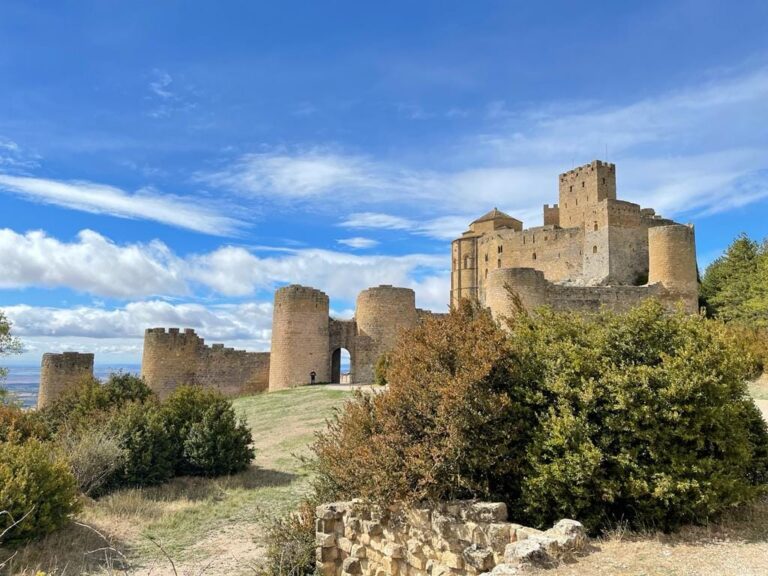
Montearagón occupies the summit of a high, rounded mountain in the municipality of Quicena. Its surviving remains form a fortified architectural ensemble that combined a castle, military housing, a church, and a royal monastery. The ruins include the main keep, an albarrana tower, a defensive tower projecting beyond a fortification and linked to it, and parts of the surrounding enclosure. The castle’s outline remains visible across much of the surrounding region, with views over the Hoya of Huesca, the Sierra de Guara, the rock formations of Salto de Roldán, and the Pyrenees.
Fortifications and internal defenses
The main wall was built from large, carefully cut stone blocks. It was described as about 120 palmos high and 10 to 12 palmos thick, and originally carried ten stone towers. The towers rose about 40 palmos above the wall before later being reduced to the wall’s level. A separate freestanding tower inside the castle served as the church belfry. A second thick wall surrounded the complex as an outer defense and barbican, enclosing the hill and helping to stabilize the fortress. The space between the two walls was wide enough for three people to walk abreast.
Church, cloisters, and residential buildings
Inside the principal enclosure were two internal spaces, each with cisterns, together with cloisters and upper cloisters. The church of Jesus of Nazareth, the abbatial palace, and houses for canons, other resident clergy, and servants stood within these cloistered areas. Military quarters and domestic buildings also accommodated the royal household, the court, the garrison, the monastic community, and their servants. This arrangement preserved the complex’s original combination of royal residence, military base, and religious foundation.
Church furnishings and surviving artworks
The church’s original main altarpiece consisted of painted saints on wooden panels arranged around a central image of Jesus of Nazareth. After the 1477 fire, a replacement made from fine alabaster was completed in 1495 and is traditionally attributed to Damián Forment. The central image was first moved to the cloister and, in 1734, placed in a carved chapel beside the stairway descending to the underground church.
The principal altarpiece by Gil Morlanes the Elder, dated 1506, survived the nineteenth-century fire. It is preserved in museums in Huesca, along with other surviving works of art from the former abbey.
Nearby sites