Churilovo Monastery: A Bulgarian Orthodox Monastery Dedicated to Saint George


Site at a Glance
- Rating
- 4.6
- Popularity
- Very Low
- Country
- Bulgaria
- Primary era
- Modern
- Eras represented
- Modern
- Civilizations
- Bulgarian, Ottoman
- Site type
- Religious
- Remains
- Monastery
On this page6 sections
History
Churilovo Monastery is a Bulgarian Orthodox monastery in Bulgaria, dedicated to Saint George and presumed to have been founded in the fourteenth century before being revived in 1858. It belongs to the Petrich Archpriesthood of the Nevrokop Diocese of the Bulgarian Orthodox Church, also known as the Bulgarian Patriarchate.
Foundation and nineteenth-century revival
An older tradition places the beginning of the monastery’s construction in 1848. A firman, an official decree issued by an Ottoman sultan, authorized the expansion and construction of the Church of Saint George on 5 April 1857. Sultan Abdulmejid, who ruled the Ottoman Empire from 1839 to 1861, issued the decree.
Inscriptions inside the church record its renewal on 10 March 1858 and the construction of its bell tower in 1890. They also preserve the names of church trustees and benefactors, while indicating that an earlier church had stood on the site. The builders and painters are not named, but they are associated with the Debar School, a regional tradition of church building and religious painting linked to craftsmen from the Debar area and the western Balkan lands.
School and community life
The monastery initially housed a cell school, a small religious school operated in or near a monastery or church. It was later reorganized as a New Bulgarian school, a nineteenth-century institution that used Bulgarian rather than Greek as its main language of instruction. The school served the religious needs of inhabitants from twelve hamlets belonging to the former village of Igumenets, and the monastery played an important part in the formation of this settlement cluster. The name of the settlement itself reflects that connection.
Churilovo Monastery was also connected with the revolutionary struggles of the local Bulgarian population. Its property covers approximately 10 decares, or about 10,000 square metres, and includes the church, bell tower, school building, slaughterhouse, courtyards, meadows, and orchards. The monastery remains periodically active without resident monks. Lay worshippers gather there three times a year for the feasts of Saint George, Saint Peter’s Day, and the Nativity of the Virgin Mary. The Church of Saint George is designated a cultural monument of national importance.
Remains
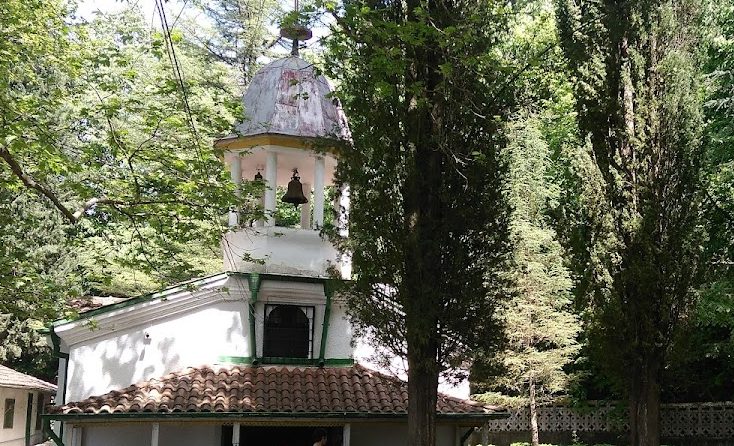
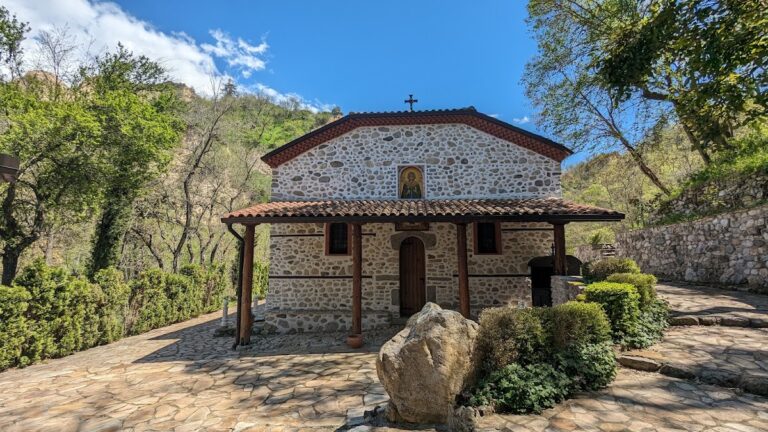
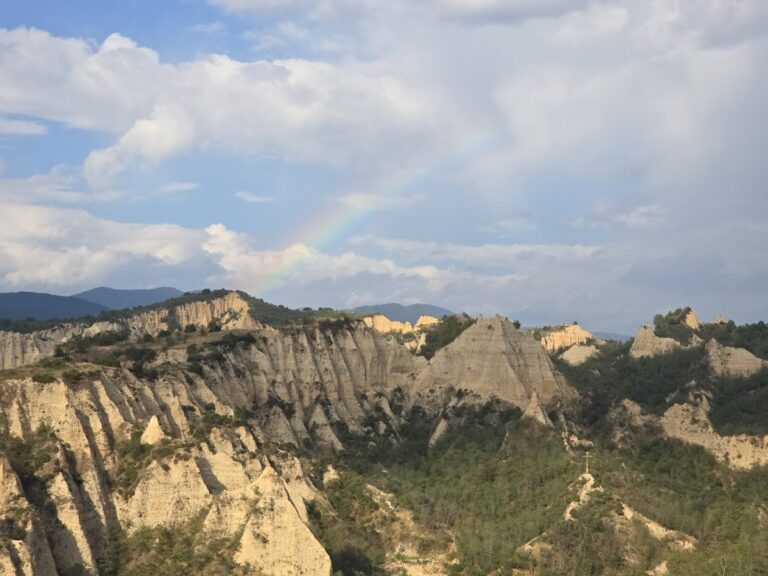
Churilovo Monastery lies on the southern slopes of the Ograzhden Mountains within the territory of Churilovo, about 28 kilometres from Petrich and 2 kilometres from Gega. Its grounds bring together a substantial stone church, a bell tower, the former school, service buildings, open courtyards, meadows, and orchards. The church forms the principal architectural element of this monastery complex.
Church of Saint George
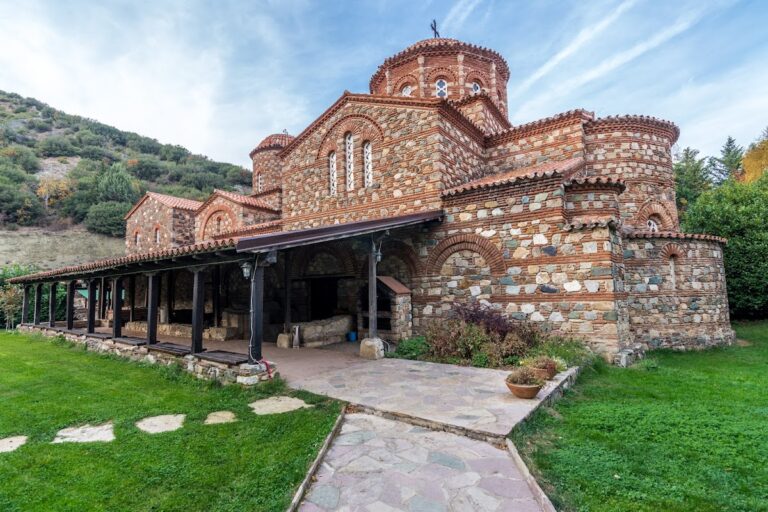
The Church of Saint George is a massive stone three-nave pseudo-basilica, meaning a long church with a central nave and side aisles arranged in basilica-like form without the fully developed structure of a classical basilica. It measures 24 metres in length and 12 metres in width. An open narthex, or entrance hall, extends along the west, while open roofed shelters extend along the north and south sides. Both the building method and the plan resemble those of the Church of Saint Dimitar in the village of Teshovo.
Wall paintings survive in the church, including scenes of the Last Judgment and the Trials of the Soul in the open narthex. The date of these frescoes has not been securely established. The bell tower, constructed in 1890 according to the church inscriptions, stands among the principal elements of the monastery grounds.
School building and grounds
The former cell-school building survives with two classrooms, a refectory, and a kitchen or monastic cookhouse. These rooms preserve the building’s educational and communal functions within the monastery. The wider property also contains a slaughterhouse, courtyards, meadows, and orchards, forming the physical setting of the church and former school.