Dryanovo Monastery: A Bulgarian Orthodox Monastic and Revolutionary Heritage Site


Site at a Glance
- Rating
- 4.7
- Popularity
- Medium
- Country
- Bulgaria
- Primary era
- Modern
- Eras represented
- Early Modern, Modern
- Civilizations
- Bulgarian, Ottoman
- Site type
- Religious
- Remains
- Monastery
On this page14 sections
History
Dryanovo Monastery is an active Bulgarian Orthodox male monastery in Bulgaria, near Dryanovo. Dedicated to Saint Michael the Archangel, it was founded around the turn of the twelfth and thirteenth centuries and is traditionally linked with events of 1206 during the reign of Tsar Kaloyan.
Foundation and medieval development
The monastery’s foundation is associated with the transfer of the relics of Saint Michael the Warrior from Potuka, an unidentified settlement in Thrace, to Tarnovgrad. According to tradition, the procession spent a night beside the Dryanovska River beneath the Gradat fortress. A monastery was then established at this sacred place.
The first monastery stood about 2 kilometres north of the present complex, at a location known as Maly Arhangel. A later foundation was established at Golyam Arhangel, before the monastery was rebuilt at its current site toward the end of the seventeenth century.
During the fourteenth century, Dryanovo Monastery became one of the principal centres of Hesychasm, an Eastern Orthodox contemplative tradition centred on inner prayer and spiritual stillness, in the Bulgarian lands. It also developed into an important centre of Bulgarian education and culture. From the seventeenth century, the monastery maintained a library, whose collection is now preserved by the Library of the National Church Historical and Archaeological Museum in Sofia.
Ottoman period and rebuilding
The monastery was destroyed during Ottoman incursions and the conquest of the Bulgarian lands. It was rebuilt more than once, and a major campaign during the 1840s created the principal church and new residential buildings. The new principal church was completed in 1845.
During Ottoman rule, the monastery helped preserve Bulgarian religious and cultural identity. It sheltered Vasil Levski, a leading revolutionary and organiser of Bulgaria’s national liberation movement, as well as Matey Preobrazhenski, known as Mitkaloto, an Orthodox monk, educator, and revolutionary, and Georgi Izmirliev, another participant in the liberation movement. A revolutionary committee was established at the monastery, which also served as one of the main bases of the Bulgarian Central Revolutionary Committee. Food and weapons were kept there in secret.
The April Uprising
Dryanovo Monastery played a major part in preparations for the April Uprising in the First Tarnovo District. The uprising was the major Bulgarian revolt against Ottoman rule in 1876 and became an important episode in the country’s national liberation movement.
On 29 April 1876, an insurgent detachment led by Father Hariton and Bacho Kiro entered the monastery and used it as a fortress. Father Hariton was a Bulgarian priest and revolutionary, while Bacho Kiro was a teacher, writer, and revolutionary. Ottoman forces surrounded the complex, and the defenders resisted for nine days. The monastery was then captured, burned, and largely destroyed, and most of the insurgents were killed.
The damaged complex was partially restored, and the principal church was solemnly consecrated on 3 April 1877. Further rebuilding after the fire gave the monastery the appearance generally associated with it from 1880. A memorial ossuary was erected in 1897 for the insurgents who died in the fighting. Its project had been prepared by the Italian Giovanni Mosutti in 1890, while the statue was made in Rome by Luca Arditti.
Later heritage
In 1946, Kolyo Karagyozov, an industrialist from Gabrovo, public figure, donor, and German vice-consul, gave 50,000 leva toward a new iconostasis for the principal church. The monastery is designated both a cultural monument and a national historical monument. It is also regarded as one of the ten most revered shrines of the Bulgarian Orthodox Church.
The monastery’s historical setting extends into the surrounding gorge, where prehistoric, Thracian, Roman-era, Byzantine, and medieval activity has shaped the archaeological record. The caves of the Boruna massif and the cavities of the Polichkite rock formation were used by early inhabitants. Nearby Byzantine fortresses at Boruna and Gradat controlled mountain passes and roads, later forming part of the defensive system protecting Tarnovgrad, the medieval Bulgarian capital. They were abandoned in the fifth century and reused in the tenth.
Remains
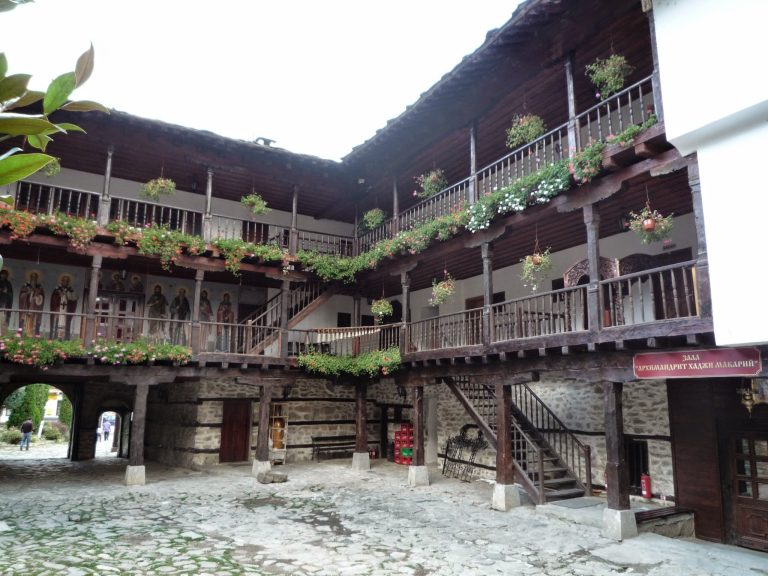
The present monastery occupies the site established during the late seventeenth-century rebuilding, in a mountain gorge near the Dryanovska and Andaka rivers. The nineteenth-century reconstruction created a complex with two churches and five residential wings containing as many as 90 rooms for monks and guests. Many of the later structures serve as accommodation buildings, while the surviving complex also incorporates memorial and museum spaces.
Churches and commemorative structures
Principal monastery church
The principal church is a single-nave building that replaced an earlier church partly set below ground level. It originally had three domes, of which one survives in the altered structure. Deliberately retained holes from Ottoman shrapnel remain in the masonry, preserving physical evidence of the 1876 fighting and the suffering associated with the April Uprising. A chalice pierced by an Ottoman bullet is also associated with the church.
Chapel-ossuary
The former Church of the Dormition of the Mother of God stood within the monastery and had an iconostasis made by the master N. Ionkov. After Bulgaria’s liberation, a chapel-ossuary was built on the site of that church to commemorate the insurgents of Father Hariton and Bacho Kiro’s detachment. An ossuary is a structure used to commemorate or contain human remains, particularly those connected with a major historical or religious event.
Memorial ossuary
The separate 1897 memorial ossuary commemorates those who died in the liberation struggles. Its statue was produced in Rome, forming part of the monument’s design prepared by Giovanni Mosutti.
Bell tower and gate building
A bell tower was added to the principal church during the twentieth century. Near the monastery gate, a long administrative building constructed from wood and stone forms another surviving element of the complex.
Museum collections and archaeological setting
Monastery exhibitions
The monastery functions partly as a museum. Its exhibitions include archaeological finds from nearby Bacho Kiro Cave dating from the Neolithic onward, an Archaeology–Revival exhibition devoted to Dryanovo, the surrounding area, and the monastery, and a small collection of icons in a building beside the church bell tower. The former monastery library is preserved in Sofia, while other archaeological and historical collections remain associated with the monastery.
Bacho Kiro Cave
Bacho Kiro Cave lies in a limestone mountain about 300 metres from the monastery, at an elevation of approximately 355 metres. The karst cave contains Paleolithic human remains, distinctive dripstone formations, and a cultural layer about 5 metres deep. More than 6,000 archaeological finds from the Middle and Upper Paleolithic, dating approximately from 100,000 to 10,000 BC, have been recovered there.