Štědrý hrádek: A Gothic Noble Castle Ruin in Czechia


Site at a Glance
- Rating
- 4.3
- Popularity
- Very Low
- Country
- Czechia
- Primary era
- Medieval
- Eras represented
- Medieval
- Civilizations
- Holy Roman Empire, Kingdom of Bohemia
- Site type
- Military
- Remains
- Castle
On this page12 sections
History
Origins and Noble Ownership
Štědrý hrádek is a Gothic castle ruin in Czechia, probably built around the middle of the fourteenth century as a hereditary noble residence. The Lords of Borek constructed it before 1361 to replace an older noble seat at Štědrá. The castle was first mentioned in 1361, when it was the residence of Vícemil of Borek.
The Lords of Rýzmburk acquired Štědrý hrádek in 1379. Their sons sold it in 1399 to Bušek Calta of Kamenná Hora, continuing the castle’s role within the network of noble estates in the region.
Seizure and Destruction
In 1417, Henry of Plauen seized Štědrý hrádek and used it as a base for military operations against King Wenceslaus IV, the late-fourteenth- and early-fifteenth-century king of Bohemia and King of the Romans. Royal forces besieged the castle in 1418, captured it, and burned it.
The ruined castle was returned to Vilém Bukovina of Pnětluk, its previous owner. King Sigismund of Luxembourg, a ruler of the Luxembourg dynasty who later became king of Bohemia and Holy Roman Emperor, authorized its restoration. It is uncertain whether the rebuilding was completed, although it probably took place.
Later Ownership and Decline
Jakoubek and Jan of Vřesovice bought the castle in 1445. Between 1463 and 1465, Jan disputed ownership with Anežka of Valdek, the widow of Vilém Bukovina. Anežka won the lawsuit, but that same year she and her father, Oldřich of Valdek, sold the entire estate to Jan for 400 score of groschen. A score was a Bohemian counting unit of 60, and groschen were silver coins used in Central Europe.
Jan of Gutštejn became the owner in 1488. The castle was last mentioned in 1506, when Jan of Plauen bought it and attached it to the estate of the neighboring Prohořský hrádek. Štědrý hrádek then lost its importance and became a ruin. Its remains are protected as a cultural monument of the Czech Republic.
Remains
Castle Core and Main Defenses
Rock-cut Ditch and Front Wall
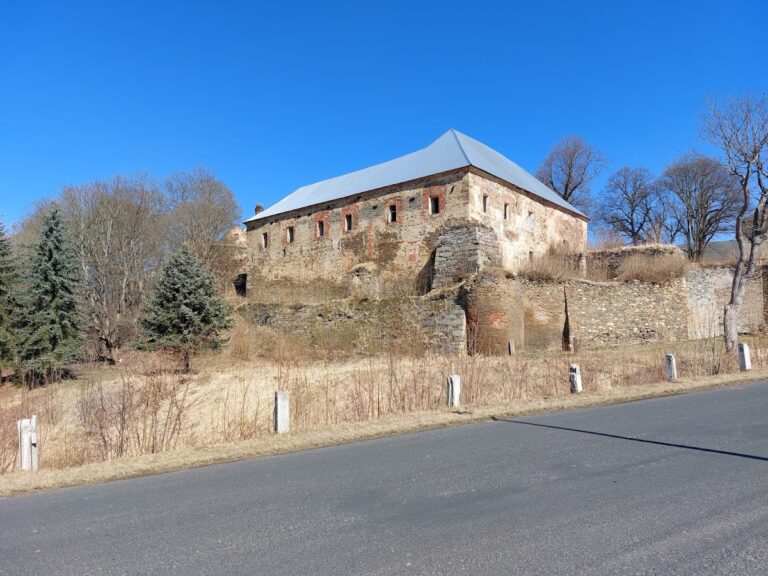
The ruin occupies a steep rocky spur above Mlýnský Pond, about 1 kilometer northwest of Borek in the municipality of Pšov. A substantial ditch cut into the rock separated the castle from the rest of the spur. Above this ditch, a massive front wall about 2 meters thick formed the main protection of the approach and remains the most conspicuous surviving feature.
Rock Outcrop Tower
A large natural rock outcrop served as the castle’s tower. This economical arrangement functionally replaced a bergfried, the principal free-standing defensive tower used for observation, defense, and final refuge rather than as the lord’s main residence. The arrangement makes Štědrý hrádek an unusual variant of a bergfried-type castle and also places it within the category of rock castles. Mortar remains on the summit show that a structure once stood there, although its form is unknown.
Stone Palace
Inside the trapezoidal castle core stood a rectangular, two-room stone palace measuring 15 by 11 meters. Its lower level survives beneath a barrel vault, a continuous curved ceiling formed by extending an arch along a room. The other buildings within the core cannot be established without archaeological investigation and were probably built of wood.
Outer Defenses
Outer Ward
North of the rock outcrop, an outer ward contained a cistern cut into the rock. The reservoir is 6 meters deep and was used to collect and store water. The terrain also preserves the remains of a corner structure.
Advanced Bastion
An advanced bastion, a projecting defensive work, stood on the ridge southeast of the castle core and protected the outer ward. It probably belongs to the castle’s restoration after its destruction in 1418. Another interpretation placed it on the site of a camp used by the besieging forces in 1418, but the orientation of the fortification makes that possibility almost certainly untenable.
Nearby sites