Hrad Brada: A Gothic Castle Ruin in Czechia

Site at a Glance
- Rating
- 4.5
- Popularity
- Very Low
- Country
- Czechia
- Primary era
- Medieval
- Eras represented
- Medieval, Modern
- Civilizations
- Holy Roman Empire, Kingdom of Bohemia
- Site type
- Military
- Remains
- Castle
On this page12 sections
History
Hrad Brada is a Gothic castle ruin in Czechia, founded above the village of Brada in the mid-thirteenth century by Načerat of the Ronovci family. Its first written mention dates to 1258. The Ronovci were among the prominent noble families involved in administering and holding estates in medieval Bohemia.
Royal administration and noble ownership
In 1304, King Wenceslaus II compelled Načerat’s son Léva to exchange Brada for the village of Štítary. The king then administered Brada through Veliš Castle, which the Vartenberg family received as a pledge in 1327. Matěj of Brada served as the castle’s governor in 1383.
At the beginning of the Hussite Wars, fifteenth-century religious and political conflicts in Bohemia associated with the reform movement founded by Jan Hus, Brada belonged to Čeněk of Vartenberg. Because Čeněk died as a Hussite, King Sigismund confiscated Veliš, Brada, and his other possessions in 1426, granting them to Oldřich of Rožmberk. The estate nevertheless remained in the possession of Čeněk’s son Jindřich, who had Mikš of Labouň as burgrave in 1427. A burgrave governed and defended a castle on behalf of its owner or ruler.
On 5 May 1434, Jindřich bequeathed all his property to his aunt, Machna of Veselá. Brada later passed to Hašek of Valdštejn and, before 1452, to Markvart of Údrnice, also known as Markvart of Labouň. Markvart’s successor, Otík Bradský of Labouň, sold the castle shortly after 1482 to Mikuláš Licka of Rýzemburk.
Abandonment and later history
Under Mikuláš Licka, Brada ceased to serve as a lordly residence and began to decay. When Mikuláš Trčka of Lípa purchased it in 1500, the castle was already described as deserted. The Brada estate later merged with the Veliš estate.
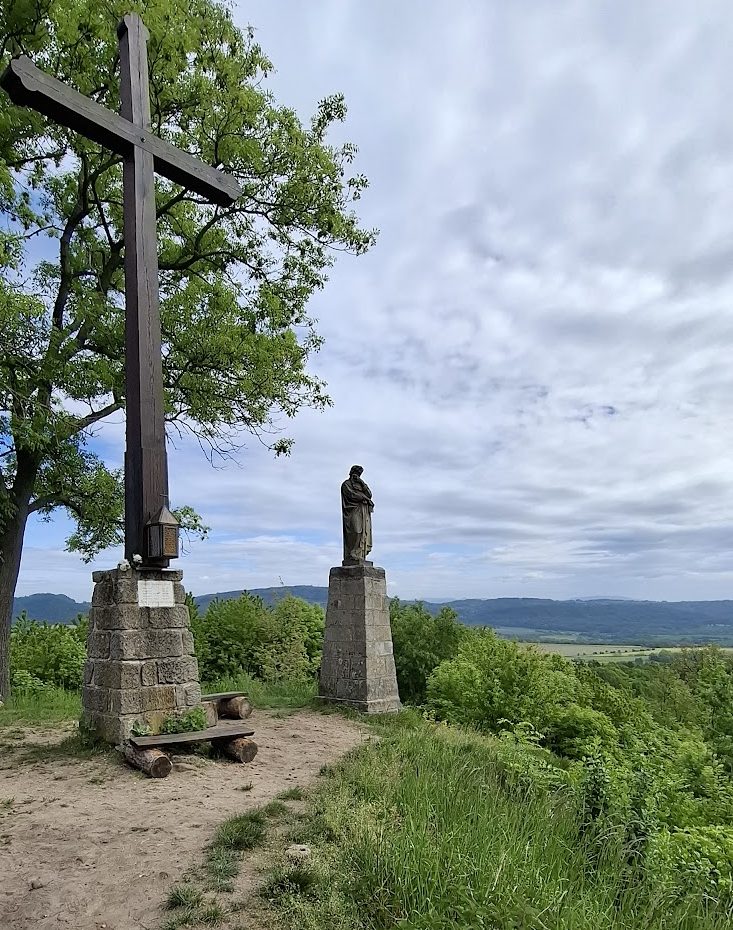
During the Austro-Prussian War of 1866, the Austrian army maintained an artillery position at Brada to defend the approach to Jičín. In 1891, on the initiative of Count Ervín Šlik, an oak cross with statues of Saint Peter and Saint Paul was erected on the summit in memory of the Battle of Jičín. The apostles were regarded as patrons of the battle because it was fought on their feast day, traditionally celebrated on 29 June. Brada has been protected as a cultural monument since 1964.
Remains
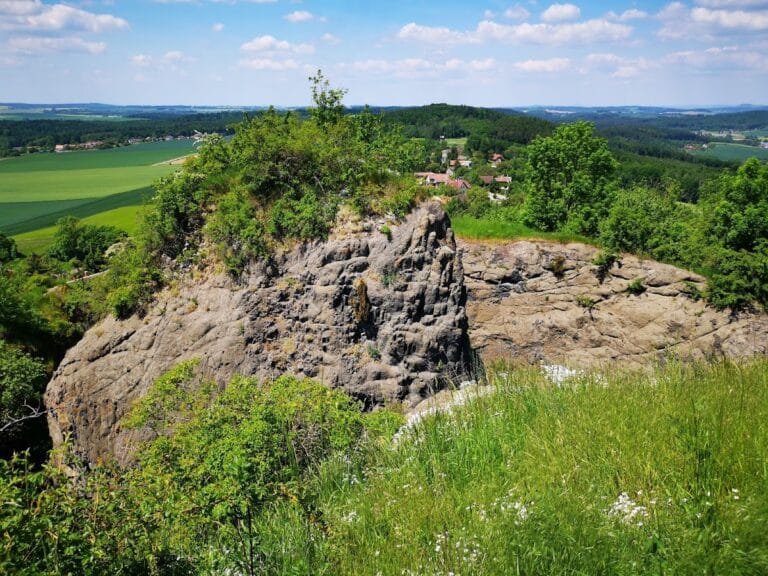
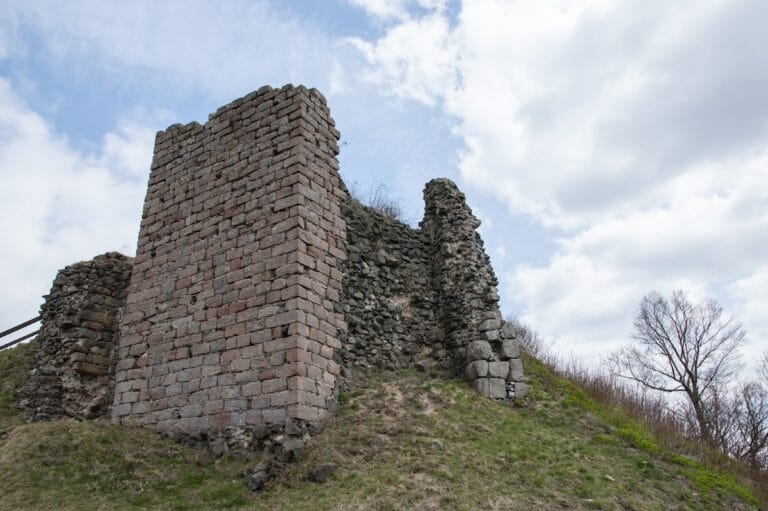
Hrad Brada occupies a hill above Brada village and survives as a damaged Gothic rock castle ruin. A quarry removed much of the castle core, leaving only part of its probable approximately square plan. The remaining structures occupy the summit and lower slope, while defensive earthworks and wall fragments preserve elements of the former fortification system.
Castle fortifications
Castle core
The castle core was the central fortified area of Brada and probably had an approximately square plan. Quarrying severely damaged this part of the site and removed most of its fabric. The surviving section remains on the summit, where the oak memorial cross and statues of Saint Peter and Saint Paul now stand.
Lower building
Below the castle core, the remains of a two-room building are visible in the lower area. Its surviving walls form part of the fragmentary archaeological remains beneath the summit.
Outer defenses
Fragments of the outer defensive wall survive on the eastern side. This wall protected the central castle area and was reinforced by at least two or three semicircular bastions, projecting fortifications used for defense. A ditch runs below the outer wall, with an additional rampart beyond it.
Crosses and bell tower
Summit memorial
The summit carries an oak memorial cross accompanied by statues of Saint Peter and Saint Paul. The ensemble was erected in 1891 in memory of the Battle of Jičín during the Austro-Prussian War of 1866.
Eastern cross
A separate stone cross dedicated to the victims of the 1866 war stands at the eastern foot of the hill. It forms a distinct memorial feature below the surviving castle remains.
Wooden bell tower
Beside the stone cross stands a Baroque wooden bell tower dating from the end of the thirteenth century. It was built together with an Early Gothic church, the earlier phase of the Gothic architectural style.
Nearby sites