Cherchell Roman Ruins: The Ancient Capital of Mauretania Caesariensis
Site at a Glance
- Rating
- 2.9
- Popularity
- Very Low
- Country
- Algeria
- Primary era
- Classical
- Eras represented
- Iron Age, Classical, Medieval
- Civilizations
- Carthaginian, Kingdom of Mauretania, Phoenician, Roman, Vandal Kingdom
- Site type
- City
On this page10 sections
History
The Cherchell Roman Ruins in Algeria are the remains of Caesarea Mauretaniae, an ancient coastal city founded as a Phoenician or Carthaginian trading station during the fifth or fourth century BC. Originally called Iol or Jol, the settlement developed into a Hellenistic-Roman capital under Juba II and later became the Roman provincial capital of Mauretania Caesariensis.
From Iol to the Mauretanian capital
Iol became associated with the Kingdom of Numidia and came under Mauretanian rule after the defeat of Jugurtha around 105–104 BC. Its strategic position led to the construction of new defenses before the Roman period. Around 25 BC, Augustus placed Juba II, a Numidian prince and Roman-aligned client ruler, on the throne of Mauretania. Juba chose Iol as his residence, renamed it Caesarea in honor of Augustus, and rebuilt it on an extensive scale.
Juba II and his wife, Cleopatra Selene II, developed Caesarea as a large Hellenistic-Roman capital and a major center of Hellenism in North Africa. The city received urban infrastructure, public buildings, artistic works, a theater, an art collection, and a lighthouse modeled on the Pharos of Alexandria. It served as the capital of the Mauretanian client kingdom, whose dynasty maintained close loyalty to Rome.
Roman provincial capital
Juba II ruled for nearly 50 years. His son Ptolemy then governed for approximately 15 years, during which Caesarea flourished as a major port. The city exported grain and wild animals for Roman amphitheater spectacles and distributed imported goods into the interior.
Emperor Caligula had Ptolemy murdered in AD 40, an event that led to war with Rome and ended the Mauretanian monarchy. Rome divided the former kingdom in AD 44 into Mauretania Tingitana and Mauretania Caesariensis. Caesarea became the capital of Mauretania Caesariensis, a Roman province in North Africa, and the seat of its provincial procurator-governor.
Under Emperor Claudius, Caesarea received the status of a colonia, a privileged Roman colonial settlement often populated by citizens and veterans, and was also known as Colonia Claudia Caesarea. A settlement of Roman veterans was established there, while the population developed into a mixed Greco-Phoenician, Berber, and Roman community.
Expansion and late-antique disruption
Caesarea expanded under Roman rule, particularly during the first and second centuries AD. Its population exceeded 20,000, and the historian Gsell estimated that it approached 100,000 during the Severan period. It became one of the wealthiest and most important cities of Roman North Africa, with commercial connections throughout the Roman world. Under Septimius Severus, the city received a new forum, while its baths, amphitheater, aqueducts, and other public monuments were enlarged or improved. From the end of the second century AD, it was also the principal base of the Classis Mauretanica, the Roman naval fleet assigned to Mauretania and its surrounding waters.
Berber forces sacked Caesarea during a revolt around AD 371–372. The attack, connected with religious and military conflict involving Firmus and the Donatists, included plundering and burning, but the city later recovered. Vandals reached North Africa in AD 429 and controlled Caesarea and its surrounding region for approximately a century. Vandal forces burned the town and converted some Roman buildings into citadels, although substantial restoration followed during the Vandal period and a Romanized Germanic community developed there.
Byzantine forces recovered Caesarea in AD 533–534 under Emperor Justinian I. The city became the capital of the province of Mauretania Secunda, but later declined. By the eighth century, it no longer possessed the social groups that had supported its earlier urban and political life, including a strong urban middle class, a substantial population of independent farmers, and the earlier military aristocracy.
Christian communities and later memory
Christianity had reached Caesarea by the early second century and spread widely by late antiquity. The city became an important center of both Catholic Christianity and Donatism, a North African Christian schism that disputed the legitimacy of clergy who had compromised during persecution.
Bishop Fortunatus represented Caesarea at the Council of Arles in AD 314. At the Conference of Carthage in AD 411, the city was represented by the Donatist bishop Emeritus and the Catholic bishop Deuterius. Augustine of Hippo publicly confronted Emeritus at Caesarea in the autumn of AD 418. In AD 484, Bishop Apocorius was among the Catholic bishops summoned to Carthage by the Vandal king Huneric and subsequently exiled.
The ancient see of Caesarea in Mauretania remains a titular see used by Catholic and Eastern Orthodox bishops. Caesarea was also the birthplace, around AD 165, of Macrinus, who later became Roman emperor.
Remains
Coastal setting and defenses
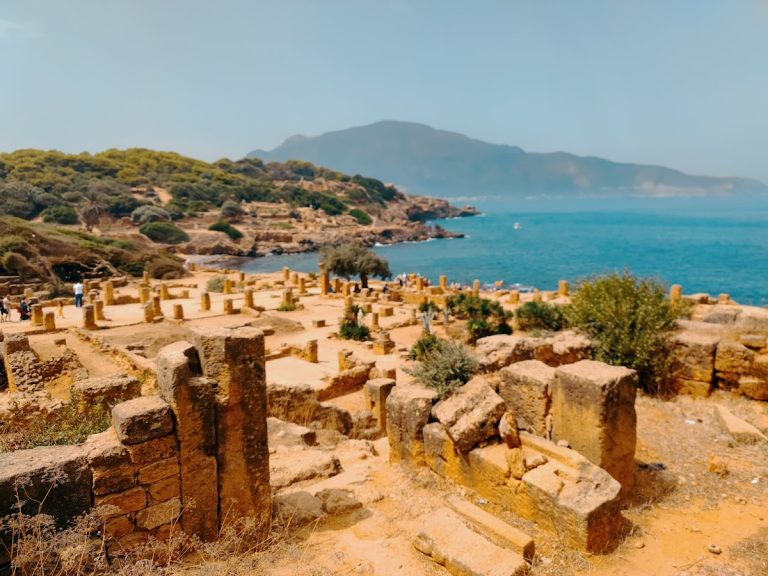
The ancient city occupied a coastal site with a natural harbor and a small offshore island, and its ruins extend beyond modern Cherchell. Juba II’s planned Greco-Roman settlement was arranged on a street grid at the meeting point of a coastal road running west from ancient Icosium and a trade route leading inland toward the south and southeast.
A continuous defensive wall several kilometers long enclosed approximately 370 hectares. On the southern side, the wall incorporated a chain of hills along the edge of a coastal plateau about 400–500 meters wide. The southern rampart stood at an elevation of roughly 200 meters above the city, while sparse remains could also be traced along the seaward side. The scale and Hellenistic character of the defenses reflected the strategic demands of the capital and the political limits placed on Juba II by Augustus.
Water supply and public infrastructure
An aqueduct approximately 45 kilometers long brought water from the interior. Several large cisterns supplied the city throughout the year and served multiple bath complexes. The wider urban infrastructure included a basilica, Roman civic buildings, a forum, and other public monuments that expanded or improved during the Roman period.
Theater, amphitheater, and circus
Public entertainment buildings included a theater, an amphitheater, and a hippodrome or circus. The theater was contemporary with the Theater of Marcellus in Rome and was regarded as one of the oldest theaters in North Africa and one of the earliest Roman theaters in the western Mediterranean. The amphitheater was designed for large spectacles, including animal combats and groups of gladiators. Its unusual form reflected both its early construction date and the aim of accommodating a large audience.
Temples, palace area, and artistic remains
Caesarea contained numerous Greek temples, sanctuaries to the ancient deities, a cult complex dedicated to Cybele, and a sanctuary of Isis. The Isis complex included a Canopus, an Egyptian religious installation associated with Isis and often involving water, crocodiles, and imagery connected with the city of Canopus. The imperial cult and other Roman religious practices were also represented.
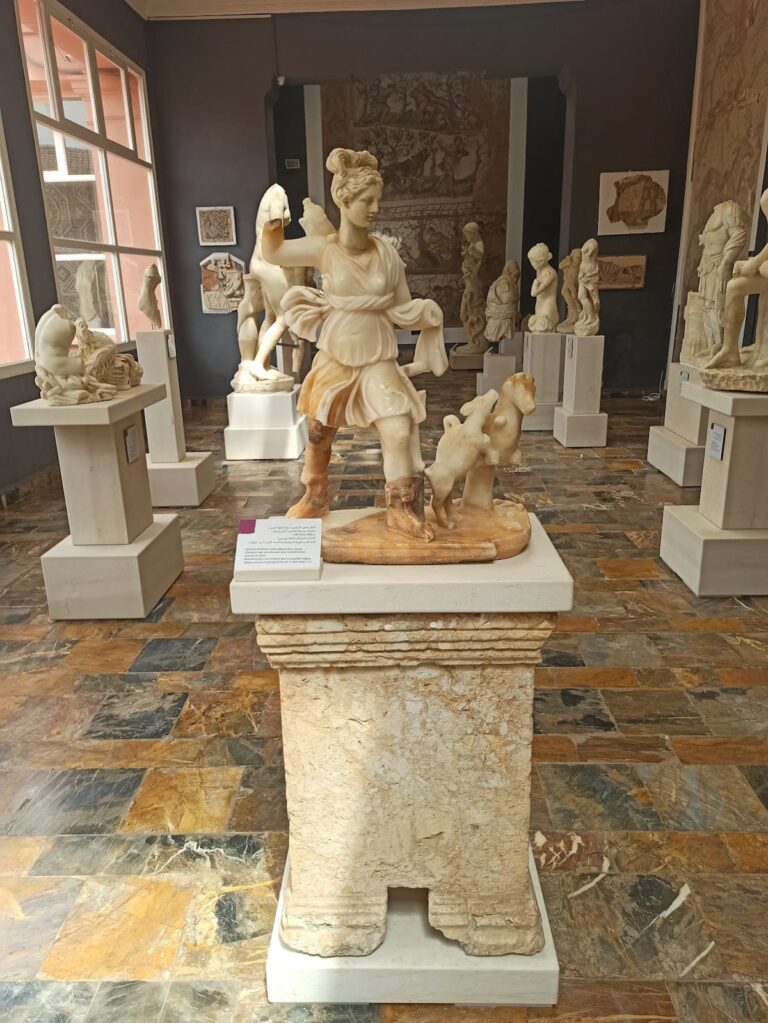
The royal palace stood near the center of modern Cherchell, close to the central square and directly above the harbor. High-quality sculptures and architectural elements indicate its former presence, while mosaics associated with the palace contribute to the evidence for the wealth and cultural aspirations of the ruling elite. Hellenistic statues of exceptional quality, sculptures, and architectural fragments reflect the blending of Egyptian, Greek, and Roman traditions.
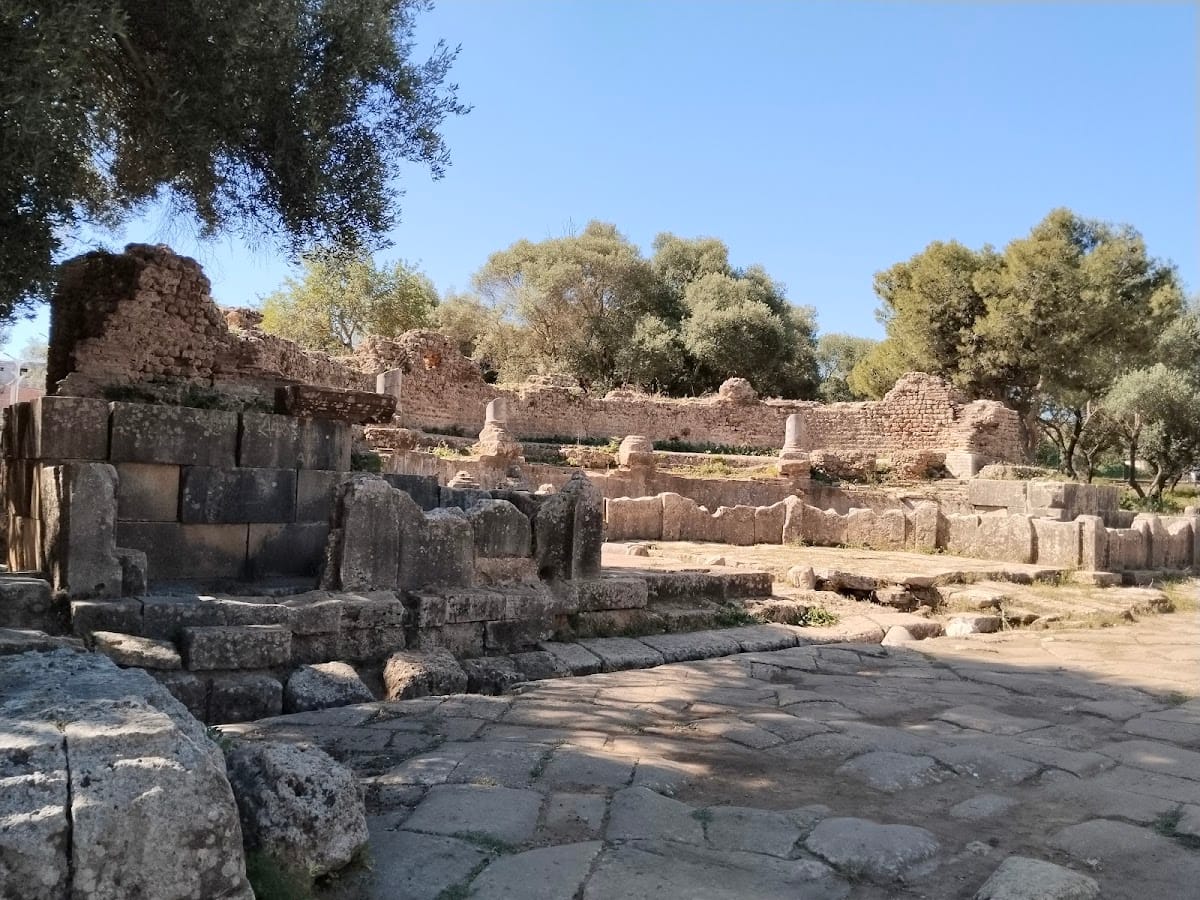
Some temple remains remain visible within the modern urban landscape and from the air. Other structures have been heavily built over, while many lie within an inaccessible military area and are known partly through earlier recordings. The wider archaeological area includes extensive Roman ruins, including temples and other monumental buildings.