Forte de Albarquel: A Seventeenth-Century Coastal Fort in Portugal


Site at a Glance
- Rating
- 4.4
- Popularity
- Low
- Country
- Portugal
- Primary era
- Early Modern
- Eras represented
- Early Modern, Modern
- Civilizations
- Portuguese
- Site type
- Military
- Remains
- Fort
On this page7 sections
History
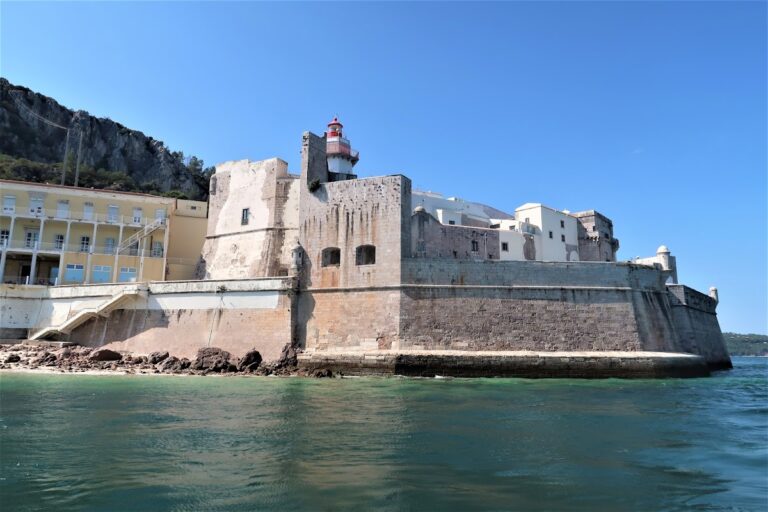
Forte de Albarquel is a seventeenth-century Portuguese coastal fortification at Albarquel Beach in Setúbal, Portugal. Built in a plain Baroque style, it formed part of the defensive line between Albarquel and Sesimbra and helped protect the entrance to the Sado River and the maritime settlement of Setúbal.
Construction under John IV
Construction began in 1643 during the comprehensive reorganization of Portugal’s defenses under King John IV. His accession in 1640 restored Portugal’s independent dynasty after the Iberian Union, and the fort was one element of the kingdom’s renewed coastal defense system. It was intended to reinforce the nearby Forte de São Filipe de Setúbal and was begun alongside Forte de Santiago do Outão.
Owners of the local salt pans and sailors associated with the Casa do Corpo Santo, a sailors’ brotherhood linked to maritime communities, contributed to the building work. Construction was completed during the reign of King Peter II, who ruled Portugal from 1683 to 1706.
Military administration and later defenses
The fort’s governor also held the hereditary office of Chief Guardian of the Salt of Setúbal, an authority connected with oversight of the region’s salt industry. King Philip IV of Spain, who was also Philip III of Portugal, granted the office, and John IV confirmed it for Diogo Botelho de Moraes Sarmento. The office belonged to the Botelho de Moraes Sarmento family. António Manoel Botelho de Moraes Sarmento, its sixth holder, was the last member of the family to govern the fort.
Forte de Albarquel remained in military use from the seventeenth through the nineteenth century and was deactivated in 1883. During the twentieth century, the Ministry of Defence owned the property and incorporated it into the Portuguese Army’s Coast Artillery Regiment as the Eighth Battery. A subterranean fortification was later constructed on the hill behind the fort under the Barron Plan, a twentieth-century defense plan for Lisbon and Setúbal. Approximately 30 men served in the underground installation.
Municipal ownership and cultural reuse
A Council of Ministers notice in 2001 provided for the transfer of the land to the Municipality of Setúbal. By early 2004, the fort had been abandoned and its conversion into a hotel was under consideration. The Portuguese Government transferred it to the municipality free of charge in January 2015, with municipal possession established for 32 years. Renovation began in 2018, and the restored fort opened as a cultural center on July 10, 2021. Its program includes exhibitions, conferences, workshops, and performances, with part of the requalification funded by the foundation of English philanthropist Helen Hamlyn. The fort is included in Portugal’s architectural-heritage inventory.
Remains
Original fortification
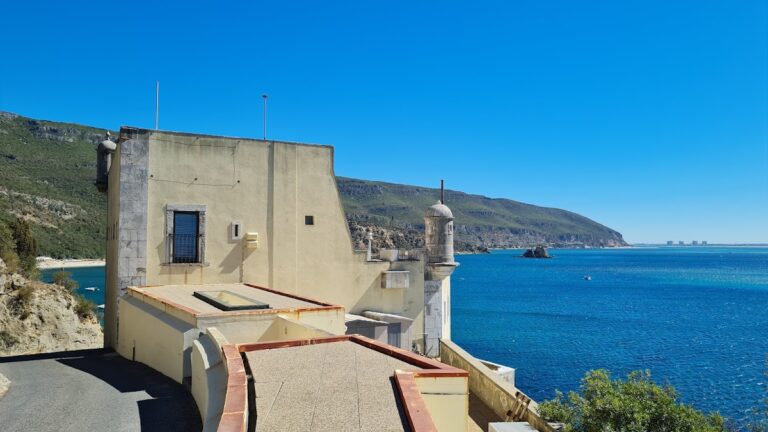
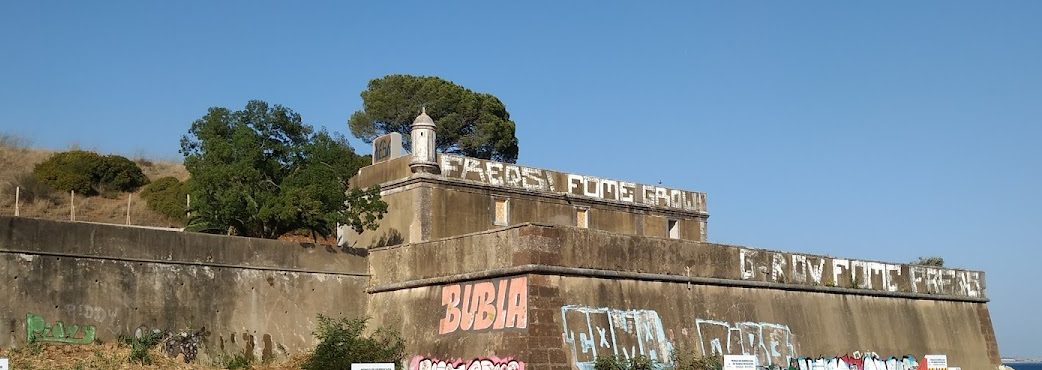
Forte de Albarquel stands on Albarquel Beach on the northern bank of the Sado River’s mouth. Its trapezoidal plan and plain Baroque design organize the fort around a central parade ground, the open area used for military assembly and movement. The gate of arms, the principal military entrance, opens at the northern corner.
A small bastion, a projecting part of a fortification designed to provide flanking fire along adjoining walls, occupies the southeastern corner. A guardhouse stands on the southern side, and both features face the sea. The building containing the service facilities occupies the northeastern side of the parade ground. The fort is in good condition.
Subterranean artillery installation
The later underground fortification on the hill behind the coastal fort contained three 150-millimetre Krupp cannons. Its associated facilities included barracks, a mess hall, magazines, an electrical power station, and warehouses. Together, these elements represent the twentieth-century military use of the hill behind the earlier coastal defense position.
Nearby sites