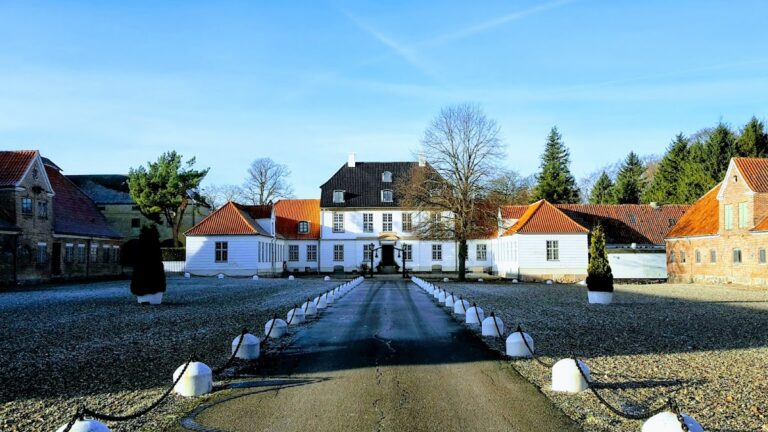
Egholm: A Historic Manor Estate in Denmark
Site at a Glance
- Rating
- 4.7
- Popularity
- Low
- Country
- Denmark
- Primary era
- Modern
- External website
- Open
- Eras represented
- Medieval, Modern
- Civilizations
- Danish
- Site type
- Domestic
- Remains
- Manor House
On this page16 sections
History
Egholm is a historic manor estate in Denmark, near Kirke Hyllinge, whose origins reach back to the thirteenth century. The site includes visible remains of a Romanesque castle, a medieval architectural form associated with heavy masonry and rounded arches, believed to have been built for Jacob Nielsen, Count of Halland and grandson of the Danish king Valdemar II, who ruled from 1202 to 1241.
Medieval ownership
Egholm was first recorded in 1405, when it belonged to Predbjørn Podebusk. The estate then remained within the Podebusk family, passing through Henning Podebusk, Claus Podebusk, Gisele Podebusk, Hans Grubendal, and Jens Due Thott. Jens Due Thott was recorded as its sole owner in 1460. Gisele Podebusk’s two marriages produced no children, and the estate later passed to the brothers Eiler and Niels Mogensen Hak, probably as an endowment from Gisele Podebusk and Jens Due Thott, although their relationship to the brothers is unknown.
Eiler acquired Niels’s share in 1484. After Eiler’s death in 1501, Egholm passed to his widow, Anne Nielsdatter, then to their son Christoffer Hak and, in 1539, to their daughter Lene Krafse. Members of the Krafse family held the estate for about a century.
The Rosenkrantz and Skeel estates
Otto Krafse sold Egholm to Holger Rosenkrantz in 1640. Following Holger’s death in 1647, his son Oluf Rosenkrantz expanded the estate by acquiring tenant farms and formed the separate manor of Krabbesholm from part of its land. In 1671, Oluf became a friherre, a noble title, and Egholm received birk status, making it an independent jurisdiction in which the landowner held local judicial authority.
Oluf opposed Denmark’s new absolute monarchy and consequently lost favour at court. He was forced to transfer his estates to his daughters and sons-in-law. Egholm passed first to Mogens Skeel and then to his brother Otte Skeel, who enlarged it with additional land. After Otte’s death, the estate went to his daughter Birgitte Skeel and her husband, Otto Krabbe. As they were childless, they endowed Egholm to Iver Rosenkrantz.
Iver Rosenkrantz died in 1745, and his widow Charlotte Amalie Skeel held Egholm until 1763. Their son Christian Rosenkrantz expanded the estate further and owned several other properties, including Krabbesholm. He arranged for his estates to pass to Niels Rosenkrantz with an obligation to establish a stamhus, or hereditary family trust that kept an estate together through a prescribed succession. Ryegaard, Barritskov, and Trudsholm became the Rosenkrantz family trust, while Egholm and Krabbesholm were sold to Marcus Gøye Rosenkrantz. Between 1804 and 1812, Egholm changed hands among Christian Conrad Sophus Danneskiold-Samsøe, Lars Lassen, Harald Rothe, and Christian Rothe.
The Haffner family trust
Johan Wolfgang Haffner acquired Egholm in 1812 and directed in his will that it should become a Haffner family trust. His son Wolfgang Haffner established the trust in 1831, expanded the forests, sold tenant farms to their tenants, and built a new main building. After Wolfgang’s death in 1887, the trust passed to his daughter Amalie Haffner. In 1902 it went to her sister Ebba Wilhelmine Haffner, the wife of a Swedish count, and later to their son Erik Alfred Wolfgang Haffner Piper.
The Haffner trust was dissolved under the Danish Lensafløsningsloven of 1919, legislation that ended the stamhus system and led to the separation or sale of many formerly entailed estates. Egholm’s main building and park were separated from the home farm, which was sold to its manager. The main building later belonged to Axel Kaufmann and Baroness Henny Caroline Wedell-Neergaard.
Modern estate and museum
Ole Falck, a great-great-grandson of Falck founder Sophus Falck, bought the main building in 1988. He later acquired the former home farm, Egholm Møllegård, Egholm Skovgård, and most of the land that had formerly belonged to the estate. Egholm Museum opened in an estate building in 2012. The main building, gatehouse, barn, stable, and former horse mill were placed on Denmark’s registry of protected buildings and places in 1998.
Remains
Egholm extends across 770 hectares and combines a moated main building with agricultural and wooded areas. The estate includes Egholm Skov, while Egholm Skovgård and Egholm Møllegård lie nearby. The surviving buildings represent several periods, from the medieval castle remains to the nineteenth-century estate structures and the Neoclassical main house.
Main building and medieval remains
Medieval castle
Visible remains of a Romanesque castle survive at Egholm. The castle is believed to have been built for Jacob Nielsen, Count of Halland, during the thirteenth century. Its surviving masonry provides the physical link between the present estate and its medieval origins.
Neoclassical main building
The present main building is a two-storey Neoclassical structure, a style based on the forms and proportions of ancient Greek and Roman architecture. Dated to 1824, it was constructed after Johan Wolfgang Haffner acquired Egholm in 1812. The white-rendered building stands within moats and has a restrained design with a rounded projection facing the garden. Sandstone surrounds frame its windows and doors, and a hipped roof covered with black-glazed tiles completes the structure.
Estate buildings
Gatehouse
The estate gatehouse dates from 1870 and forms part of the protected group of buildings at Egholm.
Barn
The barn was built in 1880. It belongs to the agricultural buildings that accompanied the manor estate and is included in Egholm’s protected historic complex.
Stable and former horse mill
The stable dates from around 1890, while the estate also retains a former horse mill. Some of the estate buildings are now used as an equestrian centre.
Woodland and museum collections
Egholm Skov
Egholm Skov contains two Bronze Age burial mounds. These prehistoric monuments add an earlier archaeological layer to the estate’s medieval and later buildings.
Egholm Museum
The building used for Egholm Museum contains Ole Falck’s extensive collections of firearms and related equipment. The displays cover Danish and German soldiers, the occupation of Denmark during the Second World War, British, Russian, and American troops, the Danish resistance movement, the American Wild West, hunting, poaching, and historic weapons dating from the seventeenth century. Other objects include a stagecoach, a taxidermied bison, and a poacher’s home, alongside hunting weapons, poaching equipment, military objects, and historical arms.
Nearby sites