Fort Revère: A Séré de Rivières Fortification Above Èze, France


Site at a Glance
- Rating
- 4.7
- Popularity
- Low
- Country
- France
- Primary era
- Modern
- Eras represented
- Modern
- Civilizations
- French
- Site type
- Military
- Remains
- Fort
On this page7 sections
History
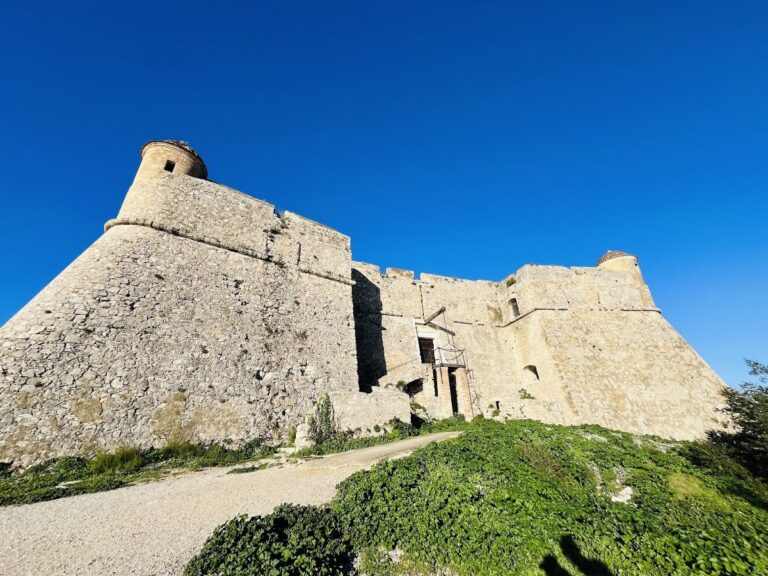
Fort Revère is a French military fortification above Èze in France, built between 1882 and 1885 in the late-nineteenth-century Séré de Rivières system. This network of forts, batteries, and defensive works protected France’s borders and strategic approaches from 1874 until the beginning of the First World War. The fort formed part of the fortified position of Nice and helped control access through the valleys.
Planning and construction
The project first appeared in a 1877 report by Commander Wagner, who led the military engineering service of Nice. Captain Rougier prepared the plans in 1878. The fort was briefly called Fort Anselme, a name it retained until 1886. Its defensive role was connected with Fort de la Drète and the associated batteries of La Calanca, La Forna, and Samboules.
Wartime and military reuse
During the Second World War, the Vichy government, the French administration that governed under German supervision, transferred Allied prisoners to Fort Revère. Most of those detained there were British pilots.
After the war, the fort was decommissioned and closed to the public. The French Air Force later occupied it as a radar station, at least until 1957. It also used the fort as barracks for conscripts completing initial training before assignment to an operational unit or fighter squadron. The Alpes-Maritimes department currently owns the fort.
Remains
Fortification and setting
Fort Revère is a semi-buried fortification standing at 696 metres above sea level in the Grande Corniche forest park, above the village of Èze. It occupies a ridge overlooking the coast from Italy to the Esterel Massif. In clear weather, an orientation table provides views towards Cap Corse, approximately 180 kilometres away.
The fort follows the Séré de Rivières arrangement known as a central massif with low batteries. This design places a raised central core around a lower ring of artillery positions. The perimeter has a trapezoidal plan and is entirely enclosed by a dry ditch. Caponiers, fortified structures projecting into the ditch so defenders could fire along it, protected the ditch and its approaches.
Barracks and artillery batteries
Within the enclosed perimeter, the central area contained the barracks, while peripheral and low batteries surrounded the core. Three associated batteries stood at La Calanca, La Forna, and Samboules. The armament comprised 13 rampart guns, four mortars, and four flanking pieces. The fort had no armoured emplacement, turret, Bourges casemate, or designated observatory.
Underground shelter
An underground shelter, or abri-caverne, was added during the 1891 to 1895 modernization. An abri-caverne was a bomb-resistant shelter excavated into or beneath the ground and protected by reinforced construction. The planned restructuring of 1900 and the supplementary programme of 1908 were not carried out.
Nearby sites