Cyrene: A Greek Colony and Roman City in Libya

Site at a Glance
- Rating
- 4.5
- Popularity
- Medium
- Country
- Libya
- Primary era
- Classical
- External website
- Open
- Eras represented
- Iron Age, Classical
- Civilizations
- Ancient Greek, Ptolemaic, Roman
- Site type
- City
On this page22 sections
History
Cyrene is an ancient Greek colony and later Roman city in Libya, located near present-day Shahhat in the Jebel Akhdar. Founded in 631 BC during the Greek Archaic period, it became the leading city of Cyrenaica, the region named after the Pentapolis, an important group of five Greek cities. Its history extends from Greek settlement and monarchy through Hellenistic and Roman rule to Arab conquest and eventual abandonment.
Greek foundation and the Battiad monarchy
Greek tradition connected Cyrene’s foundation with Apollo, a major god associated with prophecy, healing, music, and the protection of civic communities, and with the legendary huntress Cyrene. Historical traditions recorded by Herodotus and a fourth-century BC inscription state that Cretan Greeks, expelled from Sparta and settled on Thera, founded the city in 631 BC under Battus I after consulting the oracle at Delphi. The settlers may first have lived at Aziris, east of Derna, before moving to Cyrene. The details of this tradition, including Thera’s status as the city’s only mother city, remain uncertain.
Archaeological evidence confirms Greek settlement during the mid-seventh century BC. Pottery from Thera, Sparta, Samos, and Rhodes connects the early community with several Aegean centres. Caves beneath the Acropolis may indicate earlier occupation, while a small Minoan altar and a Minoan seal suggest possible Bronze Age contacts, although those objects may have arrived later.
Cyrene was initially ruled by the Battiads, the dynasty descended from Battus I. During the sixth century BC it became the most powerful city in the region. Its prosperity rested on successive immigration, horse breeding, the export of silphium, and trade linking Egypt, the Aegean, and Carthage. By the fifth century BC, Cyrene had extended political control over other Greek cities in Cyrenaica.
Battus II encouraged further immigration from the Peloponnese and Crete, provoking conflict with the indigenous Libyans. Their king, Adicran, appealed to Egypt, but the expedition sent by Pharaoh Apries was decisively defeated at Irasa around 570 BC. Later, Arcesilaus II, known as “the Cruel,” ruled around 560 to 550 BC. Conflict during his reign led his brothers to establish Barca. Arcesilaus was defeated by Barcans and Libyans at Leuco and killed by his brother. His infant son, Battus III, succeeded him during a period of internal conflict.
Reform, conflict, and the end of the monarchy
During the reign of Battus III, Demonax of Mantinea reformed Cyrene’s laws. The reforms appear to have confined the king’s authority largely to religious affairs, transferred political power to the citizens, and divided the Cyrenaeans into three tribes. Demonax may also have helped make peace with Barca and introduced trial by combat.
Arcesilaus III, the son of Battus III, attempted to reverse these changes. After being exiled, he returned with an army from Samos, regained power, and was expelled again before being killed at Barca. His mother, Pheretime, appealed to Aryandes, the Achaemenid governor of Egypt. The Achaemenids were the Persian imperial dynasty that ruled Egypt and parts of the eastern Mediterranean during the sixth and fifth centuries BC. Aryandes besieged and destroyed Barca in 515 BC, while Herodotus’s account of his subsequent passage through Cyrene leaves open the possibility of Persian conquest of the city.
During the fifth century BC, perhaps as a consequence of Persian intervention, Cyrene’s control over the other Greek cities of Cyrenaica became more institutionalized. The monarchy was later abolished in uncertain circumstances, and the tomb of Battus I was destroyed. Arcesilaus IV nevertheless preserved the city’s royal prestige for a time. He won chariot races at the Pythian Games in 462 BC and the Olympic Games in 460 BC, victories celebrated by Pindar in his Fourth and Fifth Pythian Odes. Afterward, Arcesilaus organized a new wave of Greek settlement at Euesperides.
Cyrene gave refuge in 454 BC to survivors of an Athenian army defeated by the Persians in Egypt. In 414 BC, during the Peloponnesian War, the city supplied two triremes, ancient oared warships with three levels of oars, and skilled pilots to Spartan forces blown into Cyrenaica while travelling toward Sicily.
Political conflict intensified near the end of the fifth century BC. Ariston seized power, executed about 500 leading Cyrenaeans, and exiled others. He may have tried to establish a radical democracy modeled on Athens. In 404 BC, about 3,000 Messenians expelled from Naupactus arrived in Cyrene and joined the exiles. Most were killed in battle, while the survivors settled at Euesperides. Civic conflict continued into the following century.
Fourth-century expansion and Ptolemaic rule
During the fourth century BC, Cyrene contested with Carthage over the Syrtis and the trans-Saharan trade routes that ended there. The frontier was established near the Altars of the Phileni, and Cyrene may have extended its influence eastward to Catabathmus Magnus. The city constructed a treasury at Delphi between 350 and 325 BC. When Alexander the Great conquered Egypt in 331 BC, Cyrene sent an embassy to declare its friendship but did not come under Macedonian control.
Cyrene’s wealth also supported large-scale grain exports. During a famine in the late 320s BC, an inscription states that the city sent more than 800,000 medimni of grain, approximately 40 million litres, to Greek cities and the Macedonian royal family. The city was also the seat of the Cyrenaic School, a Socratic philosophical school founded in the fourth century BC by Aristippus, traditionally described as a pupil of Socrates. The Cyrenaics emphasized pleasure and immediate experience as important elements of ethical thought.
Military intervention repeatedly altered the city’s government. In 324 BC, the Spartan mercenary leader Thibron joined Cyrenaean and Barcan exiles, invaded Cyrenaica, captured Cyrene’s port, and forced the city to accept his rule. His officer Mnasicles defected to the Cyrenaeans, helping them expel Thibron’s forces and recover the port. Thibron returned in 322 BC and defeated an alliance of Cyrenaeans, Libyans, and Carthaginians.
A democratic revolution then led exiled aristocrats to appeal to Ptolemy I Soter, the Macedonian-Greek ruler of Egypt after Alexander’s death. Ptolemy sent his general Ophellas, who occupied Cyrene and imposed a heavily oligarchic constitution. The constitution reserved Ptolemy a permanent role in the city’s administration. Cyrene entered the Ptolemaic realm under the Treaty of Triparadisus in 321 BC. The Ptolemies were the dynasty that ruled Egypt after Alexander and repeatedly controlled Cyrene during the Hellenistic period.
Cyrenaean rebels attempted to expel the Ptolemaic garrison in 313 BC, but reinforcements suppressed the revolt. In 308 BC, Ophellas led Cyrenaean and Athenian troops west to join Agathocles of Syracuse in an attack on Carthage, but he was killed shortly after arriving. Cyrene rebelled again around 305 BC. Control was restored in 300 BC by Magas, Ptolemy’s stepson. Magas later refused to submit to his half-brother Ptolemy II and had become king of Cyrene by 276 BC. He supported Antiochus I during the unsuccessful invasion of Egypt in the First Syrian War.
Inscriptions from Magas’s reign indicate severe food-price inflation and a major fundraising campaign, possibly to repair the city walls. After his death, Apama invited the Macedonian prince Demetrius the Fair to marry her daughter Berenice and take the throne. Demetrius was killed after a brief conflict with Berenice. She married Ptolemy III in 246 BC, returning Cyrene to Ptolemaic control. Euesperides was destroyed and refounded as Berenice, while the cities of Cyrenaica formed the Pentapolis federation and minted their own coinage.
Cyrene was reduced to subject status, received a garrison, and had successive Ptolemaic courtiers appointed to the priesthood of Apollo. In 163 BC, it was re-established as a separate kingdom for Ptolemy VIII after his expulsion from Egypt. The city rebelled and was defeated. Ptolemy VIII may have granted independence to its port, Apollonia, as a reward for its loyalty. He undertook extensive construction in Cyrene, including a monumental gymnasium, an institution for physical training and education.
Ptolemy VIII’s will promised Cyrene to the Roman Republic if he died without heirs, but he regained Egypt in 145 BC. Cyrene later remained under Ptolemy VIII and Ptolemy IX before apparently becoming an independent kingdom for Ptolemy Apion, Ptolemy VIII’s illegitimate son, around 105 to 101 BC. When Apion died without heirs in 96 BC, his territory passed to Rome.
Roman Cyrene and the Christian era
Cyrene was an important Jewish centre during the Hellenistic period. Jason of Cyrene, a Hellenized Jew who lived around 100 BC, wrote a five-volume history that was later abridged in 2 Maccabees. After 96 BC, Rome initially administered the territory lightly. Lucullus visited Cyrene in 87 BC, suppressed a tyranny, and granted the city a new constitution. Rome appointed its first governor, Publius Cornelius Lentulus Marcellinus, in 74 BC.
Between 67 and 30 BC, Cyrenaica formed part of the Roman province of Crete and Cyrenaica, while Cyrene remained the region’s principal city. It enjoyed considerable prosperity and extensive construction during the first century AD. In the mid-first century, Roman authorities surveyed public lands around the city that had passed into private control and had ceased paying revenue to the state treasury.
Cyrene’s large Jewish population also contributed to its role as an early centre of Christianity. Christian tradition identifies Simon of Cyrene as the man who carried Jesus’ cross. Acts refers to Jews from Cyrene in Jerusalem and to Christians from Cyrene and Cyprus who helped spread the gospel at Antioch. Coptic Orthodox tradition identifies Saint Mark as a native of Cyrene who ordained the city’s first bishop.
During the Diaspora Revolt of 115 AD, Cyrene was sacked and almost all its buildings were destroyed. As many as 220,000 people were said to have been killed before the revolt was suppressed by Marcius Turbo. The rebellion severely reduced the population of the region. Restoration began around 118 to 119 and continued until the reign of Commodus, as inscriptions and archaeological evidence show.
Cyrene was an early member of Hadrian’s Panhellenion, an association of Greek cities established by the Roman emperor Hadrian. A long inscription records the city’s efforts to prevent a neighbouring city from joining the association. By the third quarter of the second century AD, Cyrene had again become prosperous. Several palatial residences, including the House of Jason Magnus, were built during this period.
Earthquakes, late Roman rule, and abandonment
Cyrene’s economy began to decline in the mid-third century. An earthquake in 262 destroyed much of the city, after which the Marmaritae, Libyan nomads, raided it. Tenagino Probus, prefect of Egypt, defeated them in 269. Emperor Claudius Gothicus restored Cyrene and renamed it Claudiopolis.
Many buildings were rebuilt after the disaster, but a hastily constructed defensive wall enclosed only the western half of the city. The civic centre moved north from the Street of Battus to Valley Street, and former public spaces were filled with houses and shops. Under Diocletian’s administrative reforms, Cyrene became part of Libya Superior, also called Pentapolis.
A second major earthquake on 21 July 365 severely damaged Cyrene. Ammianus Marcellinus described it as an ancient but deserted city, yet the physical evidence indicates that many buildings were rebuilt and that settlement expanded eastward beyond the fortification wall of Claudius Gothicus. Many temples remained in use until they were closed under the Theodosian decrees of 395.
Cyrene continued to function as a regional centre after the earthquake. Synesius, a wealthy magnate who later became bishop of Ptolemais, grew up there. His surviving Letter 67 describes an irregular episcopal ordination performed by Philo, bishop of Cyrene, with the approval of Athanasius. It also states that Philo’s nephew, who was likewise named Philo, later became bishop of Cyrene. Rufus, a bishop of Cyrene, attended the Robber Council of Ephesus in 449, and a bishop named Leontius remained associated with the city around 580 to 607.
Cyrene fell under Arab rule in 643 and was abandoned sometime afterward, although its ancient name survived in the form “Grennah” into the nineteenth century. The site was completely abandoned in the early modern period.
Rediscovery, excavation, and conservation
Frederick and Richard Beechey produced the first site plans in 1821 and 1822. Later in the nineteenth century, the French consul at Benghazi looted part of a tomb for the Louvre. Robert Murdoch Smith and E. A. Porcher carried out the first systematic excavations in 1860 and 1861. Their finds included the Apollo of Cyrene and a unique bronze head of an African man, most of which were transferred to the British Museum.
Richard Norton began more scientific excavations in 1910, but the work stopped after the Italian invasion of Libya in 1911. The tomb of Herbert de Cou, the excavation epigrapher, remains at the site. The Italian colonial government established a military base at Cyrene in 1913. Soldiers discovered the Venus of Cyrene while building it, and the base was restricted to the Acropolis. The village of Shahhat grew in connection with the Italian presence.
Italian authorities created an antiquities service and undertook large-scale excavations closely associated with colonial propaganda. Italian archaeologists were expelled in 1943 after the Allies captured Cyrenaica. Richard Goodchild, controller of antiquities from 1955 to 1966, moved Shahhat south of the archaeological site. The settlement later expanded over much of the southern necropolis. Goodchild restored excavation control to the Italian mission under Sandro Stucchi, whose team excavated much of Cyrene and restored several buildings through anastylosis, a method that re-erects damaged structures with their original architectural elements wherever possible.
Cyrene was inscribed as a UNESCO World Heritage Site in 1982 under criteria (ii), (iii), and (vi), with a property covering 131.675 hectares. UNESCO placed it on the List of World Heritage in Danger in 2016 because of threats affecting Libya’s heritage. From 2006, conservation work by the Global Heritage Fund, the Second University of Naples, the Libyan Department of Antiquities, and the Libyan Ministry of Culture combined broad conservation with training for local workers. The programme included emergency conservation of the theatre in the Sanctuary of Apollo. The Catholic Church and the Greek Orthodox Church both retain Cyrene as a titular see, a former bishopric preserved as an ecclesiastical title rather than a residential diocese.
Remains
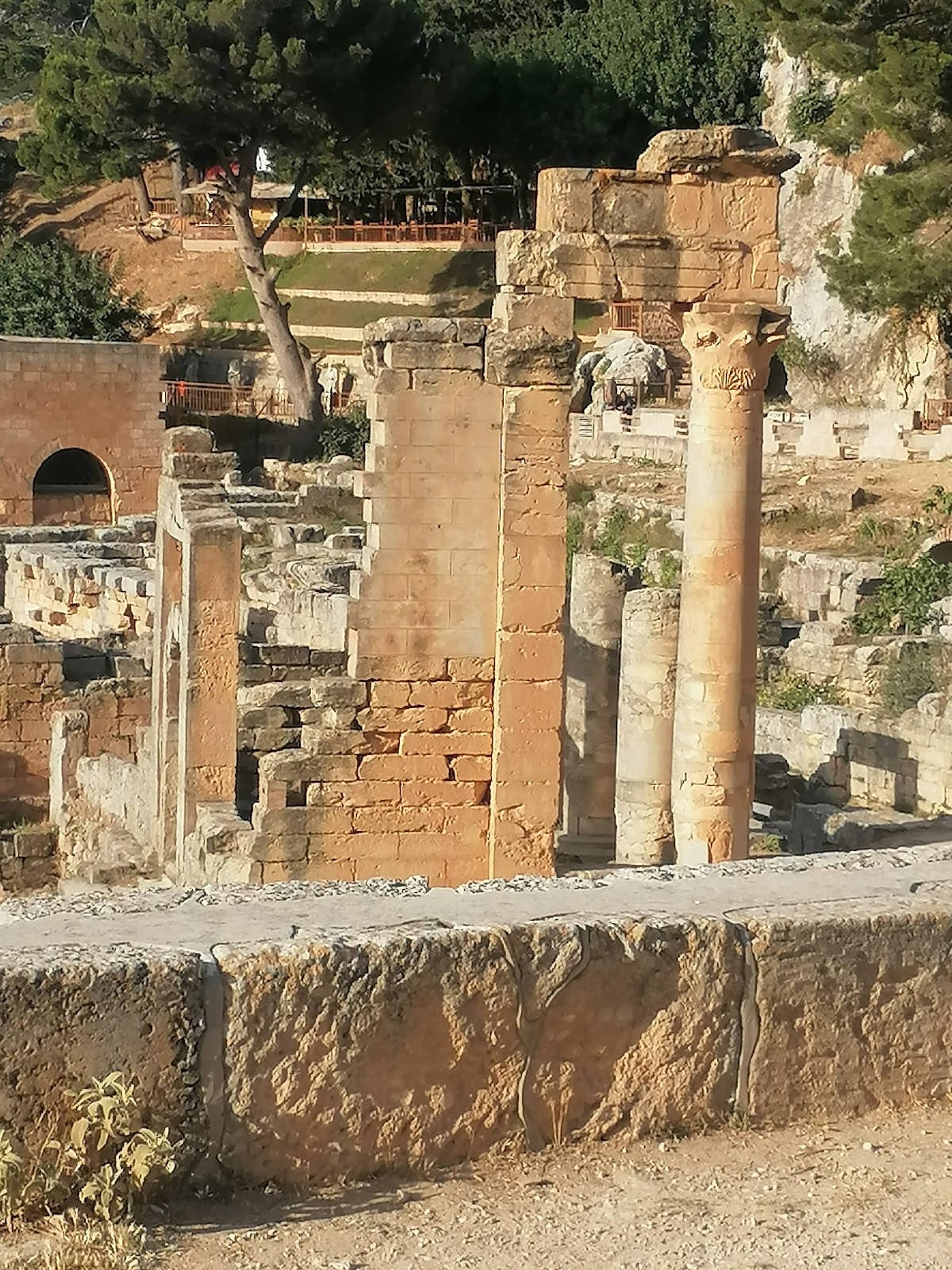
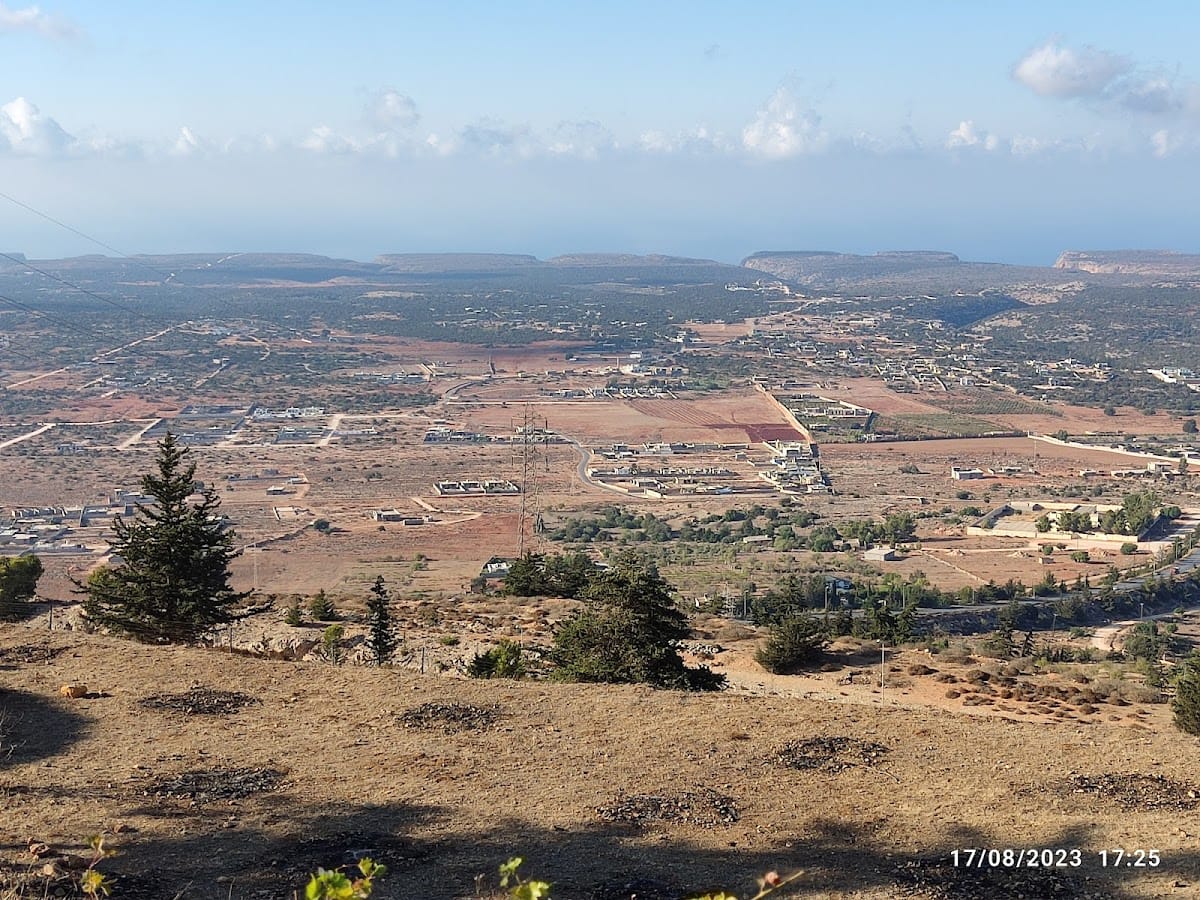
Cyrene occupies a ridge of the Jebel Akhdar at about 600 metres above sea level, north of Shahhat and east of Bayda. Wadi Bil Ghadir forms the southern edge of the ridge and city, while Wadi Bu Turqiyah borders it to the north. The archaeological remains extend across several hectares and include temples, stoas, theatres, bathhouses, churches, palatial residences, and a surrounding necropolis. The ancient port, Apollonia, also known as Marsa Sousa, lies about 16 kilometres to the north.
Acropolis and central streets
Acropolis and Street of Battus
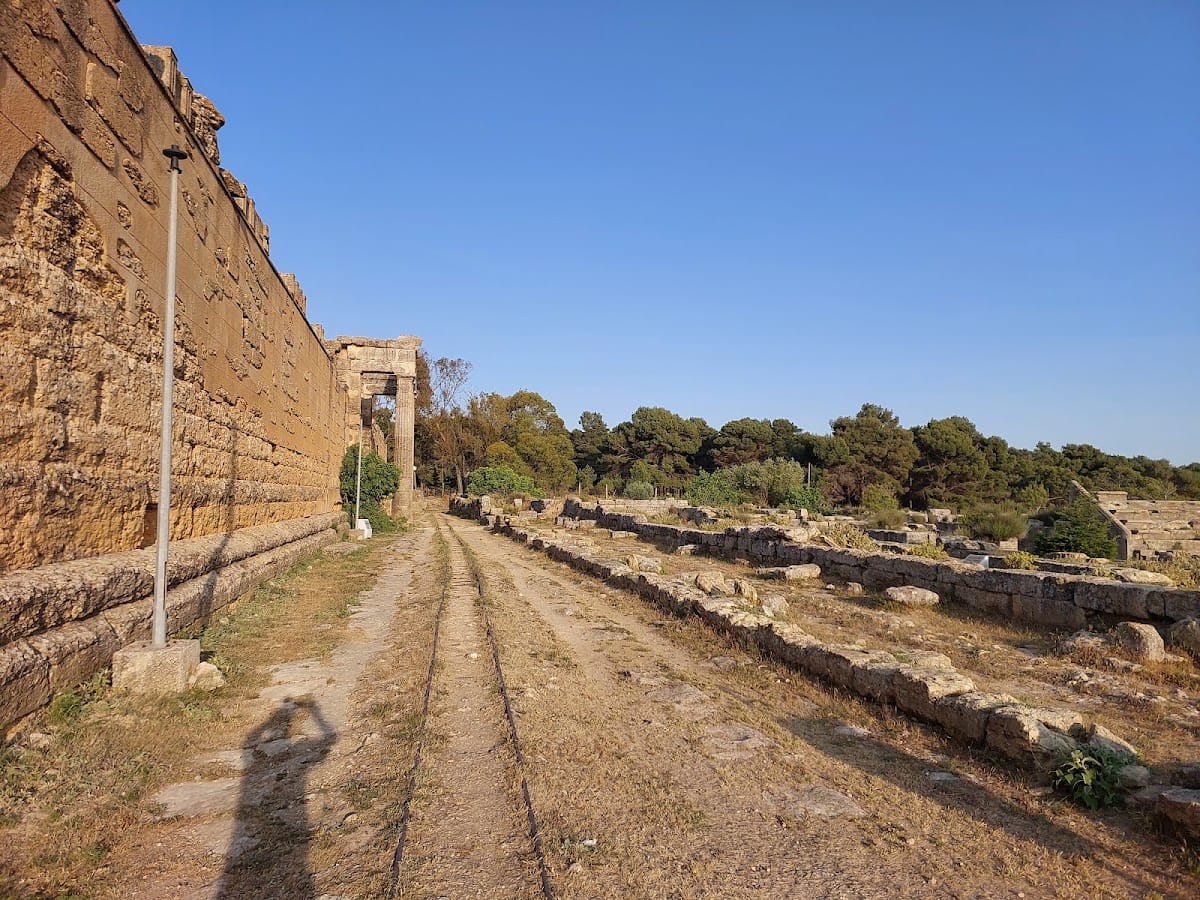
The Acropolis occupies the western edge of the ridge and represents the original centre of Greek occupation. It lies west of the Agora and south of the Sanctuary of Apollo, at the western end of the route called the Street of Battus or Skyrota. The Acropolis contained the Royal Palace and the sacred Fountain of Apollo. Water from the fountain flowed north through the Sanctuary of Apollo.
The Street of Battus runs southeast along the ridge for about 1 kilometre from the Acropolis toward the city gates. Along its course were the Agora, the House of Jason Magnus, other palatial residences, the Stoa of Hermes and Heracles, the Caesareum, two theatres, a sacred area, and the caravanserai. A stoa is a covered colonnade used as an architectural boundary and sheltered public place.
Agora and Caesareum
The Agora occupies the centre of Cyrene. Its principal features include eastern and western stoas and several temples, among them the Temple of Apollo Archegetes. Between the Agora and the Temple of Apollo stood the Caesareum, a complex dedicated to the worship of the Roman emperors. The same area contained the double colonnade known as the Stoa of Hermes and Heracles.
Valley Street and the Central Quarter
Valley Street runs southeast from the Sanctuary of Apollo up Wadi Bu Turqiyah, roughly parallel to the Street of Battus. A stepped portico lined the street, together with the Aqua Augusta. The route passed the Baths of Paris, the Market Theatre, and the Central Quarter.
The Central Quarter lies where Valley Street meets the Street of Battus. It contains substantial public buildings, palatial residences, houses, and other large urban structures. The caravanserai, a large Roman-period building for travellers and merchants, stood on the road leading toward the city gate.
Sanctuaries and theatres
Sanctuary of Apollo
North of the Acropolis, the Springs of Apollo and Cyra emerge from the cliff face onto a triangular plateau at the base of Wadi Bu Turqiyah. The plateau contains the Greek Theatre, the Sanctuary of Apollo, and the Baths of Trajan. The sanctuary includes a temple first built as early as the seventh century BC and a temple of Demeter. Its water system is associated with the nearby springs.
The Sanctuary of Apollo also contains the theatre where emergency conservation work was undertaken. Its position north of the Acropolis and beside the springs connects the religious complex with the earliest Greek occupation of the ridge.
Temple of Zeus
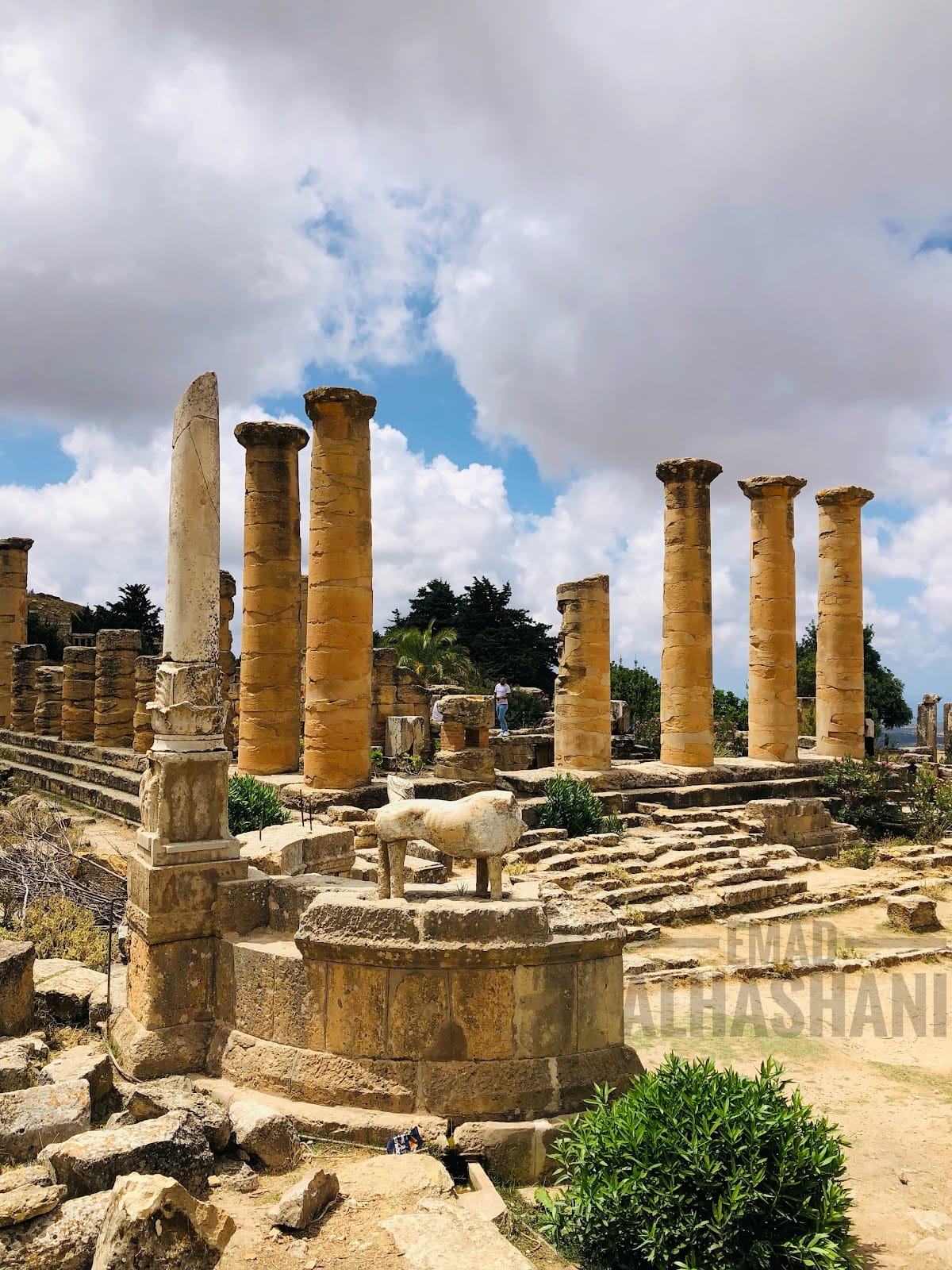
The Temple of Zeus occupied the largely unexcavated northeastern quarter, on another ridge inside the city walls. That quarter also contains the hippodrome and the East Church. The temple was the largest Greek temple at Cyrene and one of the largest Greek temples ever built.
Its original Doric form was constructed around 500 to 480 BC. It was a peripteral temple, meaning that a single outer row of columns surrounded the building, and it was octastyle, with eight columns across each end. The east-facing temple stood on a three-stepped platform measuring 68.3 by 30.4 metres. Its front vestibule had two columns set between projecting side walls, while the rear porch had three columns. The two-storey inner chamber was divided into three aisles by two rows of columns. The surrounding colonnade had eight columns at each end and seventeen along each long side.
The temple was destroyed during the Jewish sack of 115 AD and partly rebuilt around 172 to 175 as a temple without its outer colonnade. A colossal cult statue modeled on the Zeus at Olympia was installed between 185 and 192. The building was destroyed again in the earthquake of 365 and later burned by Christians.
Sanctuary of Demeter and Persephone
The Sanctuary of Demeter and Persephone lies south of Wadi Bil Ghadir and outside the city walls. Demeter and Persephone were Greek goddesses associated with agriculture, fertility, the underworld, and seasonal renewal. The sanctuary includes a temple and theatre complex arranged across Lower, Middle, and Upper Sanctuaries on three terraces. Its remains date from the late seventh century BC to the middle of the third century AD.
Large quantities of votive material came from the sanctuary, including pottery, lamps, coins, stone sculpture, jewellery, inscriptions, glass, and bronze and terracotta figurines. The pottery provides evidence for the foundation of the sanctuary and the character of its religious activities.
Residences and archaeological finds
House of Jason Magnus
The House of Jason Magnus is one of Cyrene’s most luxurious residential buildings. Dating to the second century AD, it contains elaborate statues and mosaic floors. It stood along the Street of Battus among other palatial residences and public buildings.
Roman statues and recovered works
In 2005, archaeologists from the University of Urbino discovered 76 intact Roman statues dating to the second century AD. They had been buried beneath masonry, rubble, and soil after a temple wall collapsed during an earthquake. Protective walls preserved the statues, including fragments of broken works. Archaeological finds are stored and displayed in a temporary museum in the eastern part of the site.
The Venus of Cyrene is a headless marble statue of Venus and a Roman copy of a Greek original. Soldiers discovered it while constructing the Italian military base in 1913. The statue was transferred to Rome and returned to Libya in 2008. The Apollo of Cyrene and a unique bronze head of an African man came from the excavations of Robert Murdoch Smith and E. A. Porcher and were among the finds transferred to the British Museum.
Necropolis and city limits
Burial landscape
The Necropolis of Cyrene extends north and south of the city across about 20 square kilometres, making it one of the largest known Greek necropoleis. A necropolis is a large cemetery or burial area. The cemetery contains graves, rock-cut tombs, temple-tombs, and sarcophagi dating from the sixth century BC to the fifth century AD.
Several Roman-period tombs contain niches for portrait busts of the deceased. Repeated finds include statues of the so-called Goddess of Death, generally faceless female busts shown unveiling themselves. The northern section of the necropolis is better preserved, while the southern area has been encroached upon by the expanding settlement of Shahhat. Especially after 2013, numerous southern tombs were bulldozed.
Later discoveries
In October 2023, flooding exposed a water canal that may date to the Roman period. The discovery adds to the evidence for water management within the ancient city, alongside the springs, fountains, and aqueduct features associated with its public and religious complexes.