The Ancient City of Histria: A Greek Trading Port on Romania’s Black Sea Coast


Site at a Glance
- Rating
- 4.5
- Popularity
- Medium
- Country
- Romania
- Primary era
- Medieval
- Eras represented
- Iron Age, Classical, Medieval
- Civilizations
- Ancient Greek, Byzantine, Roman
- Site type
- City
On this page24 sections
History
The Ancient City of Histria in Romania was founded by Greek settlers from Miletus around 657 or 630 BC during the Archaic period of Greek history. Established beside an ancient open bay near the mouth of the Danube, it became a trading port and is regarded as the oldest urban settlement, and possibly the first planned city, in present-day Romania.
Greek foundation and development
Histria, also called Istros, developed as an independent Greek city-state, or polis, with its own institutions, territory, and civic identity. Its territory extended about 20 kilometres westward. The bay supported trade, fishing, farming, and the production of pottery, metalwork, and glass. As the Danube deposited silt, the bay gradually closed and became part of the Sinoe lagoon system, altering the city’s access to the sea.
The city remained inhabited for roughly 1,200 to 1,300 years, passing through the Archaic, Classical, Hellenistic, Early Roman, Late Roman, and Byzantine periods. It traded with Miletus, Rhodes, Samos, Athens, and inland regions, and became one of the principal economic and cultural centers on the western Black Sea. Its original political system was oligarchic. During the Classical period, tensions between aristocratic founders and residents involved in commerce reportedly contributed to the creation of a democratic regime, a change associated with political developments discussed by Aristotle.
Histria began issuing silver currency around 480 to 475 BC. These coins represent the earliest documented coinage from the territory of present-day Romania, and circulated widely north of the Black Sea. Bronze coins were being produced by at least the 4th century BC.
Archaic and Classical conflicts
New fortifications were built in the 6th century BC, probably in response to Scythian raids. The city was destroyed at the end of that century or at the beginning of the 5th century BC, probably after the campaign of Darius I, the Persian king whose expedition reached the northern Black Sea region. Histria was then rebuilt, with new temples and expanded industrial activity.
During the 5th century BC, the city lay between the Odrysian kingdom, ruled by a major Thracian dynasty, and the Scythian sphere of power. Histria may have been required to join the Delian League, the alliance led by Athens against the Persian Empire, although direct evidence for this remains lacking. The city prospered during the Peloponnesian War, when the Athenian fleet visited Black Sea colonies to collect contributions for the league’s treasury.
At the beginning of the 4th century BC, Scythian attacks damaged or destroyed the city walls. Macedonian intervention subsequently brought the Greek colonies of Dobruja under Macedonian domination, and Lysimachus, one of Alexander the Great’s successors, later occupied the region. Histria suffered further damage near the end of the 4th century BC, possibly during the failed revolt of the Pontic Greeks against Macedonian rule in 313 BC.
Hellenistic wars and Roman conquest
Histria was drawn into conflicts among the Greek cities of the Hellenistic period, the era following Alexander the Great’s conquests. Around 260 BC, it was defeated by Byzantion while allied with Callatis. Around 200 BC, the Getae under Zoltes attacked the city, and it was probably destroyed again around 175 BC by the Bastarnae.
Mithridates VI Eupator, the king of Pontus who challenged Rome and expanded his influence around the Black Sea, established a military garrison at Histria between approximately 175 and 100 BC. The city also minted staters bearing his authority. In 71 BC, Roman forces led by Marcus Terentius Varro Lucullus occupied Histria and Dobruja without leaving permanent garrisons. Around 62 or 61 BC, Bastarnae forces defeated the Roman consul Gaius Antonius Hybrida at the Battle of Histria.
Before 30 BC, Histria was subjugated by Burebista, the ruler who united a large Dacian kingdom north of the lower Danube. In 29 BC, Marcus Licinius Crassus annexed Dobruja, bringing the city under Roman domination. Histria successively belonged to the Roman provinces of Moesia, Moesia Inferior, and, after the reforms of Diocletian, Scythia. The late-antique province of Scythia was a Roman administration of the lower Danube and western Black Sea region.
Roman prosperity and destruction
Roman rule brought renewed prosperity from the 1st to the 3rd centuries AD. Fortifications, public buildings, baths, and temples were constructed or renewed. In AD 100, the governor Manius Laberius Maximus confirmed Histria’s territorial boundaries toward the Danube Delta. The territory included rich fishing grounds, and salted fish provided most of the city’s income at that time.
The Carpi razed Histria in AD 238. The city was rebuilt within stronger walls, but on a much smaller area of approximately 6 to 7 hectares. Goths destroyed the walls again in AD 295, after which they were rebuilt under Diocletian and Constantine I.
Christian center and abandonment
Histria remained an important Christian center during the 4th to 6th centuries. An episcopal basilica and at least five other Christian basilicas show that it had become an episcopal center by the 5th or 6th century. During the 6th century, wealthy houses were built within the reduced city.
Silting continued to restrict the city’s connection with the Black Sea, although trade survived into the 6th century. Invasions by Avars and Slavs during the 7th century made the settlement indefensible and destroyed what remained of it. Histria was then abandoned and was not permanently resettled.
Rediscovery and archaeological work
The ruins were identified in 1868 by the French archaeologist Ernest Desjardins. Vasile Pârvan began systematic excavations in 1914, followed by campaigns led by Scarlat and Marcelle Lambrino, Emil Condurachi, Dionisie Pippidi, Petre Alexandrescu, Alexandru Suceveanu, Alexandru Avram, and Mircea Angelescu. Archaeological excavation and research have continued into the 21st century.
During the first campaign, Pârvan discovered the Horothesia inscription, a text concerning territorial boundaries during the reign of Trajan. The Histria Archaeological Museum was established in 1982 in a new building administered by the Museum of National History and Archaeology of Constanța. It presents Greek, Roman, and Byzantine finds from Histria and its surroundings.
A Romanian archaeological-protection ordinance issued in 2000 placed Histria first among five priority archaeological areas of national interest. The site is also included on Romania’s List of Historic Monuments, with separate entries for the city, the civil settlement, and the tumular and flat necropolises. It was added to the European Heritage List in 2007. The archaeological complex lies within the 400-hectare Istria-Sinoe zone of the Danube Delta Biosphere Reserve, established in 1994 for the area’s archaeological and wildlife value.
Remains
Histria occupied a peninsula or promontory beside the ancient open bay of the Black Sea. The southern bay served as the port, while the acropolis, the elevated fortified or sacred quarter of a Greek city, stood on the highest ground overlooking the sea. Later Danube silt formed the Sinoe lagoon, and parts of the ancient city now lie beneath its waters.
Urban layout and fortifications
The city had two main units: a western civil settlement and an eastern or northeastern sacred area on the acropolis. At its greatest extent, the urban area covered about 80 hectares, although more than half of that area was occupied by water. The civil district alone covered approximately 60 hectares. Paved streets, public buildings, shops, workshops, a gymnasium for physical training and education, and a cultural institution formed part of the urban fabric. Water reached the city through conduits and a Roman aqueduct about 20 kilometres long.
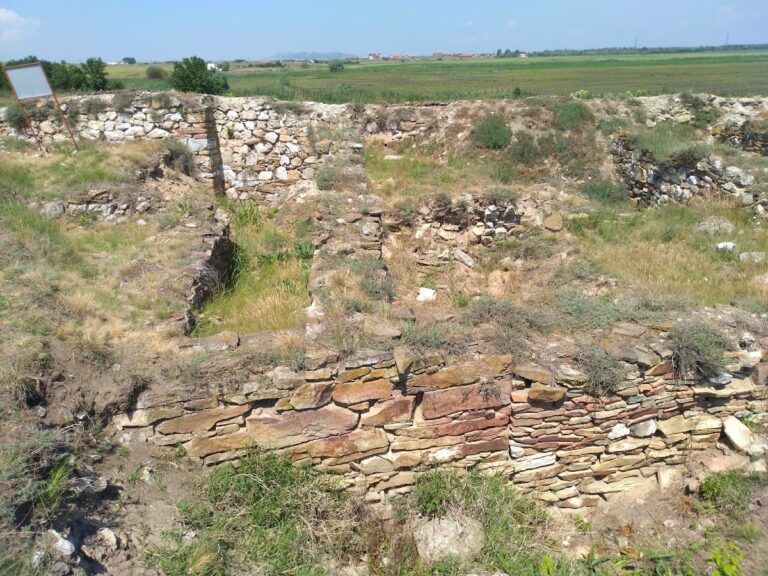
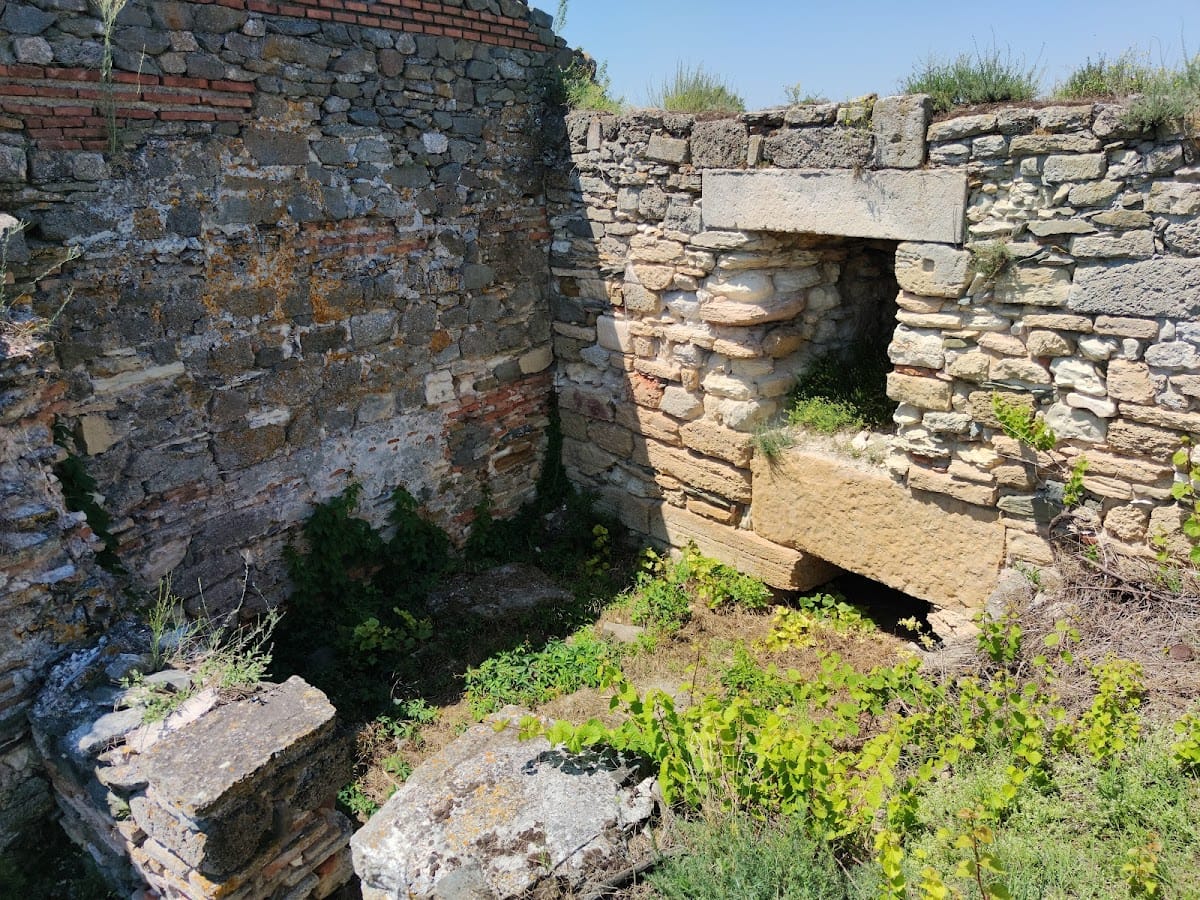
The earliest known fortifications enclosed the civil settlement and were probably built in the 6th century BC. They consisted of double earth walls set on stone foundations and topped by wooden structures. The western defenses included ten towers and two gates. Successive Archaic, Classical, Hellenistic, Roman, and late Roman wall systems followed. Builders reused stone from earlier destroyed buildings in later defenses. The late Roman enclosure survives relatively well on the western and southern sides and surrounded the reduced city of approximately 6 to 7 hectares, incorporating the former Greek acropolis.
Industrial and sacred areas
Industrial quarter
The southwest civil district contained an industrial quarter with numerous ovens and workshops. Ceramic, glass, and metal production took place there from the 6th century BC into the Hellenistic period. These installations formed part of the productive economy that supported the city’s commercial development.
Sacred Area
The Sacred Area on the northeastern acropolis functioned from the middle of the 7th century BC. Its earliest structure was a small temple known as an oikos. The principal cult was that of Apollo Ietros, meaning Apollo the Healer, while Zeus Polieus, a civic form of Zeus regarded as the city’s protector, served as the principal protective deity.
Archaic temples
After the middle of the 6th century BC, four temples were erected. Three were built from yellow limestone and had roofs decorated with polychrome painted terracotta reliefs. They faced south and measured approximately 8 by 16 metres. A fire in the sanctuary during the first half of the 5th century BC destroyed the area. Three temples were rebuilt, while Temple M was abandoned.
Hellenistic sanctuaries
At the beginning of the Hellenistic period, older temples were restored and new Doric structures were added. The area included a temple of Zeus Polieus, first built in the 6th century BC and renewed in the first half of the 5th century BC; a small Doric marble temple of Theos Megas, meaning the Great God, from the 3rd century BC; and a Hellenistic temple of Aphrodite. Altars from the 5th and 4th centuries BC were also found. Literary evidence refers to additional sanctuaries dedicated to Apollo Ietros, Apollo Pholeuterios, and Leto.
The Sacred Area was abandoned in the middle of the 1st century BC and replaced by housing. The expansion of the public area during the Classical period had required a new wall, while a later Hellenistic wall marked the city’s contraction as the port silted up. Architectural fragments from the temple of Theos Megas, including part of its facade, are displayed in the central hall of the Histria Museum. A Greek or Roman theatre is also reported, although its remains have not been located.
Roman baths and civic buildings
Thermae I
Thermae I, a Roman public bathing complex, was built in the 1st century AD and greatly enlarged in the early 2nd century. The building was destroyed in AD 238 and restored during the 4th century, reflecting the repeated rebuilding that shaped the late Roman city.
Thermae II
Thermae II stood outside the acropolis walls. Built at the beginning of the 2nd century AD, it covered approximately 1,000 square metres and remained in use until the middle of the 3rd century. It was later converted into a private house.
Civic basilicas and shops
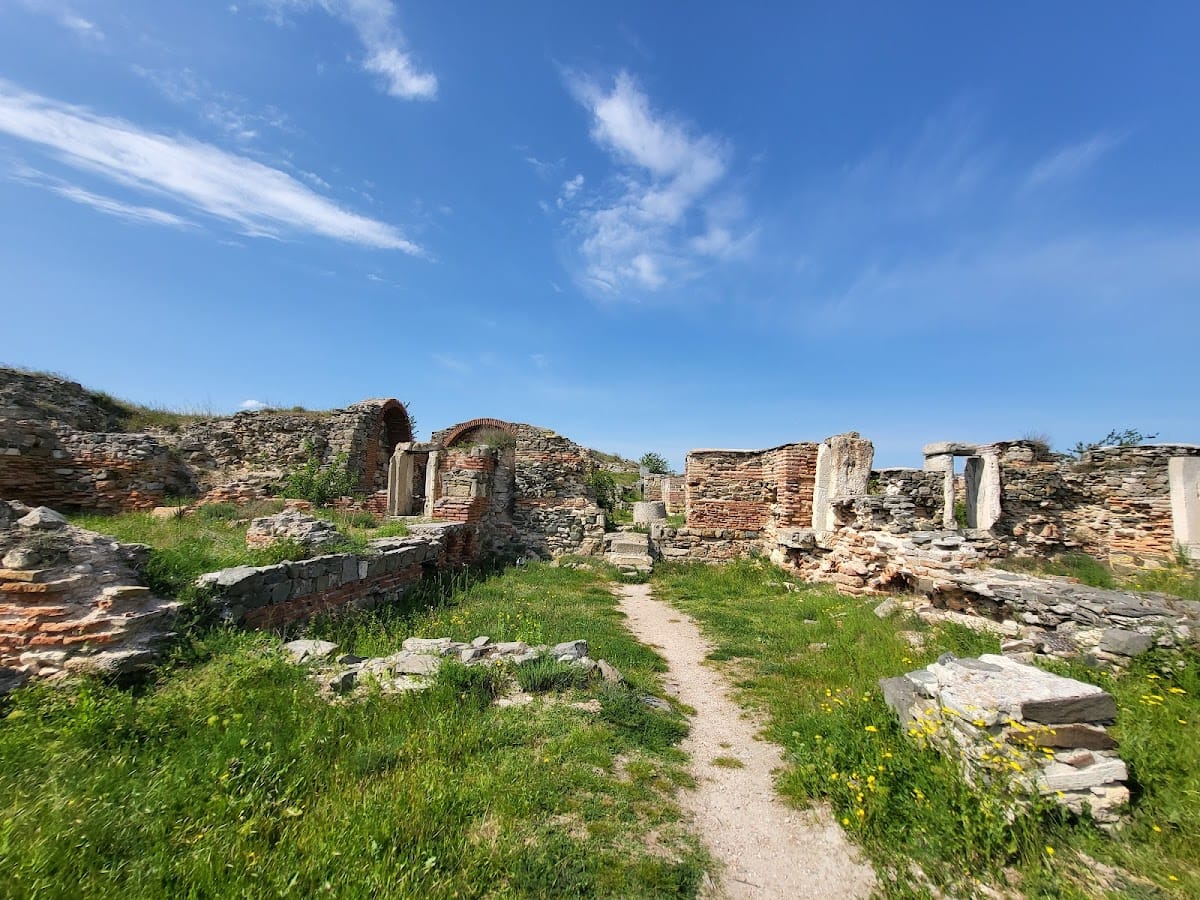
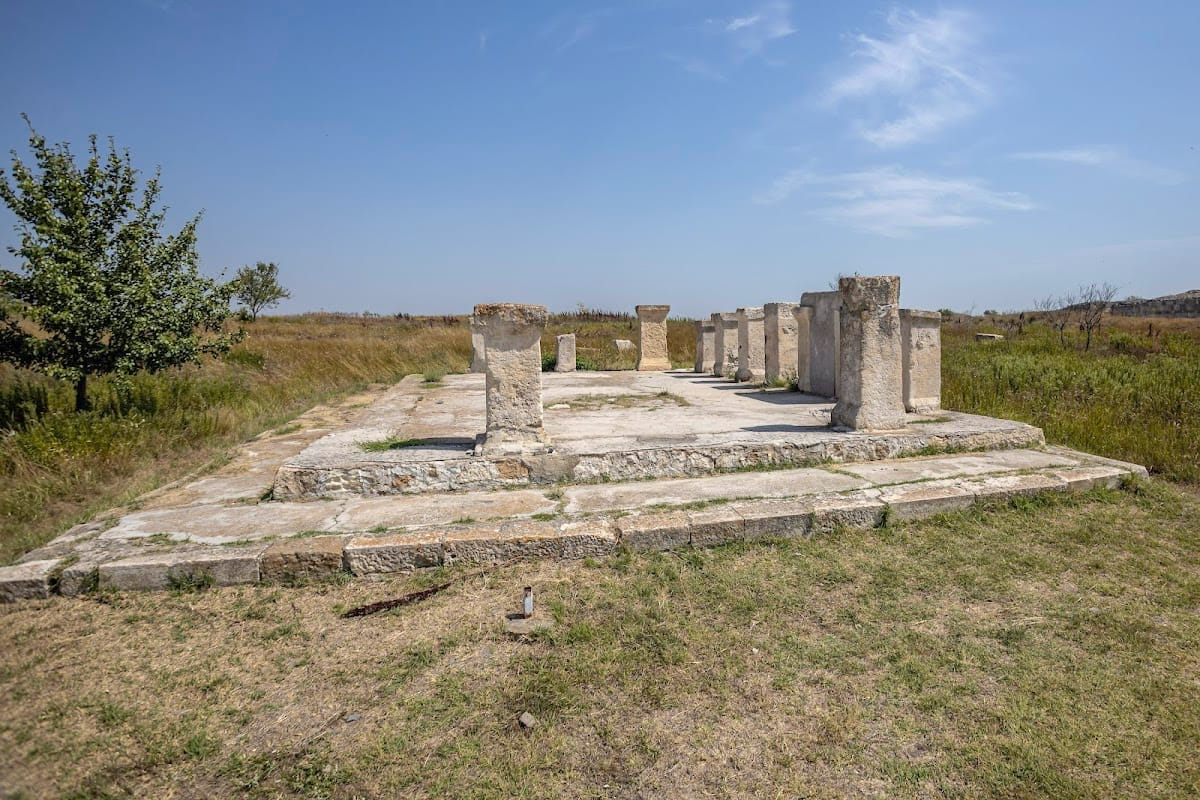
After the 4th-century rebuilding of the late city, private houses, two civic basilicas, and shops occupied the area near the public baths. Each basilica had three aisles separated by two rows of columns. Bases from the colonnades and a shop counter preserved to its full height remain visible.
Late Roman and Byzantine houses
The 6th-century residential district contained luxurious multi-storey houses with colonnaded inner courts, or atria. Stone staircases show that the buildings had upper floors. One large house in the southern part of the district included an apsidal room, a room ending in a curved recess, interpreted as either a private chapel or an elegant dining room. Another substantial house has been identified as the possible residence of the bishop.
Episcopal basilica
Several Christian basilicas stood within the late city, including the episcopal basilica at its center. The building measured more than 60 metres in length and 30 metres in width, occupying nearly two percent of the reduced urban area. Alexandru Suceveanu uncovered it in 1969.
Pârvan Basilica and the southern sector
Research at the Pârvan Basilica in the southeast resumed in 2000. It revealed superimposed lines of successive enclosures, a natural southern boundary formed by the sea, and the ancient port in this part of the city. Excavation of the civic basilica also resumed that year to investigate a possible enclosure belonging to the Archaic acropolis.
Features beyond the late walls
Outside the late Roman walls are another bath building dating from the 1st or 2nd centuries AD, a basilica from the 4th or 5th century associated with a cemetery, scattered Hellenistic houses, and surviving sections of ancient streets. Together, these remains show that activity extended beyond the smaller enclosure built after the destruction of AD 238.
Necropolises and burial evidence
The cemeteries outside Histria include numerous tumuli, or burial mounds, and a smaller number of flat graves. Greek burials date mainly from the 5th to the 2nd centuries BC. The tumuli generally had a ditch around the perimeter, a funerary platform, and a stone belt made from green schist exposed near the eastern edge of the city. Some mounds reached four or five metres in height. Central burials were accompanied by vessels, particularly amphorae.
Late Archaic Tumulus XII was associated with a locally important individual. Its burial context was interpreted as involving the sacrifice of 35 humans and several horses and donkeys. Paleoanthropological and paleozoological analyses indicated that the victims and animals probably originated in the Persian Empire. A separate study of Late Archaic Tumulus XVII in the Northern Necropolis presented evidence interpreted as supporting human sacrifice at Histria, with the interpretation based on that burial context.
Finds and archaeological collections
Excavations have produced sculptures, inscriptions, ceramics, amphorae, glass, lamps, ornaments, Hellenistic bas-reliefs, epigraphic documents, architectural fragments, and coins. A frieze discovered by Mircea Angelescu in 1994 depicts eight divinities of the Greco-Roman pantheon and places the Sun God at its edge.
The first archaeological museum building at Histria was designed by G. Simotta in the early 1920s during Pârvan’s directorship. Constructed on weak ground that was unsuitable for the building, it collapsed in 1923 and was later demolished. The present museum building, founded in 1982, houses material from the Greek, Roman, and Byzantine phases of the city and from its surrounding territory.