Schloss Ovelgönne: A Water Castle and Events Venue in Germany

Site at a Glance
- Rating
- 4.6
- Popularity
- Very Low
- Country
- Germany
- Primary era
- Early Modern
- External website
- Open
- Eras represented
- Early Modern
- Civilizations
- Holy Roman Empire
- Site type
- Domestic
- Remains
- Castle
On this page8 sections
History
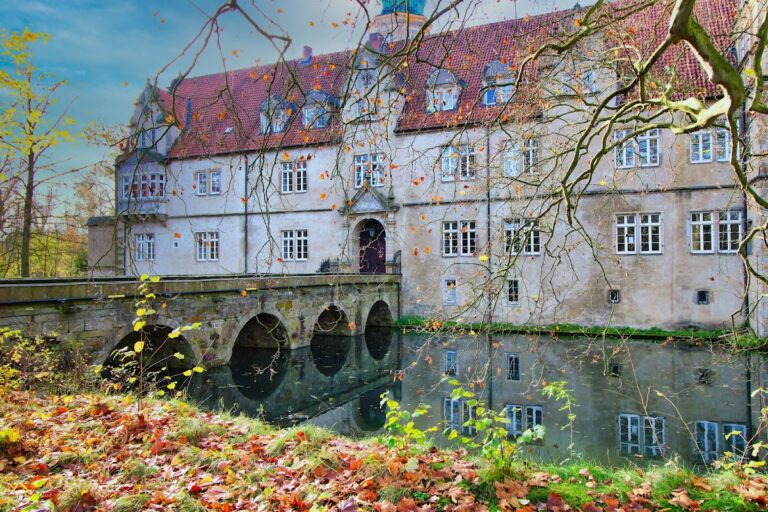
Schloss Ovelgönne is a water castle in Germany’s Eidinghausen district of Bad Oeynhausen. Its estate was first documented in 922, while the castle was built in the seventeenth century and expanded into a Baroque complex during the mid-eighteenth century. The estate is among the oldest aristocratic properties in the Minden-Lübbecke district.
Monastic and Episcopal Possession
The estate belonged to Abdinghof Monastery in Paderborn, a Catholic religious community. In 1126 it was described as a small estate in Edinhusen, and Pope Lucius III confirmed the monastery’s possession in 1183.
An exchange agreement transferred the estate and its mill to Dietrich, Bishop of Minden, on 28 August 1353. On 13 July 1362, Bishop Gerhard of Minden pledged Ovelgönne, together with Haddenhausen Castle, to Ludolf of Mönnichhusen, also known as Münchhausen. His descendants then held lordship over Ovelgönne for many years. In 1400, the estate was pledged to Simon and Bernhard of Lippe as ransom. The name Ovelgünne first appears in the records around 1458.
The von Münchhausen and von Reden Families
Agnes von Münchhausen, daughter of Albert von Münchhausen, inherited Ovelgönne in 1587. She had married Bernd von Reden-Pattensen in 1550. Bernd was later identified as the estate’s owner and styled himself lord of Ovelgönne and Pattensen. Their son, Bernd Ernst von Reden, became Landdrost of Minden, a senior regional administrative official. Their grandson, also named Bernd Ernst von Reden, became a cathedral canon of Minden, a member of the cathedral chapter.
The estate remained with the von Reden and von Schloen families until 1733. The last members of those families named the Catholic mission in Vlotho as their heir. Johann Friedrich von Weißenfels purchased Ovelgönne in 1738 and completely renovated it in 1740. During the middle of the eighteenth century, the original estate was enlarged and reshaped as a Baroque complex, using the highly decorative style that developed across Europe during the seventeenth and eighteenth centuries.
Municipal Ownership and Modern Use
Ownership changed frequently after the eighteenth-century renovation. During the first half of the twentieth century, the castle increasingly deteriorated. In 1940, the municipality of Eidinghausen bought the property for 50,000 Reichsmarks and planned to convert it for municipal purposes. The conversion did not take place because the Second World War ended before the plan was completed.
After the war, part of the building was used as an old-age home. In 1981, the city of Bad Oeynhausen began converting Schloss Ovelgönne into a civic center. Since 2013, the property has been leased to Schloss Ovelgönne Verwaltungs GmbH & Co. KG. Extensive renovation and modernization followed between 2014 and 2017, and the castle now operates as a venue for conferences and events.
Remains
Schloss Ovelgönne survives as a water castle south of the Wiehen Hills, within the Eidinghausen district of Bad Oeynhausen. A water castle is a fortified or residential castle surrounded wholly or partly by a moat or another water barrier. The property consists of the castle and its surrounding grounds, while the surviving complex reflects the estate’s transformation into a Baroque architectural setting.
Castle and Grounds
The Castle
The castle was built in the seventeenth century and later incorporated into the Baroque complex created during the mid-eighteenth century. The building was completely renovated in 1740 and underwent extensive renovation and modernization between 2014 and 2017. Its present function accommodates conferences, business events, private celebrations, weddings, trade fairs, congresses, seminars, concerts, photography sessions, and civil wedding ceremonies conducted by the city of Bad Oeynhausen.
The Surrounding Grounds
The castle stands within surrounding grounds that form part of the property. These grounds are generally accessible, although access is restricted during events. Together, the castle and grounds preserve the physical arrangement of the former estate while supporting its current civic and events use.
Nearby sites