Butrint National Archaeological Park: An Ancient Greek, Roman, and Byzantine City in Albania


Site at a Glance
- Rating
- 4.6
- Popularity
- High
- Country
- Albania
- Primary era
- Classical
- External website
- Open
- Eras represented
- Classical, Medieval, Early Modern, Modern
- Civilizations
- Ancient Greek, Byzantine, Ottoman, Roman, Venetian
- Site type
- City
On this page29 sections
History
Butrint National Archaeological Park in Albania preserves the remains of an ancient city whose history extends from prehistoric occupation through the Greek, Roman, Byzantine, Angevin, Venetian, and Ottoman periods. Settled occupation at the central site is generally dated to the tenth–eighth centuries BC, while evidence from the wider territory reaches back to about 50,000 BC. Butrint became a principal center of Chaonia, the region associated with the Chaonians, an Epirote people of the northwestern Greek world, and later developed as a Roman colony and an important Christian and Byzantine center.
Chaonian and Greek Butrint
From about 800 BC, Butrint was strongly influenced by Greek culture and maintained close relations with Corcyra, the Corinthian colony on the island now known as Corfu. Its position beside the Strait of Corfu made it one of the two principal ports of ancient Chaonia, alongside Onchesmus, modern Saranda. The waterways connected mainland Greece with Magna Graecia in southern Italy, giving the settlement strategic and commercial value.
Greek and Roman writers preserved foundation traditions that linked Butrint with Troy. Virgil and Dionysius of Halicarnassus associated the city with Helenus, the son of Priam, and described a visit by Aeneas after the fall of Troy. These stories helped connect Butrint’s identity with Rome, whose own legendary origins were traced to the Trojan past through Aeneas.
In the fifth century BC, nearby Corcyra gained control of Butrint, and Corcyrean forces built fortifications during the opening years of the Second Peloponnesian War, the conflict between Athens and Sparta and their allies. By the fourth century BC, Butrint had become a major regional city with a theatre, agora, and sanctuary of Asclepius, the Greek god associated with healing. During the same century, it became a leading center within the Epirote political organization connected with the Molossians and underwent increasing Hellenization. A third-century BC inscription records a Chaonian annual official known as the Prostates.
Roman Protectorate and Colony
Butrint and Corcyra became Roman protectorates in 228 BC, and Butrint was incorporated into the province of Macedonia in 146 BC. By the middle of the second century BC, it may have been the center of an independent state associated with the Koinon of the Prasaiboi. The city prospered during the second century BC, especially after the Third Macedonian War, when the Roman destruction of Molossian territory redirected commercial activity toward Butrint and Corcyra. Manumission records, mainly dating from 160–100 BC, point to a prosperous community with many slave owners.
Julius Caesar visited Butrint in 48 BC and designated it as a colony for Roman veterans. Titus Pomponius Atticus, a major landowner in the area, opposed the settlement plan through his correspondent Cicero, and relatively few colonists arrived. The city’s population therefore changed less than the original plan anticipated. The new colony adopted a constitution modeled on Rome, with a council of decurions, two annual duoviri, who were the colony’s chief magistrates, and a quinquennalis, an official connected with the census and civic administration. Latin became the official language, and the colony issued coins as Colonia Iulia Buthrotum.
After the Battle of Actium in 31 BC, Augustus renewed the plan to establish Butrint as a veterans’ colony. The resulting expansion approximately doubled the urban area and added residential districts, an aqueduct, baths, a forum complex, and a monumental fountain called a nymphaeum. The city was refounded as Colonia Augusta Buthrotum and became an important regional center within the Roman imperial order.
Titus Pomponius Atticus owned extensive property around Butrint and maintained a rural villa called Amaltheum. After 32 BC, the city honored Marcus Vipsanius Agrippa and Caecilia Attica with marble statues, and Agrippa became an important protector of Butrint. The city also continued to cultivate connections with Roman imperial circles. Lucius Domitius Ahenobarbus was honored as its patron in 16 BC, and Germanicus received the office of quinquennalis in AD 12.
During the reigns of Claudius and Nero, the colony was also called Colonia Campestris Iulia Buthrotum. A new district developed east of the original city on the Vrina Plain. An aqueduct and bridge connected the plain with Butrint and were probably completed as part of an Augustan project. During the first half of the second century AD, the city expanded further. Public buildings around the sanctuary of Asclepius and the forum were monumentalized, villas spread through Butrint and the Vrina Plain, and the aqueduct-bridge linked the settlement with the main road between Aulona and Nicopolis.
Earthquakes and Late Antique Transformation
Earthquakes repeatedly altered the Roman city. The Capitolium and sanctuary were damaged or destroyed during the second century, and their building materials were reused in later construction. A major third-century earthquake damaged the forum, the Triconch Palace, and other urban structures. Another destructive event in AD 365 affected the Adriatic and Ionian coasts and probably caused further damage at Butrint.
Despite economic decline in Late Antiquity, Butrint remained occupied and continued to function as a port and episcopal center. A bishopric is an ecclesiastical district governed by a bishop. Butrint’s bishopric was initially subordinate to Nicopolis, later to Naupactus, and after the fourteenth century to Ioannina. Bishops named Stephanus and Matthaeus are recorded in AD 458 and 516. In the fifth century, investment increasingly favored Christian buildings, while residential estates became smaller and less elaborate.
Emperor Anastasius probably rebuilt and enlarged Butrint’s fortifications in the late fifth or early sixth century. The new defenses enclosed more ground than the Hellenistic city and particularly strengthened the vulnerable western side. During the sixth century, declining water levels made inner harbors and docking areas less useful, while marshes and reed beds increasingly surrounded the settlement. Political instability, taxation, reduced commerce, raids, and the Justinianic Plague contributed to economic recession. Slavic groups probably reached the region in the late sixth century, although the extent of Slavic and Byzantine control between the seventh and tenth centuries remains uncertain.
Medieval Relocation and Christian Continuity
By about 700, Butrint had contracted into a peripheral Byzantine fortress, or a small seasonal settlement. Coins and imported goods became scarce, and parts of the western defenses were converted into domestic and mussel-processing spaces. A destructive fire around 800 destroyed the early medieval castrum, a fortified settlement or military stronghold. The community then relocated to the Vrina Plain, where a settlement known as “new Butrint” existed approximately between 840 and 950. Communication with the original peninsula continued by boat or across the Roman bridge.
During the ninth and tenth centuries, the Vrina Plain became the center of local political and economic activity. An administrative residence, probably the oikos of a local governor or commander, was established over the ruins of an earlier basilica. Butrint was repopulated late in the tenth century and became an important supplier of fish and mussels. Christianity remained institutionally important between the tenth and twelfth centuries. The bishop served as an assistant bishop of Naupactus, and Butrint remained within the ecclesiastical province associated with Nicopolis. In the twelfth century, the Arab geographer Muhammad al-Idrisi described the city as densely populated and possessing several markets.
Angevin, Venetian, and Ottoman Rule
After the Fourth Crusade and the fragmentation of the Byzantine Empire, Butrint became part of the Despotate of Epirus after 1204. This medieval state emerged from the division of Byzantine territories after the crusade. The city was later contested by Byzantine, Angevin, Serbian, and Venetian powers. Charles I of Anjou took control of Butrint and Corfu in 1267. Byzantine forces temporarily recovered the city in 1274, but Angevin authority was restored.
Butrint remained under Angevin control, with interruptions, until 1386. Angevin rule, exercised by a dynasty whose principal power base lay in southern Italy, brought the town into the Catholic sphere, while the Orthodox bishopric was transferred to nearby Glyki in 1337 or 1338. Political unrest and regional conflict reduced the town’s size and importance during the late fourteenth century.
Venice acquired Butrint in 1386 and retained control, with interruptions, until 1797. Venetian administrators gradually shifted activity from the old city toward fortified positions around the channel and the fish weirs, whose fisheries were among the settlement’s principal economic assets. The Treaty of Campo Formio briefly placed Butrint under French sovereignty in 1797. Ali Pasha Tepelena captured it in 1798 or 1799, and the town then remained under Ottoman rule until Albanian independence in 1912.
Archaeology and Heritage Protection
By the nineteenth century, the original city had been abandoned for centuries and was surrounded by marshes. European travelers, including François Pouqueville in 1805 and Émile Isambert in 1881, described the site, while Eugen Oberhummer published an early historical overview in 1897.
Modern archaeological investigation began in 1928 under an Italian expedition led by Luigi Maria Ugolini. Work continued under Italian direction until the Second World War and exposed substantial Greek and Roman remains, including the theatre, Lion Gate, and Scaean Gate. After Albania’s communist government was established in 1944, foreign archaeological missions were suspended. Albanian archaeologists, including Hasan Ceka, continued conservation and research. Larger excavations resumed in the 1970s, and international investigations expanded after 1991, particularly after 1993. Excavations in 1994–1999 revealed additional Roman villas and an early Christian church. Research led by David R. Hernandez continued in 2004, while work on the western defenses clarified later occupation and repairs to walls burned in the ninth century.
Butrint was inscribed on the UNESCO World Heritage List in 1992 under criterion (iii), with major boundary changes in 1999 and a minor modification in 2007. It remained on the List of World Heritage in Danger from 1997 to 2005 because of looting, inadequate protection, and management and conservation difficulties after civil unrest. Looting in 1997 affected the museum housed in the central castle, although many objects were later recovered and returned. Butrint National Park was designated in 2005 under Albania’s protected-areas legislation and covers 86 square kilometers, forming a buffer zone for the World Heritage property. The wetlands were recognized under the Ramsar Convention in 2002, identifying them as internationally important wetlands. Conservation has generally followed high-quality practice, including principles associated with the 1964 Venice Charter.
Remains
Butrint occupies a small peninsula or hill surrounded by Lake Butrint and the Vivari Channel, with a narrow connection to the mainland. The channel linked the city and its port with the open sea, while the surrounding waters provided the citadel with a naturally defensible position. The archaeological landscape includes buried remains, standing ruins, and historic buildings from prehistoric, Greek, Roman, early Christian, Byzantine, Angevin, Venetian, and Ottoman phases. Changing water levels and wetland conditions periodically cover parts of the archaeological area, especially around the ancient theatre and Roman forum.
Acropolis and Greek Civic Center
Acropolis Fortifications
The acropolis stood on the hill beside Lake Butrint. Its earliest recorded extension dates to the seventh century BC, and successive circuit walls later enclosed it. A Hellenistic wall built around 380 BC surrounded about four hectares and incorporated bastions and five gates. The Greek and Hellenistic city also contained separately enclosed areas for the agora, stoas, residential quarters, and theatre. As the settlement expanded, its walls and gates were repeatedly altered.
Theatre
The theatre lies directly below the acropolis and faces the Vivari Channel. Built in the third century BC in the Greek manner, possibly over an earlier and smaller theatre, it was enlarged and extensively remodeled during the Roman period. Its semicircular auditorium is about 24 meters in diameter and could hold up to 2,000 people. Seating was divided into five sectors of thirteen rows. Lower seats were assigned according to social rank and include footrests decorated with lion motifs.
Roman rebuilding raised the stage building to two stories and redesigned its façade. Three round-arched doors served performers, statues stood between them, and boxes for higher-status spectators were placed above the entrances. Numerous inscriptions carved into the theatre stones include manumission records, which illuminate aspects of Hellenistic social organization. Excavations between 1928 and 1932 also recovered portrait heads and statues associated with the theatre, including representations of Augustus, Agrippa, Asclepius, a muse, and a female deity.
Sanctuary of Asclepius
The sanctuary of Asclepius developed around a water source believed to have healing properties. Asclepius was the Greek god associated with healing, and his sanctuary included spaces for worship and for people seeking cures. The precinct contained a temple, stoa, treasury, theatre, and a peristyle building, meaning a structure or courtyard surrounded by columns. A temenos wall, or boundary enclosing sacred ground, separated it from the rest of the city.
A marble head of Asclepius found in 1932 may have belonged to a statue. Coins bearing snake motifs, which were associated with healing, further reflect the importance of the cult at Butrint. The sanctuary stood near the civic center, where religious and public buildings developed together through the Hellenistic and Roman periods.
Agora and Forum
The agora, the principal public and commercial square of a Greek city-state, lay near the sanctuary. It was built over an earlier stoa measuring about 4.5 by 25 meters. The surviving remains date mainly from the late second or first century BC and are arranged around the forum space. Roman expansion incorporated or enlarged the earlier civic area, adding a forum complex, houses, baths, and a nymphaeum, a monumental fountain structure.
Roman Infrastructure and Residences
Aqueduct and Bridge
The Roman aqueduct carried water from a source near modern Xarra for approximately 12 kilometers before crossing the roughly 200-meter-wide Vivari Channel. The crossing may also have served pedestrians and small vehicles. It was probably built during the reign of Augustus, when the city gained new public buildings and residential districts. The structure connected Butrint with the Vrina Plain and with the main road between Aulona and Nicopolis.
Triconch Palace
The Triconch Palace began as a Roman villa with mosaic floors, painted walls, and a courtyard containing a fountain. An eastern wing with three apsidal, or conch-shaped, spaces was added in the fourth century, giving the complex its modern name. The building was later damaged, enlarged, and reused. It is the largest known private residence at Butrint and illustrates the changing form of elite housing from the Roman period into Late Antiquity.
Villas and Bath
Villas spread through the city and the Vrina Plain. A Roman villa at nearby Diaporit was replaced by a Christian complex constructed around 490–500. Excavations also uncovered a Roman bath about 500 meters outside the city, along with further Roman villas and the gymnasium. These remains belong to the wider settlement rather than to a single building group and reflect the expansion of habitation around the central peninsula.
Christian and Byzantine Buildings
Grand Basilica
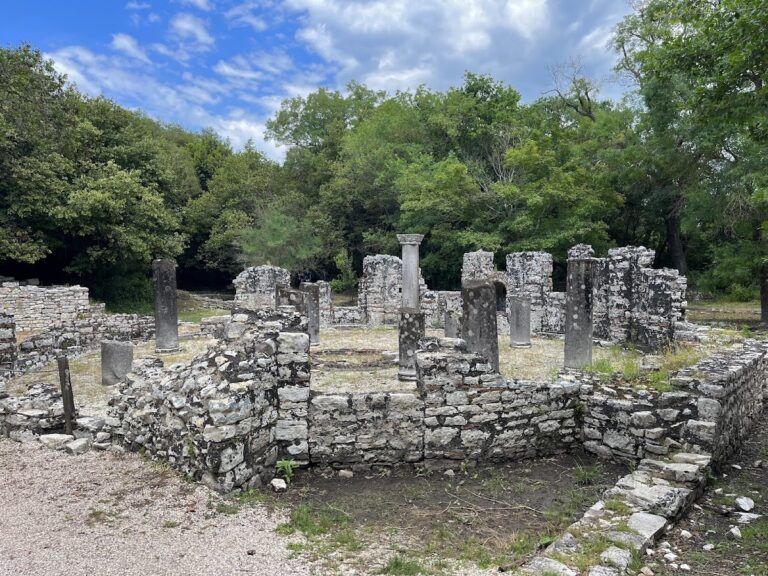
The Grand Basilica was built in the early sixth century. It had a central nave, side aisles, a transept, and an exterior polygonal apse. Its surviving ruins are substantial enough to show the original plan. Mosaic floors decorated the interior, and the arcades reportedly reached about five meters in height.
Baptistery
The Baptistery also dates from the early sixth century and was a large Christian building adapted from an earlier Roman monument. A baptistery was a room or structure used for Christian baptism. Its principal surviving feature is an elaborate mosaic floor made by craftsmen associated with Nicopolis. The mosaic is usually covered with sand to protect it.
Other Christian Complexes
Other Christian monuments include the Acropolis Basilica, the Lake Gate church, and the Baptistery church. The Christian basilica on the Vrina Plain was built in the second quarter of the sixth century. In the ninth century, an administrative residence was constructed over its ruins. The earlier narthex, an entrance hall, was reinforced and partly converted into living quarters.
Late Antique Fortifications
The late fifth- or early sixth-century fortifications enclosed a larger area than the Hellenistic defenses. Southern and eastern walls extended toward the water, while the western side, most vulnerable to attack from land, was strengthened with rectangular towers. The northern defenses incorporated earlier Hellenistic walls and gates.
As the defensive system declined, parts of the western walls were converted into housing and mussel-processing areas. Excavations indicate that the walls burned in the ninth century and were later repaired. This sequence preserves the changing relationship between the settlement and its fortifications during the transition from Byzantine urban life to a smaller medieval community.
Gates and Later Fortifications
Lion Gate and Scaean Gate
The Lion Gate, one of six recorded city gates, dates to the fourth century BC. Its relief shows a lion devouring a bull, while its narrow passage limited the number of people entering at one time. The Lion Gate and Scaean Gate were exposed during the early twentieth-century excavations. Their names refer to comparisons with the gates of Troy, not to evidence that Trojan settlers built them.
Venetian Castle
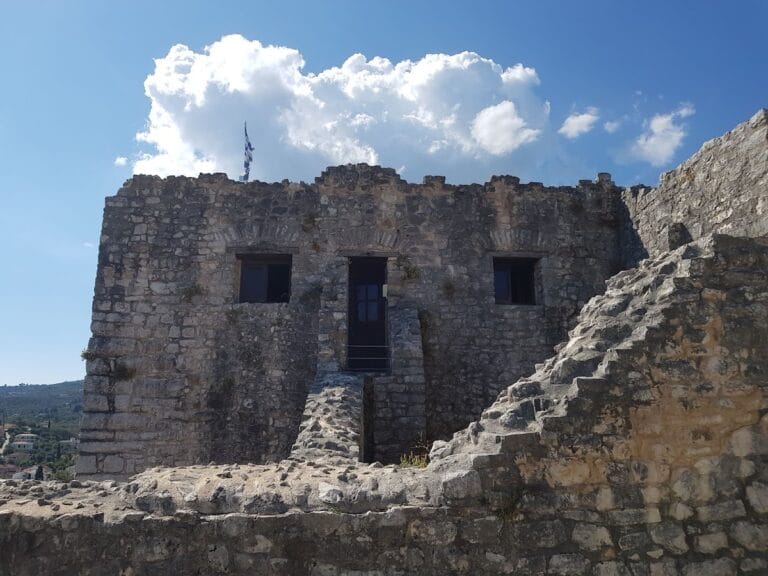
The Venetian castle occupies the western end of the acropolis and overlooks the Vivari Channel and the Strait of Corfu. It has a pentagonal plan and a square tower at the northeastern corner, reconstructed in the 1930s. A second tower may once have stood inside the castle and may have served as the castellan’s residence. The building later housed the Butrint museum.
Channel Fortification
A Venetian tower beside the channel below the castle probably dates from 1717–1718. It stands on a stone base, measures approximately six meters square, and has two stories. Its entrance was approached from the east by a drawbridge.
Triangular Fortress
On the opposite side of the Vivari Channel, a Venetian triangular fortress controlled the passage between the sea and Butrint and was associated with the fish weirs. Probably founded around 1500 and first recorded in 1572, it was originally built on an island. The corner towers were probably added during Ottoman occupation, and further Venetian alterations followed its recapture in 1717–1718.
Ali Pasha Castle
Ali Pasha Castle stands on an island in the marshes about 2.5 kilometers west of Butrint, at the mouth of the Vivari Channel. Its present form is generally attributed to rapid construction under Ali Pasha around 1807, although earlier Venetian maps and remains suggest possible predecessors. The rectangular fortress measures approximately 22 by 30 meters. Its walls are about 5.1 meters high, with corner towers of similar height.
Archaeological Collections
The archaeological collections include inscriptions, coins, sculptures, ceramics, architectural fragments, and objects recovered during excavation. Finds include Greek and Roman pottery, early Christian material, a silver Byzantine coin of Leo VI, five bronze seals from the Vrina Plain, and objects associated with the theatre and sanctuary. Together with the surviving buildings, these materials trace the city’s changing civic, religious, domestic, and economic life across many centuries.