Eulenbroich Castle: A Moated Cultural and Educational Centre in Germany


Site at a Glance
- Rating
- 4.5
- Popularity
- Medium
- Country
- Germany
- Primary era
- Early Modern
- External website
- Open
- Eras represented
- Medieval, Early Modern, Modern
- Civilizations
- Duchy of Berg, German, Holy Roman Empire
- Site type
- Domestic
- Remains
- Castle
On this page8 sections
History
Eulenbroich Castle is a moated castle in Rösrath, Germany, near Cologne on a side arm of the Sülz River. Its history reaches back to an earlier castle complex probably dating from the thirteenth century, while its later transformation into a small Baroque château began in the eighteenth century. Known popularly as the “good room of Rösrath,” the estate has served aristocratic, civic, industrial, residential, educational, and cultural purposes.
Medieval Origins and the Staël von Holstein Estate
Excavations have revealed remains of an earlier castle complex that probably dates from the thirteenth century. The identities of its inhabitants are unknown. The first documented owner was the Staël von Holstein family, recorded in 1401. The family occupied the moated castle until 1762.
During their ownership, the Staël von Holstein family established a second castle complex. It included a manor house, livestock stables, servants’ accommodation, an outer bailey, meaning an enclosed service area outside the main castle enclosure, and surrounding moats.
The Baroque Transformation
In 1762, Johann Werner, Baron von Francken, purchased the estate from the neighbouring Haus Venauen. Under the von Francken family, the medieval complex was transformed into a small château in the Baroque style, the elaborate European architectural style that predominated from the late sixteenth through the eighteenth centuries.
The Cologne manufacturer Robert Rohr later acquired the aristocratic residence and began extensive restoration. In 1851, he established his office as mayor of Rösrath at the castle. He remained mayor for life until 1878, giving the estate a direct role in the civic administration of the town.
Industrial and Twentieth-Century Changes
Emil Biedermann moved into Eulenbroich in 1908. In an adjacent building belonging to the former Rösrather Thonwerke Benfey & Co., he established a leather factory belonging to Stark & Biedermann. He also commissioned the Cologne architect Hermann Eberhard Pflaume to remodel the château as a substantial bourgeois villa.
After the Second World War, the complex was used among other purposes as a boarding school for Belgian schoolgirls attending school at the neighbouring Haus Venauen. The building stood vacant for an extended period from 1955, and a private residential home for older people was established there in 1969.
Municipal Ownership and Present Use
The municipality of Rösrath acquired the estate in 1981. Following fundamental renovation, the house opened to the public in 1984. Today, the estate functions as a cultural, educational, event, and conference centre. Its programme includes civil marriages, wedding celebrations, art exhibitions, theatre performances, and literary discussions.
Schloss Eulenbroich GmbH manages the estate. Its shareholders are the Rösrath Citizens’ Foundation, the municipality of Rösrath, the Cultural Association Schloss Eulenbroich, and the Forsbach Citizens’ Association. The gatehouse houses the headquarters of the Rösrath Historical Association, while the complex also accommodates the Rösrath–Overath music school and a magic school.
Regional funding through Regionale 2010, a North Rhine-Westphalia development programme, created an educational workshop beside the castle, with event rooms and a café with outdoor dining. Through the KennenLernenUmwelt initiative, the site provides extracurricular programmes and serves as a workshop for dance, theatre, and music for pupils from grades one through thirteen. Since January 2019, the educational centre has also addressed media-related topics and has been designated a performance and media workshop.
Remains
Moated Entrance and Gatehouse
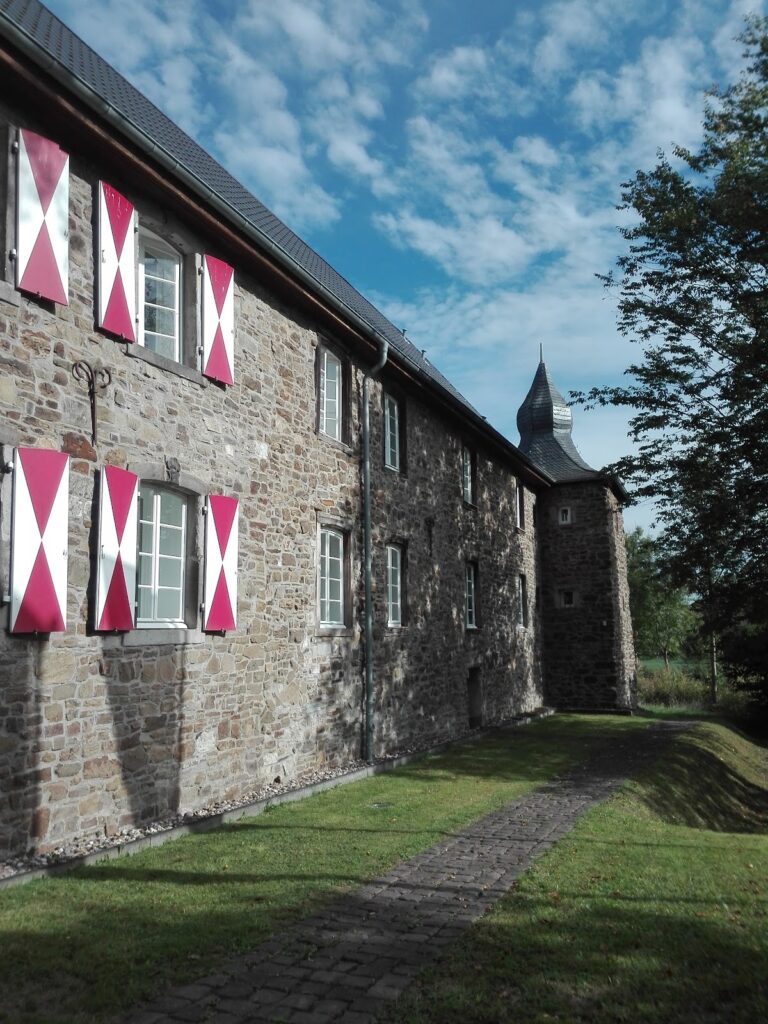
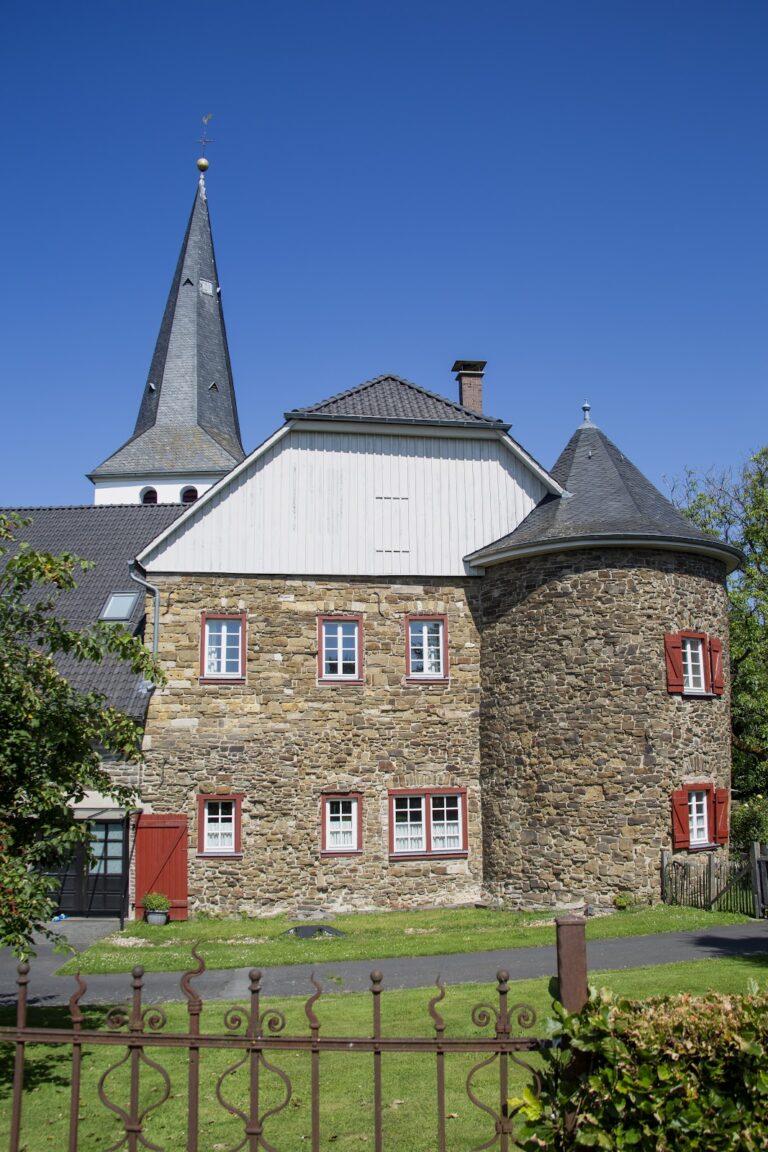
Eulenbroich is a Wasserburg, or castle whose defensive character is associated with surrounding water. The former outer bailey is now the castle gatehouse, which dates from an eighteenth-century rebuilding. A brick arched bridge crosses the moat, supplied with water from the Sülz, a river in North Rhine-Westphalia. The bridge, gatehouse, and manor house behind it are precisely aligned along the central axis of the complex.
The gatehouse entrance has wooden door leaves painted in traditional Bergisch green, the regional green used on wooden building elements in the Bergisches Land. The keystone of the gateway arch bears the coat of arms of Johann Werner, Baron von Francken, who commissioned the eighteenth-century construction. A vaulted cellar survives within the gatehouse. The building also functions as a visual emblem of Rösrath, appearing on municipal stationery and the municipality’s website.
Manor House and Bourgeois Villa
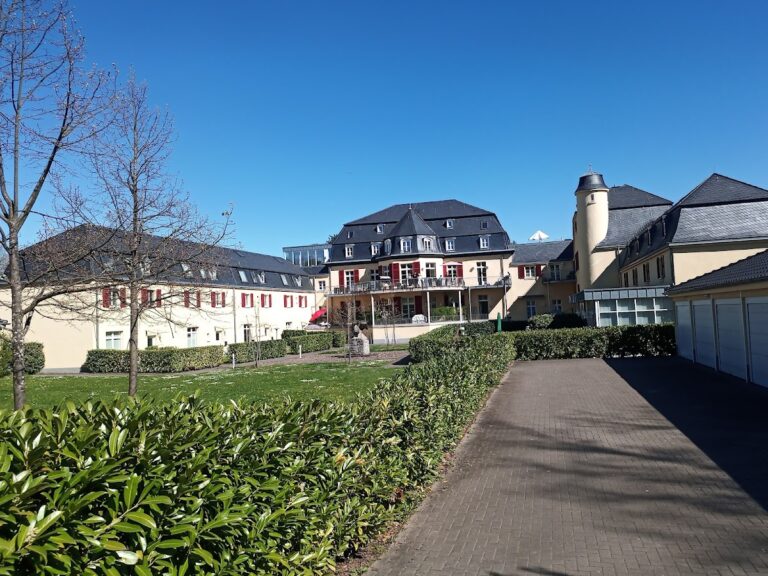
The manor house behind the gatehouse was remodelled as a bourgeois villa in the early twentieth century. The work included a conservatory on the eastern façade, built according to plans by Hermann Eberhard Pflaume. At the entrance, an open double-flight staircase with balusters forms a prominent architectural feature.