Gannocks Castle: a Norman Fortified Manor House


Site at a Glance
- Rating
- 4.7
- Popularity
- Very Low
- Country
- United Kingdom
- Primary era
- Medieval
- Eras represented
- Medieval
- Civilizations
- Norman
- Site type
- Military
- Remains
- Castle
On this page6 sections
History
Gannocks Castle is a fortified manor house in England, United Kingdom, built by the Normans in the late twelfth or early thirteenth century. Traditionally called a castle, it was arranged in motte-and-bailey form, combining a raised mound with an enclosed outer area, and incorporated a wider manorial complex.
Possible earlier fortification
The site may have been built over a tenth-century Danish Viking fort, although this remains conjectural. Danish Vikings landed in East Anglia in 865, and a battle took place at Tempsford in 921 that may have occurred at the later castle site. These events provide an earlier historical setting for the place, but they do not establish that the surviving earthworks originated in the Viking period.
Conservation and investigation
Restoration began in 1998 with environmental management and the removal of extensive scrub. The work also included interpretation facilities and measures intended to improve access without harming the archaeological remains. Geophysical surveys followed in 2004 and 2006. The first used resistivity and magnetometry across the castle site and adjoining playing field, while the second used a fluxgate gradiometer in fields west and south of the site. These non-invasive techniques detect buried features such as walls, ditches, and pits. The surveys were organized by the Friends of Gannock Castle.
Scrub clearance involved the Friends of Gannocks Castle, residents of Tempsford, and volunteers from the Ivel and Ouse Countryside Project, with specialists assisting where necessary. Larger cut wood was dried for use as firewood by local villagers, while smaller pieces were mulched and spread over the site. Gannocks Castle is owned by Central Bedfordshire Council and is protected in England as a Scheduled Monument, a legally protected archaeological or historic site.
Remains
Earthworks and enclosure
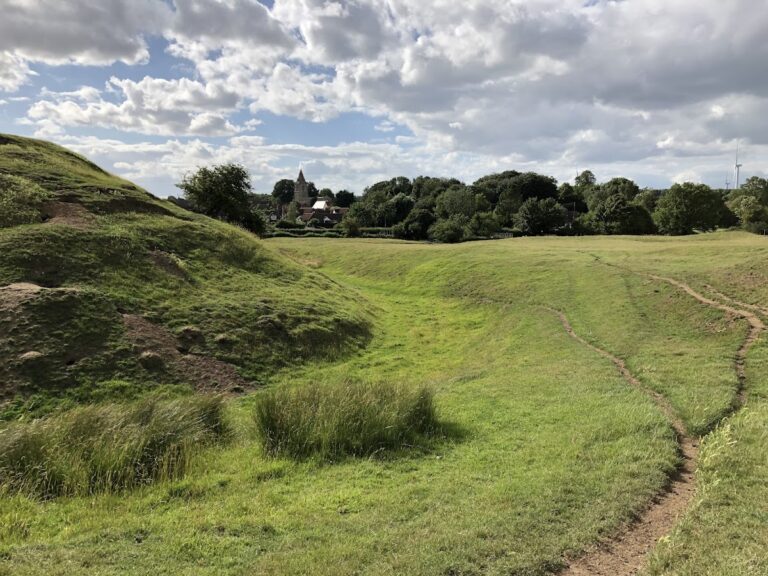
The site survives chiefly as earthworks and a moat. A rectangular ward, or enclosed fortified area, was surrounded by the moat and a defensive rampart. The moat remains wet throughout the year, preserving the principal boundary of the medieval complex. In the north-eastern part of the ward, a small motte rises as an artificial mound. It is believed to have supported either a beacon or a timber tower.
Access and landscape works
A causeway crosses the moat and was built to improve access without being dug into the archaeological site. Its construction allows it to be removed later without damaging the underlying remains. Restoration work also included tree and scrub management, the renewal of a wildflower area, benches, bird and bat boxes, and an interpretation board. A leaflet for a heritage trail was produced as part of the same programme.