Marble in Ancient Rome: Types, Sources, and Symbolism
Roman builders obtained marble from Italian and Mediterranean quarries for columns, sculpture and polished surfaces. Expensive slabs covered brick or concrete walls, and coloured stones formed patterned pavements. Extracting the blocks, shipping them and lifting them into place required skilled workers and organised transport. Imperial projects and wealthy households supported this trade.
On this page11 sections
Marble and other architectural stones
A marble column could carry weight while also decorating a building. Thin panels and paving slabs supplied polished surfaces over a structural core of concrete, brick or local stone. Volcanic tuffs served different construction needs and were particularly accessible around Rome.
Italian marble and contrasting local building stones
Luna (Carrara) marble: Quarries in the Apuan Alps exported white and blue-grey marble through ancient Luna. Roman exploitation developed in the late Republic. Its fine grain suited sculpture and carved architectural elements, while its Italian location shortened transport to Rome compared with imported Greek stone. Augustus used Luna marble in public building projects.
Anician Stone: Anician stone is a dense volcanic tuff quarried in central Italy near Lake Bolsena. Ancient builders praised its strength and resistance to fire, using it in structures where durability was key. It was a building stone rather than a marble; Vitruvius discusses its qualities in his account of stone for construction.
Gabine stone: This grey volcanic stone came from Gabii east of Rome. Tacitus reports that, after the fire of AD 64, Nero required specified parts of buildings to use Gabine or Alban stone without timber. Their resistance to heat informed the choice. Gabine blocks also formed part of the high enclosure wall of the Forum of Augustus.
Alban stone:Lapis Albanus is a speckled grey volcanic tuff quarried in the Alban Hills south of Rome. Builders used it in temples, tombs and walls from the Regal and Republican periods. It supplied an accessible local stone before imported and Luna marbles became widespread.
Imported Marbles from the Provinces
Pentelic marble: Mount Pentelikon in Attica supplied fine-grained white marble, with iron compounds giving weathered surfaces a warm tint. The Parthenon used this stone. Roman patrons imported it for sculpture and architectural elements after Rome’s conquest of Greece.
Parian marble: Quarries on Paros supplied white marble extensively used by Greek sculptors. Roman workshops continued to use it for portraits, divine and mythological figures and carved architectural decoration. Its grain and translucent appearance suited detailed sculpture.
Proconnesian marble: Marmara Island supplied white or pale-grey marble with grey bands. Its quarries yielded large blocks, exported widely by the second century AD. Columns, architectural components and paving travelled to Mediterranean cities. Production continued into late antiquity, supplying Constantinople and other eastern centres.
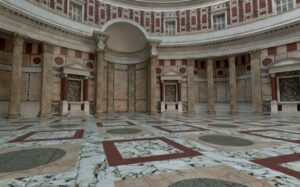
Pantheon interior, Docimian Marble (Floor) Docimian Marble (Pavonazzetto): Docimian marble, also known as pavonazzetto, is a striking white marble with purple and gray veins, quarried in Dokimeion (ancient Phrygia, in modern Turkey). Its name “pavonazzetto” means “peacock-like,” referring to the dramatic purple feather-like veining that adorns this stone. Romans began importing Docimian marble in the late first century BC, and its popularity soared under the Flavian emperors and beyond. It was commonly used for decorative column shafts, wall panels, and floor tiles where a splash of color and pattern was desired. For example, the Emperor Domitian’s palace on the Palatine Hill boasted halls lined with Phrygian pavonazzetto alongside other exotic marbles.
Pantheon, Numidian Marble Rectangle on FloorNumidian marble: Quarries at Simitthus, modern Chemtou in Tunisia, supplied the yellow limestone known as giallo antico. White and purple markings varied between pieces. Builders used it for columns, wall panels and patterned floors, including decoration at the Pantheon and Baths of Caracalla. Its contrasting colour allowed combinations with darker stones.
Egyptian granites: Aswan supplied red granite, while Mons Claudianus in the Eastern Desert supplied grey granodiorite. Their hardness required sustained cutting and abrasive work. Egyptian stone travelled in large columns and other monoliths; sixteen imported granite shafts support the Pantheon’s porch. Egyptian quarries also supplied purple porphyry, extensively used in imperial decoration and sarcophagi in late antiquity.
Decorative Stones and Colored Marbles
Decorative stone was selected for colour, pattern and the surface obtained through polishing. Thin panels could cover walls and combine several materials in the same room. Some stones called marble in architectural usage are geologically limestone, breccia or other rocks.
Giallo antico: Yellow Numidian stone appears in geometric floors and wall panels. Cutting smaller pieces allowed builders to arrange contrasting colours in repeated patterns. Later churches reused Roman slabs and fragments in their own pavements.
Rosso antico: Deep-red marble from the southern Peloponnese, particularly the Mani, supplied small columns, wall panels and floor inlays. Colour varies from dark rose to deeper red, allowing contrast with white and yellow stones.
Verde antico: Quarries in Thessaly supplied a breccia containing green serpentinite and pale marble fragments. Builders cut it into wall veneers and pieces for opus sectile floors. It also supplied columns and other shaped elements.
Marmor africano: This decorative breccia has a dark background containing pale, pink and red fragments. Its source was Asia Minor. Its identification with the ancient name marmor Luculleum remains a matter of interpretation. Roman workshops used the patterned stone for columns, slabs, table surfaces and floor accents.
Quarrying, Transport, and Logistics
Extraction Techniques
Roman quarry workers cut channels around a prospective block with iron picks and chisels, separating its sides from the surrounding rock. They inserted wedges into prepared holes to split the remaining connection. Iron wedges were hammered into the stone; wooden wedges were soaked so that their expansion forced a split along bedding or faults. Arranging the holes in a line helped control the break. Quarry faces at Aphrodisias preserve pick marks and holes for wooden wedges, while iron wedges survive from Roman quarries at Felsberg.
After detaching a block, workers roughly squared it with a pick or point chisel. Columns and sculptures could receive preliminary shaping near the quarry before transport, with finer work completed near their destination. Rough blocks, unfinished carvings and tool marks preserve different stages of this work. Labourers then moved the prepared stone toward a loading point using hauling equipment and rollers.
Labor and Administration
Skilled workers isolated, shaped and moved quarry stone. Some extraction sites used slaves or convicts. Documents from Mons Claudianus instead attest paid civilian specialists working alongside military administration. Imperial officials administered major quarries in Egypt and Asia Minor. Marks and inscriptions on blocks recorded production and personnel, helping organise the movement of stone to projects. Contractors and commercial suppliers also participated in extraction and delivery. Quarry inscriptions and block marks can identify particular ownership and production arrangements.
Moving stone from quarry to building site
Transporting heavy stone over long distances was perhaps an even greater challenge than cutting it. On land, Romans built sturdy roads and employed large carts or wooden sledges to drag blocks from quarry to coast. Dozens of oxen might be yoked to a single marble block on a sled, inching along specially prepared earthen ramps. In some cases, temporary roads were constructed solely for moving stone, with gangs of workers laying logs as rollers in front of the load.
Ships carried blocks, columns and worked pieces as commercial cargo. Exceptional monoliths required special handling. Loading, support and balance affected the safe movement of heavy stone, while unloading required prepared equipment and labour. Rome’s port infrastructure expanded to handle the influx of stone. At Ostia, the port at the Tiber’s mouth, and later at the larger artificial harbor of Portus, docks were equipped to unload marble blocks with cranes and ramps.
Warehouses near the wharves stored imported stone. Archaeologists have found hundreds of rough marble blocks and column drums in the silt of canals around Portus. These were pieces lost or left from ancient shipments, giving us insight into the scale of the trade. From Portus, the blocks were transferred to shallow-draft barges that could be towed up the Tiber River.
Workers guided cargo through waterways and hauled loads at transfer points. Ropes, boats and handling equipment connected landing places with storage and onward transport. The statio marmorum, a marble unloading and storage depot, stood in the Portus–Isola Sacra area. Blocks and partly worked shafts there record material held between extraction, delivery and installation. Rome’s river wharves received stone for building projects within the city.
Marks, inscriptions and documentary evidence could track stone and people involved in its production or delivery. Finished elements still required transport, lifting and fitting at the building site. Roman ports and river transport explain the practical movement of heavy cargo, while building techniques considers its installation.
Marble in buildings and sculpture
Imperial building projects used marble columns and facings over brick, concrete and local stone. The Pantheon combines Egyptian granite porch shafts with marble architectural elements. Forum buildings and basilicas had patterned floors and panelled walls. White Luna marble supplied elements of Trajan’s Forum, while coloured imports furnished its paving.
Imperial baths used marble for pools, benches, wall panels and sculpture. Caracalla’s complex combined green and purple stones with lighter marble and mosaics. Theatre stage buildings carried marble columns and statues; seating could combine ordinary stone with more expensive places for distinguished spectators. The Colosseum had marble seats for senators.
Elite houses used opus sectile, a decorative technique that fitted cut pieces of coloured stone together in floors. Hadrian’s Villa at Tivoli preserves examples of marble decoration in residential and reception spaces. Thin sheets covered walls, while columned porticoes combined shafts and capitals of different stones. Workshops also made marble tables, basins and baths.
Roman sculptors used white marbles for portraits and divine or mythological figures. Marble reliefs decorated arches, columns and sarcophagi. Statues could combine white stone for skin with coloured stone for clothing. Painted pigments also supplied details on eyes, hair and garments, traces of which survive on some sculptures.
A sculptor first removed substantial material with a point chisel to establish the figure. A tooth chisel defined surfaces, and a flat chisel removed its marks while adding detail. Rasps and successively finer abrasives then smoothed the stone. The order allowed the carver to work from the block toward a finished surface without attempting delicate detail during initial shaping.
Patronage, display and rank
Suetonius attributes to Augustus a boast that he transformed Rome from brick to marble. Augustan temple and forum projects gave the claim visible examples. Later emperors similarly funded marble construction and placed their names and commemorative sculpture within public complexes. Costly stone decoration distinguished wealthy houses as well as public buildings. Roman moralists criticised expenditure on such interiors. Purple porphyry acquired strong imperial associations in late antiquity, appearing in monuments and sarcophagi linked with the ruling family. Trajan’s Forum and Column commemorated his Dacian victories through building inscriptions and carved scenes. Marble surfaces supplied settings for public ceremonies and speeches. Temporary structures could also be painted to imitate expensive stone.
Reuse, collecting and modern study
Late-antique builders moved columns, slabs and carved elements from older buildings into new churches and civic projects. This reuse, called spolia, reduced the need to extract and transport fresh stone. Available dimensions and local supplies affected what could be incorporated. New quarry production continued alongside reuse. Proconnesian marble supplied eastern imperial buildings, including Constantinople. Older sculptures and architectural elements were also transported to the capital.
Medieval builders reused Roman columns and cut older coloured slabs into church pavements. Lime kilns burned marble to produce lime for mortar, consuming carved and architectural stone. These practices changed both the supply of material and the condition of surviving monuments.
Renaissance artists and architects obtained newly quarried marble alongside stone recovered from ancient buildings. Carrara supplied sculptors including Michelangelo, who visited the quarries to select blocks. Renaissance excavations recovered ancient sculptures and decorative stone for papal and princely collections. The discovery of the Laocoön group in 1506 became particularly influential. Building projects obtained reused ancient material as well as fresh Carrara marble. St Peter’s Basilica combined contemporary quarry supply with stone taken from older structures.
Stable-isotope analysis and examination of mineral structure help researchers identify marble sources. Comparisons with quarry samples can distinguish Carrara, Paros, Pentelikon and other deposits. Results help reconstruct supplies used in particular statues and buildings.
Eighteenth- and nineteenth-century neoclassical architects adopted ancient column orders and porticoes. Marble ornament in public buildings continued this architectural practice.
Manage your privacy
To provide the best experiences, we and our partners use technologies like cookies to store and/or access device information. Consenting to these technologies will allow us and our partners to process personal data such as browsing behavior or unique IDs on this site and show (non-) personalized ads. Not consenting or withdrawing consent, may adversely affect certain features and functions.
Click below to consent to the above or make granular choices. Your choices will be applied to this site only. You can change your settings at any time, including withdrawing your consent, by using the toggles on the Cookie Policy, or by clicking on the manage consent button at the bottom of the screen.
Functional
Always active
The technical storage or access is strictly necessary for the legitimate purpose of enabling the use of a specific service explicitly requested by the subscriber or user, or for the sole purpose of carrying out the transmission of a communication over an electronic communications network.
Preferences
The technical storage or access is necessary for the legitimate purpose of storing preferences that are not requested by the subscriber or user.
Statistics
The technical storage or access that is used exclusively for statistical purposes.The technical storage or access that is used exclusively for anonymous statistical purposes. Without a subpoena, voluntary compliance on the part of your Internet Service Provider, or additional records from a third party, information stored or retrieved for this purpose alone cannot usually be used to identify you.
Marketing
The technical storage or access is required to create user profiles to send advertising, or to track the user on a website or across several websites for similar marketing purposes.
 Luna (Carrara) marble: Quarries in the Apuan Alps exported white and blue-grey marble through ancient Luna. Roman exploitation developed in the late Republic. Its fine grain suited sculpture and carved architectural elements, while its Italian location shortened transport to Rome compared with imported Greek stone. Augustus used Luna marble in public building projects.
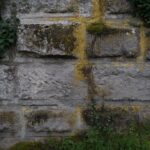 Gabine stone: This grey volcanic stone came from Gabii east of Rome. Tacitus reports that, after the fire of AD 64, Nero required specified parts of buildings to use Gabine or Alban stone without timber. Their resistance to heat informed the choice. Gabine blocks also formed part of the high enclosure wall of the Forum of Augustus.
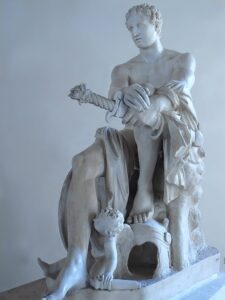 Pentelic marble: Mount Pentelikon in Attica supplied fine-grained white marble, with iron compounds giving weathered surfaces a warm tint. The Parthenon used this stone. Roman patrons imported it for sculpture and architectural elements after Rome’s conquest of Greece.
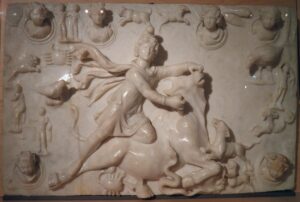 Parian marble: Quarries on Paros supplied white marble extensively used by Greek sculptors. Roman workshops continued to use it for portraits, divine and mythological figures and carved architectural decoration. Its grain and translucent appearance suited detailed sculpture.

 Proconnesian marble: Marmara Island supplied white or pale-grey marble with grey bands. Its quarries yielded large blocks, exported widely by the second century AD. Columns, architectural components and paving travelled to Mediterranean cities. Production continued into late antiquity, supplying Constantinople and other eastern centres.



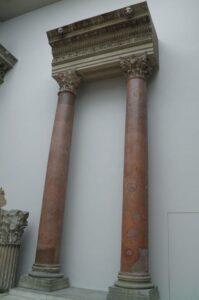 Egyptian granites: Aswan supplied red granite, while Mons Claudianus in the Eastern Desert supplied grey granodiorite. Their hardness required sustained cutting and abrasive work. Egyptian stone travelled in large columns and other monoliths; sixteen imported granite shafts support the Pantheon’s porch. Egyptian quarries also supplied purple porphyry, extensively used in imperial decoration and sarcophagi in late antiquity.

 Giallo antico: Yellow Numidian stone appears in geometric floors and wall panels. Cutting smaller pieces allowed builders to arrange contrasting colours in repeated patterns. Later churches reused Roman slabs and fragments in their own pavements.

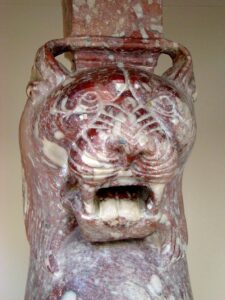 Rosso antico: Deep-red marble from the southern Peloponnese, particularly the Mani, supplied small columns, wall panels and floor inlays. Colour varies from dark rose to deeper red, allowing contrast with white and yellow stones.

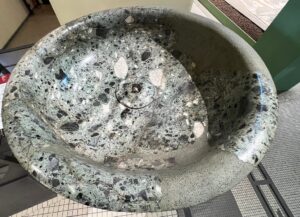 Verde antico: Quarries in Thessaly supplied a breccia containing green serpentinite and pale marble fragments. Builders cut it into wall veneers and pieces for opus sectile floors. It also supplied columns and other shaped elements.

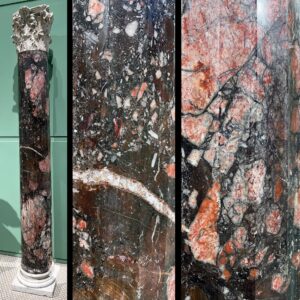 Marmor africano: This decorative breccia has a dark background containing pale, pink and red fragments. Its source was Asia Minor. Its identification with the ancient name marmor Luculleum remains a matter of interpretation. Roman workshops used the patterned stone for columns, slabs, table surfaces and floor accents.
