Burg Richstein: A Medieval Hilltop Castle in Germany

Site at a Glance
- Rating
- 3
- Popularity
- Very Low
- Country
- Germany
- Primary era
- Medieval
- Eras represented
- Medieval
- Civilizations
- Holy Roman Empire
- Site type
- Military
- Remains
- Castle
On this page4 sections
History
Foundation and Sayn-Wittgenstein rule
Burg Richstein is a medieval hilltop castle in Bad Berleburg, Germany, probably built during the second half of the fourteenth century. It was first mentioned in a document from 1384, when Landgrave Hermann II of Hesse granted it as a fief to Count Johann I of Sayn-Wittgenstein. A fief was property granted by a superior in return for loyalty and service. The feudal relationship was confirmed in 1416, 1427, and 1490.
From 1415, officials administering the territories of the counts of Sayn-Wittgenstein were based at Burg Richstein. This placed the castle within the administration of the surrounding lands controlled by that territorial noble dynasty.
Residence, decline, and ruin
In 1502, Count Wilhelm the Elder of Sayn-Wittgenstein assigned Burg Richstein to his wife, Johannetta von Isenburg, as a widow’s residence. Such a residence was a noblewoman’s assigned home after her husband’s death.
After the castle became militarily obsolete, it was no longer restored and fell into ruin during the second half of the sixteenth century. In 1590, the village on the castle hill burned down and was rebuilt in the valley. The ruined castle was subsequently used as a source of building stone. Richstein is now a district of Bad Berleburg in North Rhine-Westphalia.
Remains
Burg Richstein occupied a high hill above the settlement of Richstein, at approximately 480 metres above sea level. The hill, known as Burg, stood above the settlement’s western edge in the valley of the natural Richsteitbach watercourse, near the modern boundary with Hesse. The Lützelbach valley surrounded the hill on its western side.
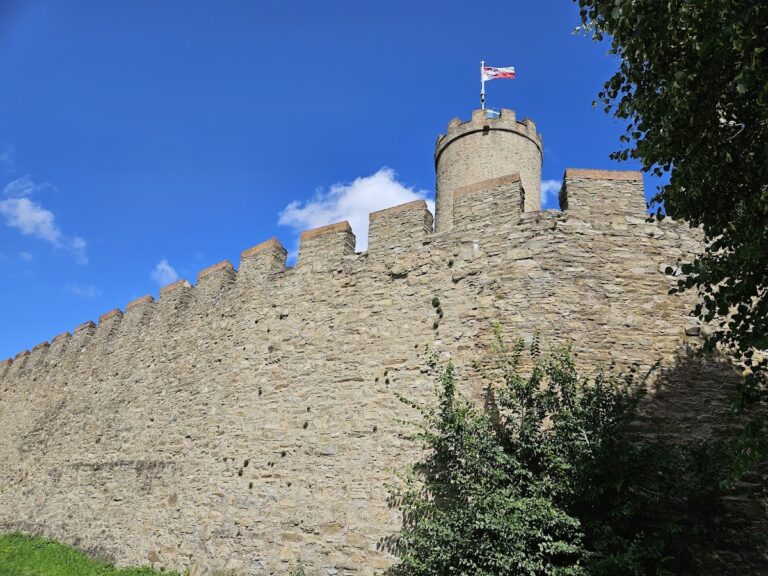
The former castle complex survives as small or slight foundation remains on the hilltop. These foundations represent the surviving physical evidence of the castle after its decline and the later removal of stone for construction.
Nearby sites