Caerleon Castle: A Norman Motte Castle in Wales


Site at a Glance
- Rating
- 4.2
- Popularity
- Very Low
- Country
- United Kingdom
- Primary era
- Medieval
- External website
- Open
- Eras represented
- Medieval
- Civilizations
- Norman
- Site type
- Military
- Remains
- Castle
On this page8 sections
History
Caerleon Castle is a ruined Norman motte castle in Caerleon, Wales, in the United Kingdom. Founded around 1085 on the north bank of the River Usk, it was an earth-and-timber fortification and became one of the oldest and largest castles of its type in South Wales. Its remains are protected as a Scheduled Monument, a legally protected archaeological or historic site.
Norman foundation and Welsh control
The castle was established after the Norman conquest of the Welsh kingdom of Gwent, which followed the death of its last king, Caradog ap Gruffydd. The Norman lord Robert de Chandos conquered the region from Owain Wan, Caradog’s son, and created the fortification at Caerleon around 1085.
After the death of King Henry I of England, Owain Wan’s sons Morgan and Iorwerth captured both Caerleon Castle and nearby Usk Castle during a Welsh uprising. Caerleon then became the center of Welsh rule in Caerleon. In 1171, Iorwerth lost the castle to King Henry II and his ally Lord Rhys, the ruler of Deheubarth, a medieval Welsh kingdom in south-west Wales. Iorwerth’s first attempt to recover it failed later that year, but he regained control in 1173.
Stone construction and medieval conflict
Iorwerth’s grandson, Morgan ap Hywel, later attempted to seize the neighboring lordship of Striguil, the Welsh name for the lordship centered on Chepstow, from William Marshal. Marshal captured Caerleon Castle in 1217 and developed it as a stone castle, changing the character of the earlier earth-and-timber stronghold.
Llywelyn ap Iorwerth of Gwynedd, another major medieval Welsh kingdom in north Wales, destroyed the castle during a campaign in 1231. In 1236, Gilbert Marshal was forced to return it to Morgan ap Hywel after a rebellion by Gilbert’s brother Richard against King Henry III. Following Morgan ap Hywel’s death in 1248, the castle passed to Richard de Clare, 5th Earl of Hertford. Richard de Clare’s grandson Gilbert later died, and the castle passed first to Gilbert’s widow Maud and then, after her death in 1320, to Gilbert’s sister Elizabeth de Clare.
Crown ownership and destruction
Elizabeth de Clare was compelled to surrender Caerleon Castle to her brother-in-law Hugh le Despenser in 1322. Despenser was executed as a traitor in 1326, after which the castle passed to the Crown.
In 1402, Rhys Gethin, a commander of Owain Glyndŵr, captured and destroyed the castle during Glyndŵr’s uprising. Owain Glyndŵr was a late-medieval Welsh leader who led a major revolt against English rule. In 1466, William Herbert, 1st Earl of Pembroke, was appointed constable of Usk and Caerleon Castle.
Decline and later development
After its medieval military role ended, the castle continued to decay and was quarried for building stone. The former castle was leased by the Earl of Pembroke in 1622 and sold to its tenants in 1732.
The new owners built a manor house called Castle House, or The Mynde, on the former castle site, together with an adjoining garden. The former motte was incorporated into the garden, which was enclosed by a wall around 1840. Roads now cross parts of the former castle complex, and later building has altered other areas. The former castle mound is privately owned, while Hanbury Tower has separate Grade II* protection, a high level of protection in the British system for structures of particular importance.
Remains
The surviving site is organized around a large earthwork mound and the ruin of a detached round tower to its south-west. These features represent the principal visible remains of a castle that developed from an early motte fortification into a stone stronghold with an outer curtain wall, a defensive wall enclosing the castle precinct.
The motte
The principal surviving feature is the motte, a raised earth mound that carried the castle’s timber or masonry stronghold. It rises almost 30 metres, measures more than 60 metres across at its base, and is approximately 25 metres wide at the summit. The mound was built over the ruins of a Roman bath at Caerleon and was originally surrounded by its own ditch.
Access to the castle was provided by a gate at the foot of the mound, where two towers defended the entrance. The motte now lies within a walled enclosure and is densely covered by trees and shrubs. The surrounding former castle grounds have been affected by roads and later construction, while the mound is only partly visible from the road.
Outer enclosure and Hanbury Tower
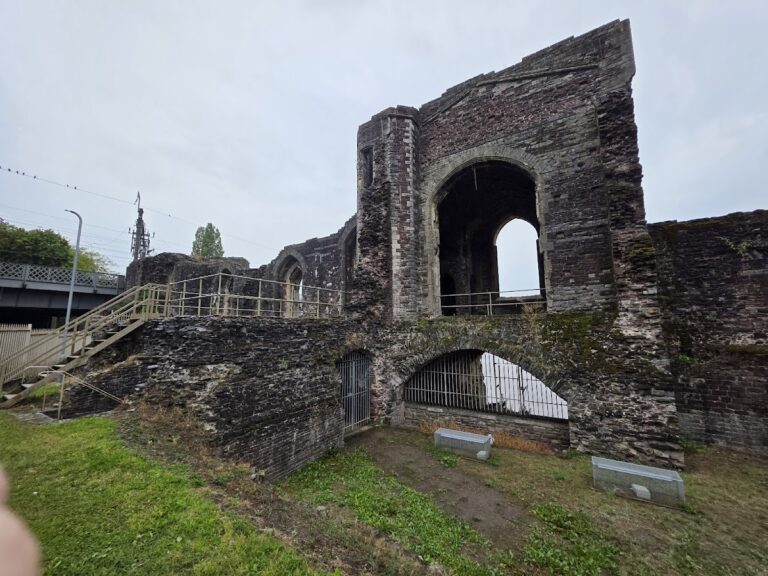
About 180 metres south-west of the motte stands Hanbury Tower, a ruined round tower built in the thirteenth century. It formed part of the southern section of the castle’s outer curtain wall, whose enclosure covered approximately 150 by 50 metres. Parts of the tower were built with stone taken from Isca Silurum, the Roman fortress and settlement at Caerleon, showing the reuse of Roman building material in the medieval castle.
The tower ruin now adjoins the old public house called the Hanbury Arms, from which it takes its name. Together with the motte, it preserves two separated elements of the castle’s medieval defensive arrangement: the raised central stronghold and part of the outer fortified enclosure.