Haus Haan: A Water Castle and Former Knightly Estate in Cologne


Site at a Glance
- Rating
- 4.3
- Popularity
- Very Low
- Country
- Germany
- Primary era
- Early Modern
- External website
- Open
- Eras represented
- Early Modern
- Civilizations
- Duchy of Berg, Holy Roman Empire
- Site type
- Domestic
- Remains
- Castle
On this page9 sections
History
Haus Haan is a water castle and former knightly estate in Cologne, Germany, whose origins reach back to a castle built before 1200. The present manor house dates from 1730, and the site lies in the Höhenhaus district near the boundary with Dünnwald. Its history is closely connected with the Mutzbach, the Dünnwald convent, and several noble families.
Origins and the dispute over the Mutzbach
The site was first mentioned in 1203. An initial motte, a fortified castle centered on a raised earthen mound and protected by a ditch or moat, had been established there before 1200 by the knight Seybold von Blech on cleared land. In 1230, the castle passed to the knight Konstantin von Haane. The name Haus Haan is linked to later disputes between the Haane family and the Dünnwald convent over rights to the water of the Mutzbach.
In 1264, Konstantin’s sons, Nikolaus and Jakob von Haane, contested the convent’s use of the stream. The convent had been granted the right to operate its mill with the water by Count Adolf “with the Beard,” while the Haane knights diverted the stream into the castle moat. After the dispute continued for some time, Countess Margarete of Berg and her son Adolf appointed a twelve-member arbitration panel.
The settlement gave the convent exclusive rights to the watercourse but permitted the knights to divert water to the castle on two specified periods each week, from Saturday to Sunday and from Wednesday to Thursday, beginning at 9:00 a.m. The water could be directed only to the castle moat or the castle itself. As part of the settlement, a relative of the knights was to enter the Dünnwald convent, while the convent was required to pay the knights 20 Cologne marks for damage and harassment suffered during the conflict.
The Haane and Lülsdorf families
In 1355, the knight Wilhelm von Haane built a mill where the Mutzbach descended from the lowest heath terrace into the Rhine valley. Probably operated in agreement with the Dünnwald convent, it was a fulling mill, using water-powered machinery to clean, thicken, and finish woven cloth, while also processing leather. Before the mill was built, cloth and leather had to be taken to Mülheim for fulling at the Strunde stream. The mill later operated under leases to tenants and remained associated with Haus Haan for a long period as the lower fulling mill.
Through inheritance, the castle passed from the Haane knights to the knightly family of Lülsdorf. The Lülsdorfs lived at Haus Haan from 1373 to 1710, and the estate became their ancestral seat.
War, rebuilding, and later ownership
Imperial troops burned the castle in 1628 during the Thirty Years’ War, the major European conflict fought mainly between 1618 and 1648. The manor house in its present form was built in 1730 and renovated in 1786.
Inheritance later transferred the estate to the Droste zu Vischering family. In 1812, it was sold to Brügelmann of Ratingen, and Friedrich Wilhelm Brügelmann became its administrator. He founded the company Brügelmann in Cologne in 1822. Brügelmann sold Haus Haan in 1818 to Baron von Fürstenberg zu Neheim, whose family later became the comital house of Fürstenberg-Stammheim.
The Counts of Stammheim sold the estate to the City of Cologne in 1828. Without a plan for its use, the complex deteriorated in the following years. Parts of it, particularly the outbuildings, were used as an equestrian facility. The City of Cologne sold the property in 1986, after which it was converted into a condominium complex.
Legends and local memory
A local legend tells of an underground passage linking Haus Haan with the Dünnwald convent. According to the story, nuns used the passage to reach safety during hostile attacks on the convent. A local poem also describes a Count of Stammheim as a benefactor of the church and connects a church pew bearing his coat of arms with the residents and tenants of the castle.
Remains
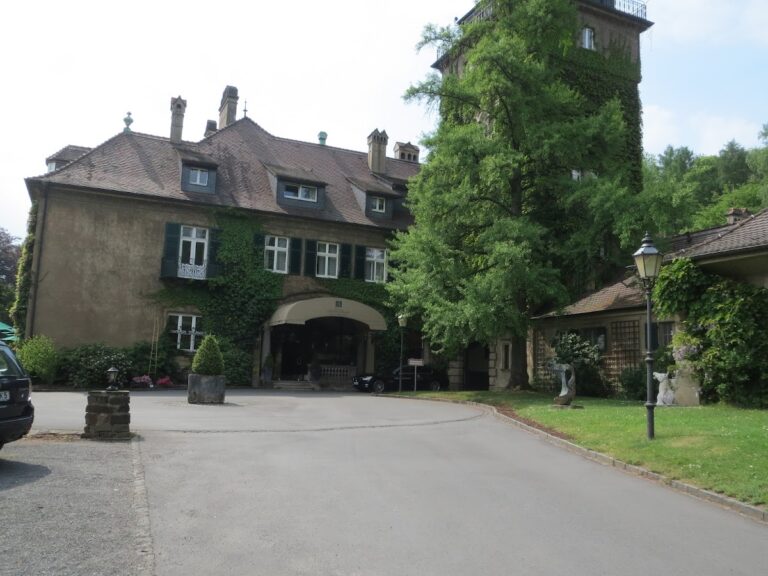
Haus Haan has a quadrangular layout centered on a manor house standing on a high masonry-built island. The island is entirely enclosed by a moat, while younger former outbuildings extend around the manor house on three sides from the edge of the water. The complex is not completely enclosed by buildings. A steep stone arch bridge leads from its courtyard to the island and the manor house.
Manor house and courtyard buildings
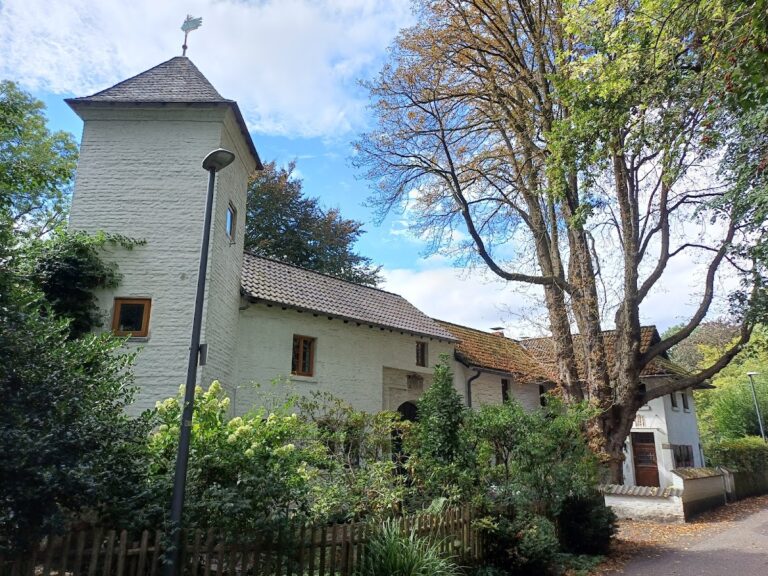
The manor house is an undecorated, two-story quadrangular building with aligned window axes, meaning vertical lines along which windows are arranged on the facades. It is covered by a high mansard roof, whose lower slopes are steeper than the upper slopes and create additional usable space beneath the roof. A gate passage in the surrounding courtyard buildings faces the entrance to the manor house and opens toward present-day Zeisbuschweg.
Moat and water system
The moat is supplied by a small stream that branches left from the Mutzbach near the Dünnwalder Mauspfad. A weir regulates the flow of water into the moat. This surviving arrangement reflects the long connection between the castle and the Mutzbach, which also shaped the medieval dispute between the Haane knights and the Dünnwald convent.
Former fulling mill
The former fulling mill stood near the point where the Mutzbach left the lowest heath terrace for the Rhine valley, approximately at the level of the present-day Dünnwalder Mauspfad. Built in 1355, it processed cloth and leather with water-powered machinery and was later operated by tenants. It became known as the lower fulling mill and remained associated with Haus Haan for a long period.
Nearby sites