Waldenburg: A Medieval Hilltop Castle and Administrative Centre in Germany



Site at a Glance
- Rating
- 4.5
- Popularity
- Low
- Country
- Germany
- Primary era
- Medieval
- Eras represented
- Medieval
- Civilizations
- Holy Roman Empire
- Site type
- Military
- Remains
- Castle
On this page12 sections
History
Waldenburg is a ruined hilltop castle in Germany near Attendorn, probably founded around 1000 and built no later than the tenth century. Regarded as the oldest known structure in the Olpe district, it became an important centre of territorial administration and a starting point for the region’s municipal self-government during the Middle Ages.
Early lords and inheritance
The county of Waldenburg was probably granted by Emperor Otto II to his son-in-law Ezzo, Count of Lorraine, as free property of the Ezzonen, a powerful aristocratic family whose possessions and offices extended across the Rhineland and Westphalia. The lordship later passed to Ezzo’s son Ludolf. Ludolf was also the vogt of Brauweiler Abbey, a lay official responsible for representing and protecting a religious institution and its property, and became Count of Zutphen through marriage.
After Konrad of Zutphen died in 1053, his sister Adelheid inherited Waldenburg. Her marriage to Gottschalk of Zutphen transferred the castle to their son Otto II of Zutphen. Otto’s son Heinrich I, Count of Zutphen and vogt of Corvey, died around 1120 after taking part in the 1114 revolt against Emperor Henry V. With Heinrich’s death, the male line of the Counts of Zutphen ended, and the inheritance passed through the female line to Judith of Zutphen.
Judith’s marriage to Hermann I of Ravensberg and Calvelage brought Waldenburg to the Counts of Ravensberg. The Ravensbergs still held the main court of Drolshagen and Waldenburg in 1231. By 1235, Count Henry of Sayn was associated with the Drolshagen estate. After his death in 1247, his widow, Countess Mechtild, sold the lordship and the castrum, or fortified castle, of Waldenburg to Archbishop Konrad of Hochstaden of Cologne on 13 January 1248. The sale included Drolshagen, apart from its Cistercian monastery, Meinerzhagen with specified exemptions, and the Ebbegebirge forest with the rights of others reserved.
Cologne administration and regional conflict
From 1248 to 1305, the archbishops of Cologne appointed officials who administered an extensive district from Waldenburg. The territory included the parishes of Attendorn, Olpe, Wenden, Drolshagen, Elspe, Lenhausen, Valbert, and Bilstein. This arrangement is described as the first form of municipal self-government in the region. Officials recorded at Waldenburg included Johannes de Hurte in 1258, Arnold von Elberfeld in 1259, Konrad von Elberfeld in 1289, and Johann I von Plettenberg in 1300.
Waldenburg’s political and military position changed after the Battle of Worringen in 1288. In that conflict, the archbishop of Cologne lost his regional predominance to the forces of Jülich, Berg, and Mark. Under the settlement of 1289, Waldenburg was pledged to Count Adolf of Berg, who repledged it to Eberhard von der Mark. Cologne then strengthened nearby Schnellenberg Castle, while the Count of Mark reinforced Waldenburg. The surrounding territory became involved in repeated feuds between Cologne and Mark.
Archbishop Wigbold of Holte redeemed Waldenburg in 1300 and appointed Johann I von Plettenberg as drost of the Amt Waldenburg. A drost was a high territorial administrator. In 1305, Johann’s son Heidenreich von Plettenberg became burgrave of Waldenburg. The Plettenbergs later became the effective lords of the castle, although Waldenburg remained connected to the archbishopric of Cologne.
The Plettenbergs and the loss of military importance
Sixteen noble castle retainers served at Waldenburg in 1307. For approximately two centuries, the castle was the principal base for the expansion of Cologne’s territorial authority in the Bigge region. The principal castle fiefs initially belonged to the Waldenberg and Drolshagen families, but both eventually passed to the Plettenbergs. From the mid-fourteenth century, different branches of the family held several castle residences.
The castle and Amt Waldenburg were repeatedly pledged as security for loans between 1333 and 1469. The pledge holders included Berthold of Büren, Johann of Reiferscheidt, Friedrich and Gerhard von Seelbach, Valentin von Sayn, Johann of Grafschaft, Henry of Spiegel, Engelbert von der Mark, Salentin of Isenburg, Henry of Nassau, Dietrich of Sayn, Wilhelm von Nesselrode, and the Hatzfeld brothers.
Between 1364 and 1368, Count Engelbert III of the Mark acquired the former Bilstein inheritance. The resulting loss of Bilstein’s importance as a rival lordship reduced Waldenburg’s function as a territorial fortress. Most of the castle men left, and the site became a knightly estate of the Plettenbergs. Its feudal dependence on Cologne was later forgotten, and the castle and its associated properties were treated as free property unless held from the abbess of Herford.
During the fifteenth-century conflicts, Wilhelm von Plettenberg and his brother Engelbert raided the territory of Fredeburg in 1442 and brought booty and prisoners to Waldenburg. Wilhelm was captured and ransomed during the Soest Feud, a conflict in which the city of Soest struggled to free itself from the authority of the archbishop of Cologne. In 1461, forces from Soest stormed the outer bailey, burning the stables and kitchen but failing to capture the fortified tower.
In 1462, the knights and towns of the Amt Waldenburg formed a mutual protection alliance, renewing it in 1480 and 1530. Attendorn, Olpe, Drolshagen, several parishes, and associated noble families joined the agreement. Members promised to remain under the archbishopric of Cologne, support one another, open their houses for mutual defence, and settle internal disputes through arbitrators.
Later owners and decline
The Waldenburg branch of the Plettenbergs died out in 1488, and the Hoberg family succeeded them in 1495. By that time, the castle had almost entirely lost its military importance and was no longer regarded even as a fief. Johann Hoberg appears to have been its last resident. Waldenburg then declined rapidly, leaving a reduced complex and scattered surviving remains.
After Amtmann Heinrich Hoberg died in 1542, his sister Anna Hoberg, widow of Franz von Hörde of Boke, and Klara Hoberg, wife of Drost Goswin Ketteler of Hovestadt, inherited the estate. The Ketteler family held it from 1554 to 1576. Friedrich von Fürstenberg was appointed Amtmann of Bilstein and Waldenburg in 1556 and again in 1564. In 1570, he received responsibility for Waldenburg and its associated administration. His son Kaspar von Fürstenberg later held the office and built Schnellenberg Castle.
The von Heiden family acquired Waldenburg by inheritance in 1576. From 1579, the branch based at Bruch near Hattingen owned the estate, but its members no longer lived at the castle, which stewards administered. In 1618, a collateral branch represented by Georg von Heiden of Schönrath and Johann Dietrich von Heiden succeeded the Bruch line.
Johann Dietrich von Heiden sought to exchange Waldenburg for the Teutonic Order commandery at Ootmarsum. A commandery, or Kommende, was an estate administered by a military religious order. In 1635, the Teutonic Order permitted the exchange on condition that Johann Dietrich resign as commander and leave the order. The order took possession of Waldenburg in May 1638, and a formal valuation and inventory of the castle and its furnishings followed on 29 September that year.
The transfer led to prolonged legal disputes with the von Heiden heirs. A final agreement in September 1656 transferred Waldenburg and its appurtenances as free property, together with the Amt Schönholthausen as a Herford fief, two farms in the parish of Körbecke, and 5,000 Reichstaler. The Teutonic Order’s short-lived Waldenburg commandery operated during the seventeenth century. Its commanders included Gisbert von der Capellen, Henrich von Ittersum, Dietrich von dem Broel, Eberhard von Dellwig, Hermann Otto de Baer, Franz Wilhelm von Fürstenberg, and Heinrich von Boeselager.
In 1662, Johann Adolf von Fürstenberg became drost of Waldenburg, Bilstein, and Fredeburg until the young Maximilian Heinrich von Fürstenberg came of age. In 1673, the Fürstenbergs were legally placed in possession of the Waldenburg properties as heirs of Goda von Fürstenberg, wife of Bernhard von Heiden. After further disputes, the Teutonic Order sold the contested properties on 8 December 1691 to Reichsfreiherr von Fürstenberg of Schnellenberg, hereditary drost of the three offices.
Fire, demolition, and conservation
Waldenburg probably burned around 1712. Part of the complex was rebuilt, but the reconstruction was apparently smaller than the medieval castle. Johann Hardenacke, his wife, and their nine children lived for several decades in part of the reconstructed stables as caretakers. After Hardenacke was found to have acted dishonestly, Clemens Lothar von Fürstenberg ordered the house of Waldenburg demolished. The Hardenacke family were the last inhabitants.
The von Fürstenberg family retained ownership of the site. Since 1990, the district of Olpe has held the hereditary building right and has been responsible for the ruin. Between 1989 and 1991, the district of Olpe and the city of Attendorn comprehensively secured and restored the surviving parts of the great tower, with financial participation by North Rhine-Westphalia. Waldenburg lies within the Waldenburg nature reserve and forms part of regional hiking routes. Since 2019, the 16.8-kilometre Two Castles Trail has connected it with Schnellenberg Castle.
Remains
Waldenburg is a rubble-stone hilltop castle at an elevation of about 370 metres on a mountain spur beside the Bigge reservoir. The ground falls steeply on three sides. An ascending side valley borders the eastern side, while the Bigge valley curves around Dünekenberg to the northwest. Earlier approaches came from the Bremge valley through Bürberg or along a hollow way rising from the Bigge valley at about 265 metres. The approach then passed through the side valley from the southwest.
Approach and defensive setting
Three deep crosswise ditches, each approximately 100 metres from the next, blocked the ridge leading toward the castle. The approach probably crossed them by drawbridges before reaching the inner castle. Historical descriptions place economic and residential buildings between the ditches. From the castle, the upper Bigge and Lister valleys, the Worbscheid and Erbscheid heights, the Ebbegebirge ridge, and parts of the historic Heidenstrasse could be surveyed. Dünekenberg blocked a direct view of Attendorn, while Rappelsberg blocked the line of sight to Schnellenberg Castle, about 3 kilometres away.
Castle buildings
Residential building
The principal residential building stood beside the great tower on the northwest side, toward the Bigge valley. An inventory made in 1638 describes a large room with an adjoining chamber and kitchen, including a small room for the kitchen maid. On the upper floor were a clock room containing the castle and courtyard clocks, a sleeping chamber, and a large hall that probably extended across the full width of the house. A stairwell in front of the hall led to the attic.
The attic included a farmhand’s chamber and a small grain loft. The top attic stored grain, held hare and roe-deer skins for drying, and contained a loom during the summer. A small gable chamber in front of the grain floor provided a bed for the steward. The cellar contained a three-ohm beer cask and a fodder chest with its associated bushels. The bakery and brewery stood beside the residential building.
Stables, barns, and gatehouse
Stables and barns occupied the opposite side of the inner courtyard. The stable held thirteen cows, four young cattle, one ox, four pigs, and twenty-five goats. A horse stable for three horses adjoined it and led toward the barn, where wagons, carts, and agricultural implements were stored. A gatehouse between the tower and the stables enclosed the courtyard with the other buildings.
The small gatehouse beside the great tower contained a writing room and two additional chambers. A later chapel and the Waldenburg forestry house stood at the foot of the castle. Close to the site, the boundary of the Bilstein lordship was secured by a double ditch and rampart.
Great tower and surviving fabric
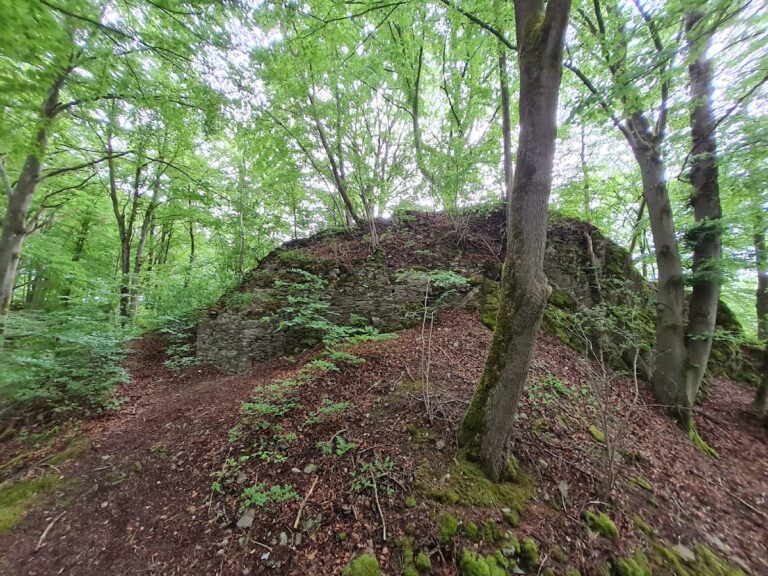
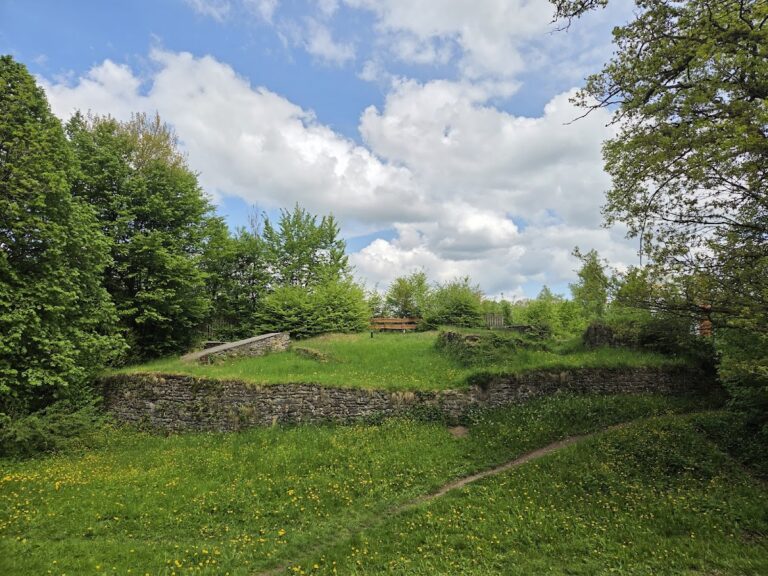
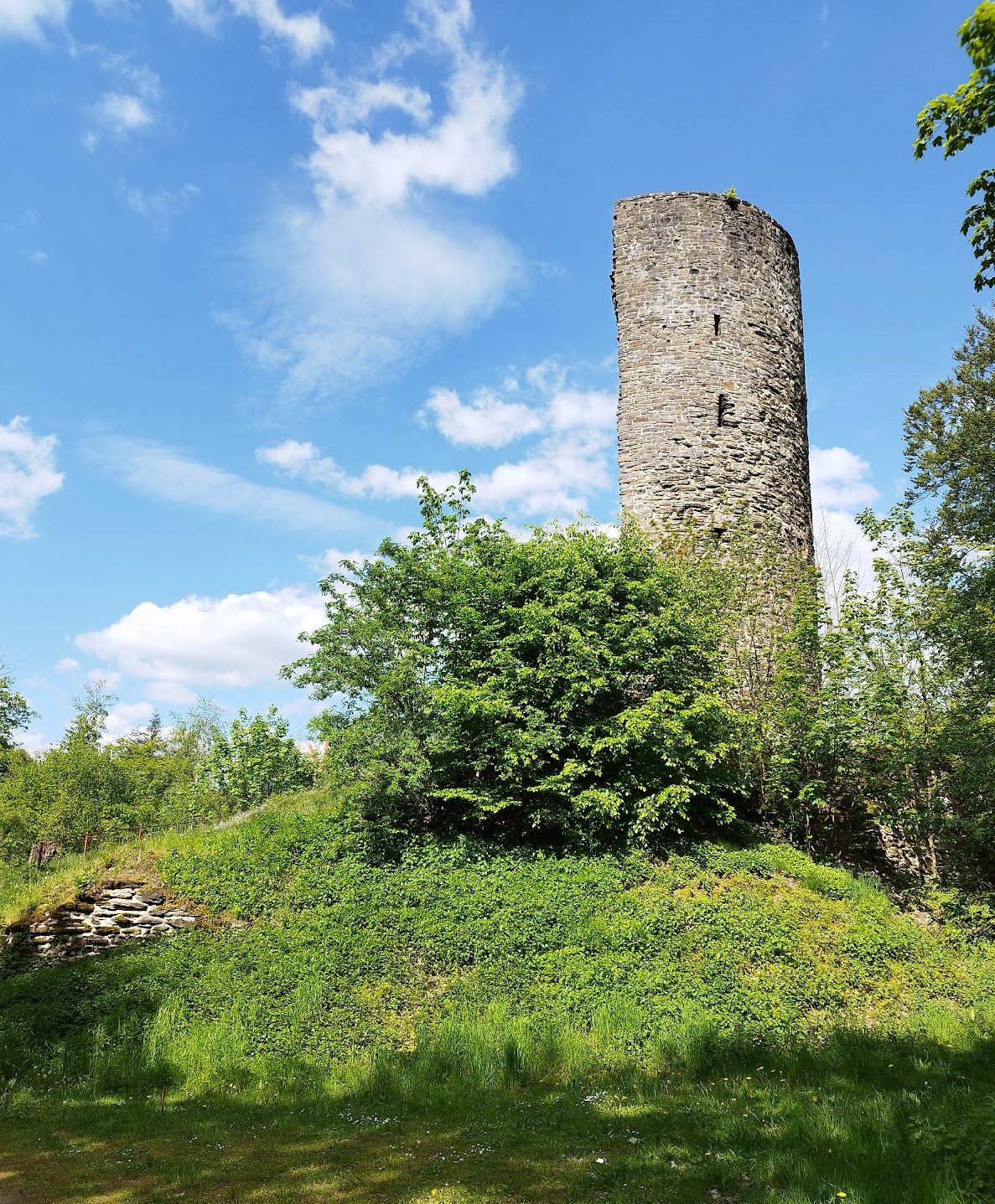
The most prominent surviving element is part of the great tower, or bergfried, the principal fortified tower of a medieval German castle, used chiefly for defence and refuge rather than ordinary residence. The tower was comprehensively secured and restored between 1989 and 1991. The fire, partial rebuilding, and later demolition left the castle represented chiefly by the tower remains together with scattered fragments and ruins of the wider complex.
Nearby sites