Königsburg: A Medieval Hill Castle in Germany


Site at a Glance
- Rating
- 4.5
- Popularity
- Low
- Country
- Germany
- Primary era
- Medieval
- External website
- Open
- Eras represented
- Medieval
- Civilizations
- Holy Roman Empire
- Site type
- Military
- Remains
- Castle
On this page9 sections
History
Königsburg is a medieval hill castle in Germany, southeast of Königshütte in the Harz district of Saxony-Anhalt. It was first recorded in 1312, when Bishop Albrecht of Halberstadt purchased the fortress from the squire Heinrich von Botvelde. The castle belonged to a medieval period when fortified sites served as places of residence, administration, and defense.
Medieval records and later names
The first surviving reference calls the site castrum Königshof. It appeared again in 1324 under the name castrum Köningshof acqisivit. In 1614, the site was mentioned in connection with its keep, which was then called Königshoffe. The name Königsburg came into use from 1709, by which time the castle had already fallen into ruin.
The Bodfeld identification
Between 1898 and 1901, Paul Höfer carried out extensive excavations at Königsburg. He believed that the remains represented the long-sought Bodfeld palace, or hunting palace, a residence associated specifically with medieval rulers’ hunting expeditions. Höfer published this interpretation several times.
Carl Schuchhardt rejected the identification in 1931, and Paul Grimm confirmed the conclusion shortly afterward. The finds, particularly the pottery, were no older than the thirteenth century. The view that Königsburg was not the Bodfeld hunting palace became generally accepted in scholarly research, although Königshütte has continued to promote that association.
The ruins are listed in the local monument register as an architectural monument under number 09403363 and in the archaeological-monument register under number 42830158.
Remains
Setting and defensive earthworks
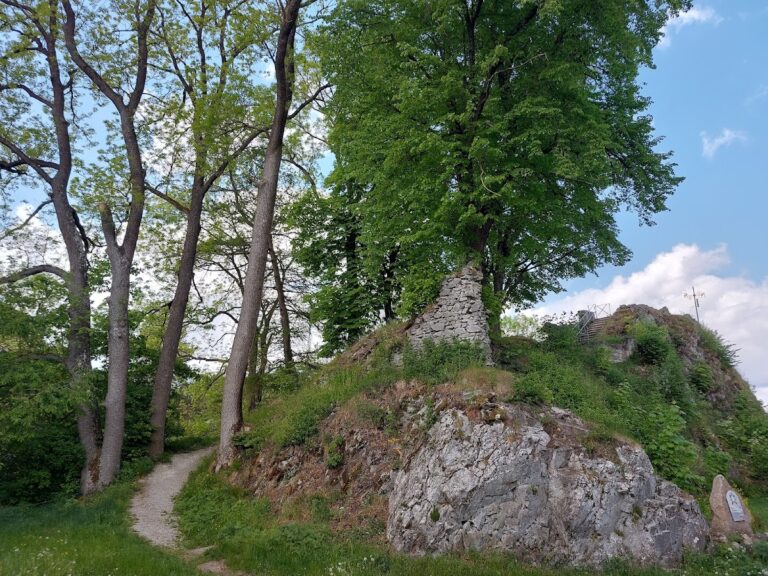
Königsburg occupied a small, roughly rounded castle area on the edge of a wooded plateau. The site lies about 460 metres above sea level, southwest and below the Katzenberg, whose elevation is given as 475.8 metres. It stands approximately 250 metres northeast of the confluence of the Warme Bode and Kalte Bode rivers, with views toward the Wurmberg and the Brocken.
The castle layout included an outer bailey, a tower mound, a rampart, and a ditch. Several ditches and ramparts remain among the visible features, defining parts of the former fortified area.
Buildings and water supply
Keep
Parts of the keep survive within the ruins. A keep, also called a bergfried in medieval German castle architecture, was the principal fortified tower and served mainly as a strong defensive and refuge structure rather than as the castle’s ordinary residential hall.
Palas
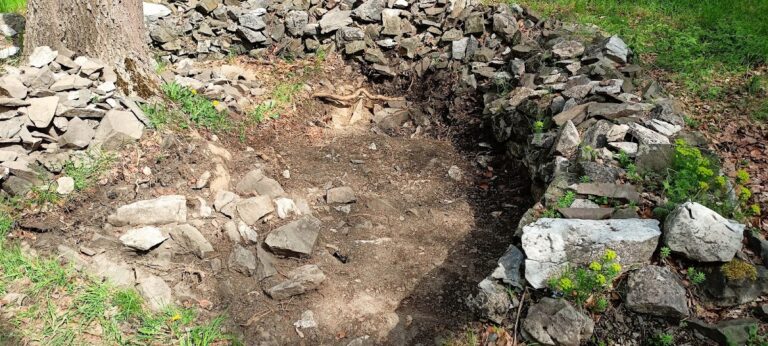
Foundations identified as those of the palas remain in the inner castle area. The palas was the main residential and representative building of a medieval German castle, and its foundations form part of the surviving architectural evidence at Königsburg.
Well and inner castle
A well is identified among the castle remains. Together with the keep, the palas foundations, and other remains of the inner castle area, it illustrates the principal components of the medieval fortified settlement.