Aizanoi: An Ancient Greek and Roman City in Türkiye
Site at a Glance
- Rating
- 4.7
- Popularity
- Medium
- Country
- Turkey
- Primary era
- Classical
- Eras represented
- Bronze Age, Classical, Medieval
- Civilizations
- Ancient Greek, Roman, Seljuk
- Site type
- City
On this page19 sections
History
Aizanoi was an ancient Greek city in Türkiye, at modern Çavdarhisar near Kütahya, whose most important monumental phase developed under Roman rule from the early Roman Empire to the third century AD. Built beside the Penkalas River at roughly 1,000 metres above sea level, it became a political, economic, and religious centre of inland western Anatolia.
Early settlement and Hellenistic rule
Human settlement in the area reaches back to the Bronze Age. Ceramics indicate habitation during the first half of the third millennium BC, while the hill later occupied by the Temple of Zeus also preserves evidence from this early period. The name Aizanoi may derive from Azan, a legendary Phrygian ancestor said to be the son of Arcas and the nymph Erato.
During the Hellenistic period, the era between the conquests of Alexander the Great and the rise of Roman power in the eastern Mediterranean, Aizanoi passed between the kingdoms of Pergamum and Bithynia. Pergamum was bequeathed to Rome in 133 BC, bringing Aizanoi into Rome’s province of Asia. The city retained the right to mint its own coins.
Roman development
Aizanoi expanded into an important urban centre during the Roman period. Its major public buildings were erected between the early Roman Empire and the third century AD. Under Roman administration, the city belonged to the province of Phrygia Pacatiana and received monumental sanctuaries, theatres, baths, markets, bridges, and civic spaces.
The city’s religious life included the local Anatolian mother-and-earth deity Meter Steunene, who was associated with Cybele, as well as Zeus and other Greek and Roman gods. A Temple of Artemis was built during the reign of Claudius, from AD 41 to 54, before later being demolished to make way for a colonnaded street. The theatre and stadium were begun after AD 160 and completed around the middle of the third century.
Christian and late antique Aizanoi
Aizanoi became a Christian bishopric at an early date. Its bishopric was initially subordinate to Laodicea, a larger metropolitan see. After Phrygia Pacatiana was divided into two provinces, Aizanoi became subject to Hierapolis, the capital of Phrygia Pacatiana II.
Several bishops are associated with important church councils. Pisticus, also called Pistus, attended the First Council of Nicaea in 325. Pelagius attended a synod in 518 and the Second Council of Constantinople in 553. Gregory attended the Trullan Council in Constantinople in 692, John attended the Second Council of Nicaea in 787, and Theophanes attended the councils of Constantinople in 869 and 879. Aizanoi is no longer a residential bishopric and is listed by the Catholic Church as a titular see, a historical bishopric name retained for a diocese that no longer functions as a residential one.
The city began to decline during Late Antiquity, the later Roman and early medieval centuries, particularly after the seventh century. One bath complex was rebuilt several centuries after its construction and then used as the seat of the bishop, showing how earlier public buildings were adapted to changing urban and religious needs.
Seljuk transformation and modern archaeology
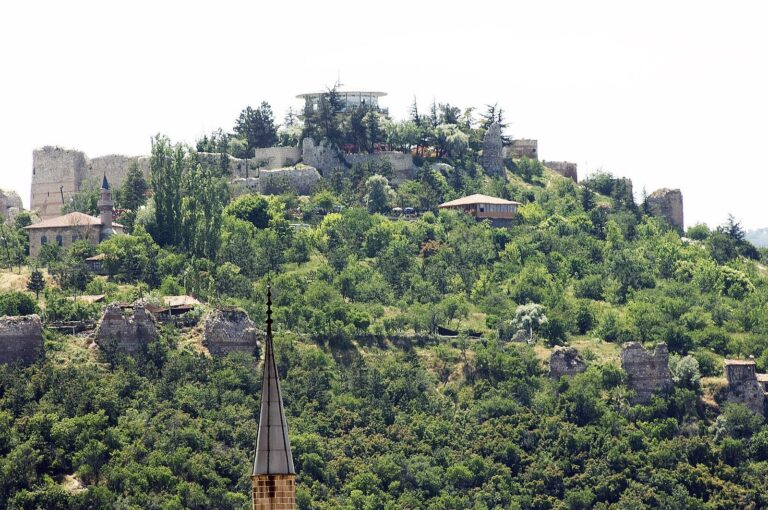
During the Seljuk period, the hill carrying the Temple of Zeus was converted into a citadel by the Çavdar Tatars. The modern settlement of Çavdarhisar takes its name from both the Çavdar Tatars and this fortified hill.
European travellers recorded the ruins in 1824, and surveys followed during the 1830s and 1840s. Systematic excavation began under the German Archaeological Institute in 1926, initially led by the archaeologist and architectural historian Daniel Krencker, whose work included a study of the Temple of Zeus. Excavations resumed in 1970 and continue under the Department of Archaeology at Dumlupinar University. Work in 2017 included excavation in the northern necropolis, preliminary soundings for the restoration of the odeon or bouleuterion, and test trenches examining a wall foundation within the Penkalas Project.
Archaeological discoveries have continued to shape understanding of Aizanoi. In January 2021, a team led by Elif Özer announced a hoard of 651 Roman coins found in a jug buried near a stream. It contained 439 silver denarii and 212 silver cistophori from Pergamum. The best-preserved coins carried images or names associated with Caesar, Brutus, Mark Antony, and Augustus. In August 2021, archaeologists announced a human-sized statue of Hygieia, the Greek goddess associated with health and sanitation, holding a snake. A marble statue of Heracles, the Greek heroic figure renowned for his labours, was found in December of the same year.
Aizanoi was placed on Türkiye’s UNESCO World Heritage Tentative List in 2012 under criteria (ii) and (iv). The archaeological site is administered by the Kütahya Museum Directorate and is described as preserved. Its cultural and monumental remains have sometimes led to the informal comparison “second Ephesus,” although Aizanoi’s own historical character rests on its inland Anatolian setting and its combination of Greek, Roman, and Christian phases.
Remains
Aizanoi’s surviving remains occupy both banks of the Penkalas, or Kocaçay, River. The site combines a hilltop sanctuary with civic buildings, bathing complexes, a market, a connected theatre and stadium, bridges, streets, and extensive burial areas. The remains range from early settlement traces to Roman monumental construction and later adaptations.
Sanctuaries and religious buildings
Temple of Zeus
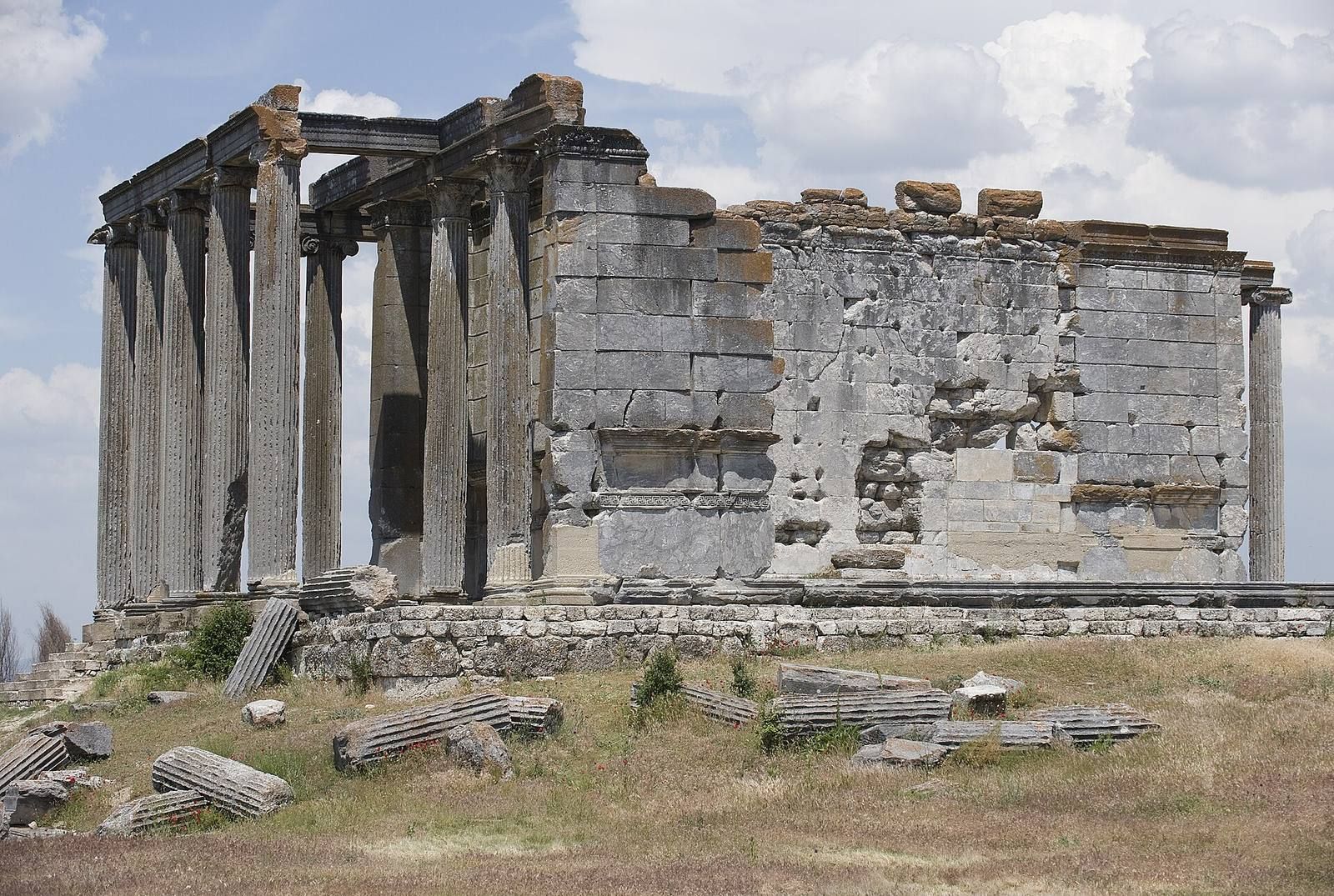
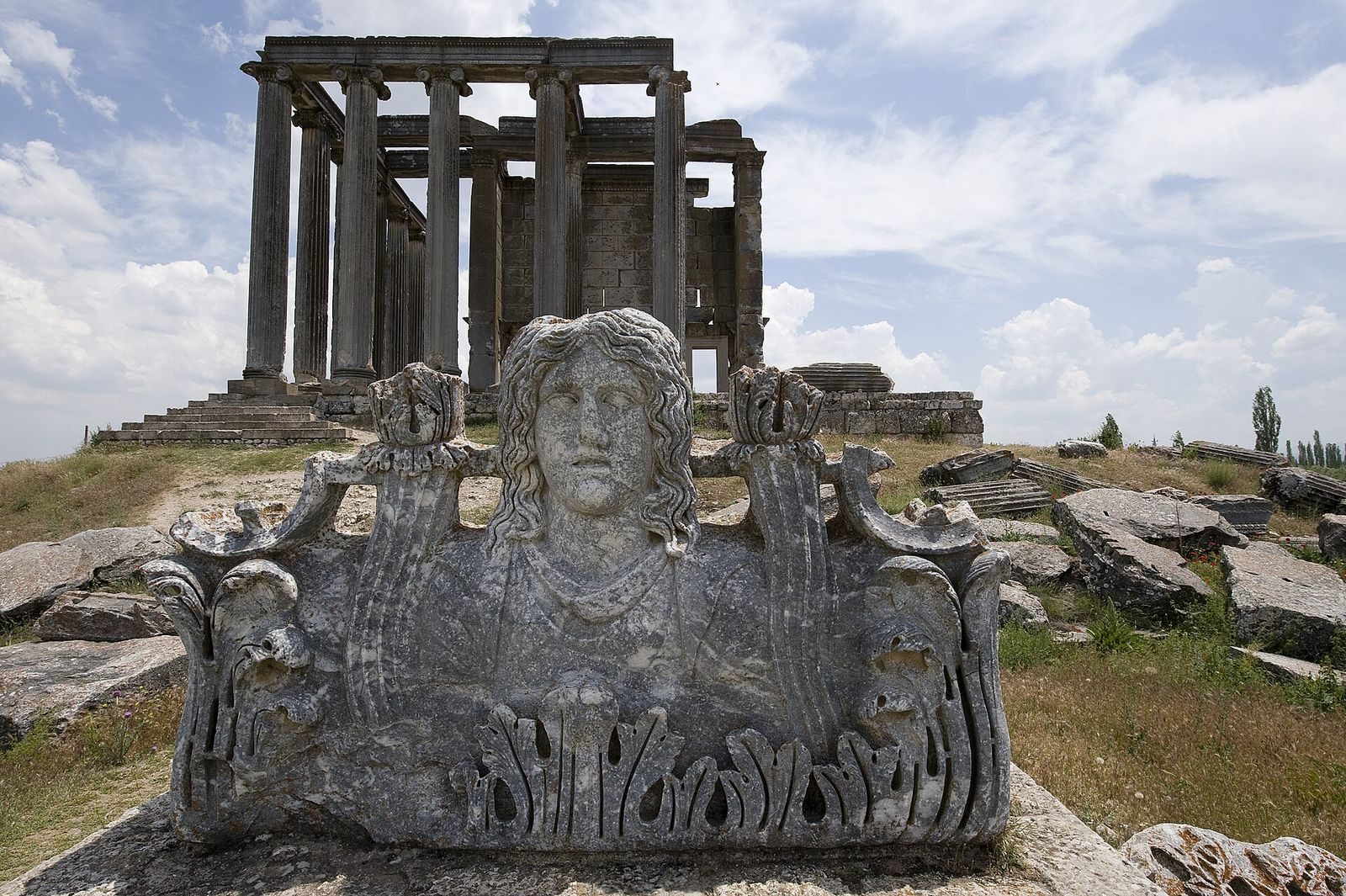
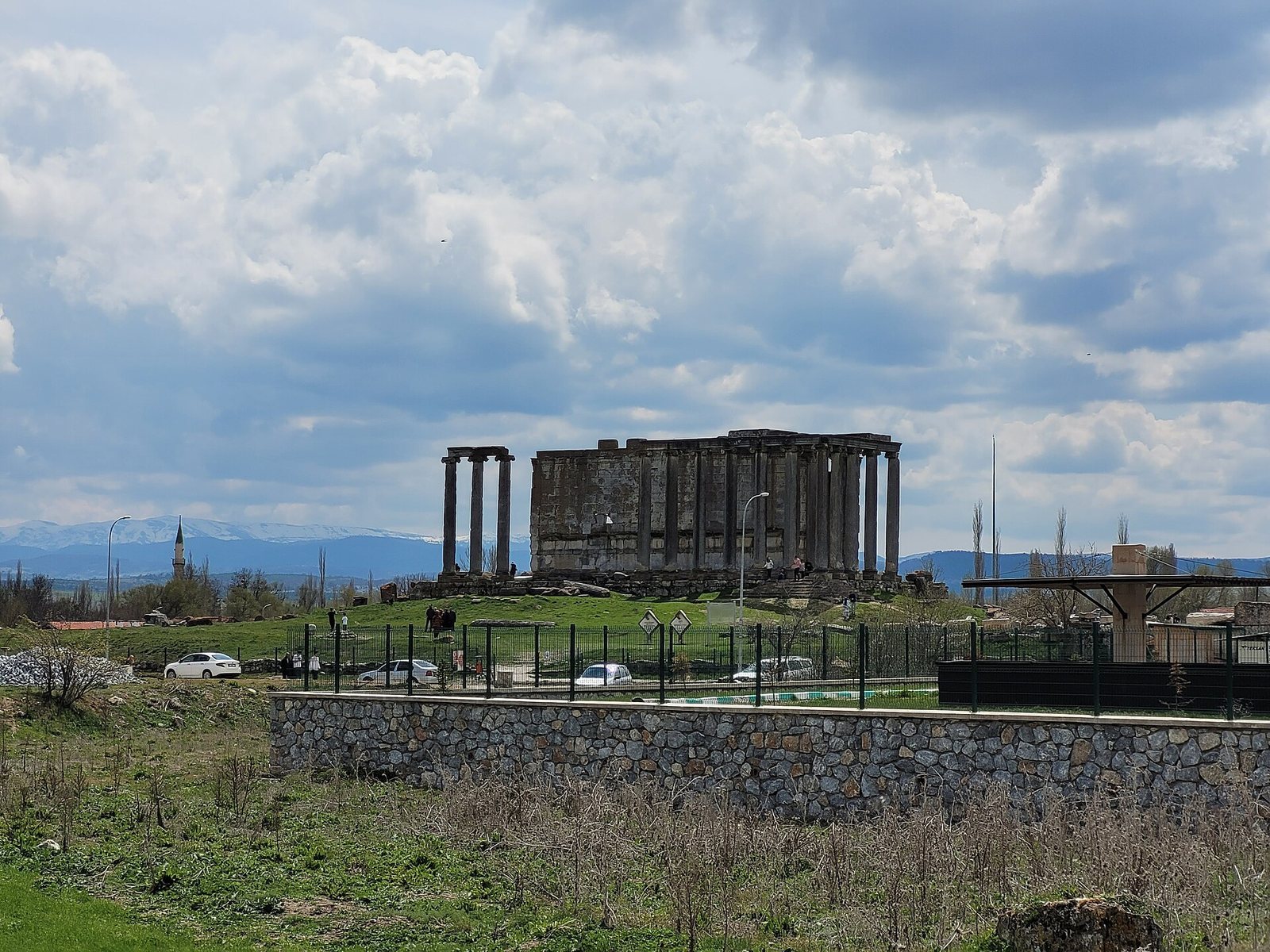
The Temple of Zeus stands on a mound that formed the city’s main sanctuary. Construction began during the reign of Domitian, probably in AD 92 or AD 94–95, according to readings of an inscription on the eastern architrave. The building is pseudodipteral, meaning that it has one surrounding row of columns spaced as though a second outer colonnade were present. It measures approximately 35 by 53 metres, with eight columns at each short end and fifteen along each long side.
A vaulted space lies beneath the temple, an unusual arrangement for Roman-period Anatolia. Its precise function remains uncertain, although it has been plausibly connected with the cult of Meter Steunene. Inscriptions record imperial assistance from Hadrian in recovering unpaid rents and the benefactions of Marcus Apuleius Eurykles. The western pediment acroterion has been interpreted as a bust of Cybele, while the eastern one may have carried a bust of Zeus, suggesting that the building could have served both deities. The Çavdar Tatars later carved equestrian and battle scenes into its stonework. The temple was damaged in the 1970 Gediz earthquake and subsequently restored.
Sanctuary of Meter Steunene
The sanctuary of Meter Steunene included a deep tunnel within a cave. The cave later collapsed, while excavations recovered clay cult figurines and two round pits apparently used for animal sacrifice. The larger pit is called a taurobolium, a ritual pit associated with the sacrifice of a bull, and has been linked with offerings to the goddess.
Civic entertainment and public life
Theatre and stadium
The theatre and stadium were constructed directly beside one another north of the Temple of Zeus, with the stage building separating the two complexes. Work began after AD 160 and continued in stages until about the middle of the third century. Their combined arrangement is described as unique in the ancient world. Inscriptions also record the benefactions of Marcus Apuleius Eurykles.
Bath complexes
One group of baths stood between the theatre-stadium complex and the Temple of Zeus. Dating to the second half of the second century AD, it included a palaestra, an exercise area attached to a Greek or Roman bath complex, together with marble furnishings, water channels, and heating channels.
A second bath complex in the northeastern part of the city was built about a century later. Its mosaic floors depict a satyr and a maenad. After being rebuilt several centuries later, the complex became the seat of the bishop.
Agora and odeon
The agora included a columned gallery along its southern wing. A human-sized statue of Hygieia holding a snake was found in this gallery. An odeon or bouleuterion formed another component of the civic centre, and preliminary soundings for its restoration were undertaken in 2017. A marble statue of Heracles was also recovered at Aizanoi.
Market and streets
Macellum
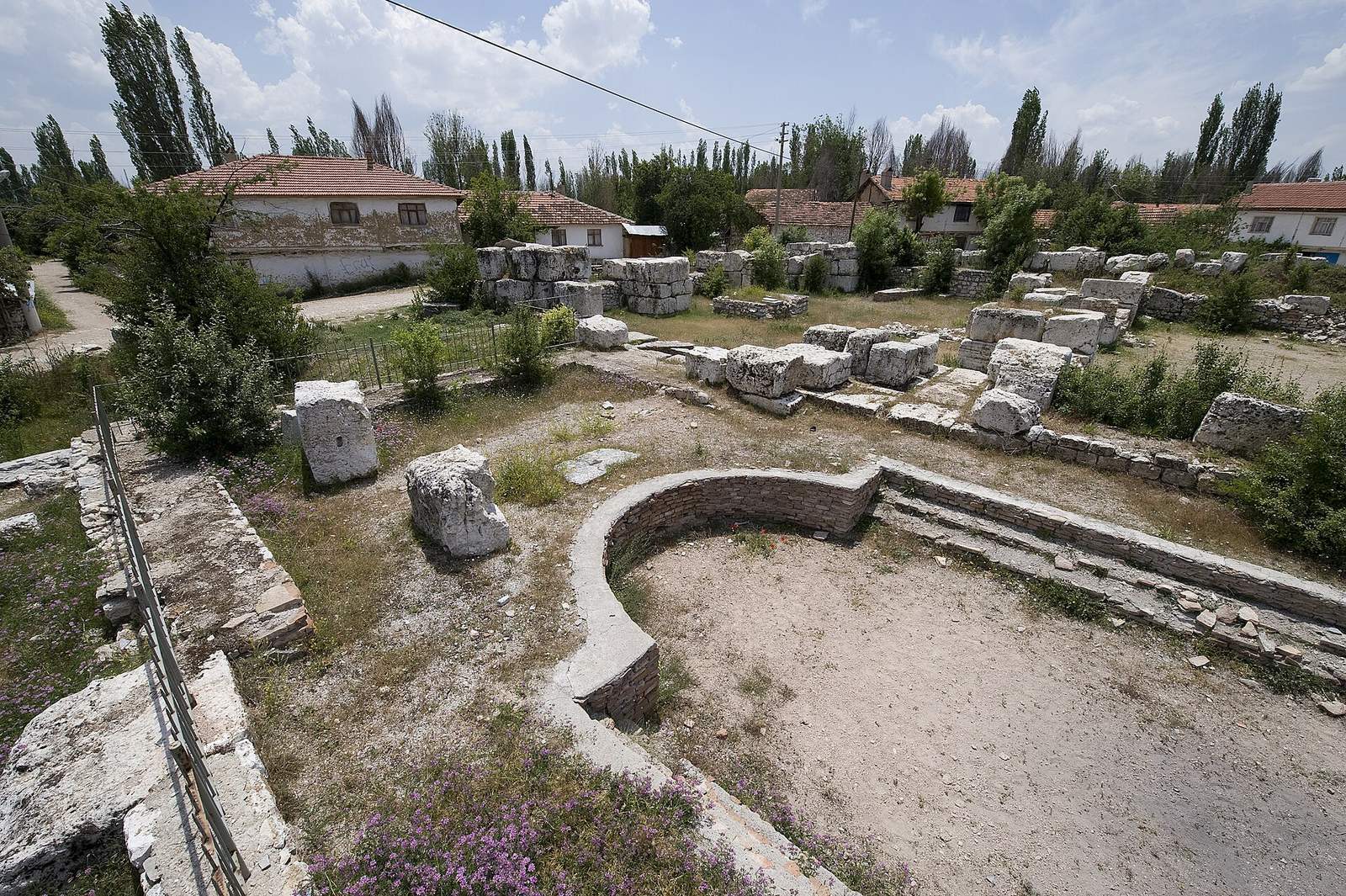
A circular macellum, a Roman market building commonly associated with the sale of food and other commodities, stood in the southern part of the city. It dates to the second half of the second century AD. Latin and Greek inscriptions cover its walls, including a fourth-century copy of Diocletian’s Price Edict, issued in AD 301 to limit inflation associated with the debasement of coinage.
One inscription gives comparative prices for enslaved people and animals, stating that a male slave aged sixteen to forty was valued at the price of two donkeys, while three male slaves equalled the price of one horse. Aizanoi has consequently been described as the first recorded place where inflation was calculated, and the macellum has also been called one of the world’s earliest exchange buildings, although its probable function was a food market. The structure was exposed after a mosque built above it was demolished following the 1970 earthquake.
Colonnaded street
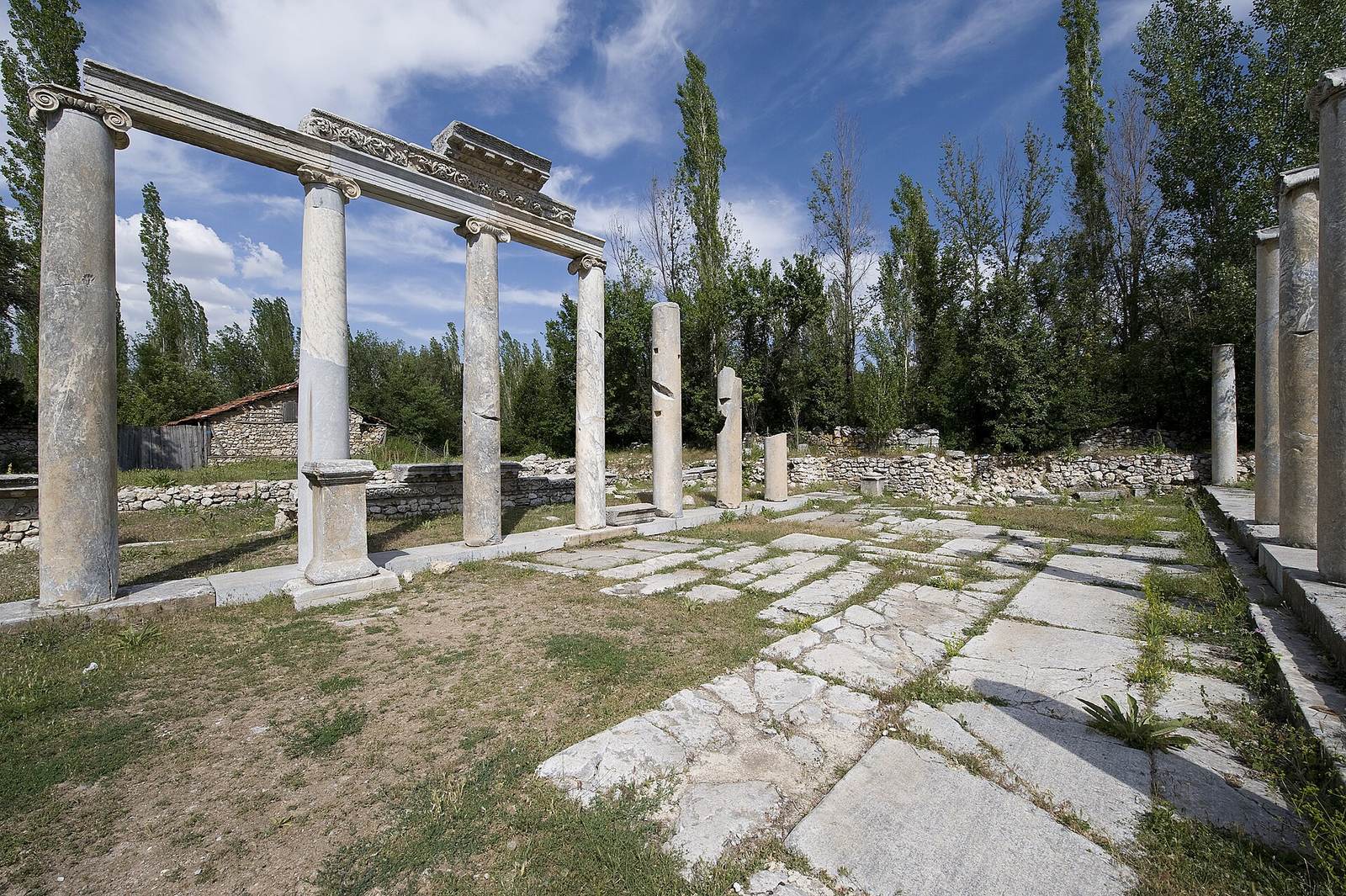
Northeast of the macellum, a colonnaded street was associated with a stoa, a covered walkway supported by columns, dating to approximately AD 400. The colonnade extended for about 450 metres and led toward the sanctuary of Meter Steunene. Its columns were reused from earlier ancient buildings. The street remained in existence until the sixth century and may have been destroyed by an earthquake.
River crossings and burial grounds
Bridges
Four Roman bridges crossed the Penkalas River. Two surviving bridges remain in use after repairs by the Turkish highways authority, although the surviving structures have also been described as poorly restored.
Necropolises
The Karabulut necropolis lies approximately two kilometres southwest of the city. Tomb structures on the northern bank of the Penkalas have been used to estimate Aizanoi’s Roman-period population at approximately 30,000. The large necropolis contains door-shaped Phrygian tombstones whose inscriptions give the names of deceased people or donors. Tombs associated with men carry images of bulls, lions, and eagles, while those associated with women feature wool baskets and mirrors.
Excavation in the northern necropolis identified six or seven simple inhumation graves. Objects from Aizanoi have also entered the Archaeological Museum of Kütahya, including a sarcophagus decorated with an Amazonomachy, a representation of the mythical battles between the Greeks and the Amazons.