Lucentum: An Iberian-Roman City at Alicante


Site at a Glance
- Rating
- 4.5
- Popularity
- Low
- Country
- Spain
- Primary era
- Classical
- External website
- Open
- Eras represented
- Classical
- Civilizations
- Carthaginian, Iberian, Roman
- Site type
- City
On this page15 sections
History
Lucentum is an Iberian-Roman city in Spain, located at Tossal de Manises in Alicante’s Albufereta district. Its earliest major fortification dates to the last third of the third century BC, and its Roman urban development continued through the first century AD. The city became a municipium, a Roman community with a defined legal relationship to Rome and its civic institutions, and served as a commercial and strategic centre in the province of Hispania Tarraconensis.
Iberian and Punic foundations
The Albufereta area was already an important Iberian settlement zone before the creation of Lucentum. At the adjacent Tossal de les Basses, an Iberian community was established by at least the fourth century BC. Its inhabitants maintained commercial and cultural contacts with Greeks, Phoenicians, and Tartessos, an ancient culture and polity associated with the southwestern Iberian Peninsula.
Occupation at Tossal de Manises began in the last third of the third century BC, when a large Punic fortification was built. Punic settlements were associated with Carthage and the western Phoenician world. The installation initially served a primarily defensive purpose, but it was urbanized a few years later and developed into a fortified city. This change appears to have led to the abandonment of Tossal de les Basses and the movement of its Iberian inhabitants to the new settlement.
The fortification is generally connected with the Carthaginian conquest of Iberia around 230 BC. It was probably the military camp called Akra Leuce, traditionally attributed to Hamilcar Barca, a Carthaginian commander active in Iberia during the late third century BC. The attribution remains probable rather than certain. The settlement may also have been the place called Castrum Album by Livy during the campaigns of Mago and Hasdrubal.
In 209 BC, during the Second Punic War, the conflict fought mainly between Rome and Carthage from 218 to 201 BC, the fortification was destroyed and burned in a military confrontation. The settlement then remained abandoned throughout the second century BC.
Rebuilding and Roman urban development
The fortification was rebuilt during the first quarter of the first century BC, probably in the context of the Sertorian War, a Roman civil conflict fought in Hispania from 80 to 72 BC. This rebuilding did not amount to a formal refoundation or a complete reorganization of the city. Tossal de Manises apparently retained its defensive character until the region was pacified after the later Roman civil war.
Around 30–20 BC, the city’s first forum was constructed. A forum was the principal public civic space of a Roman town. Its creation marked the beginning of Lucentum as a Roman municipium, followed by the planning and construction of the rest of the city during the first decades of the first century AD. The Roman city prospered and reached its peak between the first century BC and the first century AD, when it combined civic, commercial, and strategic functions.
Decline and abandonment
Lucentum’s decline began during the reign of the emperor Vespasian, who ruled from AD 69 to 79. Maintenance of the forum sewer ceased, and the Baths of Popili were abandoned. During the second century, material was taken from the forum for reuse and refuse was dumped there. The decline intensified during the later second and early third centuries.
The city was definitively abandoned during the third century, and its legal status as a municipium disappeared. Its territory was probably incorporated into that of Ilici, the ancient city corresponding to present-day Elche. Ilici had stronger land and maritime communications, which reduced Lucentum’s commercial and strategic importance.
Later references and archaeological rediscovery
The area continued to be visited after the city’s abandonment. A seventh-century reference to Lucentes in the Ravenna Cosmography, a late antique geographical compilation, may preserve the ancient name, although the date and basis of the reference are uncertain. Laqant is also mentioned in the Pact of Theodemir in 713. During late antiquity or the Islamic period, the settlement associated with Laqant probably shifted to the other side of the Serra Grossa, beneath the area of Alicante’s present historic centre. Tossal de Manises was later used as a Muslim cemetery, probably during the tenth or eleventh centuries.
The ancient name appears in literary and inscriptional evidence as Lucentum, Lucentia, and Lucentis. Diodorus described a place called Akra Leuce, while Livy used the Latin name Castrum Album. These names have traditionally been associated with Lucentum, but some archaeologists question that identification. The modern names Alicante and Laqant cannot be derived straightforwardly from Lucentum, and alternative indigenous or pre-Roman origins have been proposed.
In 1780, Antonio Valcárcel Pío de Saboya y Moura, Count of Lumiares, identified the ruins at Tossal de Manises with ancient Lucentum after excavating there for several years. Excavations in the 1930s were conducted by José Lafuente Vidal and Francesc Figueras i Pacheco, who were seeking a Greek and Carthaginian city. Professor Belda also investigated the site.
Rapid urban and real-estate development in the 1950s threatened the ruins. The archaeologist Solveig Nordström helped prevent their demolition by physically blocking construction machinery. Lucentum was declared an Artistic and Historic Monument in 1961, giving it legal protection, although high-rise development later surrounded and visually isolated the archaeological complex. Years of neglect and looting followed, before a sustained conservation and museum-display programme began in the 1990s. The major redevelopment, directed by the architect Rafael Pérez Jiménez and the archaeologist Manuel Olcina Doménech, secured the remains and was recognized by the journal of the Official College of Architects of the Valencian Community.
Lucentum is managed by the Diputación of Alicante through the Archaeological Museum of Alicante, commonly known as MARQ. Archaeological work continues at Tossal de Manises, and further excavation is expected to expand the complex.
Remains
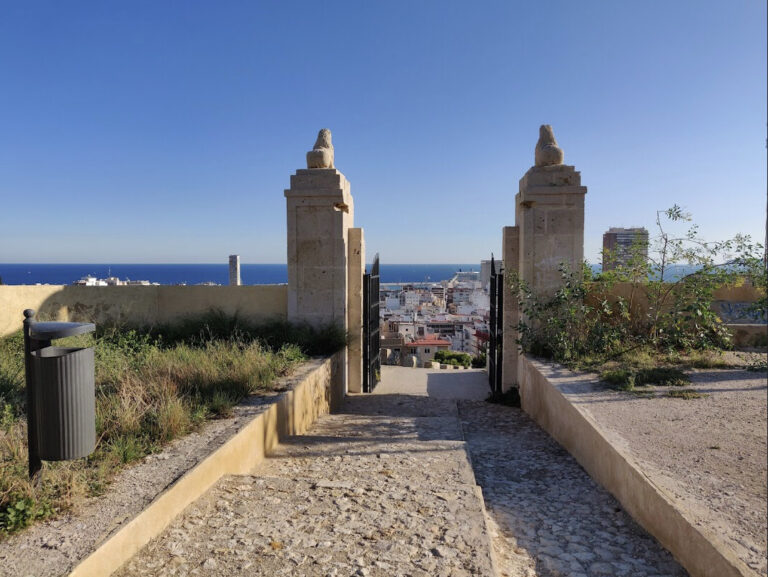
The archaeological complex covers approximately 30,000 square metres at Tossal de Manises. It occupies a position overlooking the former Albufereta lagoon, Tossal de les Basses, and the bay. A wall encloses the settlement along its most accessible side, while the excavated city preserves the forum, baths, houses, sewers, temples, defensive-tower foundations, and other urban installations. The surviving fabric is predominantly Roman, especially from the first century AD onward, and modern high-rise buildings surround the remains, altering their wider historical setting.
Defences and civic centre
Fortification wall and towers
The settlement’s defensive system includes substantial stretches of an enclosing wall and the foundations of pre-Roman defensive towers. The fortification belongs to the early history of Tossal de Manises, when the site developed from a Punic military installation into a fortified urban settlement. Its later rebuilding in the first quarter of the first century BC preserved the site’s defensive character before the Roman city acquired its civic form.
Forum and urban installations
The forum formed the principal public centre of Roman Lucentum. Built around 30–20 BC, it marks the city’s transformation into a Roman municipium. The excavated urban complex also includes temples, sewers, houses, and other installations associated with civic life. The forum area preserves evidence of later change, including the reuse of building material and the dumping that took place there during the second century.
Baths and houses
The remains include numerous houses and baths, among them the Baths of Popili. These structures belong to the Roman urban phase and help define the range of domestic and public buildings within the settlement. The Baths of Popili were abandoned during the decline that began under Vespasian, while the wider urban complex continued to undergo deterioration before the city’s abandonment in the third century.
Earlier settlement and funerary archaeology
Iberian archaeological level
A lower archaeological level is contemporary with the Iberian necropolis excavated during road construction in the 1930s. It connects Tossal de Manises with the earlier communities of the Albufereta area and complements the evidence from Tossal de les Basses, where Iberian occupation dates at least to the fourth century BC. Finds from the necropolis are preserved in the Archaeological Museum of Alicante.
Funerary finds
The funerary material includes perfume burners, Iberian ceramics with geometric and figurative decoration, vessels showing riders, birds, and fish, sculptural fragments, jewellery, glass-paste necklaces, Egyptian amulets, terracottas, spindle whorls, and weapons. Three earrings from tombs F81 and F142 may have been intended for male use. Their form, which also occurs in other necropolises including the Hellín hoard, suggests the presence of a local workshop.
Kore of Alicante
The Kore of Alicante, an ancient sculpture of a standing young woman, may have originated at Lucentum. The figure is now held by the Archaeological Museum of Catalonia. Its possible connection with the site adds to the evidence for the cultural contacts and artistic traditions represented in the ancient settlement.
Muslim cemetery
Part of a later Muslim necropolis survives within the excavated archaeological area. It belongs to the period when Tossal de Manises was used as a cemetery, probably during the tenth or eleventh centuries, after the ancient city had ceased to function as an urban centre.