Religion in the Roman Empire: Beliefs and Practices
Roman public worship sought the gods’ favour through sacrifices, vows and prescribed ceremonies. Magistrates performed rites for the community, supported by priestly colleges that supervised religious law and divine signs. Households honoured their own protective gods, while provincial communities maintained local cults under Roman rule.
The expansion of Roman government brought these practices into contact with established regional traditions. Emperors gained religious honours and held major priesthoods. In the fourth century, imperial support for Christianity changed public worship: Constantine sponsored churches, and later emperors restricted traditional sacrifice while endorsing a preferred Christian orthodoxy.
On this page11 sections
Religion as a relationship between people and gods
Roman religion rested on the idea that the gods governed the heavens, the earth and the affairs of human communities. There was no requirement to worship only one deity. A person could honour the gods of the household, the official gods of Rome, the deity of a local community and an imported cult without necessarily seeing these loyalties as contradictory.
The Latin word religio referred to the obligations and careful observances that maintained this relationship. The related quality of pietas meant dutiful respect toward gods, family and community. Romans associated their success with collective piety and believed that neglect or incorrect performance could provoke divine anger, known as ira deorum. Ritual mistakes were not minor matters. A public ceremony performed incorrectly might have to be repeated, since the intended communication with the gods had not been completed properly.
Roman religious practice was therefore highly attentive to words, gestures, timing and ritual materials. Public prayers were delivered clearly by priests or magistrates on behalf of the community. The correct name or epithet of a deity mattered, because naming identified the divine power being addressed. Vows, or vota, were promises made to a deity in return for a hoped-for benefit, such as victory, safety or recovery. An oath called upon the gods to witness agreements, offices, treaties and bonds of loyalty.
Romans distinguished proper religio from superstitio, a term that could describe excessive, inappropriate or suspect religious behaviour. The boundary was flexible. State-approved divination could be legitimate, while private attempts to obtain secret knowledge or use supernatural power were often treated with suspicion. Women, foreigners, astrologers and private diviners were sometimes portrayed by elite writers as especially prone to such practices, although magical and divinatory activities occurred across the social order.
Many gods and changing religious traditions
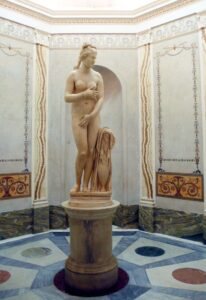 Roman religion had no single creation myth or permanently fixed theological system. The functions of gods could overlap, and their identities could be interpreted differently in different places and periods. Jupiter was the chief god of the Roman state and represented divine authority, especially in relation to public office, political order and external affairs. Juno and Minerva joined Jupiter in the Capitoline triad, while Mars, Quirinus, Ceres, Venus, Diana, Apollo and numerous other gods had particular cults and associations.
Roman writers and artists identified deities with Greek counterparts, using Greek myths and artistic forms to represent their gods. The term interpretatio graeca describes this identification. Etruscan specialists supplied traditions of divination, including interpreting prodigies and examining sacrificial entrails.
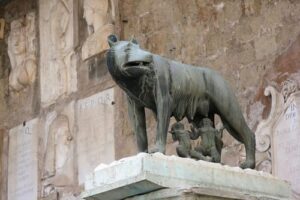 Stories of Aeneas, Romulus and Numa linked later institutions with Rome’s legendary beginnings. Aeneas was associated especially with bringing Trojan sacred objects and the Penates to Italy; different traditions described the fate of the Palladium, a sacred image associated with Troy. Romulus was credited with founding cults and consulting divine signs, while Numa was remembered as an organiser of religious life. These accounts gave customs an ancient pedigree. They are foundation traditions rather than contemporary evidence for the institutions of early kings.
The mos maiorum, ancestral tradition, gave authority to established rites. New cults could be introduced by public decision. In wartime crises, the Senate and magistrates consulted specialists and reorganised worship in response to what they understood as divine requirements.
The article on the twelve main Roman gods and goddesses introduces prominent deities, while lesser-known Roman gods considers more specialised figures.
Households, neighbourhoods and daily worship
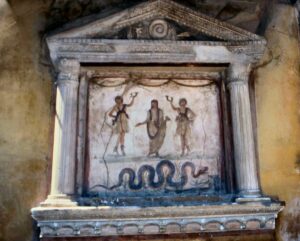 For most people, religion was experienced as much in homes and local communities as in monumental state temples. A Roman household commonly maintained a shrine, or lararium, where members honoured household deities. The Lares were associated with the protection of the household and its members, while the Penates were connected with the family’s provisions and domestic welfare. The household Genius represented the generative spirit of the head of the family and his line.
The legally recognised head of a household performed important rites, but domestic religion also involved women, children, dependants and enslaved people. Roles differed according to occasion and household arrangements. The hearth, family provisions, protection and commemoration could all receive ritual attention.
Offerings could be modest and repeated. Grain, first fruits, wine, incense, honey and food from family meals might be offered to household gods. Community festivals could also include offerings made on behalf of a neighbourhood. Sacred springs, groves, crossroads and small shrines extended religious practice beyond the home. A traveller could make a vow or leave an offering at a sacred place while continuing to honour a deity from the traveller’s home community.
Religious observances structured public time. Calendars record festivals, ritual days and restrictions on some civic business, with substantial changes across periods and communities. Processions, sacrifices, games and theatrical performances could form part of a festival. Participation extended beyond those holding political office, while access to major priesthoods remained unequal. The separate article on Roman leisure explains entertainment within this wider public setting.
Temples, altars and sacrifice
A Roman temple was both a building and part of a wider sacred precinct. The Latin word templum originally referred to space ritually marked out by an augur, a religious official who interpreted signs, rather than simply to the structure that housed a deity. In public ceremonies, the principal sacrifice usually took place outdoors at an altar. The temple building contained the cella, the inner room where the cult image was kept, along with objects and offerings associated with the deity.
Public ceremonies often involved processions that began at, visited or ended at a temple. The interior of a temple was not necessarily an unrestricted congregational space. The most visible part of a sacrifice occurred before the building, allowing the ritual to be witnessed by the community. Temples also commemorated political and military events. A general might vow a temple in exchange for divine assistance in war and dedicate it after victory. In this way, architecture recorded a relationship between military success, public finance and religious obligation.
Animal sacrifice followed procedures specific to the rite and deity. Victims such as cattle, sheep and pigs could be led to an altar, consecrated and killed by trained attendants. Inspection of the entrails could establish whether an offering was acceptable. Selected portions, including the exta (the animal’s inner organs), were prepared and offered to the gods, often by burning, while other meat could be distributed to participants.
Public and private rites also used food, wine, incense and other offerings. Vows connected a promised gift with an anticipated benefit, while expiatory ceremonies addressed a reported disturbance in relations with the gods.
Priests, magistrates and religious authority
Political leaders also held public priesthoods. Republican magistrates could serve as augurs or pontiffs, bringing religious expertise into the same elite that conducted government. Priestly colleges supervised defined areas of practice, while magistrates performed rites connected with public decisions.
The pontifices supervised important areas of religious law and practice. Their most senior member, the pontifex maximus, held a position of exceptional authority. The flamines served individual gods, with the major flamines traditionally dedicated to Jupiter, Mars and Quirinus. The rex sacrorum, whose title preserved the memory of the monarchy, performed certain royal religious duties after kingship had been abolished, although the office had little civil authority.
Major priesthoods in Rome brought honour and authority and were frequently held by members of the political elite. Their resources and duties differed from those of cult attendants, temple staff or specialist diviners. In provincial communities, priesthoods could enhance the public standing of local patrons, especially through festivals and imperial honours.
The Vestals formed an important exception to the male dominance of public priesthoods. Six women served Vesta, goddess of the hearth of the Roman state, and maintained the sacred fire. Chosen as girls, they were released from their father’s legal authority and answered directly to the pontifex maximus. Their public status and privileges were unusual for Roman women, but they were tied to strict obligations, including chastity and long service. The Vestals also prepared mola salsa, salted flour sprinkled over sacrificial victims, and helped connect household hearth worship with the religious life of the state.
Augury, omens and the decisions of the state
Magistrates took auspices for public actions, while augurs supplied expertise in the rules governing those signs and the definition of ritual space. Birds were one source of signs, but auspices also involved other observations. Unfavourable or disputed signs could delay business and become part of political conflict.
Haruspices, specialists associated with Etruscan tradition, examined the entrails of sacrificed animals and interpreted prodigies. A prodigy was an event understood as a disturbance in the normal order of nature, such as unusual celestial phenomena, strange births or blood appearing in unexpected places. The Senate decided whether a reported prodigy was genuine and of public concern. If so, priests prescribed rites of expiation intended to restore the relationship between Rome and the gods.
Festivals, games and military religion
Festivals joined religious observance with public entertainment, social identity and political display. Some included ludi, meaning games such as chariot races and theatrical performances. The triumph of a victorious general was both a procession and a religious act. The commander displayed spoils, honoured Jupiter and presented himself as a servant of the community and the gods. During the late Republic, triumphal games and gladiatorial contests became increasingly elaborate and politically competitive.
Emperors funded major games, while magistrates provided spectacles through their public duties. Religious observances accompanied accessions and anniversaries. The setting of the games connected entertainment with the ruler’s patronage and the public calendar.
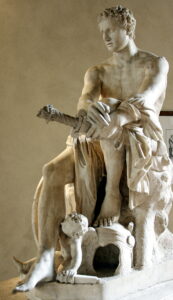 Military religion centred on communal rites, standards, official dedications and vows as well as individual worship. Army purification could involve the suovetaurilia, a sacrifice of a pig, sheep and bull.
Soldiers honoured Roman gods, imperial power and deities associated with their origins or places of service. Mithraic worship became visible in some military settings, but also among civilians, freedpeople and imperial personnel.
Provincial cults and religious diversity
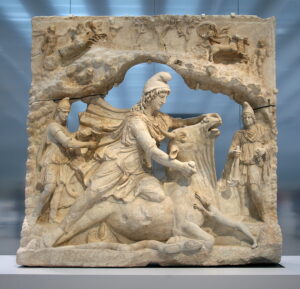 As Rome expanded, it usually incorporated local gods and cults rather than attempting to eliminate every regional tradition. Communities could preserve local calendars and worship while acknowledging Roman authority. Temples might be built to Roman gods, local gods or combinations of both. Inscriptions record Romans honouring provincial deities and local communities worshipping Roman gods alongside their own.
At the Roman Baths in Bath, the temple and spring complex was dedicated to Sulis Minerva, joining a local divine identity with a Roman one. Surviving temple sculpture, altars and offerings illuminate public worship, while inscribed tablets appeal to the goddess over personal disputes.
Acceptance had limits. Roman authorities could restrict religious associations judged to threaten public order, as in the regulation of the Bacchanalia in 186 BC. The Great Mother had already been officially introduced to Rome in 204 BC, yet aspects of her priesthood and ritual continued to be marked as foreign.
Mithraic worship used initiation and an enclosed setting for communal ritual. The London Mithraeum preserves remains of a small third-century sanctuary, displayed through a modern reconstruction using surviving fabric. Its interior provided a different setting from the outdoor altar and precinct of a major civic temple.
People could honour an emperor through a city’s ceremonies and maintain household worship at home. Travellers and migrants encountered deities outside their place of origin. Dedications record these acts of worship through the names of the donor and the deity receiving the offering.
The imperial cult and loyalty to the emperor
After the Republic, religion was adapted to the rule of one-man government. Augustus presented his settlement as a restoration of ancestral traditions and revived or reorganized older cults. The emperor also accumulated major priesthoods, including the office of pontifex maximus. Religious restoration gave the new political order a traditional vocabulary while linking the emperor’s authority to the welfare of Rome.
Communities honoured emperors and their families through temples, festivals, images, sacrifice and priesthoods. These practices drew on honours for benefactors, traditions of divine rulers and Roman ideas about the Genius and deification. At Maison Carrée in Nîmes, a substantial Augustan temple commemorated Gaius and Lucius Caesar, the emperor’s adopted heirs. The dedication is reconstructed from fixing holes left by lost bronze letters. A provincial monument could thus give dynastic loyalty a lasting civic and religious form.
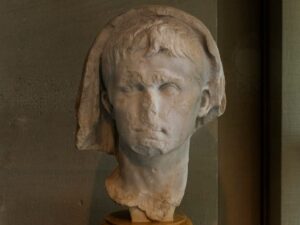 The living emperor was generally honoured through his Genius or associated divine power rather than treated in Rome exactly like a fully deified god. After death, the Senate could grant an emperor the status of divus, meaning a deified ruler. Similar honours could be given to members of the imperial family. The imperial cult expressed loyalty, dynastic continuity and the emperor’s responsibility for the stability of the Empire, but its form varied between Rome and the provinces.
Refusal to participate could be interpreted as a rejection of the state, especially when imperial authorities required public sacrifice as proof of loyalty. This issue became particularly difficult in relation to Judaism and Christianity. Jewish communities had long-standing legal arrangements and were sometimes exempted from official sacrifices. Christians, who rejected sacrifice to Roman gods and the emperor’s Genius, were more often treated as a novel and disobedient movement.
Funerals, ancestors and the afterlife
Roman ideas about death varied according to philosophical school, social status and local tradition. Yet the care of the dead was a durable religious obligation. Families commemorated their ancestors, maintained tombs and performed offerings. The dead could become part of the di Manes, spirits of the underworld, and were honoured during festivals such as the Parentalia.
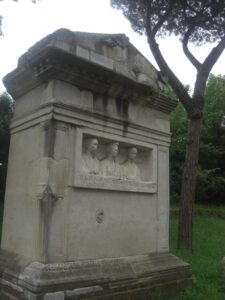 Funerals combined disposal of the body with mourning and offerings. Cremation and inhumation coexisted, with preferences changing by period and community. Roman accounts describe a ninth-day ceremony completing the funeral rites. Later visits and commemorative meals renewed the survivors’ relationship with the dead.
Roman intellectuals debated the fate of the soul, but funerary customs did not depend on agreement about one philosophical explanation. Inscriptions, tombs, offerings and commemorative meals show the continuing importance of family memory and the relationship between the living and the dead. During Late Antiquity, Christian and non-Christian funerary customs overlapped in some respects. Traditional offerings and commemorative feasts continued, while Christian practice increasingly interpreted death as a transition to new life and encouraged the veneration of saints and relics.
Judaism, Christianity and the transformation of Roman religion
Judaism occupied a distinctive position within the Empire. Jewish communities had established traditions and legal arrangements, and synagogues were recognized as legitimate associations in some periods. Judaism’s insistence on worshipping one God and refusing sacrifice to other gods could create tensions with Roman expectations, but authorities sometimes granted exemptions and sought practical compromises.
 Christianity initially appeared to Roman officials as a new and problematic movement associated with Judaism but unwilling to perform the public rites expected of loyal subjects. Christians’ rejection of sacrifices to Roman gods and the emperor could be interpreted as atheism or superstitio. After the Great Fire of Rome in AD 64, Nero accused Christians and used them as scapegoats. Later persecutions varied in intensity and location rather than forming one uninterrupted policy.
Decius’s order in AD 249–250 required sacrifice and certification on a wide scale; surviving certificates show how the demand operated in Egypt. Christian refusal made the policy a persecution, although its stated requirement was broader than Christians alone. Valerian’s later measures targeted Christian leadership and communities more directly. Diocletian and his colleagues began further persecution in AD 303, with changing demands and uneven enforcement. Galerius issued a toleration measure in AD 311.
Constantine’s support transformed Christianity’s position. In AD 313, Constantine and Licinius agreed on religious toleration and restoration of Christian property, arrangements conventionally called the Edict of Milan. Constantine sponsored churches and convened the Council of Nicaea in AD 325.
The law issued in AD 380 under Theodosius I, Gratian and Valentinian II endorsed the Christianity associated with the bishops of Rome and Alexandria and labelled other Christian groups heretical. Later fourth-century legislation prohibited traditional sacrifices and other rites. Changes in patronage and temple use followed successive laws and local decisions.