Roman Architecture as Political Propaganda
Augustus inaugurated his forum in 2 BC around the Temple of Mars Ultor, which commemorated vengeance for Caesar’s murder. Statues connected his family with Roman founders and Republican commanders. Later emperors likewise attached their names and achievements to public buildings through inscriptions, sculptural imagery and ceremonies.
On this page8 sections
Republican competition and civic spaces

The Roman Forum brought legal, political, commercial and religious activity into a shared setting. Republican monuments could invoke service to the community while enhancing the standing of the person or family responsible for them. Civic language and personal competition therefore worked together.
Visibility depended on location as well as size. A dedication near an important route or meeting place could repeatedly connect a name with public activity. Temples, porticoes and other amenities supplied recognisable benefits while preserving the donor’s claim. Restoration offered another opportunity: a ruler or magistrate could present maintenance as care for inherited institutions and attach his name to an older monument.
Military vows, triumphs and religious obligation
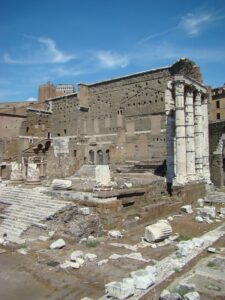
Commanders could vow temples in the hope of victory and dedicate them after success. Such buildings joined obligation to a deity with the commemoration of achievement. Spoils, images and inscriptions could then place military action within the city’s religious landscape. The act honoured divine assistance while making the successful commander’s role memorable.
Triumphal processions also displayed a victor, captured wealth and defeated enemies before an audience. They celebrated Roman success and offered exceptional personal prominence to the commander. Later monuments could preserve that spectacle beyond the day itself.
Homes, palaces and the politics of space
Elite houses accommodated visitors as well as domestic life. Reception spaces, decoration and access could communicate standing and ancestry. Literary praise of modesty coexisted with competition over impressive residences. A house’s political significance lay partly in who entered it, how they were received and what relationships were conducted there.
Imperial residences magnified questions about the relationship between a ruler’s household and the city. Nero’s Domus Aurea became associated in hostile accounts with private appropriation and luxury. Its decoration and extent could support claims about exceptional power, while critics turned the same features into evidence of misconduct.
Imperial benefaction and public use
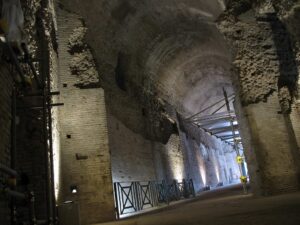
Emperors paid for public facilities and identified themselves as patrons in inscriptions. Baths served daily recreation, while forums accommodated proceedings and ceremonies. A completed building gave the ruler a public setting for appearances and a permanent dedication recording his contribution.
The Flavian amphitheatre, the Colosseum, occupied part of the landscape transformed by Nero’s palace. Its public spectacles offered a striking contrast with a private imperial pleasure ground. That contrast helped the Flavians present their rule favourably.
Victory monuments and dynastic memory

The Arch of Titus joins reliefs of the Jewish War’s spoils and triumph with a dedication to the deified emperor. The surviving inscription places Titus within the Flavian dynasty by naming his deified father Vespasian. Victory, family and divine status are therefore brought together in one monument.
Triumphal reliefs displayed captured wealth and the victorious procession. Their placement on a monument prolonged the commemoration after the event. The dedication named the honoured ruler, connecting the military celebration with his public memory.
Augustus and an organised version of Roman history
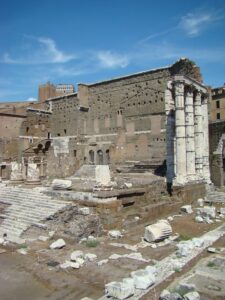
The Forum of Augustus, inaugurated in 2 BC, centred on Mars Ultor, Mars the Avenger. Its podium, columns and portico remains preserve parts of the public setting. Sculptural fragments include Aeneas carrying Anchises and leading Ascanius, alongside Romulus and Republican triumphators. These figures connected the Julian family with Rome’s founders and military history.
Military ceremonies and public proceedings took place within the forum. The temple commemorated Augustus’s vow to avenge Caesar, made before the Battle of Philippi in 42 BC. Its later programme also celebrated the recovery of Roman standards and Augustus’s military achievements.
Harbours, rivers and the promise of supply
Maritime imagery extended architectural claims beyond the physical building. A sestertius of Nero dated AD 64 shows the harbour at Portus with ships, enclosing works, a lighthouse and a reclining river figure. The coin associated the emperor with infrastructure supporting arrivals and Rome’s supply. Merchants and crews carried the cargo, and workers handled it after landing. Roman ports and the grain dole explain the operation of this supply system.
Claudius staged a mock naval battle on Lake Fucinus in AD 52 just before releasing the water through the lake’s drainage outlet. The spectacle brought an audience to an engineering project intended to alter the surrounding land and water. Suetonius also records difficulties during the display.
Materials, labour and different audiences
Large projects required money, building materials and skilled workers. Their scale and finish made a patron’s expenditure visible. Building techniques explains construction, while Roman marble follows the extraction and transport of decorative stone.
Local benefactors also funded public buildings and recorded their contributions in dedications. A donor’s name remained attached to the place where residents met or used the facilities. Restoration allowed later patrons to add their names to an existing civic monument.