Rocca Manfrediana: A Late-Medieval Fortress in Brisighella, Italy
Site at a Glance
- Rating
- 4.5
- Popularity
- Medium
- Country
- Italy
- Primary era
- Medieval
- External website
- Open
- Eras represented
- Medieval, Early Modern
- Civilizations
- Papal States, Venetian
- Site type
- Military
- Remains
- Castle
On this page10 sections
History
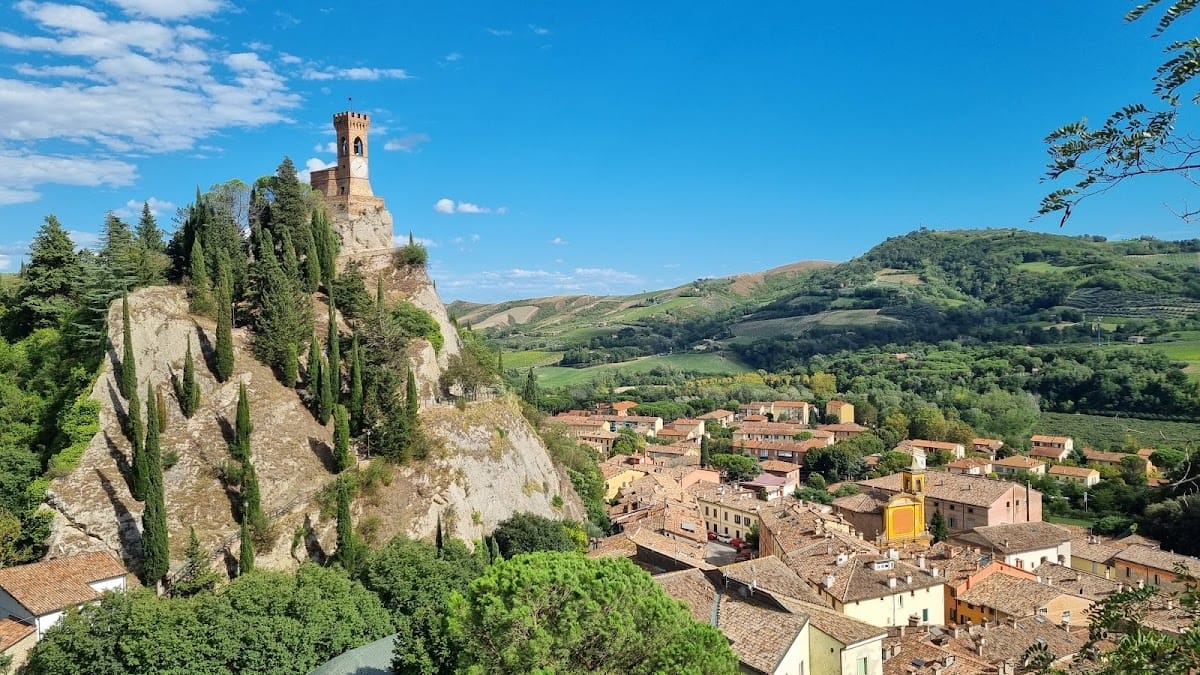
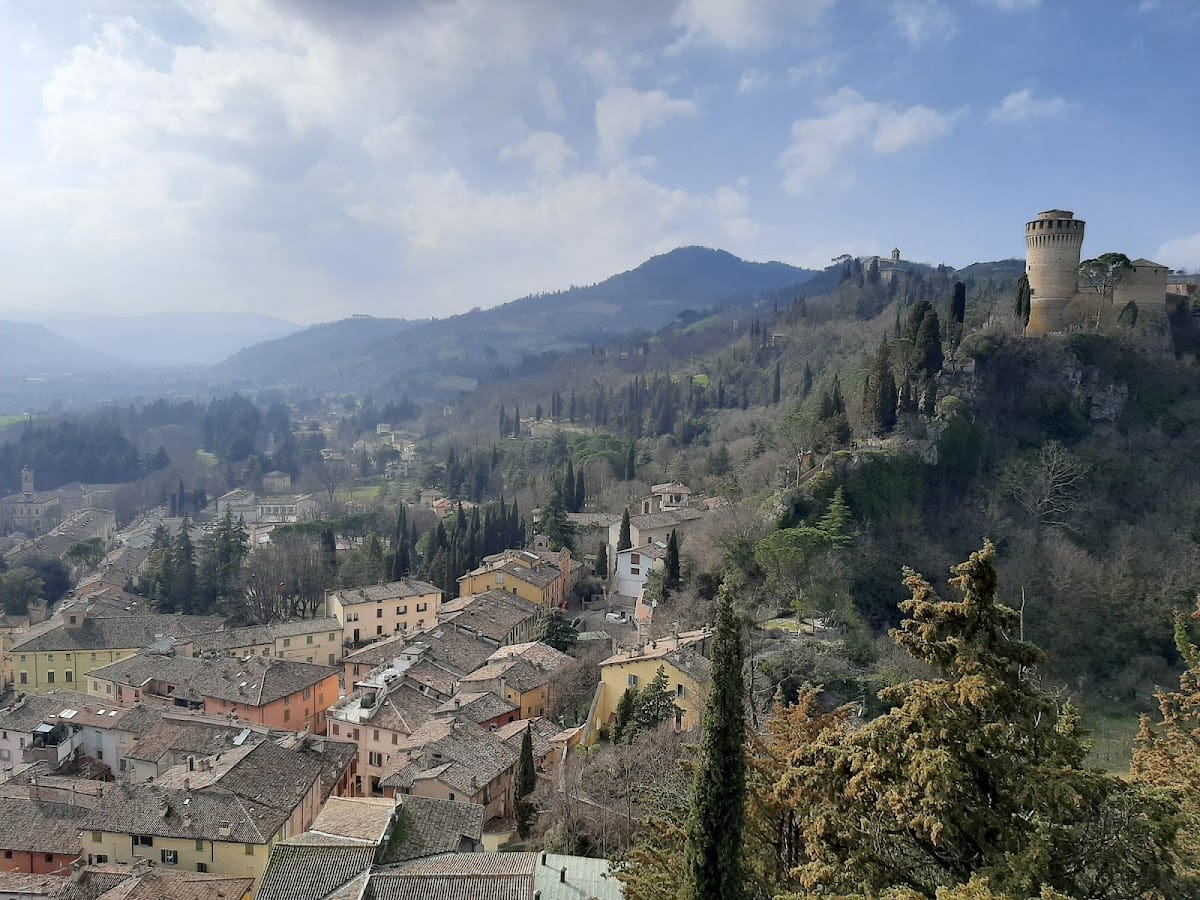
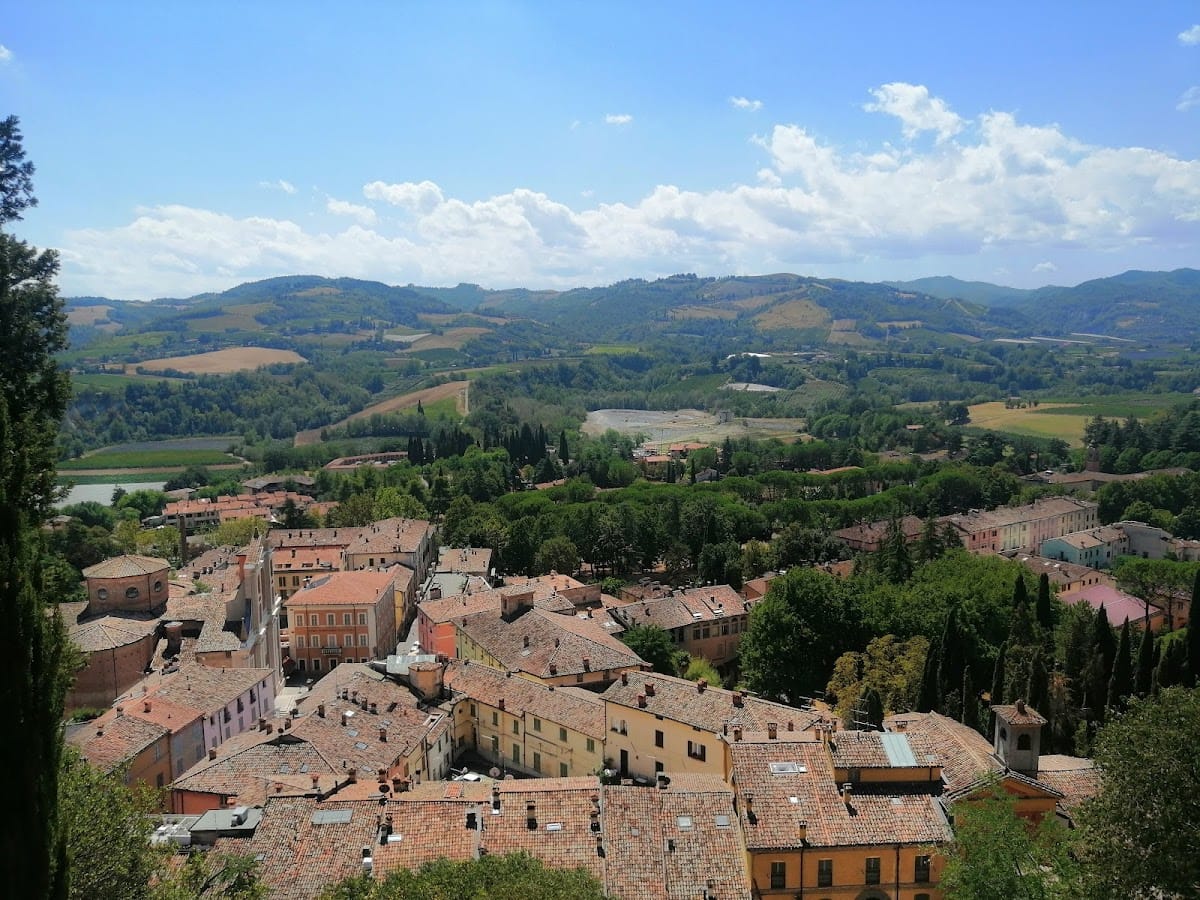
Rocca Manfrediana is a late-medieval fortress in Italy, located at Brisighella in Emilia-Romagna on the second of three selenite rock pinnacles within the Vena del Gesso Romagnola Regional Park. The present stronghold was begun by Francesco Manfredi, lord of Faenza, at the beginning of the fourteenth century and is conventionally dated to 1310.
The Manfredi Fortress
The fortress remained in the hands of the Manfredi family, the ruling house of Faenza and its surrounding territory, apart from a short interval between 1368 and 1376. During their rule, the complex was enlarged in several stages. Gian Galeazzo Manfredi undertook an important expansion in 1394, while Astorgio II Manfredi directed further works in 1457 and 1466. The building therefore developed over time rather than representing a single campaign of construction.
Cesare Borgia and Venetian Rule
In 1500, Rocca Manfrediana entered the short-lived dominion of Cesare Borgia, a Renaissance military and political leader whose territorial expansion briefly brought Brisighella under his control. In 1503, the fortress passed to the Republic of Venice and remained Venetian until 1509.
The Venetians reshaped the stronghold by adding the large keep and constructing walls on both sides of the existing fortress. These works gave the complex its later distinction between the older Manfredian turret and the taller Venetian tower. Toward the end of the sixteenth century, the two principal towers were roofed.
Papal and Modern History
After Venetian rule, the territory became part of the Papal States, the lands governed by the pope as a temporal ruler. The fortress experienced a brief period under Napoleonic rule before returning to papal control. In 1860, Romagna became part of the Kingdom of Italy during the political unification of the country.
At the beginning of the twenty-first century, the fortress underwent a complete restoration. The work strengthened its masonry and enhanced the architectural complex, including through specially designed lighting. Rocca Manfrediana is designated as Italian national heritage.
The fortress also has a place in modern cultural history. The dramatic conclusion of a historical novel by the Irish writer Ethel Lilian Voynich is set inside the Rocca, whose first English edition appeared in 1897. Since 1980, the site has hosted the Festa Medievale near the beginning of June. Over two consecutive days, the event uses the fortress as a setting for simulated armed clashes, medieval camps, and historical performances.
Remains
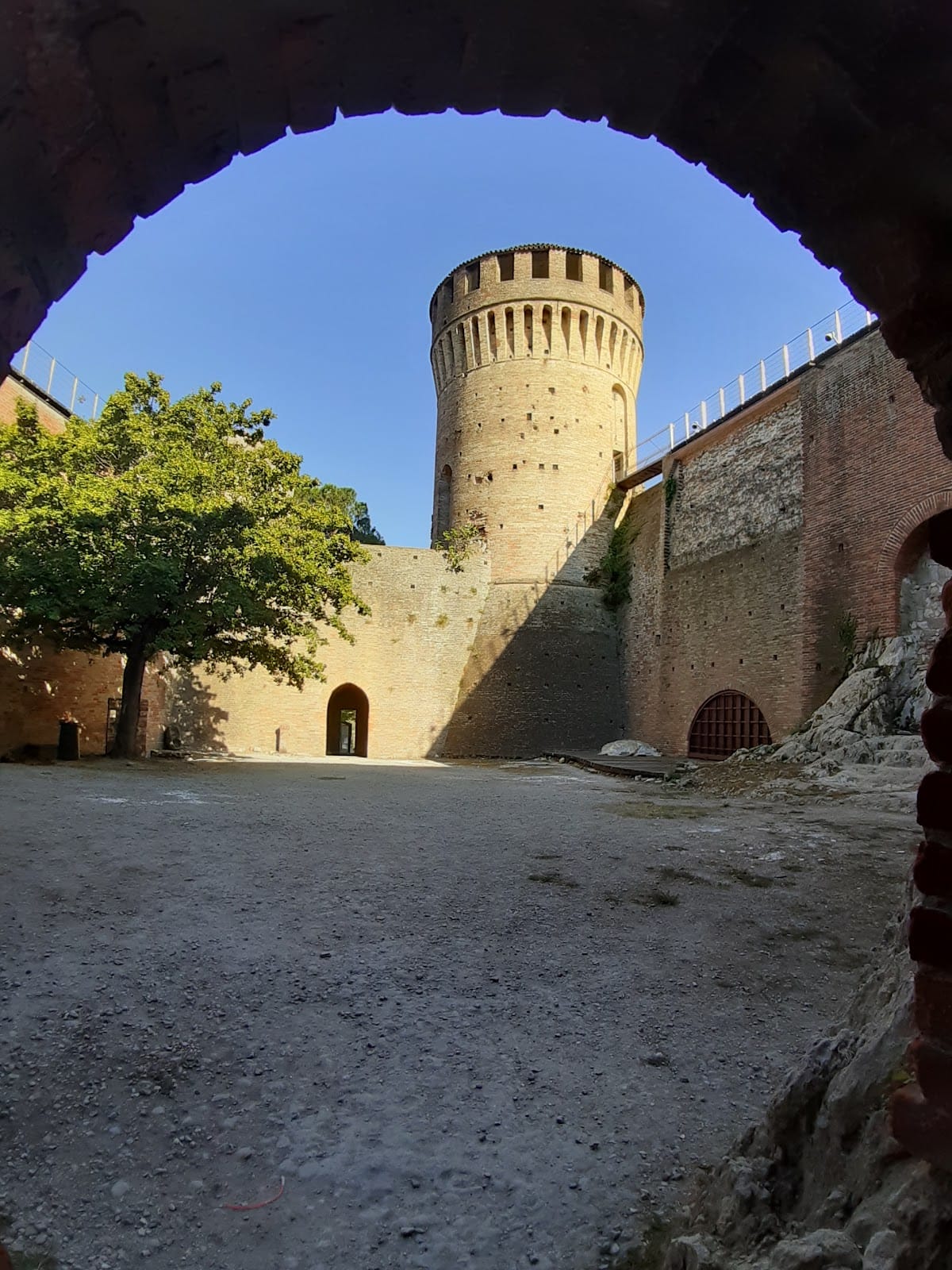
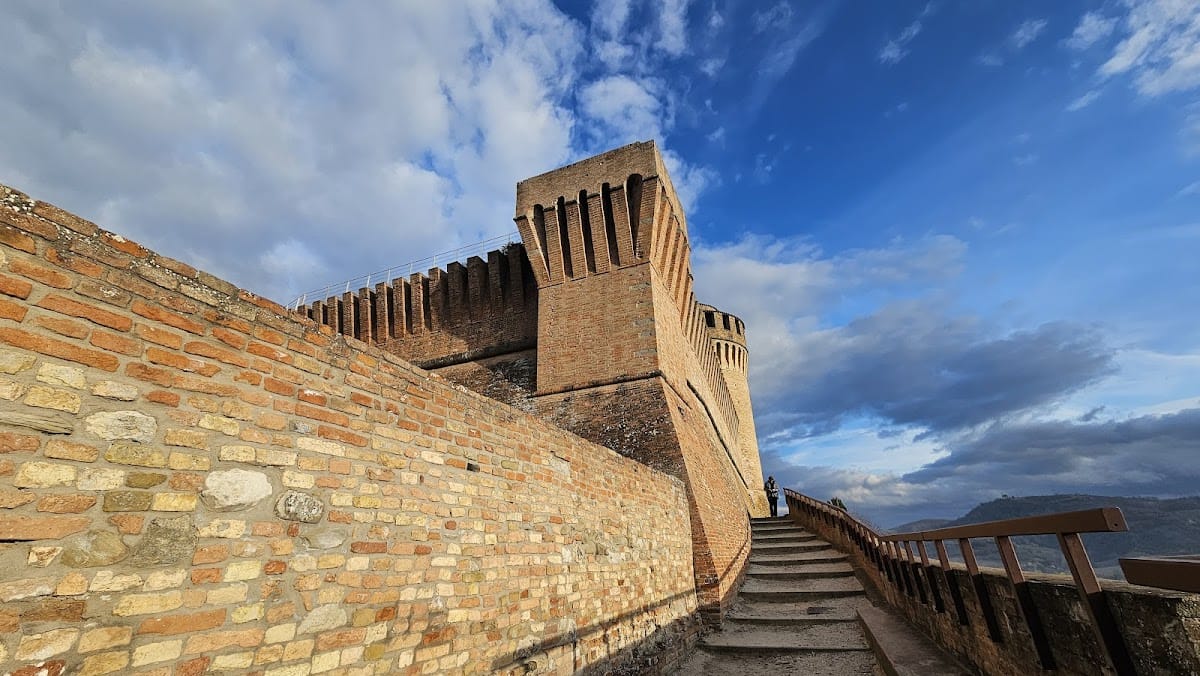
Rocca Manfrediana occupies a selenite pinnacle at approximately 147 metres above sea level. Its buildings are characterized by brick masonry. The main plan consists of two cylindrical towers on the eastern side, two walls linking them, a trapezoidal internal courtyard, and enclosing walls that end in an angled western curtain. The connecting walls preserve the entrance and the sockets for the drawbridge, the movable bridge that once crossed the surrounding ditch and could be raised to obstruct access.
Towers and Connecting Walls
Torricino
The older northeastern tower is the Torricino, also called the Torre Manfrediana. A torricino is a smaller tower or turret. The museum route rises through this oldest part of the fortress by a spiral staircase and a sequence of small rooms. The tower’s upper circular hall contains display cases with material recovered from different periods in the Vena del Gesso, including finds from Rontana Castle, Grotta dei Banditi, Cava della Lucerna, and the Carnè excavations.
Torre Veneziana
The southeastern keep is the Torre Veneziana, whose masonry preserves evidence of an earlier square-plan core. The tallest tower dates from 1503, when the Venetians built it beside the pre-existing Torricino. A short suspended bridge or the wall-walk connects the two towers. The Torre Veneziana contains presentations on the Middle Ages, the Renaissance, castle construction, and life within the fortress. Its interiors include reconstructed kitchen and bedroom spaces, together with the prisons.
Both towers were linked to the wall-walk by drawbridges. By raising all three bridges, the fortress could be reduced during an attack to a defensible enclosure formed by the two towers. This arrangement made the towers the core of the stronghold’s defensive organization.
Defensive Works
The curtain wall had a sloping defensive base with a covered flanking passage, called a caponiera, containing loopholes. A caponiera is a protected structure or passage from which an approach can be defended from the side. Its gallery continues southward into another gallery that formerly held two gun ports. The flanking system was concealed by the mule track ascending to the fortress. Panels in the internal courtyard and the caponiera explain these defensive arrangements.
Museum Route and Finds
The museum route, Museo l’Uomo e il gesso, explains the relationship between human communities and gypsum, the material of the rock pinnacle and a long-standing basis of the local economy. Displays in the Torricino address the period before written history, the Roman period, and the Middle Ages. They include the ritual, religious, and funerary use of gypsum caves, Roman extraction of lapis specularis, a transparent form of gypsum quarried for window material, and aspects of medieval life.
The collections include finds from Grotta dei Banditi, a bronze sestertius of the Roman emperor Tiberius from the Carnè excavations, fragments of Aucissa-type and tweezer fibulae, and a fragment of a bronze buckle from Carnè. Faenza-made tankards recovered during the excavations at Rontana Castle are also displayed. Together, these objects connect the fortress museum with the wider archaeological landscape of the Vena del Gesso.