Aqua Tepula: The Roman Aqueduct Supplying Ancient Rome
Site at a Glance
- Popularity
- Medium
- Country
- Italy
- Primary era
- Classical
- Eras represented
- Classical
- Civilizations
- Roman
- Site type
- Infrastructure
- Remains
- Aqueduct
On this page8 sections
History
Aqua Tepula was a Roman aqueduct serving ancient Rome, Italy, completed in 125 BC to supplement the water supply to the Capitol and the city’s higher districts. It was the fourth of Rome’s eleven principal aqueducts. The censors Gnaeus Servilius Caepio and Lucius Cassius Longinus Ravilla, senior magistrates who oversaw public works, completed it during the consulship of Marcus Fulvius Flaccus and Marcus Plautius Hypsaeus. Consuls were the Republic’s chief annual magistrates. The project was more limited in scale than the Aqua Marcia, perhaps reflecting economic pressures during political instability.
Republican foundation
The original aqueduct’s capacity is unknown, but its delivery was less than that of the Aqua Marcia. Aqua Tepula’s tepid water had an unpleasant taste and was generally avoided for drinking until its quality improved under Augustus. In the meantime, it served industrial uses, leaving more of the Aqua Marcia’s better-tasting water available for consumption.
Agrippa’s rebuilding and Augustan repairs
After almost a century without maintenance, the aqueduct underwent extensive work in 33 BC under Agrippa, a Roman general and statesman closely associated with Augustus. It was restored and probably largely rebuilt, an additional water source was connected, and the first few miles of the original conduit were abandoned. Its supply was integrated with the Aqua Julia system. After the work, Aqua Tepula delivered 400 quinariae a day, a quinaria being a Roman unit for measuring water flow. This quantity was also expressed as 17,800 cubic metres per day, although modern conversions of the unit are uncertain.
Augustus restored the aqueduct between 11 and 4 BC. This followed a report submitted in 11 BC by the consuls Quintus Aelius Tubero and Paullus Fabius Maximus, who warned of the water network’s condition. Archaeological remains point to local repairs during the reign of Emperor Claudius, from AD 41 to 54. Later repairs also took place, but their dates are uncertain.
Imperial supply and administration
By the first century AD, Aqua Tepula probably no longer drew on independent springs. The Roman official Frontinus listed its capacity as 400 quinariae, but his separate calculation of 445 included 190 from the Aqua Julia’s settling basin, 92 supplied farther along from the Aqua Marcia, and 163 from the Anio Novus. The Anio Novus water entered the system at the Epaphroditian Gardens on the Esquiline. The calculated total was also given as 18,467 cubic metres per day, or about 0.2 cubic metres per second. Because this total matched the amount distributed, the aqueduct was not affected by illegal diversions.
Aqua Tepula supplied Rome’s regions IV, V, VI, and VII, four of the city’s numbered administrative districts, through 14 distribution tanks. Its elevation suited the Capitol and other high-lying areas. Its service to the same districts as the Aqua Marcia also indicates that it helped meet growing demand alongside that aqueduct. Rome’s water supply and aqueducts were administered by the Cura aquarum, the authority responsible for managing them.
Remains
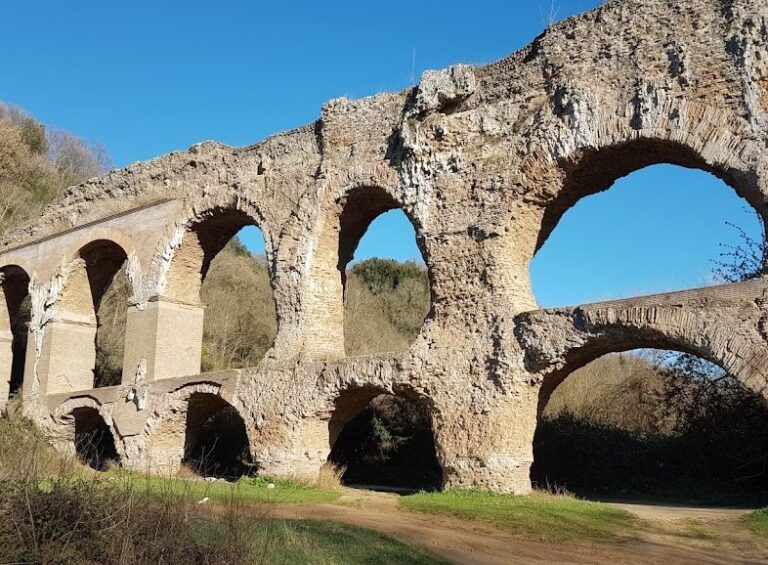
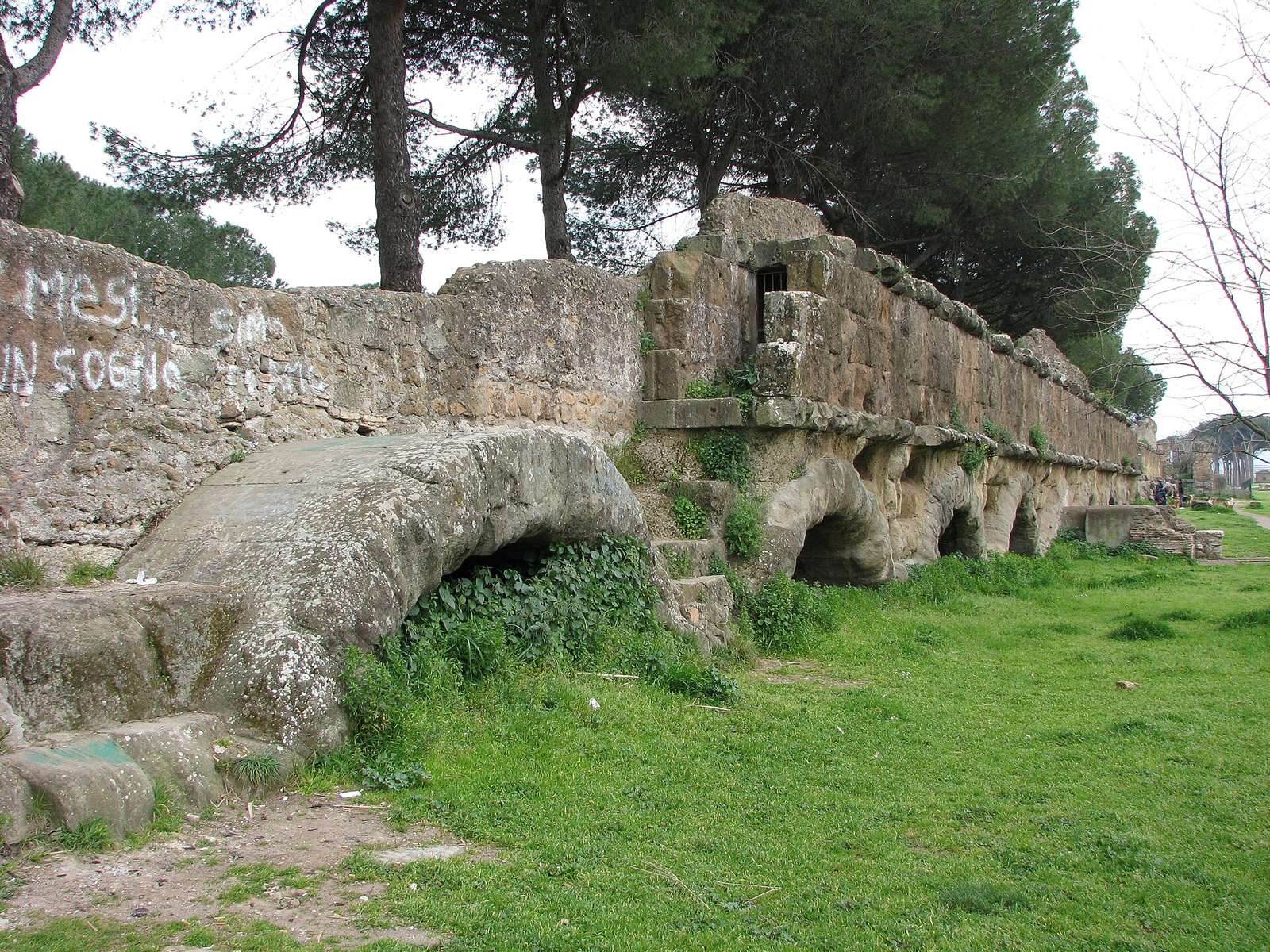
Aqua Tepula’s estimated route extended about 18 km, descending from roughly 151 m at its beginning to 61 m at its end. Around 13 km ran on aqueduct bridges and 5 km through tunnels. Masonry formed the aqueduct’s construction, while surviving sections show the channels and supporting arches of the shared water network.
Spring and source area
The springs lay on land belonging to Lucullus, a late Republican Roman general and statesman, in the volcanic Alban Hills, about 18 km from Rome. Their proposed location is between the present-day municipalities of Grottaferrata and Marino, on the hills’ northern slope in the territory of Tusculum. They have been identified with a watercourse known as the Precious Spring in the Valle Marciana, between the tenth and twelfth milestones of the Via Latina. The water at its source was about 16–18°C.
Country route and settling basin
The original Republican route is unknown, though it probably ran underground at least as far as its junction with the Aqua Marcia. Before the Augustan period, the conduit is understood to have run underground from source to terminus. On the reconstructed route, Aqua Tepula and Aqua Julia followed separate courses for their first five kilometres, then shared a route to a basin for settling water near Capannelle, close to the Aqua Marcia. Their waters joined along this stretch and had cooled by the basin before flowing into separate conduits for the Tepula and Julia.
Channels and distribution in Rome
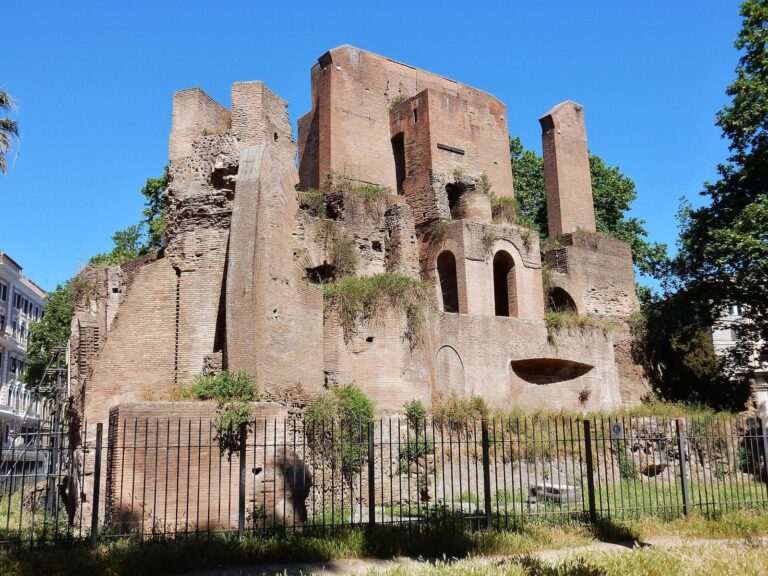
Aqua Tepula reached Rome at Ad Spem Veterem, near Porta Maggiore, where its conduit entered closed tanks and was supported on the Aqua Marcia’s arches. From there, the three aqueducts ran on the same arches in separate channels, with the Aqua Julia above the Tepula and the Tepula above the Marcia. The Tepula occupied the highest channel and continued on the Marcia’s arches for the remaining 10 km. Surviving remains include the arches supporting the Marcia’s stone channel and brick channels belonging to the Tepula and Julia.
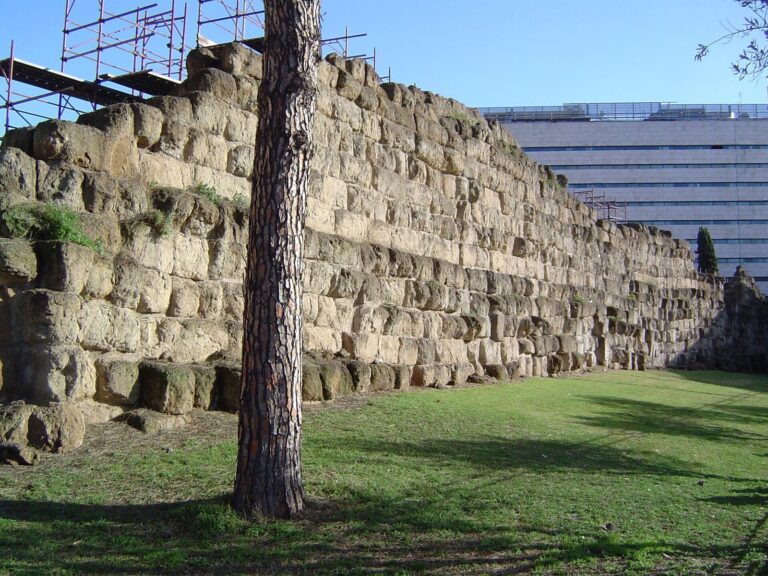
From Porta Maggiore, the route followed the Aurelian Walls and crossed the Via Tiburtina on an arch that later became Porta Tiburtina. It passed the Viminal Gate and reached a main distribution tank near Porta Collina, north of the Baths of Diocletian and near present-day Via XX Settembre. From that point, underground channels carried the water into Rome.