Tell Arqa: A Bronze Age Settlement and Crusader Fortress in Lebanon
Site at a Glance
- Popularity
- Medium
- Country
- Lebanon
- Primary era
- Bronze Age
- Eras represented
- Bronze Age, Iron Age, Medieval
- Civilizations
- Canaanite, County of Tripoli, Crusader
- Site type
- Settlement
- Remains
- Town
On this page16 sections
History
Early settlement and Bronze Age
Tell Arqa, a settlement mound near the modern village of Arqa in northern Lebanon, preserves evidence of occupation across several millennia. Permanent settlement may extend back to the sixth millennium BCE. Finds from the surrounding plain appear to belong to the Natufian and Pre-Pottery Neolithic periods, the latter preceding regular pottery use. The earliest excavated levels at the site date to Early Bronze II, a subdivision of the Bronze Age, around 2800–2650 BCE.
By Early Bronze II, Arqa was a small, organized urban center. It continued to develop through the end of the third millennium BCE. During the Middle Bronze Age, a cemetery was used for almost five centuries.
Late Bronze and Iron Age
Arqa appears to have lost regional importance in the Late Bronze Age. Around 1450 BCE, the Egyptian pharaoh Thutmose III destroyed the city. It remained deserted into the early Iron Age, then was resettled during Iron II, a later phase of the Iron Age.
Irqata and the Roman city
In antiquity, the city was known as Irqata. Biblical references call its inhabitants Arkites or Arqians in different translations. The city’s elders also sent a letter to the Egyptian pharaoh Akhenaten asking for help against attacks by the Habiru, an ancient term whose precise identification is uncertain. The letter belongs to the Amarna correspondence, diplomatic messages preserved on tablets found at Tell el-Amarna in Egypt.
The Roman author and natural historian Pliny the Elder mentioned Arca alongside cities of the Decapolis, a grouping of cities in the Greco-Roman Levant, but did not include it within the group. In Roman times, the city was called Arca Caesarea or Caesarea of Lebanon. Severus Alexander, who later became a Roman emperor, was born there in 208.
Crusader and Mamluk control
After the siege of Antioch during the First Crusade, part of the Frankish army reached Arqa on 12 February 1099. In this context, Frankish refers broadly to Western European Latin Christians. Although the Arab governors of Tripoli were favorably disposed toward them, Muslim defenders held the fortress. On 26 February, Raymond of Saint-Gilles lost Anselm of Ribemont, Count of Ostrevent and envoy to the Byzantine emperor Alexios Komnenos, as well as Pons de Balazuc. After three months, Raymond ended the siege and continued toward Jerusalem.
In 1108, Raymond’s cousin William Jordan, Count of Cerdanya, captured Arqa after a three-week siege and annexed it to the County of Tripoli, a Crusader state in the Levant. A fortified castle was built after the conquest.
In 1167, Nur ad-Din, a Muslim ruler and military leader, tried to take Arqa while Raymond III, Count of Tripoli, was captive. King Amalric I of Jerusalem later granted the site to the Hospitallers, a religious and military order. In 1171, the atabeg of Mosul, a senior political and military office in medieval Islamic states, besieged the fortress again. It suffered heavy damage but resisted. In 1266, as the County of Tripoli was collapsing, the Mamluk sultan Baybars took the citadel from the Hospitallers, ending Crusader control of Arqa. The Mamluks were a military ruling class that held power in Egypt and Syria.
Excavations
Excavations in 1978–1981 and 1992–1998 uncovered remains from the Bronze Age settlement.
Remains
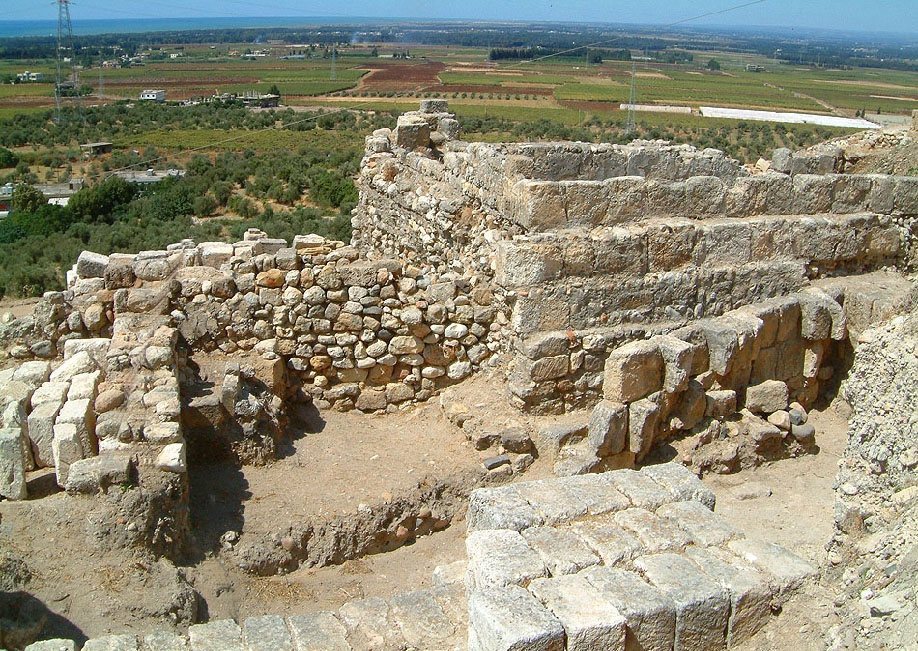
The excavated remains form a mound of successive settlement layers, from early houses and burial areas to fortifications and a later castle. Tell Arqa stands about 100 m above sea level on a well-watered coastal plain, with a river running at its foot.
Bronze Age settlement
Early Bronze Age streets and houses
An outer circular street served adjoining houses of similar design. In Level 16, remains of houses stand more than 3 m high. Their mud-brick walls and many cedar- and palm-wood elements from roofs and floors were burned around 2300 BCE. The fire helped preserve the buildings and their contents.
Household remains
The houses had lower storeys divided into small square compartments for storing provisions, especially food. Large quantities of burnt wheat were found there. Upper storeys served for living and work, while evidence also points to activity on a terrace and possibly on a second storey.
Several dozen ceramic jars, cooking pots, cups, and jugs were found crushed where they had been used or where they had fallen. Their positions helped establish the arrangement of the neighborhood and its individual dwellings.
Middle Bronze Age features
Workshop, silos, and fortifications
Middle Bronze Age remains include a pottery workshop, numerous silos, and fortifications. Together, these features show the range of production, storage, and defensive structures present at the settlement during this period.
Cemetery and grave
The cemetery includes a notable grave interpreted as that of a warrior or chief. It contained a set of bronze weapons.
Late Bronze Age houses and tombs
Houses and tombs also survive from the Late Bronze Age occupation.
Iron Age sanctuary
A sanctuary, or place of worship, belongs to the site’s Iron II occupation.
Crusader castle
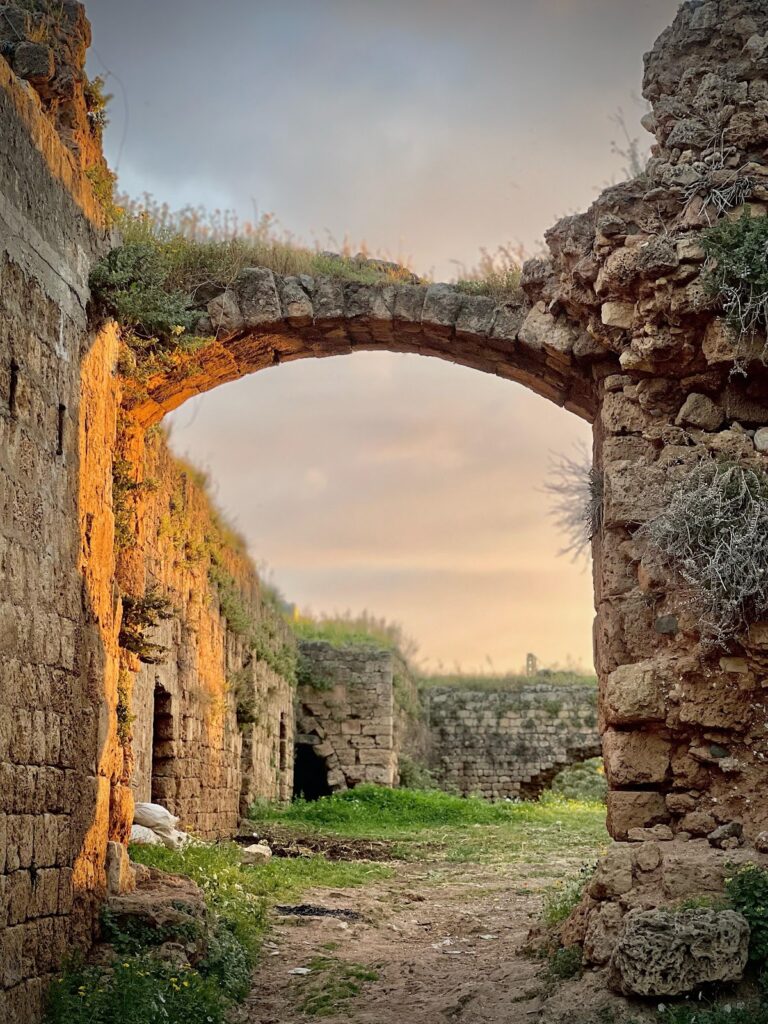
The Crusader castle is now in ruins, with sections of its walls still standing.