Cheltenham Minster, St Mary’s: The Parish Church of Cheltenham
Site at a Glance
- Rating
- 4.8
- Popularity
- Medium
- Country
- United Kingdom
- Primary era
- Medieval
- Eras represented
- Medieval, Modern
- Civilizations
- British, English
- Site type
- Religious
- Remains
- Church
On this page8 sections
History
Cheltenham Minster, St Mary’s, is Cheltenham’s parish church in the United Kingdom, dedicated to St Mary, the Christian saint venerated as the mother of Jesus. Its origins date to the 12th century, and its surviving medieval fabric is chiefly associated with 13th- and 14th-century English Gothic architecture. Worship has continued here for about 850 years, although repairs brought periods of closure between 1859 and 1877. The title minster does not make it a cathedral, and St Mary’s has never been a bishop’s seat.
Origins and ownership
An 8th-century Saxon church is believed to have stood on the site before the present church. The Domesday Book records the church and its rectory land as belonging to Regenbald, also known as Reinbald, chancellor to William the Conqueror, England’s Norman king from 1066 to 1087. Regenbald later bequeathed them to Cirencester Abbey, an Augustinian monastery in Gloucestershire.
After Henry VIII’s Dissolution of the Monasteries, the suppression of English monasteries in the 1530s, the property passed to the Crown. James VI of Scotland, who also ruled England as James I, later sold it. Several lay rectors followed, holding rights or income associated with the rectory without serving as the parish priest. In 1863, Edward Walker took possession of the chancel and the title of rector.
Parish life and the town
After the English Reformation, the 16th-century break between the English church and papal authority, St Mary’s became part of the Church of England, having previously been Roman Catholic. Its churchmanship is Evangelical, an Anglican tradition emphasizing the Bible’s authority and personal Christian faith. For much of its history, the church served a population of fewer than 1,500. Early 19th-century Regency building placed shops and offices between the church and its surroundings, while later Victorian population growth led to the construction of other churches.
Francis Close served as St Mary’s perpetual curate, a clergyman appointed to serve a particular parish, for 30 years. An Evangelical and follower of the influential Anglican clergyman Charles Simeon, Close founded two teacher-training colleges that later became part of the University of Gloucestershire. In 1856, he became Dean of Carlisle, a senior cleric responsible for a cathedral chapter.
The church’s first change-ringing bells, rung in changing sequences, probably formed a set of six installed around 1680. The number rose to eight in 1697 and ten in 1833. In 1889, ringers completed 15,227 changes of Grandsire Caters, a method using nine working bells and a tenth covering bell; the performance took 9 hours and 43 minutes. Two more bells brought the total to twelve in 1912.
Restoration and later changes
Declared unsafe, St Mary’s closed in July 1859. The congregation first worshipped in the Town Hall, then in a temporary church on Clarence Street made of timber covered with corrugated iron. In 1863, Walker proposed enlarging or replacing St Mary’s. Although 34 designs were submitted, opposition brought the proposal to an end, and an extensive restoration went ahead instead. The campaign is dated to 1851–1877. Gas lighting and a new heating system were installed during this period.
A permanent stone church eventually replaced the temporary Clarence Street building. Consecrated as St Matthew’s in 1879, it was proposed by rector Charles Bell as the new parish church, but parishioners rejected the change. In 2012, an interior reordering moved the prayer chapel from the south transept to the north transept, transferred the font from the former north porch to the south entrance, and removed some pews to make room for the chapel and exhibitions. On 3 February 2013, Michael Perham, Bishop of Gloucester, formally designated St Mary’s as Cheltenham Minster. It is a Grade I listed building, England’s highest category of listed-building protection.
Remains
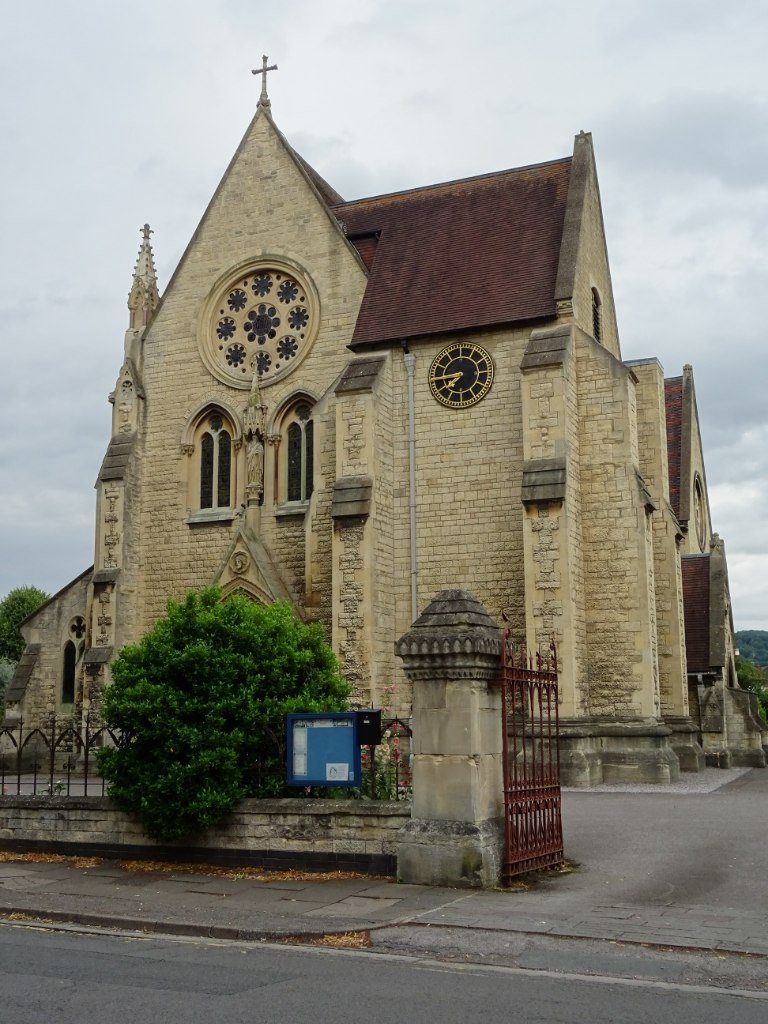
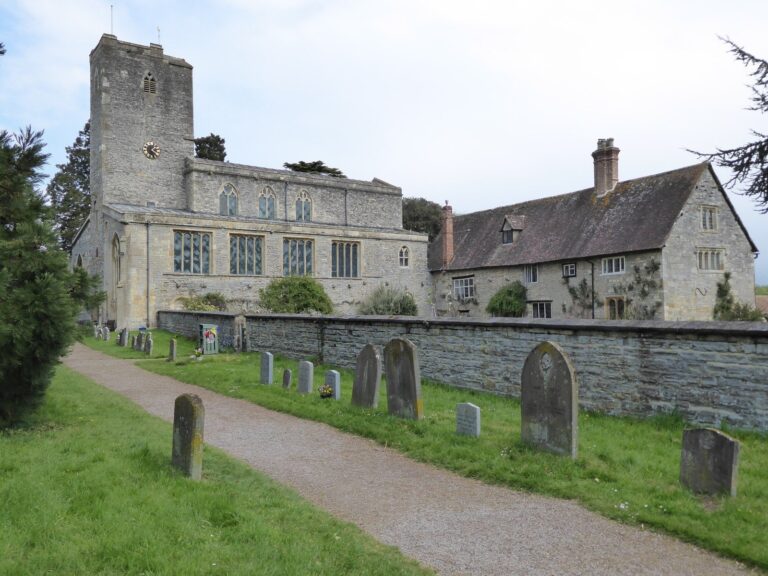
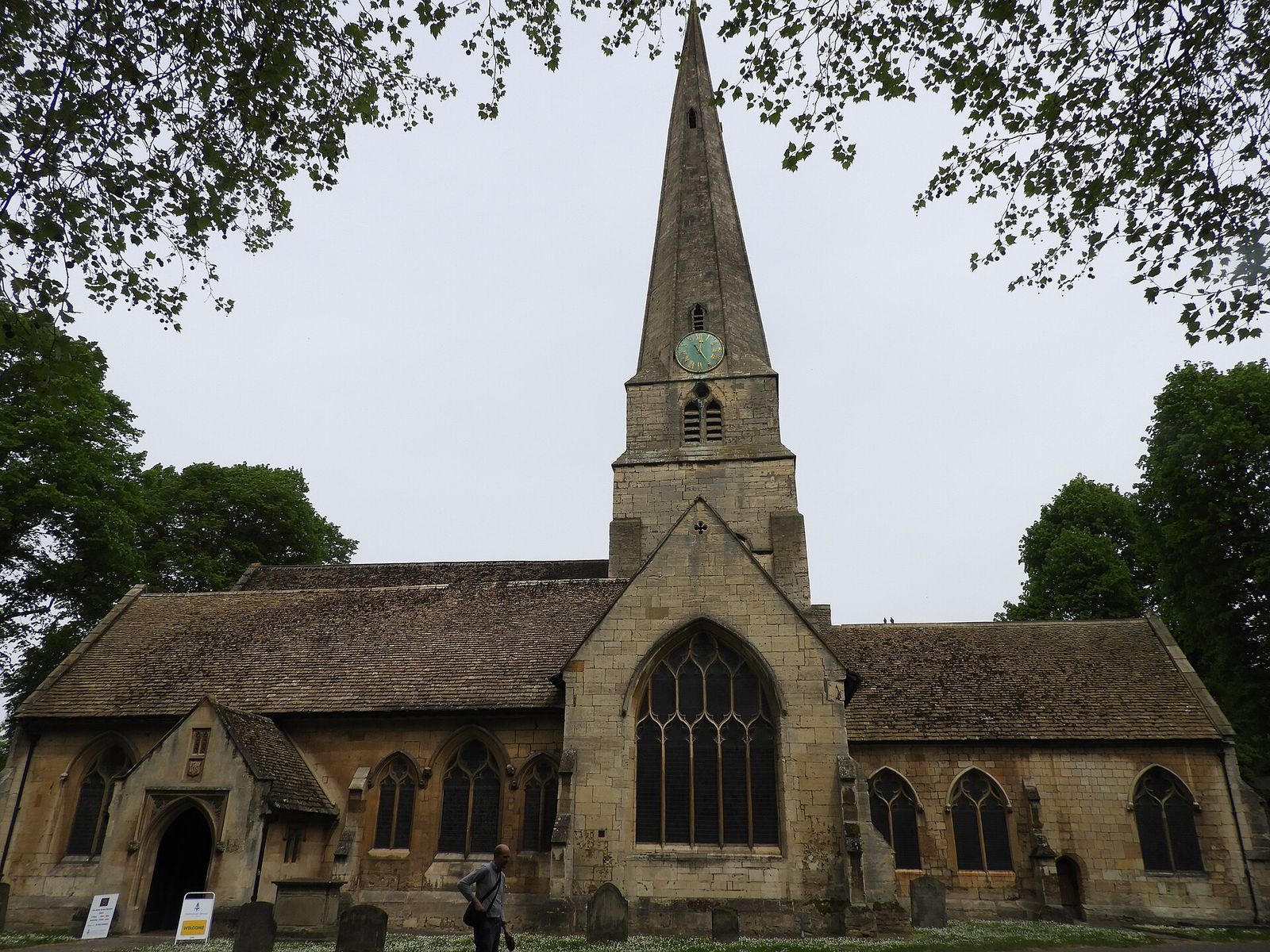
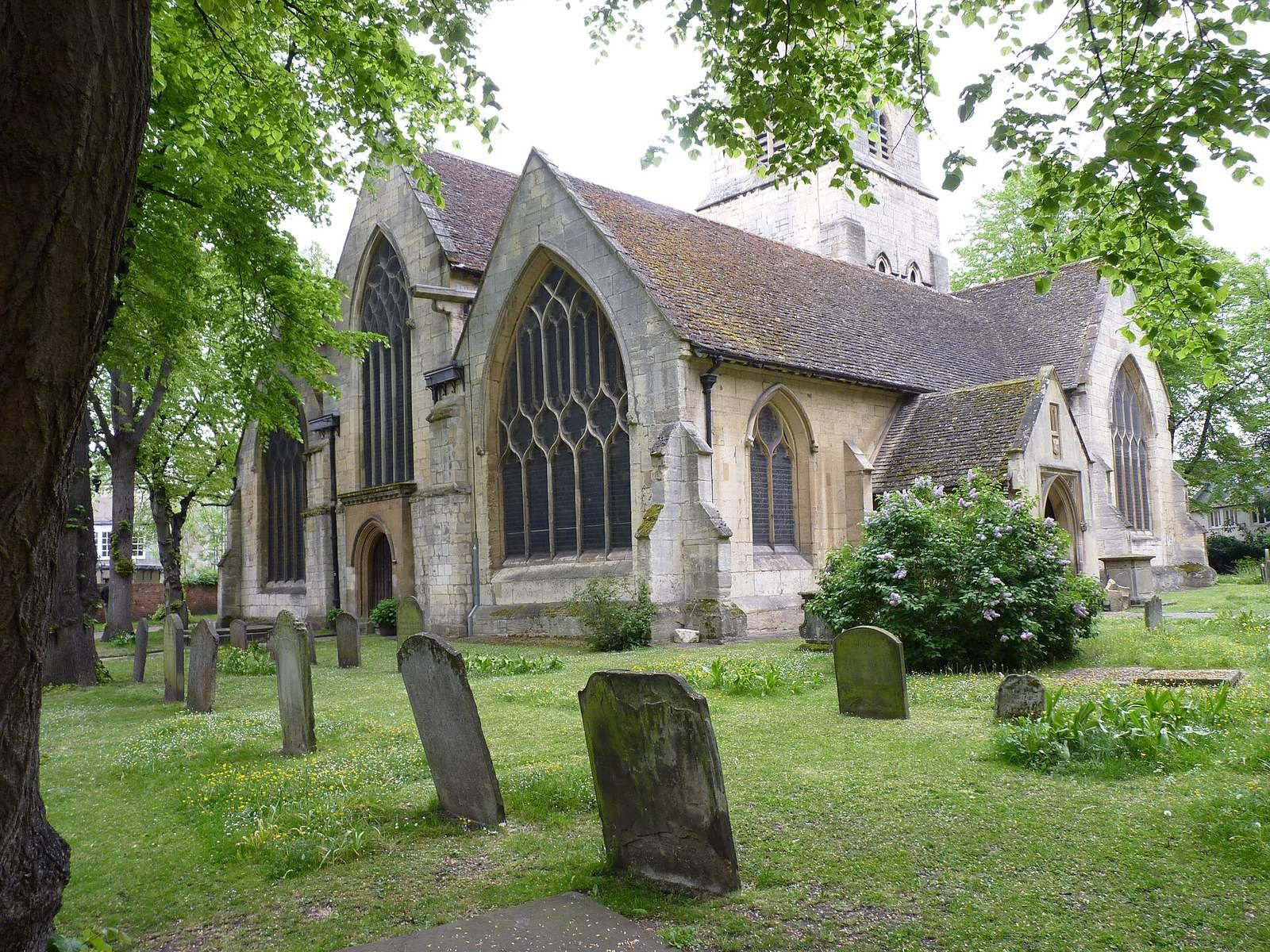
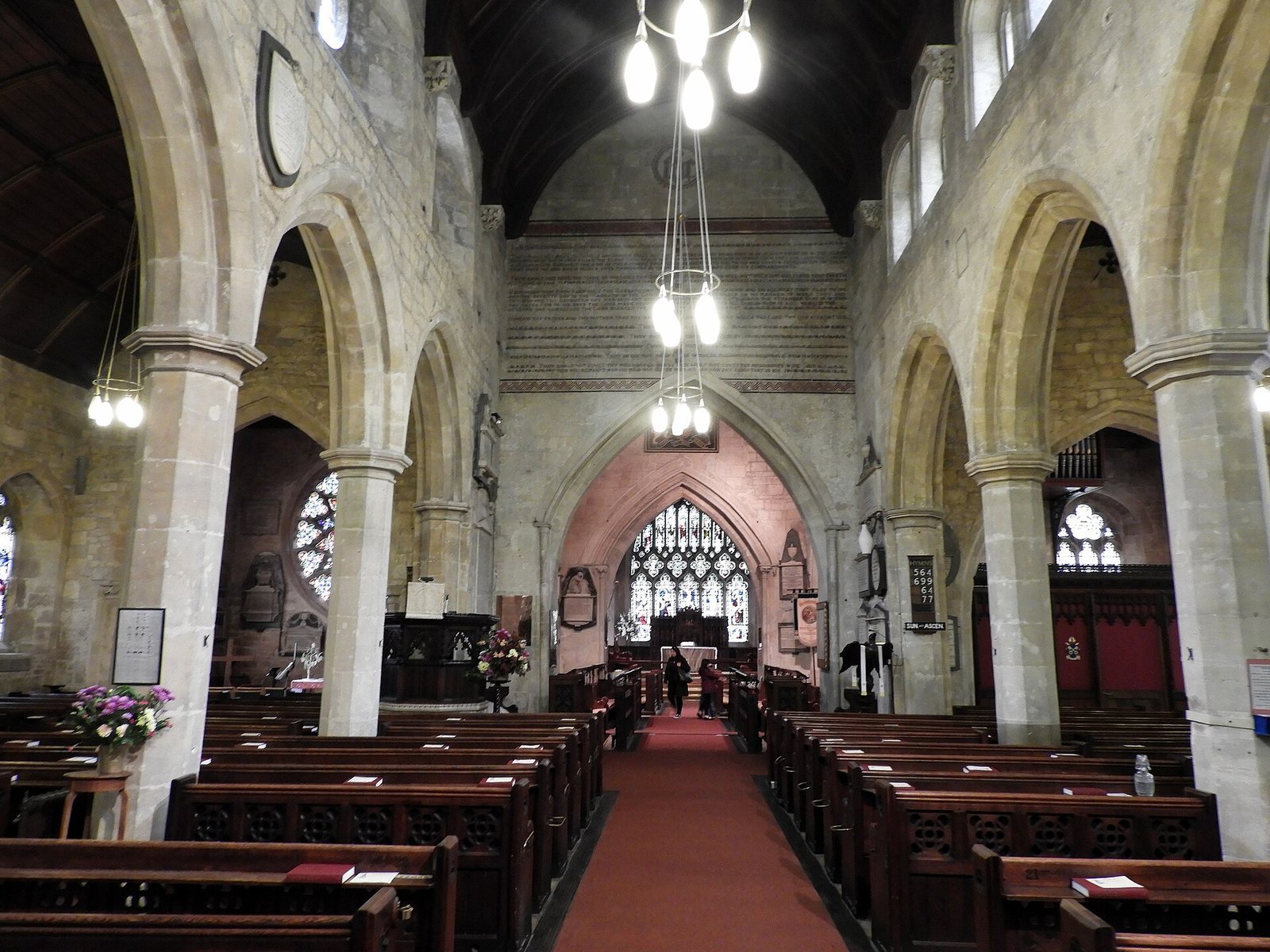
St Mary’s is Cheltenham’s only surviving medieval building. Its three-aisled basilican plan has a high central nave flanked by lower aisles, wooden vaults, a transept, and a chancel that ends in a straight wall. Early English Gothic elements remain, while later extensions make the Decorated style predominant; the building is also associated with the Perpendicular style.
Windows and ornamental stonework
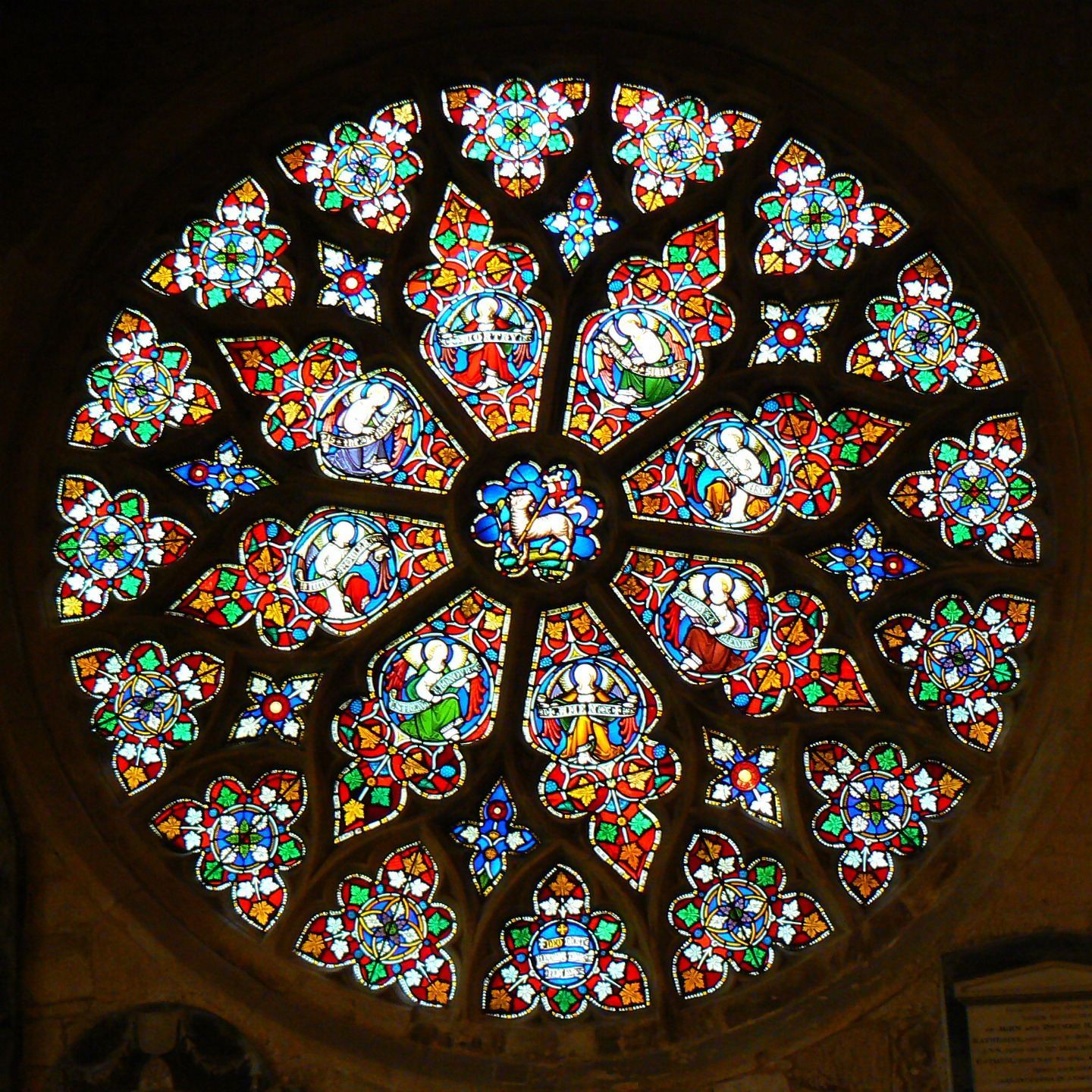
The window frames preserve varied ornamental stonework reflecting developments from about 1250 to 1350. Their stained glass dates from the late Victorian period and is regarded as particularly high quality.
Tower and bells
The upper part of the tower dates to around 1200. Above the crossing, where the church’s main and crosswise arms meet, it carries a spire added in the early 14th century. The spire rises about 40 metres and is octagonal, with angled faces connecting it to the square tower below. The tower now holds twelve bells cast by John Taylor & Co in 2018 as part of a major restoration.
Porches, fittings, and memorials
The former north porch is in the Early Perpendicular style and has a vaulted ceiling with subsidiary ribs. A late Victorian south porch was added in 1890. The church’s woodwork is Victorian or later, including a neo-Gothic wooden screen behind the altar, installed in 1916 and decorated with numerous figures. Memorials commemorate Captain Henry Skillicorne, developer of Cheltenham’s first spa; King George III, who attended services at St Mary’s during his 1788 visit; and former priest John English, imprisoned by Puritans, English Protestants who sought further reform of the Church of England.