Bohyeonsa: A Buddhist Monastery and Center in North Korea
Site at a Glance
- Popularity
- High
- Country
- North Korea
- Primary era
- Early Modern
- Eras represented
- Medieval, Early Modern, Modern
- Civilizations
- Goryeo, Joseon
- Site type
- Religious
- Remains
- Monastery
On this page19 sections
History
Bohyeonsa is a Korean Buddhist monastery in the Myohyang Mountains of Hyangsan County, North Pyongan Province, North Korea. Tradition attributes its foundation to the monk Uisang in 784, while the monastery is generally dated to 1024; an inscription gives 1042 as the year two monks established it. It became a major Buddhist center in northern Korea and a destination for pilgrims. Historically a monastery for men, Bohyeonsa now serves as North Korea’s principal Buddhist center.
Foundation and Koryo-period growth
The 1141 inscription recounts that one monk arrived in 1028 and built a hermitage northwest of the later monastery. His nephew joined him in 1038, and in 1042 the two established the monastery southeast of the hermitage. It had 243 bays, meaning spaces between columns, and lodging for 300 monks. Bohyeonsa was extensively rebuilt during the middle Koryo period, the dynasty that ruled Korea from 918 to 1392.
The royal house granted land to the monastery in 1067. An inscription commissioned by King Injong in 1141 recorded the succession of its abbots. Named for Samantabhadra, a bodhisattva, or being who seeks enlightenment while aiding others, Bohyeonsa developed into an important religious institution in northern Korea.
Invasion and refuge
In 1216, remnants of the Khitan crossed the Yalu River into Koryo. Some, pursued by Koryo forces, took shelter in the Myohyang Mountains and burned Bohyeonsa. The pursuing army killed more than 2,400 Khitan, and a commander died after being struck by an arrow.
During the Imjin Wars, Japan’s invasions of Korea from 1592 to 1598, the monastery was associated with monk-led forces organized by Sŏsan Taesa and his disciple. They fought the Japanese and helped retake Pyongyang. Sŏsan returned to the Myohyang Mountains in 1603 and died at Geumgang Cave the following year.
Bohyeonsa also sheltered royal portraits and records during the invasions. The portrait of Sejo was moved from Bongseonsa to Ganghwa and then to Bohyeonsa for protection from the Japanese; it later traveled through Kaesong to Seoul. The portrait of Taejo and the Jeonju copy of the annals were also kept at the monastery for a time. Monks secured the annals copy at nearby Puryong Hermitage, and it was the only copy to survive the war.
Officials considered returning the annals to Seoul in 1599 but judged the plan premature. They remained in the region until 1603, when they were moved by way of the Yeongbyeon guesthouse to Ganghwa. A reprint produced between July 1603 and April 1604 had a copy kept in the Myohyang Mountain archive until 1628. During the war, a sacred bone relic of the Buddha from Tongdosa was divided between two caskets. One went back to Tongdosa; monks took the other to Naewon Hermitage within Bohyeonsa, where a pagoda for the relic was erected in 1600.
Early twentieth-century institutional change
In the early twentieth century, Bohyeonsa lost land that had supported the monastery amid efforts to suppress Buddhism. After monks petitioned for its return, taxes were raised in 1907 on both the monastery and nearby farmers. The abbot, Pak Pobong, appealed unsuccessfully to Japanese police. He then sought help from Inami Sensho, a missionary of the Ōtani branch of the Japanese Jōdo Shinshū tradition, who proposed making Bohyeonsa a branch monastery. The land dispute remained unresolved.
Rinzai missionary Taiko Furukawa helped secure Pobong’s release after Korean authorities imprisoned him, then became the monastery’s director. Bohyeonsa became the first Korean branch monastery of the Rinzai Zen school. In October 1910, Wŏnjong appointed Furukawa abbot, but the colonial government prevented him from taking the position in 1911 and named the Korean monk Pae Yeonghae instead. Pobong had to wait three years before applying again and was selected for the position five times.
Korean War and present status
US bombing in 1951 destroyed more than half of Bohyeonsa’s 24 buildings from before the war, including its principal hall. Several buildings were later rebuilt. In 1984, a printed copy of the Tripitaka Koreana, a Korean collection of Buddhist scriptures, was transferred from the monastery to the Hyangsan Literature Preservation Repository, established by the North Pyongan provincial people’s committee. Bohyeonsa is North Korea National Treasure No. 40; the Tabo Pagoda, Kwanŭm Hall, Suchung Shrine, and Sokka Pagoda also have separate national treasure designations.
Remains
Setting, plan, and entrance
Grounds and orientation
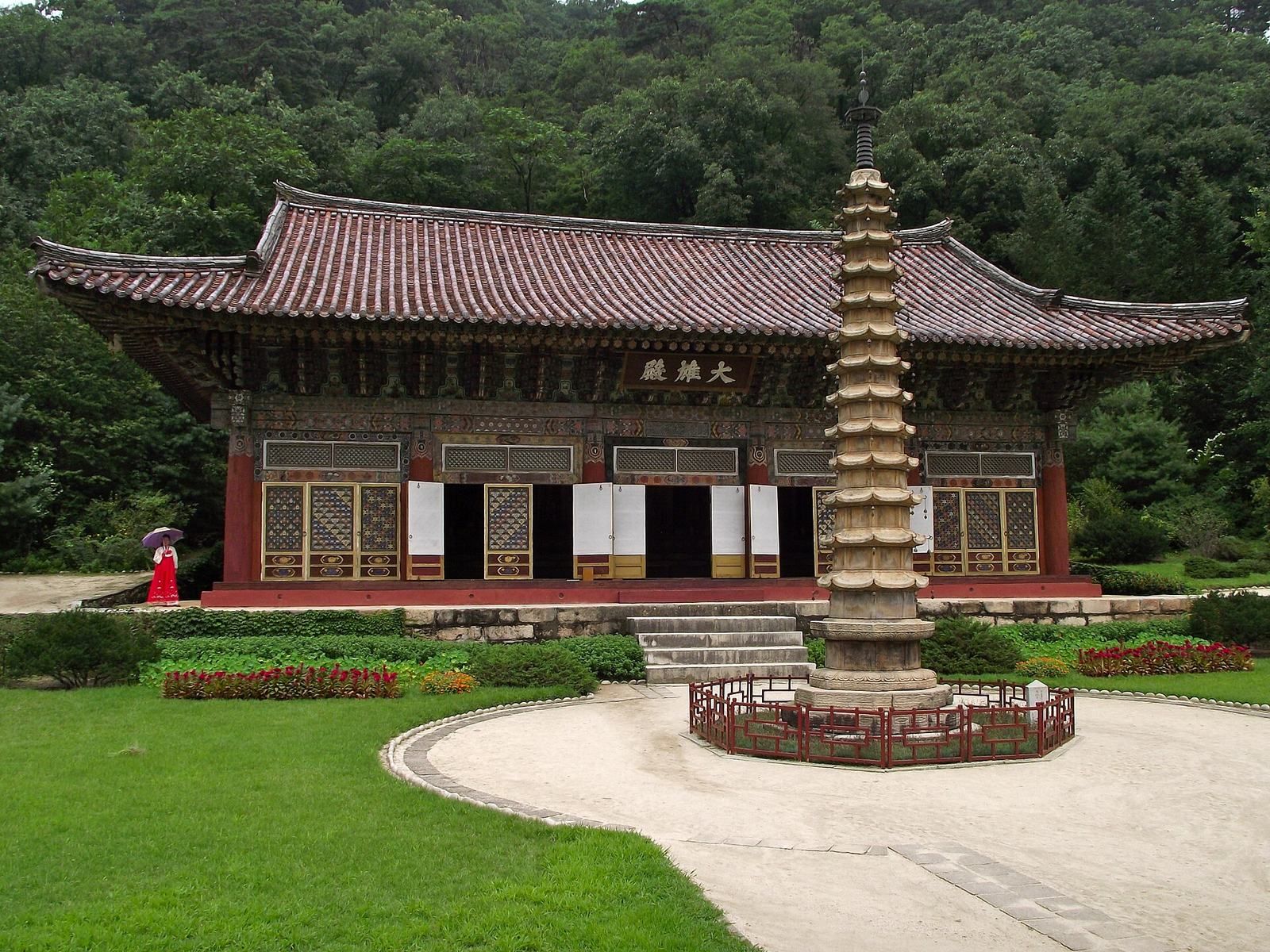
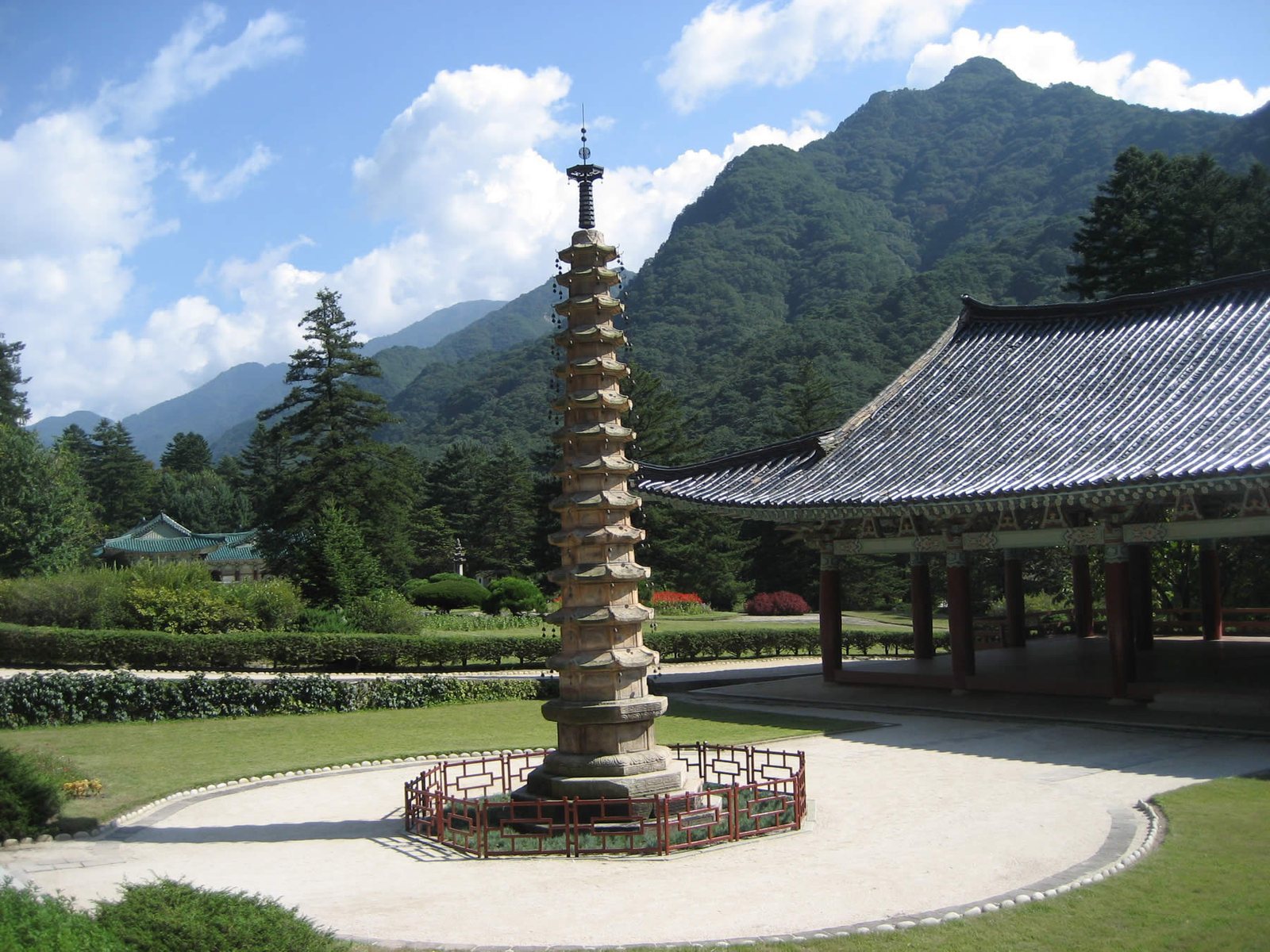
The extensive grounds are arranged around a broad central lawn, with halls and pavilions around its edges. The principal buildings follow a south-to-north line centered on Taeung Hall, while other major buildings stand along an east-to-west line to its east. The complex faces southwest, with a mountain peak behind it, a broad stream in front, and another peak across the water.
Approach, gates, and stone monuments
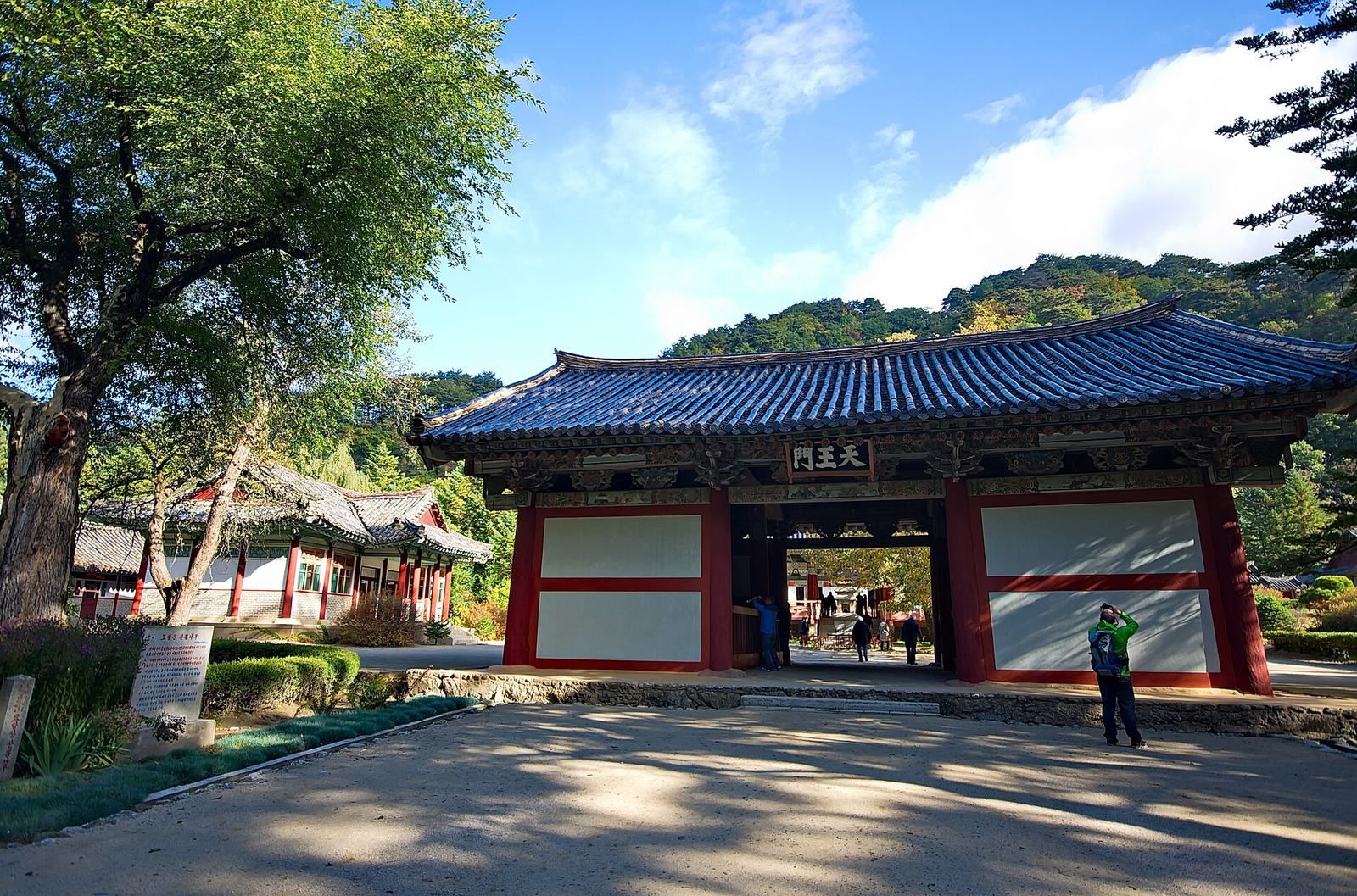
The traditional approach passes through Jogye Gate, Haetal Gate, and Chonwang Gate. They are slightly offset rather than precisely aligned, and a long, tree-lined path links the first two. Stone steles, upright monuments often bearing inscriptions, stand to the left after Jogye Gate; one commemorates the monastery’s history. Some along the path bear shrapnel scars from the Korean War. Jogye Gate contains two statues of devas, celestial beings in Buddhist belief, while Chonwang Gate holds statues of the Four Heavenly Kings, guardian deities.
Central halls and pagodas
Manse Pavilion and Tabo Pagoda
Manse Pavilion stands just beyond Chonwang Gate and was formerly used for meditation. Rebuilt in 1979, it incorporates concrete in place of most of its original wooden elements. The nine-story stone Tabo Pagoda stands in front of the pavilion. It was erected in 1044.
Taeung Hall and Sokka Pagoda
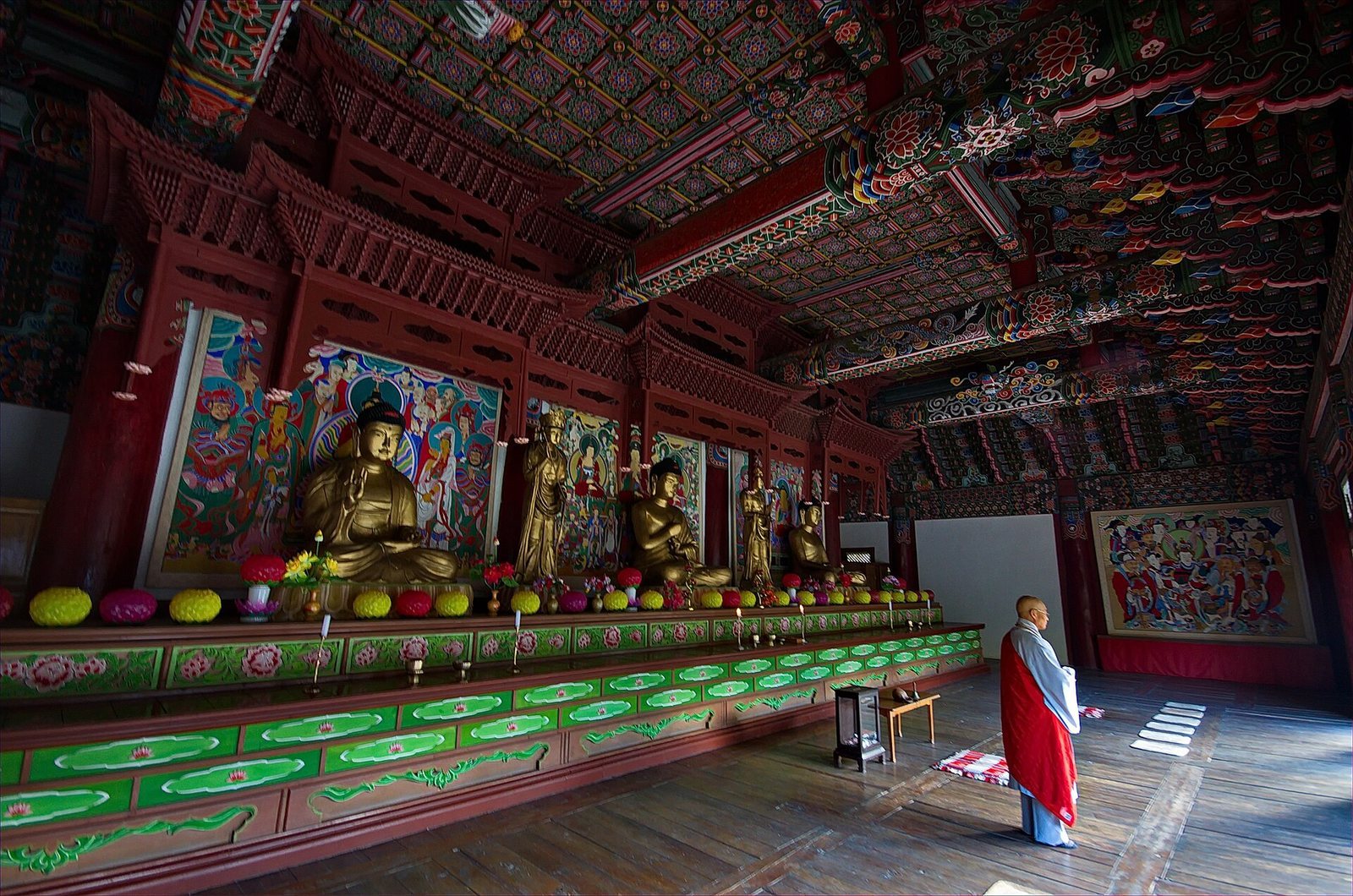
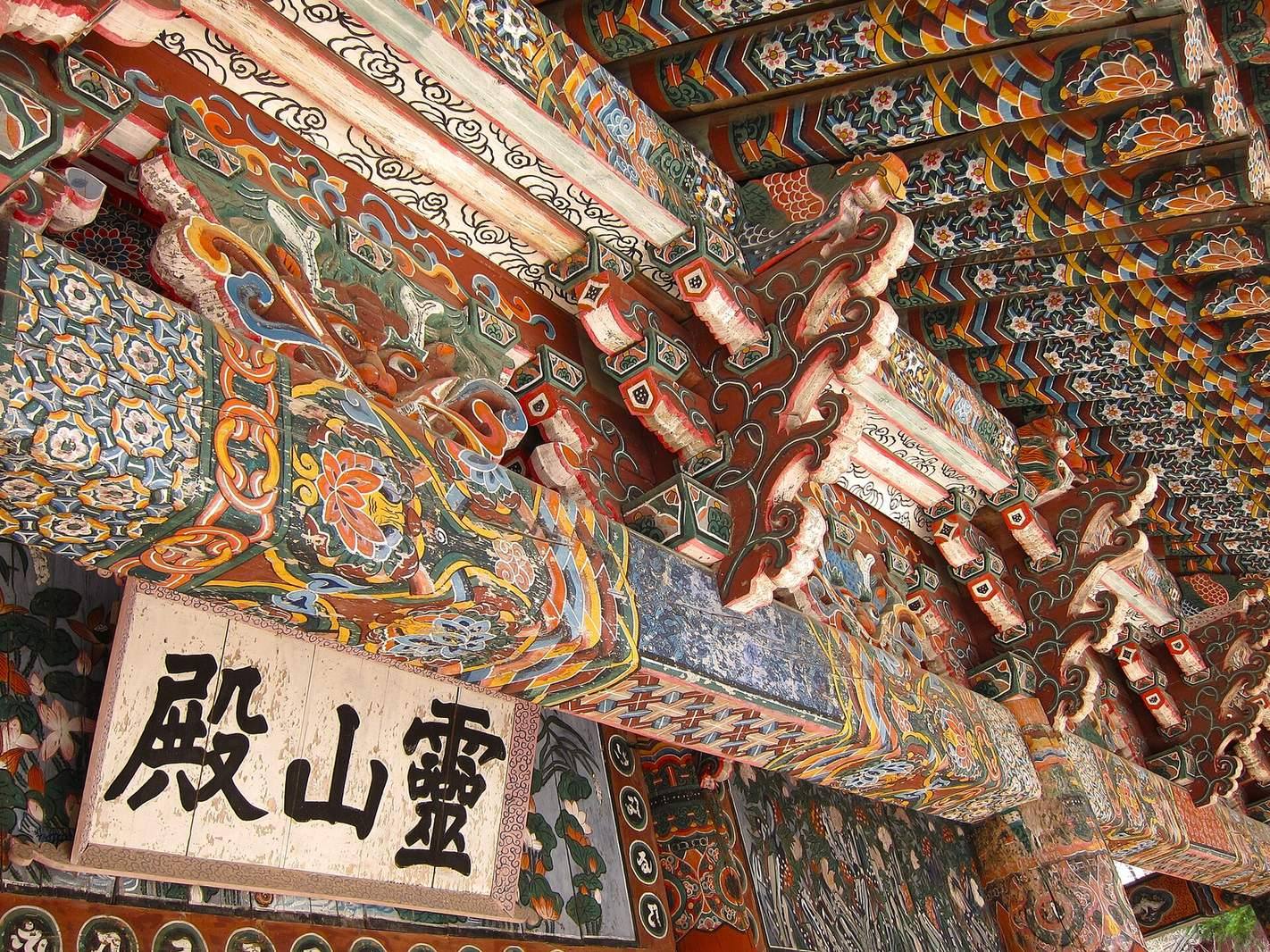
Taeung Hall is the complex’s principal hall. The present building, reconstructed in 1976, faithfully reproduces the hall built in 1765. Between it and Manse Pavilion stands the Sokka Pagoda, a thirteen-story, octagonal stone structure dating to the fourteenth century, in the late Koryo period.
Kwanŭm and Ryongsan Halls
Kwanŭm Hall stands beyond a small garden to the right of Taeung Hall. Built in 1449, it is the oldest building in the complex and is dedicated to Avalokitesvara, a bodhisattva associated with compassion. Ryongsan Hall stands east of Kwanŭm Hall.
Northeast shrine and archive
Suchung Shrine
Suchung Shrine occupies the northeastern corner of the complex within a walled enclosure. Built in 1794, it honors monks who led forces against the Japanese invasions of 1592–1598. Its portrait hall contains paintings and relics associated with three patriotic monks, including Sŏsan Taesa. A separate pavilion houses a stele erected in 1796 that recounts Sŏsan’s patriotic deeds.
Changgyong Pavilion
Changgyong Pavilion, the temple archive, stands on the east side of the lawn, south of Suchung Shrine. It is a modern building that replaced a library destroyed in 1951. The Tripitaka Koreana’s original carved woodblocks are held at Haeinsa.
Earlier architectural arrangement
Main-hall precinct
Plans and photographs from the early twentieth century show the complex divided into three areas. In the main-hall precinct, a hall stood to the left of Taeung Hall and a monks’ residence to its right, forming a courtyard arrangement of four buildings. Two further buildings, believed to have served as an underworld hall and another hall, stood to the left of the principal hall and faced it.
Adjoining precinct
An adjoining area included Kwanŭm Hall and another hall, together with two side-by-side buildings, one five bays by two bays and the other three by two. Three square, single-bay structures stood north of the latter: a mountain-spirit shrine and two other buildings. A hall with a complex roof stood slightly east, in front of the two side-by-side halls. A shrine west of it held portraits of Sŏsan and two other monks, while two structures farther east were thought to be stele pavilions. The complex has contracted since the Korean War; Taeung Hall and Manse Pavilion were rebuilt at their original positions.