Tonglüshan Mine Site: An Ancient Copper-Mining Complex in China
Site at a Glance
- Rating
- 5
- Popularity
- Very Low
- Country
- China
- Primary era
- Classical
- Eras represented
- Iron Age, Classical, Modern
- Civilizations
- Chinese, Han, Zhou
- Site type
- Economic
- Remains
- Mine
On this page14 sections
History
The Tonglüshan Mine Site is an ancient copper-mining complex in Daye, Huangshi, Hubei, China. Its main period of activity extended from the Western Zhou through the Western Han, approximately the ninth to first centuries BCE. The name means “copper-green mountain,” referring to a green patina said to appear on the soil and rocks after rain.
Ancient Mining and Chu
The mine’s earliest workings are debated. Proposed beginnings range from the Erligang culture, an early Bronze Age culture associated with the Shang dynasty, and the late Shang period to the Western or Eastern Zhou. A timber from the mine was dated to 3,260 years before 1982, plus or minus 100 years, and has been used to support a late Shang date. Other interpretations place the beginnings about 4,200 years ago. Excavated evidence points to concentrated activity from the Spring and Autumn and Warring States periods into the Han dynasty, while also indicating earlier mining. The Spring and Autumn and Warring States periods formed part of the Eastern Zhou; the Han followed the Qin, and the Western Han was its first major period.
Mining and smelting had reached a substantial scale by the Spring and Autumn and Warring States periods. Tonglüshan was an important copper-producing center in the territory of Chu, an ancient state that included parts of present-day Hubei. A survey from 1982 to 1985 identified the ancient cities of Dajipu and Caowangzui in Daye. Both were closely connected with mining and smelting at Tonglüshan. Scholars have interpreted Caowangzui as an administrative center overseeing production at mines in southeastern Chu, including Tonglüshan.
Modern Mining and Archaeological Work
In 1916, the Hubei Official Mining Bureau established the Daxin Copper Mine at Tonglüshan to extract iron and nonferrous metals, but operations later stalled. A mining company decided to resume extraction in September 1959. Following several reorganizations, the mine became part of the Daye Smelter under the Ministry of Metallurgy, the government department responsible for the metallurgical industry. The smelter was later reorganized as Daye Nonferrous Metals Company, under which the mine remains.
Ancient remains came to notice during renewed exploration and mining around 1965, when workers found black, flaky slag, the waste left by smelting. Tests showed it had a high iron content. Workers uncovered near-carbonized timber supports in the early 1970s, although some were taken away and burned as fuel. In 1973, miners stripping overburden exposed ancient shafts and slag, as well as tools and pottery. A joint inspection by the China History Museum and Hubei Provincial Museum identified the site as a large mining complex of the Spring and Autumn and Warring States periods. Formal excavation began in February 1974, and the first phase continued through 1985.
A second phase began in 2011 in preparation for a national archaeological site park. Excavations in 2015 uncovered burials of mine managers and workers, the first cemetery in Chinese mining-and-metallurgy archaeology directly associated with a mining and smelting site. The discovery was selected among China’s top ten archaeological discoveries of that year. Excavations also brought attention to the site’s wider historical importance: it was named among China’s 100 major archaeological discoveries of the twentieth century in 2001.
Preservation and Recognition
Plans for a site museum were approved in 1981 by the Ministry of Metallurgy and the State Administration of Cultural Heritage, China’s national agency for cultural heritage protection. Mining interests proposed moving the remains to reach ore beneath the planned protected area, while heritage authorities and scholars argued that relocation would damage the site and diminish its value. In 1991, the mine formally abandoned development of the ore body beneath the protected area, ending the dispute.
Tonglüshan became a Hubei Provincial Cultural Relics Protection Unit in 1981 and a National Key Cultural Relics Protection Unit in 1982. It was placed on China’s World Heritage Tentative List in 1994 and again in 2012; this inventory identifies sites a country may nominate, but is not the same as inscription on the World Heritage List. Further designations followed, including National Mining Park status in 2005, inclusion on the National Industrial Heritage list in 2018, and provincial cultural heritage site park status in 2024. Elemental comparisons led researchers at Hubei Provincial Museum to suggest that copper in the bronze bells associated with Marquis Yi of Zeng, a ruler of the ancient state of Zeng, may have come from Tonglüshan. In 2023, the museum made a copy of the bell ensemble for display at the site museum.
Remains
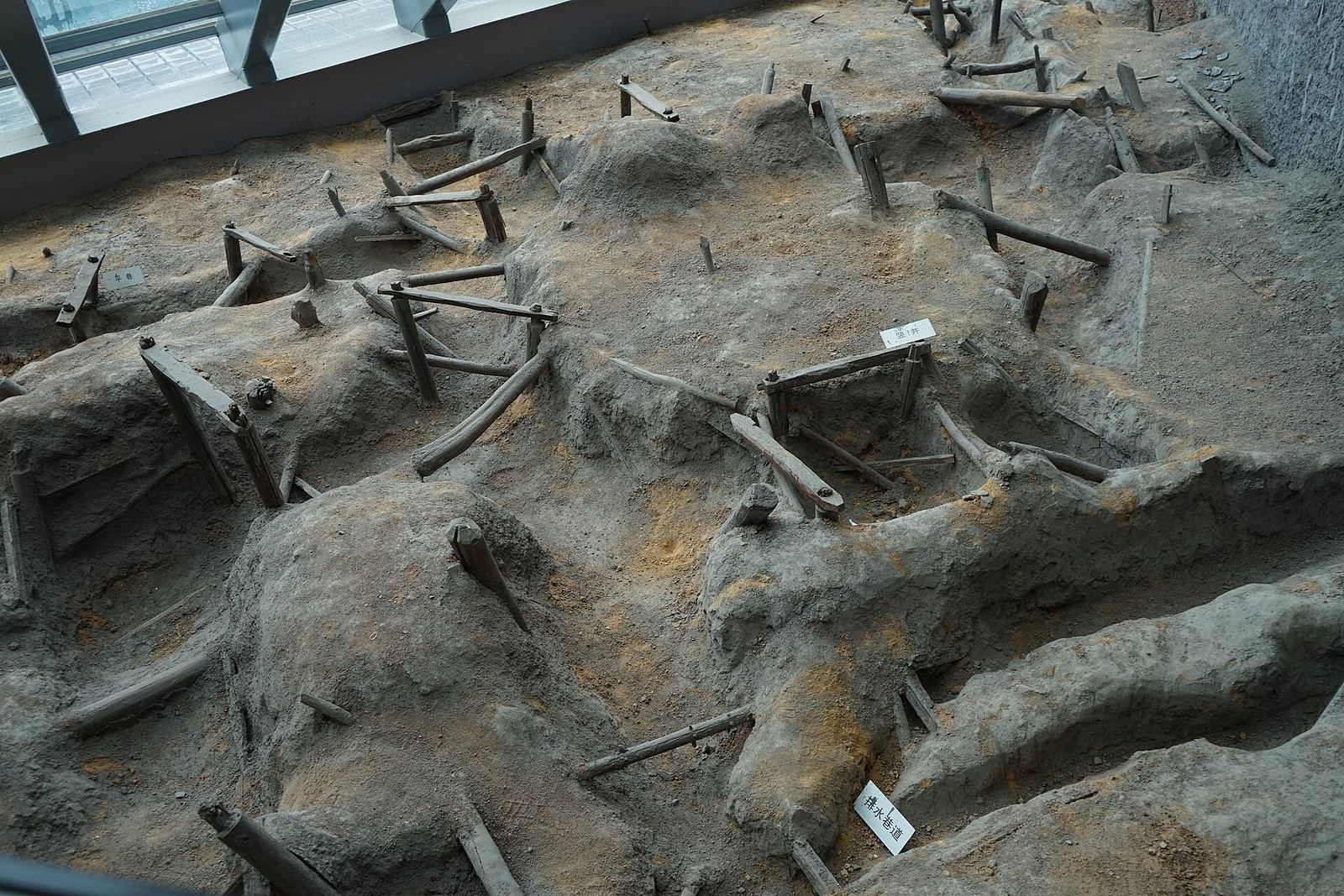
The archaeological area covers about 2.5 million square metres and encompasses workings at twelve copper deposits. Its remains include underground shafts and horizontal passages, smelting installations, burial areas, and archaeological finds. The mine’s rock was brittle enough to work with simple tools, but the excavated workings required extensive timber support.
Underground Workings
Shafts and Galleries
Excavations recorded several hundred vertical, inclined, and blind shafts, the last being shafts that end underground, along with more than one hundred horizontal galleries cut laterally through the mine. Shafts dating from the Western Zhou to the Spring and Autumn period reached depths of about 20 to 30 metres. Those assigned to the Warring States period through the Han reached about 40 to 50 metres. Gallery cross-sections measured approximately 0.8 metres square.
Mining Scale
Estimates based on the quantity of slag indicate that miners extracted about 80,000 to 100,000 tonnes of copper ore. The slag represents waste from the smelting process and provides evidence for the scale of production.
Smelting and Excavated Finds
Furnaces and Tools
Eight vertical copper-smelting furnaces dating to the Spring and Autumn period were found at the site. Excavations recovered more than a thousand objects used in production and daily life, including copper axes, wooden mallets, shovels, and pottery.
Miners’ Footprints
In 2012, excavators uncovered 35 miners’ footprints in an archaeological area at the foot of a rocky hill. Their number and preservation were considered exceptional among known smelting sites.
Burials and Protected Area
Cemetery and Graves
Excavations in the cemetery area revealed multiple burials associated with mine managers and workers. The second phase of excavation also uncovered burials dating to the Xia and Shang periods. The Xia is traditionally regarded as an early Chinese dynasty, although its historical status is debated.
Site Museum and Enclosure
The site museum’s main building, constructed in 1983, occupies 2,046 square metres directly above mine remains. A protected area of 75,475 square metres was established around the site. Its protected enclosure is bounded by a 920-metre wall and covers 82.47 mu, a Chinese unit of land area; the construction-control zone extends 30 metres beyond the wall.