Moyoro Shell Midden: A Prehistoric Settlement in Japan
Site at a Glance
- Rating
- 4.1
- Popularity
- Medium
- Country
- Japan
- Primary era
- Medieval
- Eras represented
- Classical, Medieval
- Civilizations
- Unclassified
- Site type
- Settlement
- Remains
- Village
On this page11 sections
History
Moyoro Shell Midden is a prehistoric settlement site on the north bank of the Abashiri River estuary in Japan. Buildings were constructed there during a period corresponding to Japan’s Late Jōmon period, and habitation continued through the Zoku-Jōmon phase, a cultural phase in Hokkaido, into the Okhotsk culture, an archaeological culture associated with the Sea of Okhotsk region. The site is regarded as a representative example of Okhotsk culture.
Discovery and cultural identification
Amateur archaeologist Yonemura Kiyoe discovered the site in 1913 after moving to Abashiri from Aomori Prefecture. Pottery he found led him to recognize a culture distinct from both Jōmon and Ainu cultures. He settled in Abashiri, opened a barber shop, and began investigating the site.
In 1918, Yonemura named the midden after Moyoro Kotan, a name used by Ainu people, the Indigenous people of northern Japan. Kotan means a settlement or village, while “Moyoro” means “inside an inlet” or “place of an inlet.” By 1933, the Okhotsk coastal culture was treated as distinct from other contemporary cultures in Hokkaido and became known as the Okhotsk culture. Pottery from Moyoro was grouped into four Okhotsk-style types alongside pottery from Sakhalin, Hokkaido’s Okhotsk coast, and the Kuril Islands.
Preservation and archaeological investigations
The Kitami Local History Museum, now the Abashiri City Local History Museum, was built in 1936 to preserve and exhibit finds from the site. On 16 December that year, Moyoro Shell Midden was designated a National Historic Site.
Construction of naval facilities in 1941 and 1942 destroyed part of the site and led to emergency excavations. A large-scale investigation followed between 1947 and 1951. Further excavations in 1989 and in 2003 and 2004 added to knowledge of the settlement.
Remains
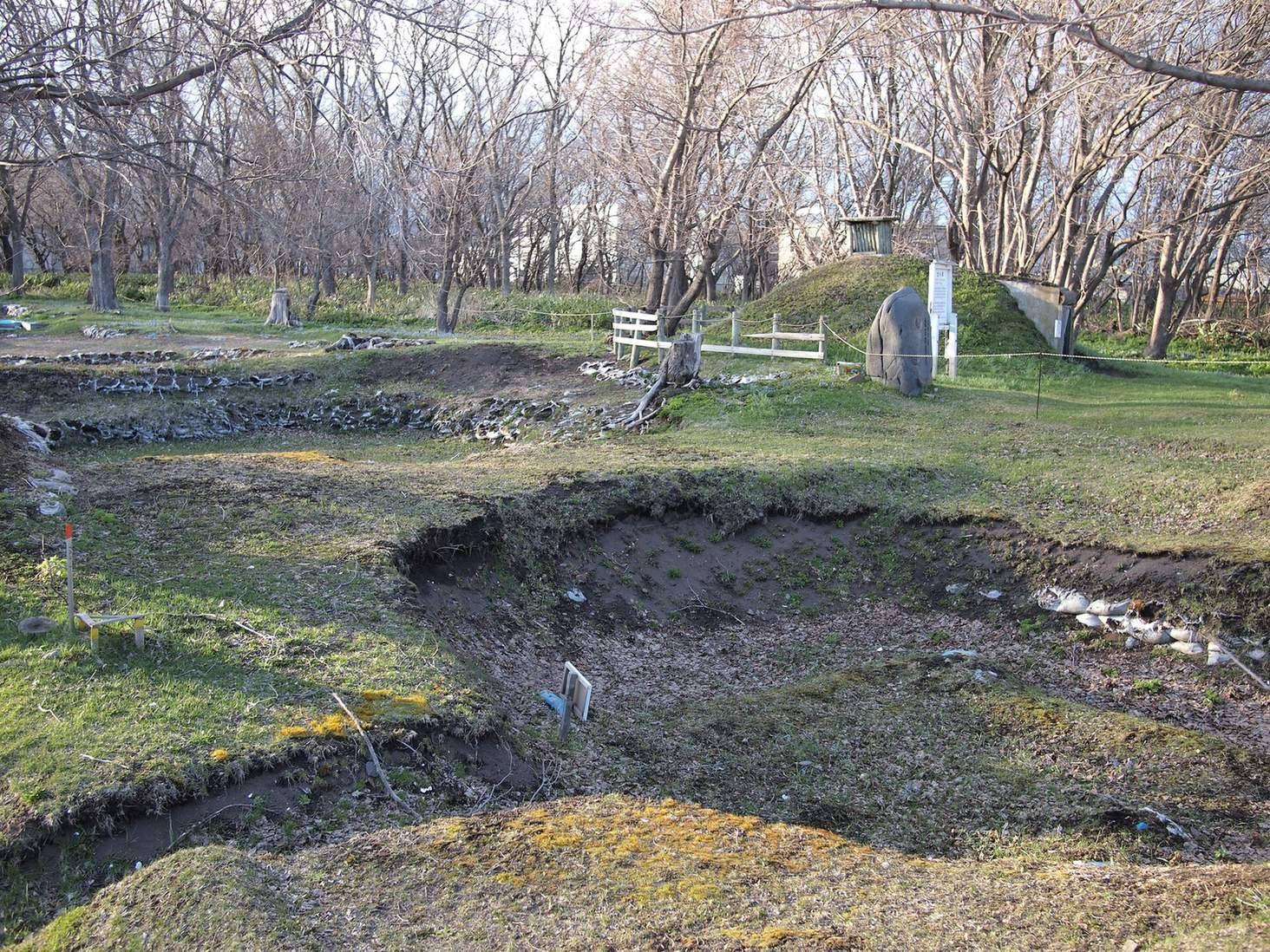
The site lies on a sand-dune plateau near the Sea of Okhotsk, about 5 metres above present sea level. Its settlement remains include homes set partly below ground, as well as burials and objects associated with the people who lived there.
Settlement and burials
Pit-house settlement
At the time of the site’s 1936 designation, 28 building remains had been identified. Remains numbered 1 to 14 lie in the southeast and were attributed to the Okhotsk culture; those numbered 15 to 27 lie in the northwest and were assigned to the Zoku-Jōmon phase. Around 20 building remains survive today. In large buildings associated with Okhotsk culture, bones of sea mammals and brown bears had been carefully arranged.
Burials in the shell midden
The shell midden, an accumulation of discarded shells and other settlement remains, was also used for burials. Many people were placed in flexed positions, with their limbs bent. Emergency excavations in 1941 and 1942 recovered human remains representing more than 100 individuals. Excavation in 1989 revealed about 80 closely spaced graves.
Artifacts and subsistence
Tools and weapons
Finds include implements made from bone and antler, pottery, stone tools, iron swords, and spears. The swords include straight forms, fern-hilted swords, and long swords with tweezer-shaped hilts. The iron weapons are thought to have been made on Honshu, while bronze bells are thought to have come from the Asian continent. The proportion of tools associated with hunting at sea suggests that sea-mammal hunting was a major focus of settlement life.
Carved objects and pottery
Carvings of whales, dolphins, and bears appear on pottery and bone and antler implements. Animal figures were also carved from tusks. One finely modeled female figure was made from walrus tusk and is believed to have come from Primorye, a coastal region of Russia’s Far East. Excavations in 2003 and 2004 also uncovered many artifacts, including an earthenware bear figure.
Cultivated plants
Excavations recovered seeds of cultivated plants, including barley, providing evidence of plant cultivation at the settlement.