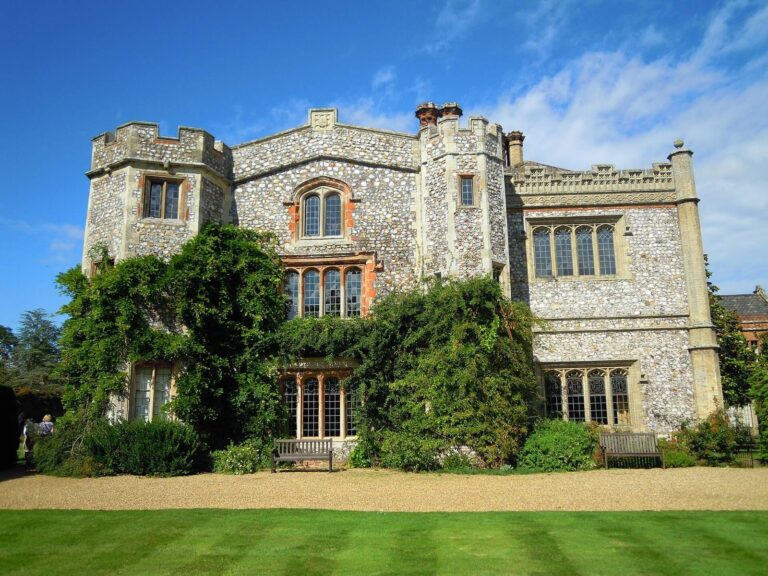
Melton Constable Hall: A Norfolk Country House and Estate
Site at a Glance
- Popularity
- High
- Country
- United Kingdom
- Primary era
- Early Modern
- Eras represented
- Medieval, Early Modern
- Civilizations
- English
- Site type
- Domestic
- Remains
- Manor House
On this page12 sections
History
Manor and early house
Melton Constable Hall is a country house in the parish of Melton Constable, Norfolk, England. William I, better known as William the Conqueror, granted the manor to the Bishop of Thetford. The bishop’s constable lived there and adopted “Melton” as a name, with “Constable” added as a suffix. The manor later passed to the Astley family, whose male line held the estate from 1235 until its sale in 1948. An earlier house on the estate dated to about 1500.
Seventeenth-century rebuilding
The Hall’s core is Elizabethan, from the reign of Elizabeth I (1558–1603). Sir Jacob Astley remodelled and enlarged the house between 1664 and 1670, replacing the earlier building. Its design is associated with the style of Christopher Wren, a prominent English architect, though this does not mean that Wren designed the Hall.
Astley fought in the English Civil War, the conflict between supporters of King Charles I and Parliament from 1642 to 1651. A prayer attributed to him is still quoted: “Lord, I shall be very busy this day. I may forget Thee, but do Thou not forget me.”
Park, mill, and later ownership
In 1721, Sir Jacob Astley, 1st Baronet, built the Belle Vue smock mill, a windmill with a tower-shaped body and a rotating cap. It saw little use. Capability Brown, an influential designer of country-house parks, designed Melton Constable Park between 1764 and 1769. Around 1775, Sir Edward Astley, 4th Baronet, replaced the mill’s wooden tower with a brick one.
In 1948, Albert Astley, 21st Baron Hastings, sold the estate to Hugh Grosvenor, the 2nd Duke of Westminster. It changed hands again in the 1950s. The land continued to be used for agriculture, while the Hall deteriorated. In 1985, under threat of a compulsory purchase order, a legal mechanism for acquiring property, the owner was obliged to sell the Hall and parts of the estate.
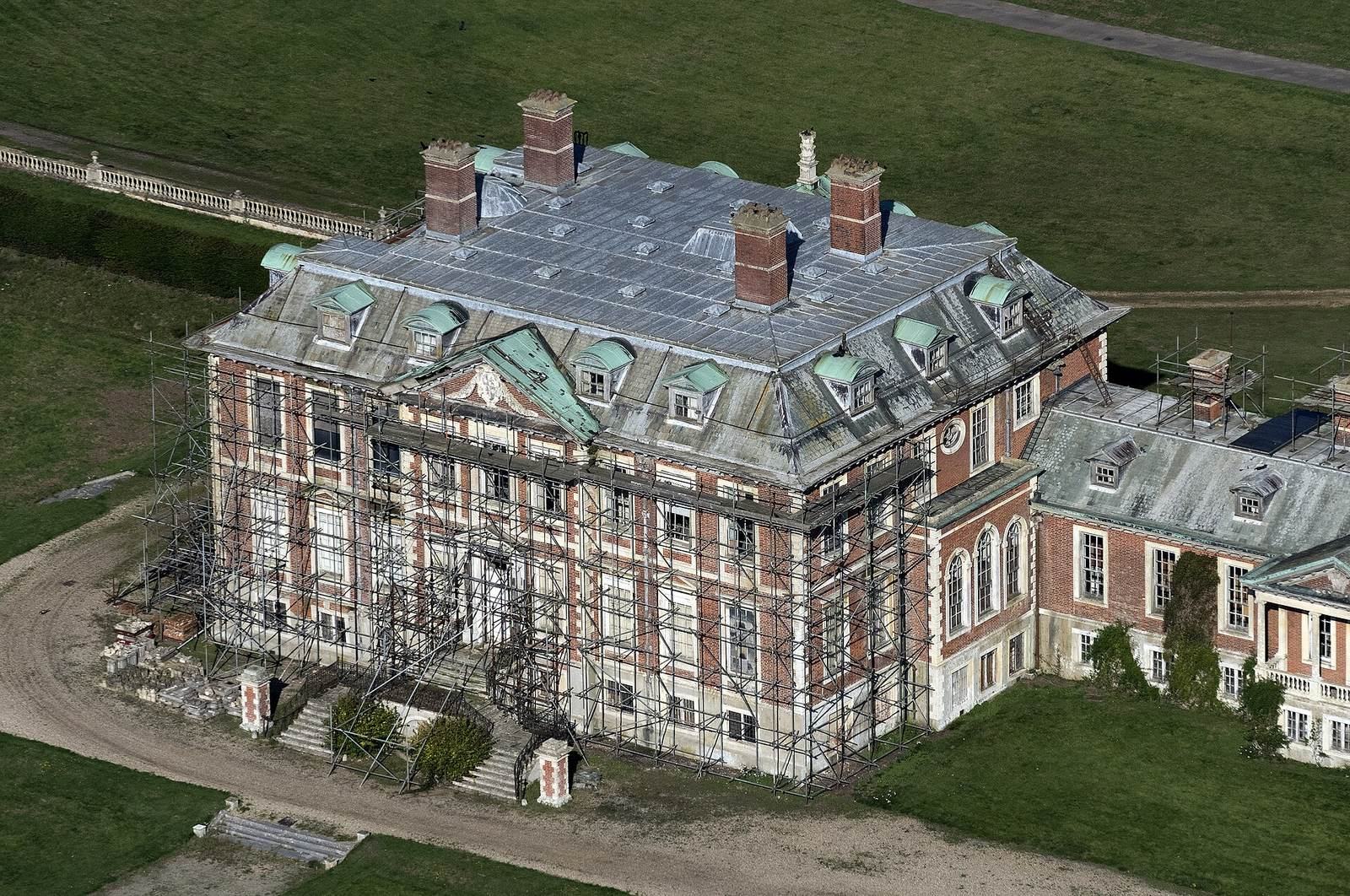
The Hall received Grade I listing in 1951, the highest category in England’s listed-building system. The north wing is Grade II*, a category for buildings of particular importance, and the stable buildings have Grade II or Grade II* status. By April 2010, the Hall, the west and north wings of the stable court, the terraces, and the park’s Bath House and Teahouse were on the Heritage at Risk Register, which identifies heritage assets threatened by loss or deterioration. The register also included the Belle Vue tower and several estate outbuildings.
Remains
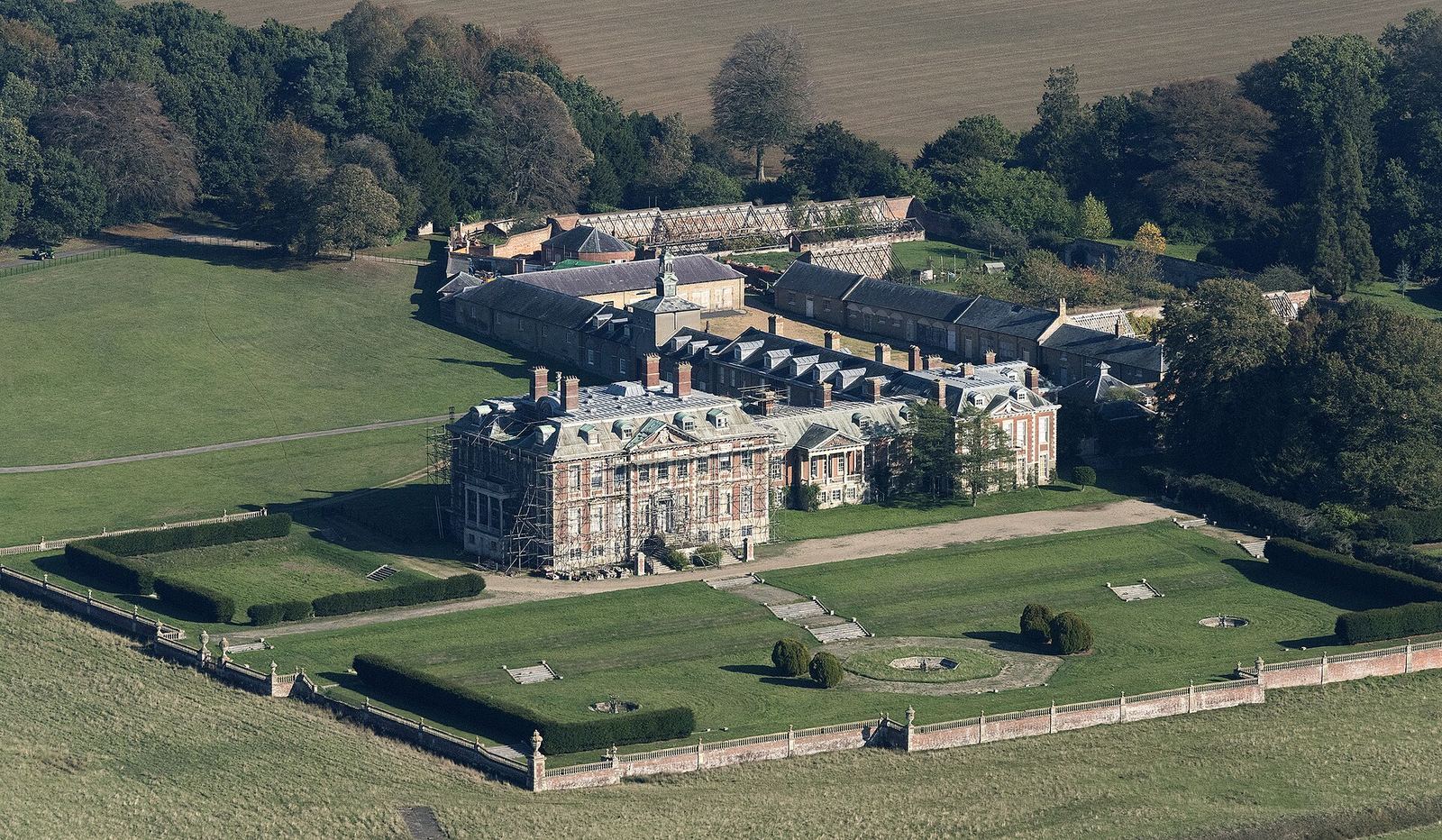
The estate’s main building is a brick house with slate and copper roofs. Its principal range has a nine-bay frontage, meaning nine divisions across the front, with seven-bay extensions to the east and north. A stable court and a range of structures within Melton Constable Park form other parts of the estate.
Hall and stable court
Main Hall
Plaster ceilings inside the Hall are dated to 1687 and were probably made by Edward Goudge, a craftsman associated with decorative plasterwork.
Stable court
The stable court has west and north wings. These buildings are among the estate structures with listed status.
Park and associated structures
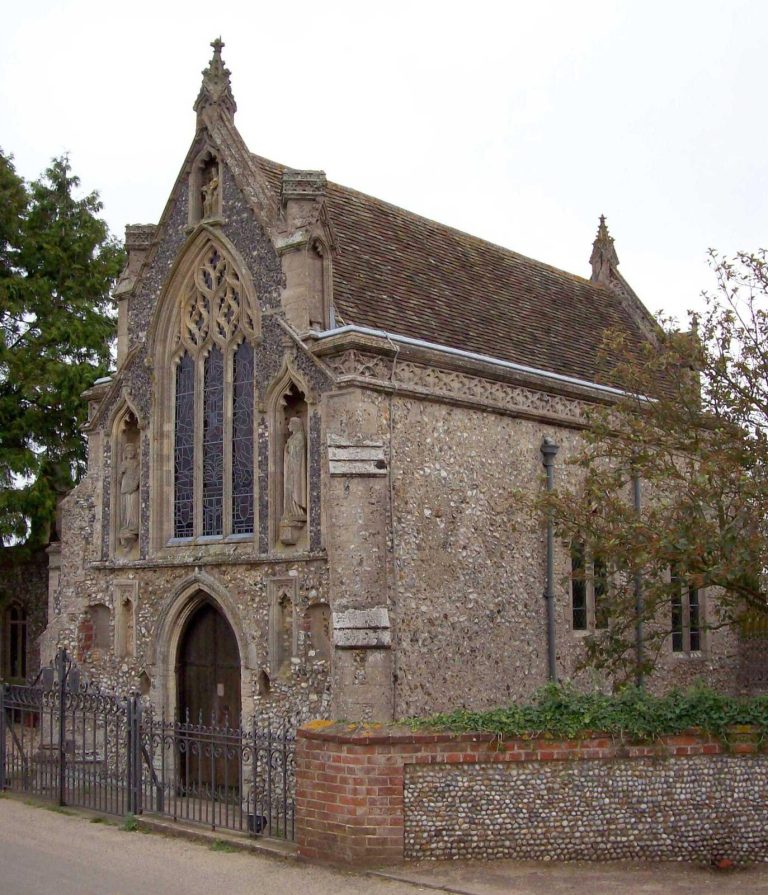
St Peter’s Church
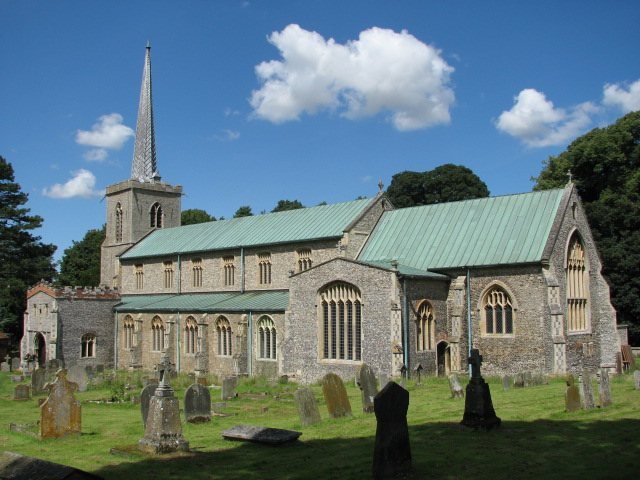
St Peter’s is a small, unusual church with Norman-period work, associated in England especially with the 11th and 12th centuries. It contains numerous memorials to the Astley family, who held the title Lord Hastings. Yews, firs, and oaks surround the church, which is approached by a drive lined with rhododendrons.
Park features
The park includes a temple and ornamental follies, decorative landscape structures often made without a practical purpose. Other identified features include terraces, a Bath House, and a Teahouse.
Belle Vue
Belle Vue stands in Briningham, about two miles from the Hall. Its brick tower rests on an existing three-storey, octagonal brick base. The tower is the county’s only example of its type, and the base is described as the county’s oldest. After falling into disrepair, the tower became a private home. It offers views of Norwich and the sea.