Wuying Pagoda: A Southern Song Buddhist Monument in Wuhan
Site at a Glance
- Rating
- 4.3
- Popularity
- Very Low
- Country
- China
- Primary era
- Medieval
- Eras represented
- Medieval
- Civilizations
- Song
- Site type
- Religious
- Remains
- Pagoda
On this page7 sections
History
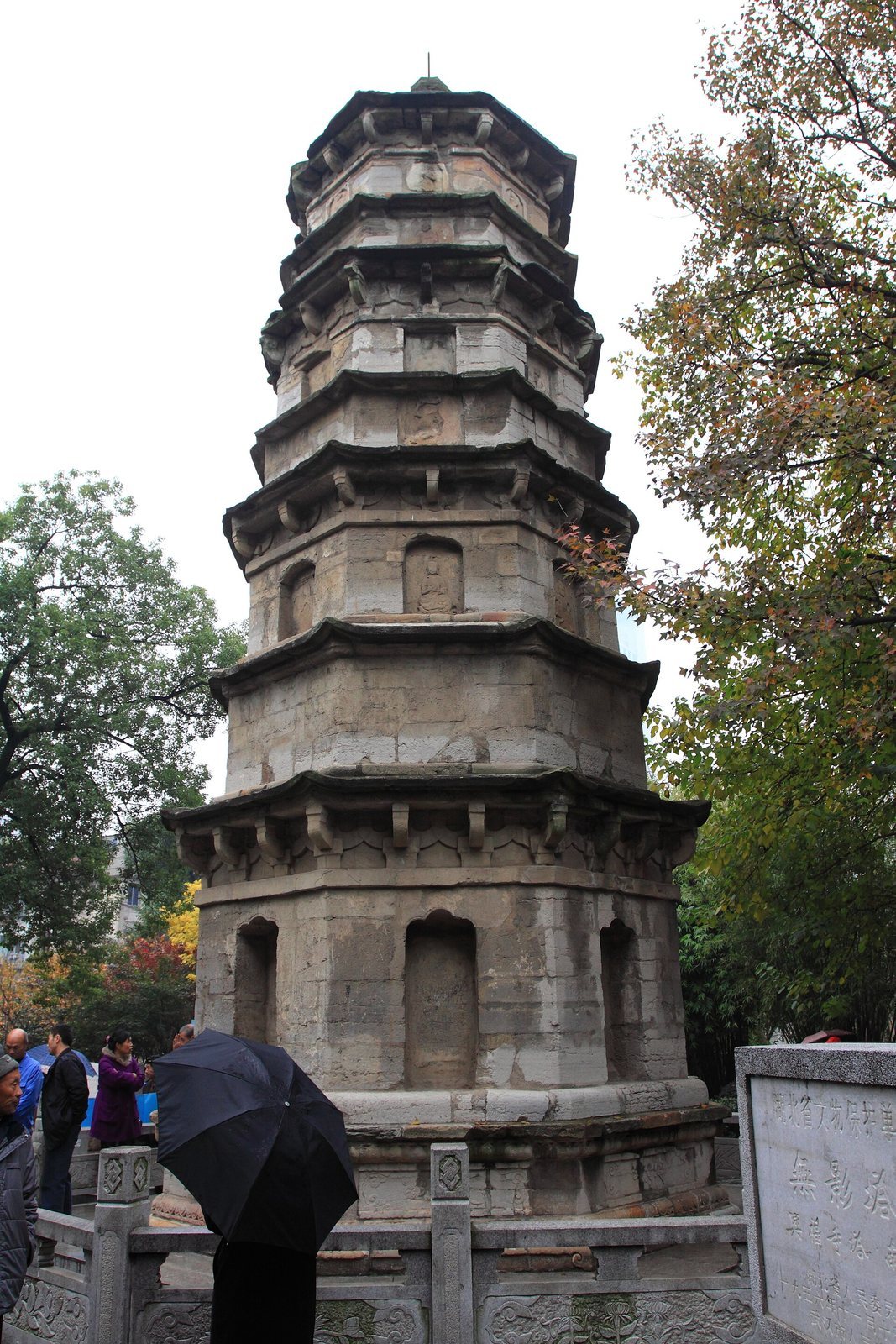
Wuying Pagoda is a Buddhist monument in Hongshan Park at the southwestern foot of Mount Hong in Wuhan, China. Its surviving form dates to a rebuilding in 1270 under the Southern Song, the later period of the Song dynasty after it lost control of northern China. The pagoda is regarded as Wuhan’s oldest surviving architectural feature.
The temple and its pagoda
An earlier pagoda was built between 552 and 554 as part of Jin’an Temple, during the reign of Emperor Yuan of Liang, a ruler of the Liang dynasty. During the reign of Emperor Wen, who founded the Sui dynasty, the temple was renamed Xingfu Temple. This later gave the monument its alternative name, Xingfu Temple Pagoda.
After the first pagoda was destroyed, it was rebuilt in 1270, during the reign of Southern Song emperor Duzong (1264–1274), as the dynasty faced overthrow. The rebuilt tower is the structure that survives today.
Relocation and later history
Xingfu Temple was ruined during the Taiping Rebellion, a major civil war in nineteenth-century China, but the pagoda remained. It originally stood within the temple on Mount Hong’s eastern slope. In 1953, the tower was in a courtyard beside a kitchen on the grounds of South Central University for Nationalities, east of the mountain, and was leaning severely.
Because of its tilt, the pagoda was moved from the eastern to the southwestern foot of Mount Hong in the winter of 1962–1963. Its new location adjoined the tomb of Shi Yang in Hongshan Park. Shi Yang, a lawyer and labor activist, was executed in 1923. Repairs by the Wuchang Cultural Department were completed on 18 December 2001.
The pagoda was among Hubei’s first 101 provincial-level protected historical and cultural sites, designated on 15 November 1956. In 2013 it was added to the seventh national list of Major Historical and Cultural Sites Protected at the National Level as a Song-dynasty site.
The “Shadowless” name has several traditional explanations. One says the tower casts no shadow at noon on either solstice; another claims that it never casts a shadow. The appearance of a shadow has been attributed to the pagoda’s relocation. A separate local tradition describes a “dragon vein,” an auspicious channel of vitality through the landscape, with its head beneath the Yellow Crane Tower and its tail beneath Wuying Pagoda. In this story, the pagoda was built to block the vein. The Annals of Huguang Province preserves another tradition, placing the tower over a water vein connected to the Yangtze River.
Remains
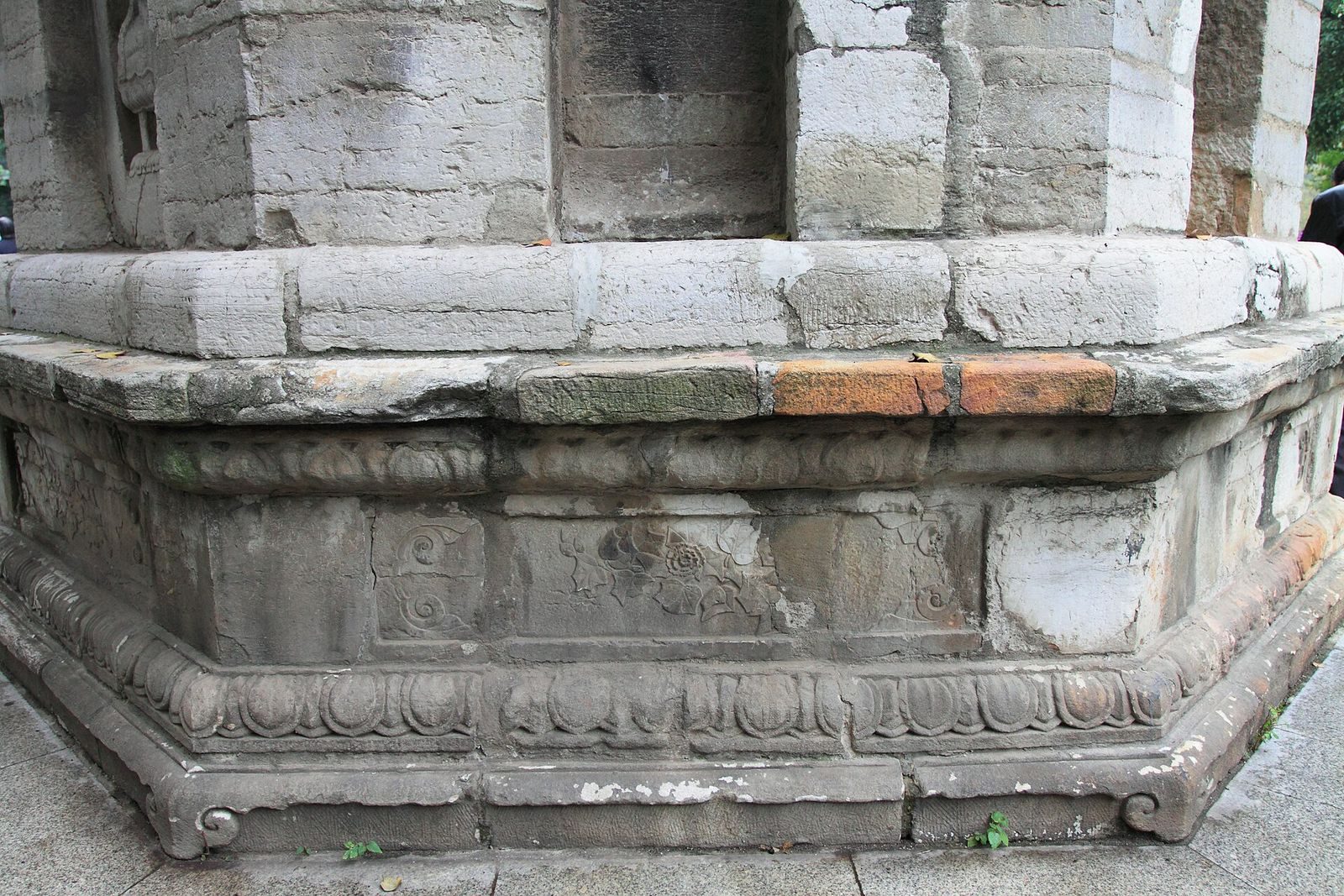
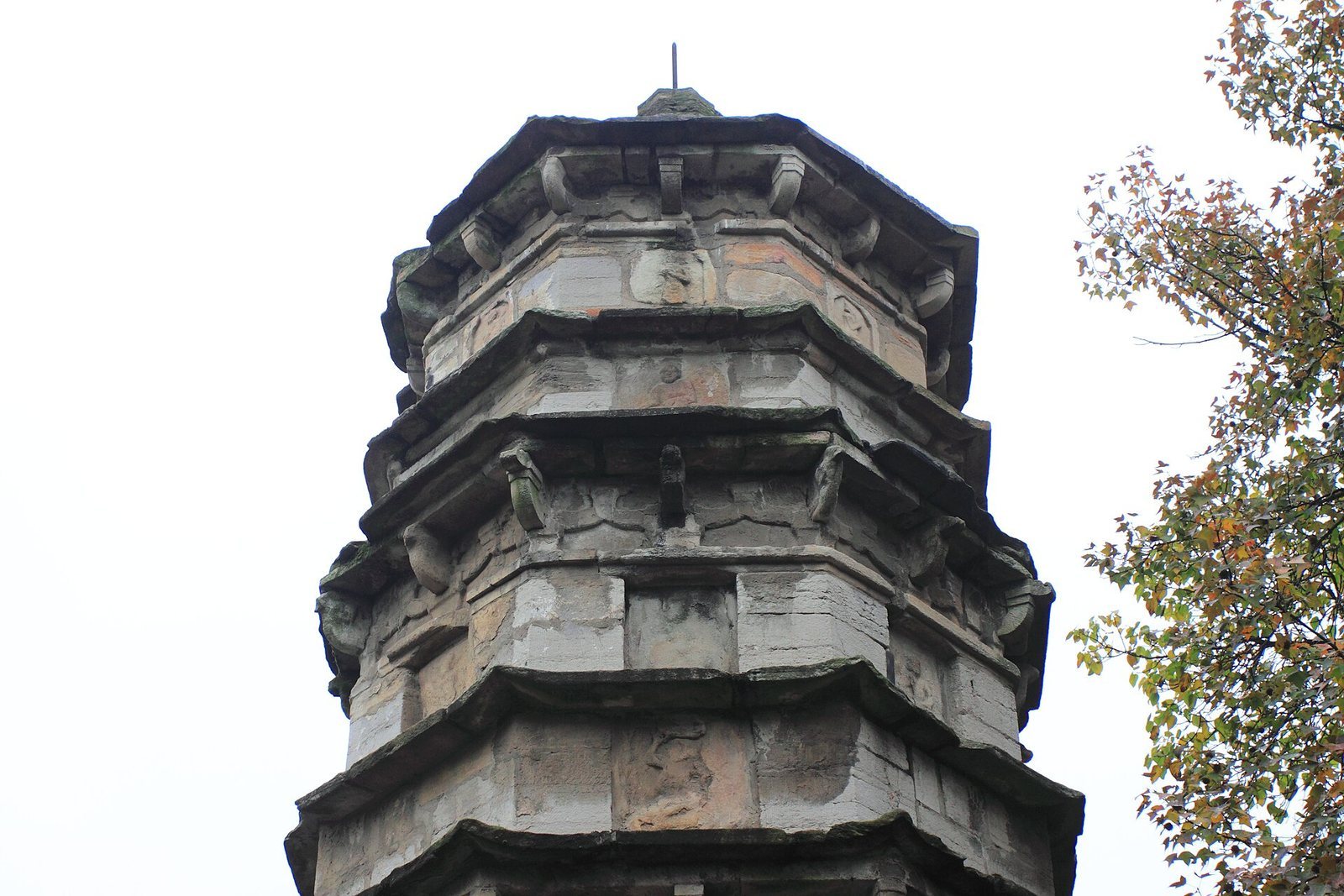
The surviving pagoda is a solid stone tower that imitates the form of a multi-storey wooden building. It has seven storeys and an octagonal plan, stands 11.25 metres tall, and measures 4.25 metres across at its base. The base takes the form of a Sumeru throne, a pedestal associated with Buddhist images and named for a sacred mountain in Buddhist cosmology.
Carved decoration and inscriptions
Figures and niches
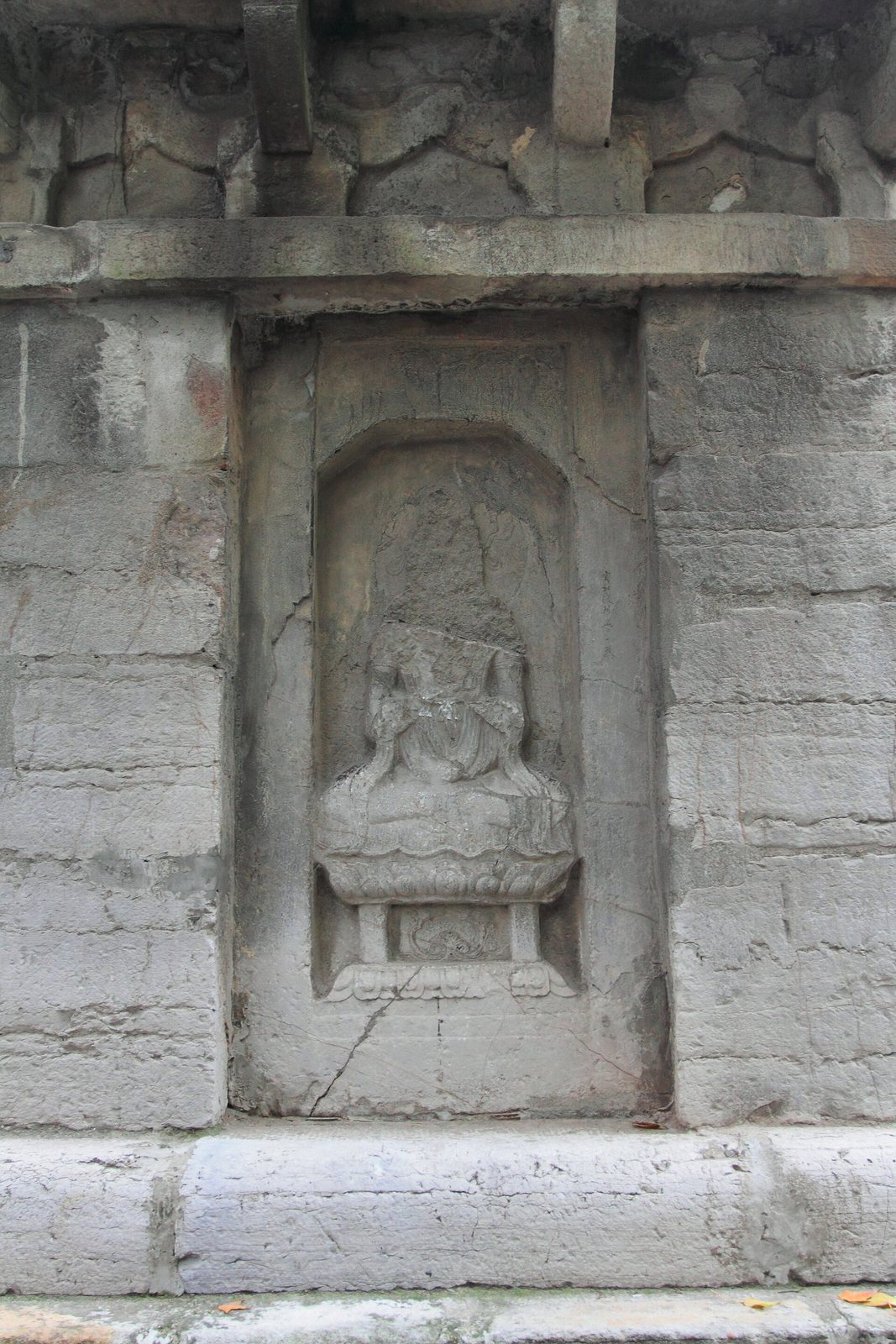
Figures cover parts of the base and body, including Buddhas, bodhisattvas (beings seeking enlightenment for others), Buddhist disciples, guardian figures, and donors. Small recessed niches on four storeys contain Buddhist figures, among them Buddhas, bodhisattvas, heavenly kings, and celestial guards. Some original carvings are damaged, and ornamentation also appears on an upper storey.
Inscriptions
The inscriptions date to the 1270 rebuilding. One identifies the monument as the Southern Song Shadowless Tower and the Xingfu Temple Pagoda. It also notes provincial protection approval dated 15 November 1956, naming the Hubei Provincial People’s Committee and the Wuhan People’s Government.