Church of St Mary, Ecclesfield: A Parish Church in Sheffield
Site at a Glance
- Rating
- 4.7
- Popularity
- Medium
- Country
- United Kingdom
- Primary era
- Medieval
- Eras represented
- Medieval, Early Modern, Modern
- Civilizations
- Anglo-Saxon, British, English, Norman
- Site type
- Religious
- Remains
- Church
On this page9 sections
History
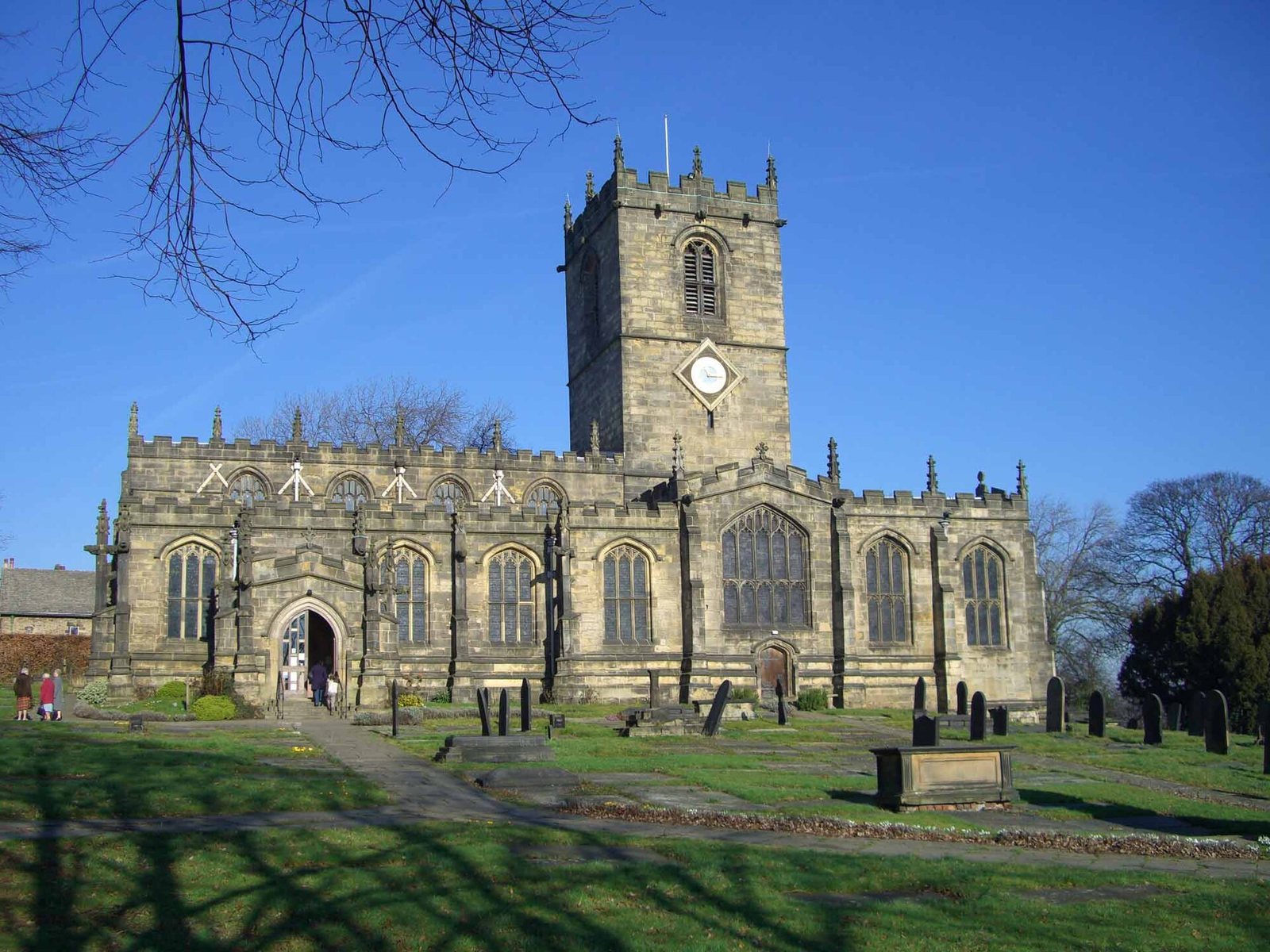
Church of St Mary, Ecclesfield, is an Anglican parish church in Sheffield, South Yorkshire, United Kingdom. Its present building, begun in 1478 and completed around 1500, is in the Perpendicular style, a late medieval English Gothic style marked by strong vertical lines. The church served Hallamshire, the historic district centered on Sheffield.
Early church and medieval ownership
Ecclesfield appears in the Domesday Book, England’s 1086 survey of land and resources, but the survey does not mention a church there. The place-name may mean “church in the field.” Historians have suggested that the Anglo-Saxons, the peoples of early medieval England, established a church here between 625 and 650, though its founding date is unknown.
After the Norman Conquest, the takeover of England in 1066, and the Harrying of the North, a campaign of devastation in northern England, lands around Ecclesfield passed to William de Lovetot at the beginning of the twelfth century. He built the first substantial church on the site. The building is often dated to 1111, but no written evidence confirms that precise year.
The church was given to Fontenelle Abbey near Rouen in Normandy and became an alien priory, a religious house in England dependent on a monastery abroad. A small community of monks came from France to live there. In 1386, Richard II dissolved the alien priories and transferred the church to Carthusian monks at Coventry. The Carthusians, members of a contemplative monastic order, held it until the Dissolution of the Monasteries, Henry VIII’s dismantling of England’s monastic institutions in the 1530s. It then passed to the Lords of Hallamshire.
Parish life and seventeenth-century damage
As parish church for Hallamshire, St Mary’s served a territory covering 82 square miles, making it one of England’s largest parishes. Its size meant that it had four churchwardens rather than the usual two, a tradition that continues. In the seventeenth century, the church was known as the “Minster of the Moors,” a name reflecting its rural setting.
During the 1640s, under Puritan influence, the church’s decorative pieces and stained glass were smashed. An Act of Parliament in 1643 required images of angels and saints in parish churches to be removed, defaced, or destroyed. Puritans were English Protestants who sought further reform of the Church of England, including the removal of religious images.
Later changes and commemorations
Vicars William Ryder and Alfred Gatty oversaw substantial changes to the church in the eighteenth and nineteenth centuries, particularly in the nave and chancel. Since the Second World War, those parts of the building have received new roofs. The church was registered as a Major Parish Church in 2019, a designation recognizing parish churches of particular importance. It is also Grade I listed, England’s highest listed-building category, and one of only five Grade I buildings within Sheffield’s city boundary.
In 1878, a football club representing Ecclesfield Church joined the Sheffield Football Association. The churchyard is the burial place of Joseph Hunter, an antiquarian and archivist who wrote the local history Hallamshire in 1819; Alexander John Scott, chaplain to Horatio Nelson and present when Nelson died at the Battle of Trafalgar in 1805; and Scott’s daughter Margaret Gatty, a writer and botanist. Parkin Jeffcock, a mining engineer, is also buried there. He died while trying to rescue miners during the Oaks mining disaster, a major colliery disaster in South Yorkshire.
Remains
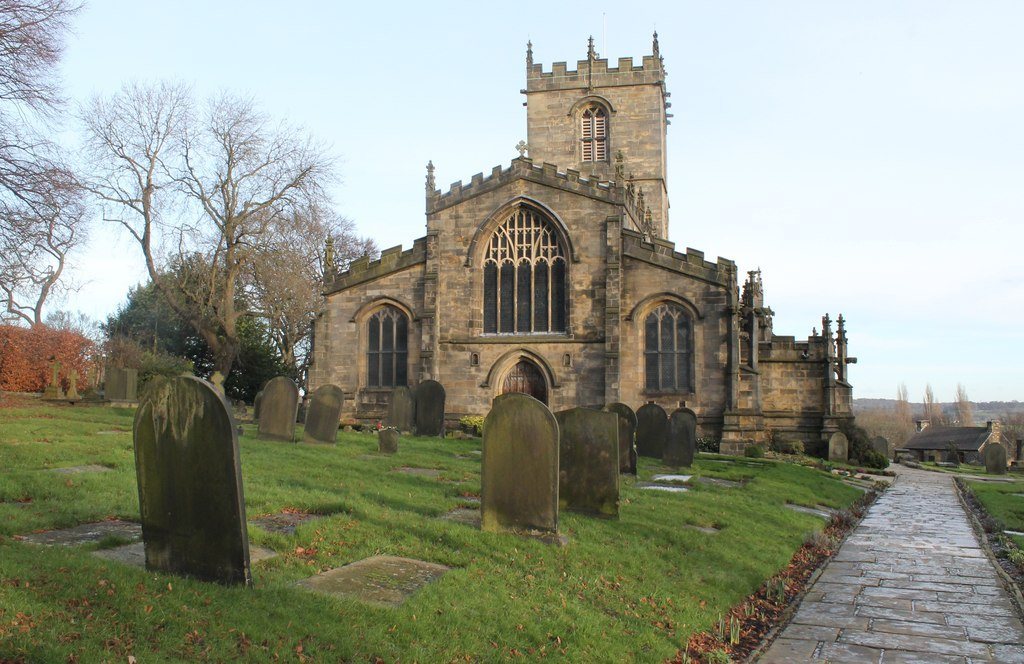
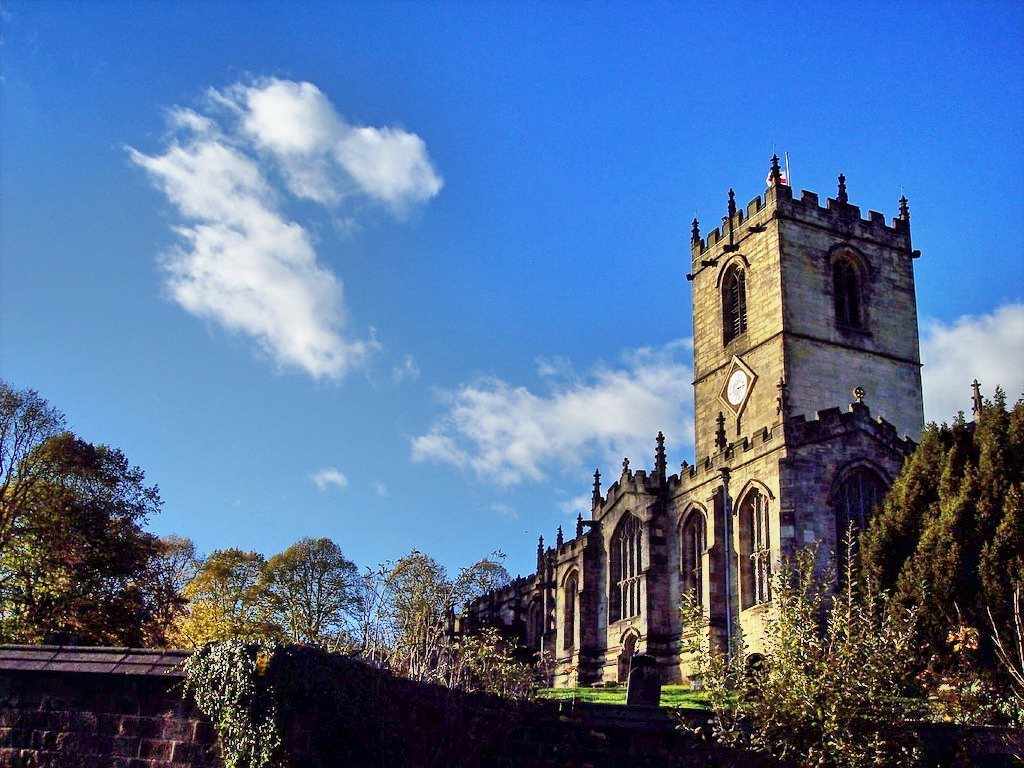
Built of local stone, the church has a Perpendicular design. Its surviving spaces and features include the nave, chancel, tower, north aisle, and vestry, as well as an octagonal font, a pulpit, a lectern, bells, and a pipe organ.
Church fabric and furnishings
Parts of the nave, its principal roof-supporting pillars, and the tower belong to the earlier twelfth-century church. Some surviving stained glass was assembled from fragments of the smashed windows and fitted into windows in the north aisle and vestry. The pulpit, dated 1876, has four carved panels showing scenes from the life of St Paul, an early Christian apostle and missionary; the lectern was installed at the same time. The tower holds ten bells, including two from the seventeenth century, and the church also has a pipe organ.
Crosses and churchyard features
Carved crosses
A carved Anglo-Saxon cross shaft, dating to the early eleventh century, was found buried outside the west door in 1892 and reconstructed inside the church. About five feet high, it is fitted into a double base. Pieces of a second cross were uncovered at the same spot in 2020.
Sundial and war memorial
A churchyard sundial stands on a base whose lower part may be ancient. The war memorial, made of light-coloured limestone and designed by R. B. Brook-Greaves, bears the names of 54 local people who died in the First World War, 36 who died in the Second World War, and one man who died in the Falklands War, the 1982 conflict between the United Kingdom and Argentina.