Cladh Hallan: A Bronze Age Settlement and Burial Site in Scotland
Site at a Glance
- Popularity
- High
- Country
- United Kingdom
- Primary era
- Iron Age
- Eras represented
- Iron Age
- Civilizations
- Unclassified
- Site type
- Settlement
- Remains
- Village
On this page12 sections
History
Cladh Hallan is a prehistoric settlement and burial site on South Uist in Scotland’s Outer Hebrides, United Kingdom. People occupied it from about 2000 BCE during the Bronze Age, a prehistoric period when bronze was used for tools and other objects. Prehistoric mummies have been found nowhere else in Great Britain, and Cladh Hallan’s human remains are regarded as Europe’s earliest examples of deliberate preservation.
Settlement and House-Building
Three excavated circular houses, known as roundhouses, were built around 1080–1020 BCE within a settlement of about seven buildings. Burials beneath the houses included people who had died centuries before the buildings were erected, a sheep, and children who had died more recently.
Ritual Use and Relocation
Several decades later, people placed ashes from cremated children, broken pottery, and three broken quernstones, stones used to grind grain or other materials, in the northern house. Some house walls were filled with unfired pottery vessels. The buildings were repeatedly demolished and rebuilt a few metres away. Around 900 BCE, a child was buried again in the northern house, which was moved about two metres soon afterward.
The northern and middle houses served ritual purposes for several hundred years while the settlement remained a place of residence. People deposited pottery, bone and horn tools, and animal burials in both buildings. The northern house was abandoned around 700 BCE; the middle house continued in use until about 400 BCE, making it one of the longest-used buildings in prehistoric Britain. After the settlement was abandoned, its inhabitants shifted it to locations about 300–400 metres to the north and south.
Preservation and Burial Chronology
The human remains indicate deliberate preservation before burial. The dead may have been placed soon after death in a bog, waterlogged ground whose acidity can preserve soft tissue while affecting bone. They may have remained there for about six to eighteen months, then been retrieved and kept in a warm, dry place until burial beneath house floors centuries later. After burial, their soft tissues decomposed, leaving skeletons. Their tightly curled positions, especially that of the woman, may have resulted from wrapping or binding.
Interpretations place the final burial of the bodies beneath house floors around 1000 BCE, roughly 300–600 years after the deaths estimated through radiocarbon dating, which uses carbon in once-living material to estimate age. However, the burial of the composite male remains has also been dated to about 1440–1260 BCE, before the houses were built, leaving the chronology uncertain.
The reasons for preserving the dead and delaying their burial remain unclear. The practice may have been ritual, and the deceased may have been people of high status who were revered as ancestors. Combining bones from different individuals could have repaired damaged preserved bodies, adjusted them to changing beliefs, or brought more family lines into ancestor veneration. The bodies may have been kept in a purpose-built building. Their burial beneath house floors does not prove that they were offerings made during construction; moving them from an earlier place of keeping may instead reflect a major change in religious belief.
Excavation and Interpretation
Excavations took place from 1988 to 2002 as part of the South Uist Archaeological Project. In 2001, archaeologists found human skeletons beneath the floors of two roundhouses. With soft tissue gone and the bodies apparently conventionally buried, they were first interpreted as ordinary burials. Their unusually tight positions and good skeletal preservation prompted further investigation. Excavator Mike Parker Pearson observed that their posture recalled mummies from Peru.
Remains
Settlement Layout
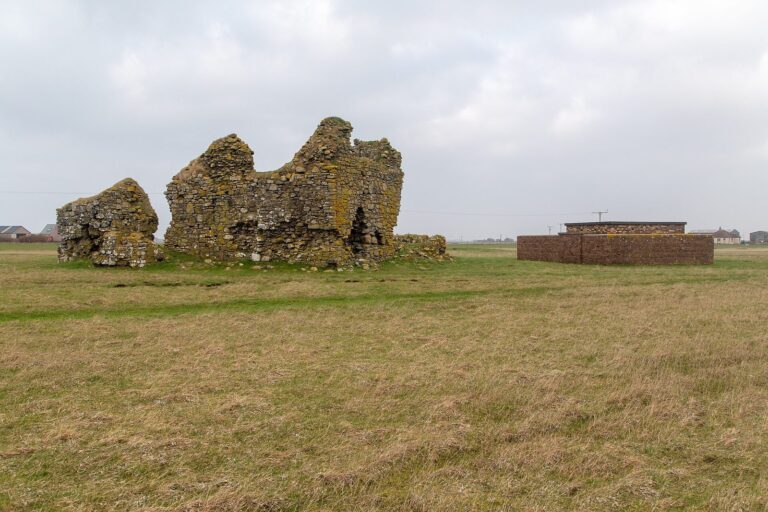
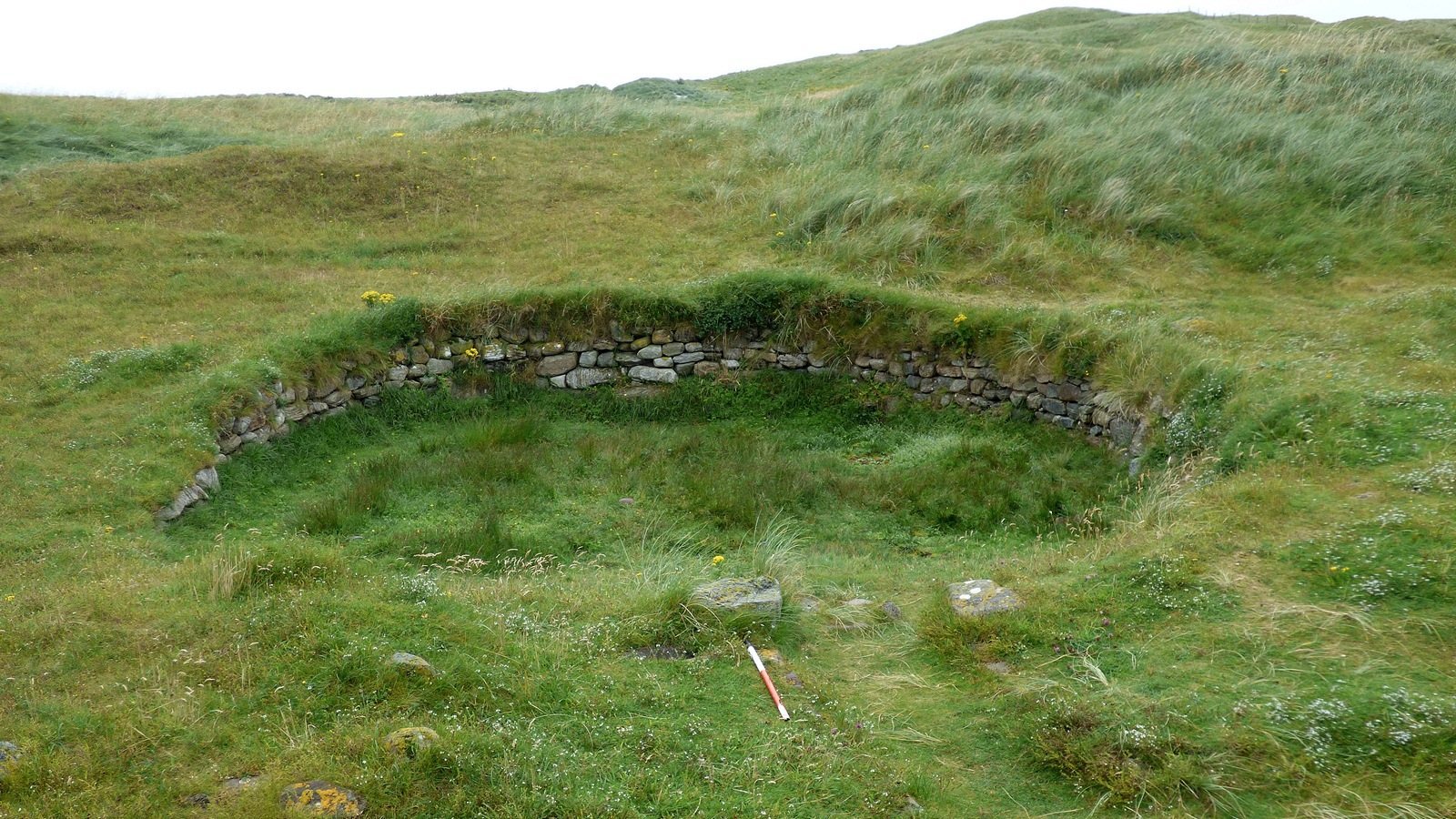
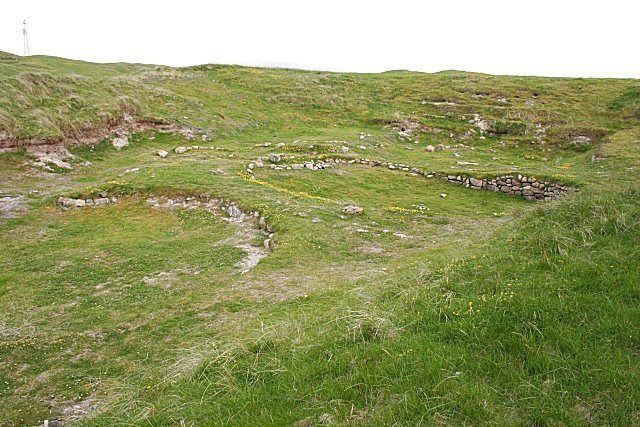
The excavated core consists of three adjoining roundhouses in a north–south row, joined by shared walls. Their floors sat slightly below ground level, and their walls had inner and outer stone layers with sand packed between them. Preserved features include floors, sleeping areas, entrances, yards, refuse heaps, or middens, and outdoor surfaces. Each house had a central fireplace; the entrances faced east except for one. Below these remains are traces of earlier ploughed fields, a Bronze Age burial ground, and earlier occupation.
Burials Beneath the Houses
Composite Remains in the Northern House
The northern house contained the mummified skeletal remains of a man, a woman, and a sheep. The man’s remains formed a combined skeleton made from bones belonging to several people. Its main skeleton was that of a man about 20 years old who died around 1600 BCE. It also included the skull and neck bones of a second man, who died around 1500–1400 BCE, and the lower jaw of a third man.
Woman’s Burial in the Northern House
The woman lay on her left side in the southern part of the northern house. Her left thigh and lower-leg bones were buried outside the building in a grave pit. After her death, two upper front teeth were removed, with one placed in each hand. The torso belonged to an adult woman, while the skull and jaw had skeletal traits more typical of a man. Dating placed two body bones, on average, at 1370–1050 BCE and the head at about 1440–1260 BCE. DNA analysis indicated that the skull, jaw, thigh bone, and upper-arm bone came from three, and possibly four, people. Isotope analysis, which compares forms of elements in tissue, found slight differences between the skull and thigh but could not establish that they belonged to different individuals. A test of pores in the bones found little bacterial breakdown from digestive-tract microbes, which may indicate that internal organs were removed after death.
Child Burial in the Middle House
A child who was not mummified lay beneath the middle house. The child was probably a girl aged between 10 and 14.
Child Burial in the Southern House
Beneath the southern house was the mummified skeleton of a child who died around 1400–1300 BCE. The child was about three years old, with an estimated age range of roughly 18 months to three years.