Monument of the Eponymous Heroes: Athenian Civic Monument and Public Notice Point
Site at a Glance
- Popularity
- Medium
- Country
- Greece
- Primary era
- Classical
- Eras represented
- Classical
- Civilizations
- Ancient Greek, Roman
- Site type
- Civic
- Remains
- Monument
On this page12 sections
History
The Monument of the Eponymous Heroes was a civic monument and public notice point in the Athenian Agora, Athens, Greece, built in the mid-fourth century BC. It followed the reorganization of Athens under Cleisthenes around 508–507 BC, a reform that shaped the city’s civic and military administration.
The ten tribes and the monument
Cleisthenes divided the citizen body into ten phylai, or civic tribes, which were administrative groups rather than kinship units. Tribal membership formed a basis for citizenship; each tribe also organized military contingents and service on the council. The tribes honored their eponymous heroes, legendary figures whose names identified the groups and who could, in later use, be honored people. According to Aristotle, the Pythia, the oracle priestess at Delphi, chose the ten heroes from a hundred candidates put forward by the Athenians. Pausanias later recorded their names.
The monument’s mid-fourth-century BC version, known as Phase I, displayed a statue of each tribe’s hero. It also served as a civic information point. Proposed laws, decrees, public announcements, and notices for individual tribes appeared on wooden tablets, with tribal information placed below the statue of the relevant hero. Aristophanes referred in 424 BC to a monument where lawsuits were posted; that reference predates the mid-fourth-century phase described for the Agora structure.
Later additions and changes
In the late fourth century BC, Phase II added statues of the Macedonian kings Antigonus I and Demetrius I Poliorcetes, alongside two newly established tribes. Ptolemy III was added in Phase III about 80 years later. The Macedonian kings’ statues were subsequently removed during Philip V’s siege of Athens in the Second Macedonian War, about 20 years after their addition. A statue of Attalos I was installed in Phase IV. In the second century AD, Phase V added a statue of the Roman emperor Hadrian.
Excavation and interpretation
Excavators exposed the structure in 1931 but initially did not identify it as the monument. Richard Stillwell published a detailed study of its foundations in 1933, and excavation plans identified it by at least 1947. In 1949, Eugene Vanderpool addressed apparent differences between ancient descriptions and the monument’s location. Pausanias placed it “above” the Tholos, a circular building connected with civic administration; Vanderpool suggested the word meant “farther away.” An ancient commentary on Aristophanes’ Peace placed the monument near the Prytaneion, an official civic building. Vanderpool and earlier commentators considered this a confusion with the Prytanikon, a part of the Tholos. Further examination of the area’s fill took place in 1967.
Remains
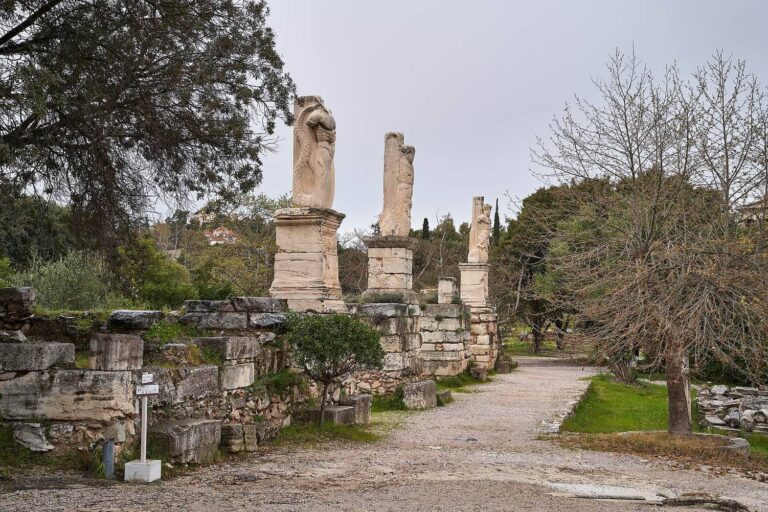
The monument stood beside the Metroon, the old Bouleuterion, or council house, in the Agora, Athens’ central civic and commercial space. Its long axis ran almost parallel to the Bouleuterion’s porch. The structure lay east of a major road that marked the eastern edge of the Agora’s market area. A statue platform occupied the center of a fenced enclosure.
Platform and enclosure
Statue platform
A marble podium, 16.64 metres long and 1.87 metres wide, supported bronze statues of the tribal heroes, with space for ten figures. A bronze tripod stood at each end. The additions of statues in Phases II and III led to an extension and redesign of the podium, while the builders altered the fence as little as possible. They removed the marble steps at the narrow ends of its stepped base.
Enclosure sill and fence
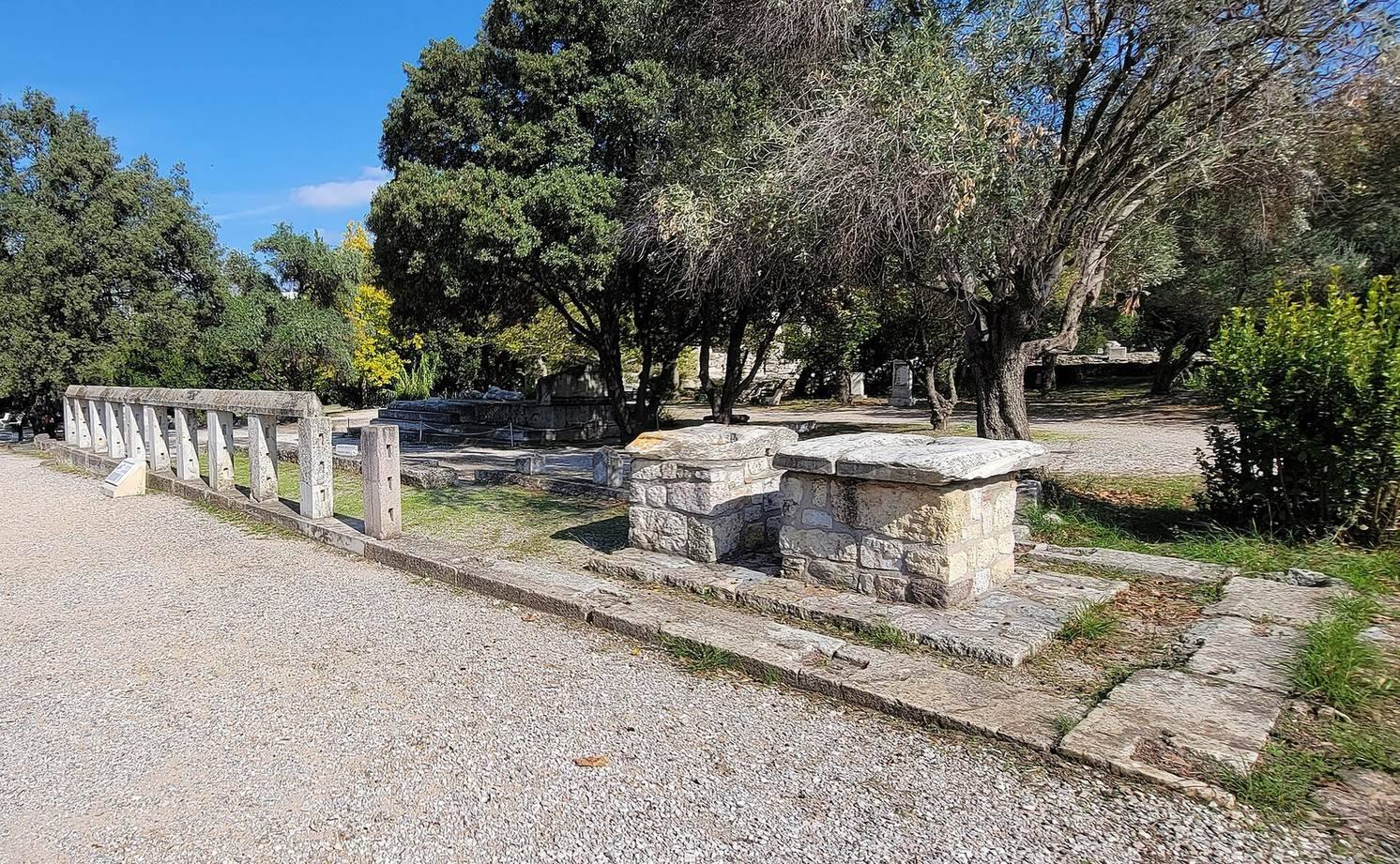
The surviving sill forms a rectangle 18.40 metres long and 3.56 metres wide. It consists of a course of narrow blocks made from hard, light-gray poros, a local stone. The north end is 12 centimetres wider than the south. At the north, foundation remains survive; elsewhere the sill rests on shallow earth over rough ground compacted by earlier heavy traffic. The blocks have shifted, leaving gaps of up to five centimetres. Because the ground slopes down to the north, about 18 centimetres of sill shows at the south end and 30 centimetres at the north, although the northern course remains seven centimetres lower. Some regularly spaced cutouts retain traces of marble posts set in lead.
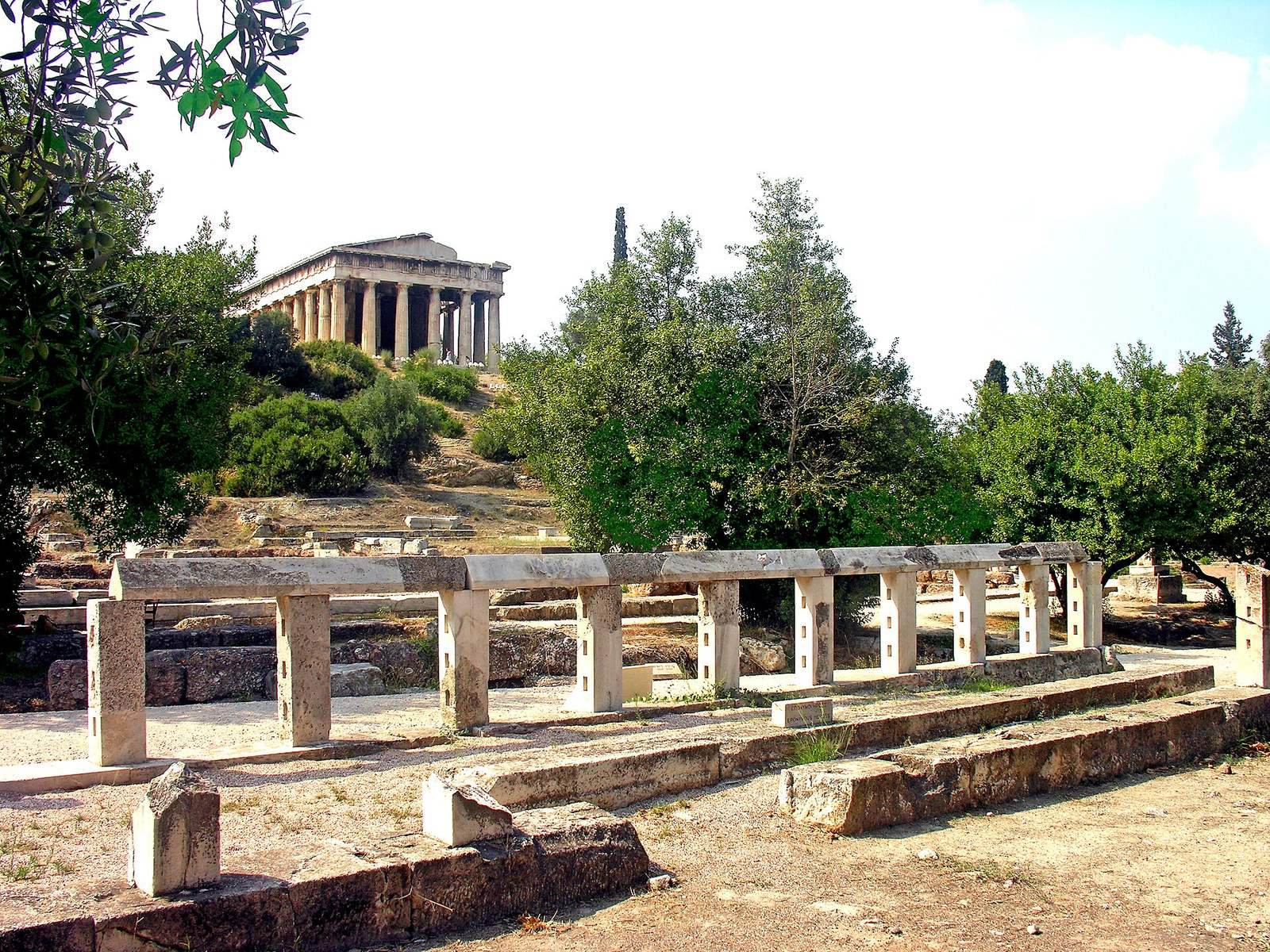
The original fence used metal dowels fitted into cutouts at the ends of the sill blocks. Posts stood about 1.27 metres apart at the north end and 1.02 metres apart at the south, with fifteen posts along each long side and four along each short side. A post passing through the dowels linked neighboring sill blocks. Three wooden rails fitted into the posts. The enclosure grew to more than 21 metres in length in Phase V.
Later alterations
During Phase IV, the enclosure was repaired and gates were added so officials could reach the podium to post notices. In Phase V, the enclosure was extended about 2.75 metres to the south. Along the eastern side, a taller fence of relatively poor-quality Pentelic marble replaced the earlier poros fence and ended against upright facing blocks at the ends of the podium.
Surviving stonework and possible earlier base
Surviving remains
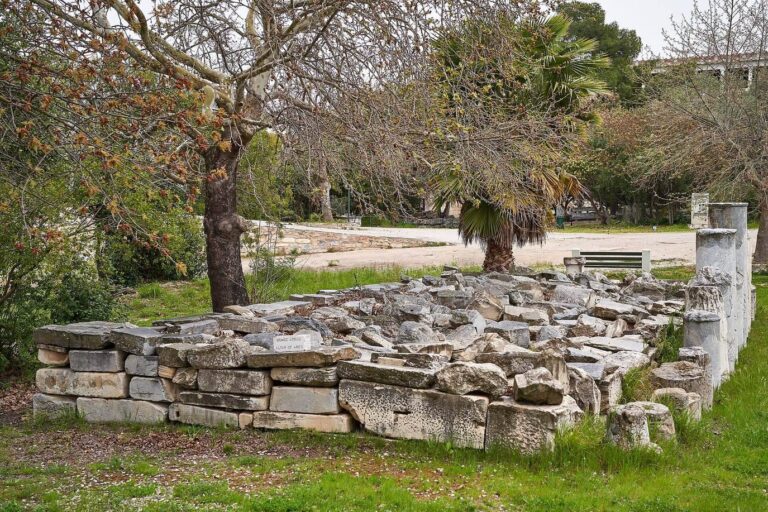
Five blocks from the leveling course above the foundation survive, along with foundation traces at the north end. Two small fragments belong to the marble steps of the platform’s stepped base. Two pedestal caps also remain, one for a statue and one for a bronze tripod. Parts of the stone threshold and enclosure survive, and the western fence has been partly reconstructed. In 1951, fragments of stone posts and capping blocks were reused to rebuild fence panels on that side.
Possible earlier monument site
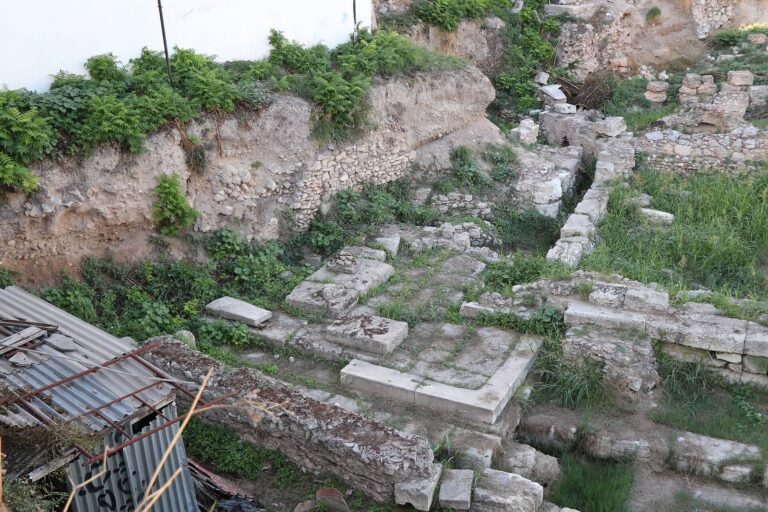
A smaller base, about 9.7 metres long, lay roughly 50 metres to the south beneath the Middle Stoa. It has been suggested as the location of an earlier monument, but that identification remains uncertain.